





Short answer. Both platforms read the same raw signals from Git and Jira without asking engineers to log anything. Jellyfish is built around engineering investment and financial reporting for the board. Waydev is built around delivery, developer experience and AI impact, with self-hosted deployment and an open API for teams that need the data in their own systems.
If your first question is “what did we spend engineering on last quarter,” Jellyfish answers it well. If it is “where is delivery breaking down, and what is AI actually doing to our throughput and quality,” that is where Waydev is built to go deeper.
Waydev is a software engineering intelligence platform for engineering leaders. It connects to your version control and issue tracking systems, then surfaces what you need to improve delivery speed, team health and planning accuracy. اطلب عرضًا توضيحيًا للمؤسسات.
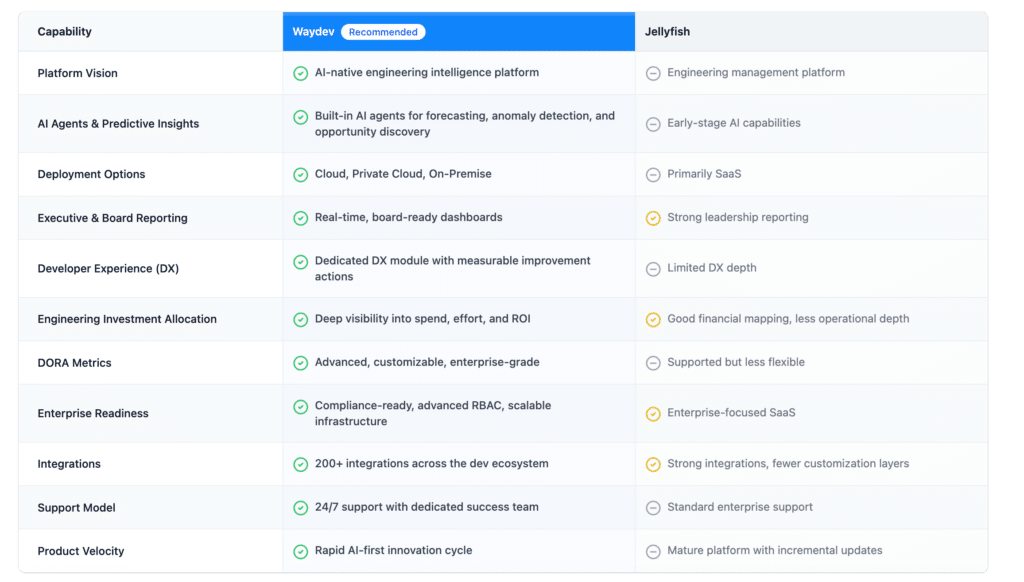
Waydev vs Jellyfish at a glance
Both tools cover the core engineering intelligence ground. The differences that matter sit at the edges: deployment model, data portability, and what the platform is optimized to answer.
| Capability | Waydev | Jellyfish |
|---|---|---|
| مقاييس DORA | Yes | Yes1 |
| Cycle time by stage | Yes, coding, review and deploy | Yes |
| Investment and cost allocation | Yes, resource planning and project costs | Yes, a core strength including software capitalization2 |
| Developer experience module | Yes | Yes |
| AI adoption and impact | Yes; Waydev Brain and AI measurement | Yes1 |
| On-premise or self-hosted | Yes | Not offered publicly |
| Open API, read and write | Yes | Limited |
| Custom metrics and dashboards | Yes | Configurable reports |
| Code quality data | Yes, via Sonar | Not published |
| Trial before purchase | Proof of concept trial | Demo first, no public free trial |
| Enterprise pricing | Private quote | Verify current terms with Jellyfish |
| Security reporting | SOC 2 Type II with a public SOC 3 report | SOC 2 |
Scroll the table sideways to see both columns.
Where Waydev goes further
Where Jellyfish is the better fit
Every honest comparison has this section. Here is ours.
Jellyfish is strong when the primary audience for engineering data is the finance organization and the board. Its investment allocation and software capitalization tooling is mature, it has been recognized as a leader in G2’s software development analytics category for seventeen consecutive quarters, and its executive dashboards are built for exactly that conversation.3
If your top three questions are all about R&D spend classification, capitalization and initiative-level cost reporting, Jellyfish is a reasonable choice. Waydev is the stronger fit when delivery health, developer experience, AI impact and deployment control matter more than accounting output.
See both on your own repositories
Waydev runs a proof of concept on your real commit and PR history before any purchase commitment, so you can compare outputs rather than demos.
اطلب عرضًا توضيحيًا للمؤسساتInside the Waydev platform
Waydev is organized into four modules. Each answers a different question, and they read from the same commit-level source.
التسليم
Measure, optimize and improve every stage of software delivery.

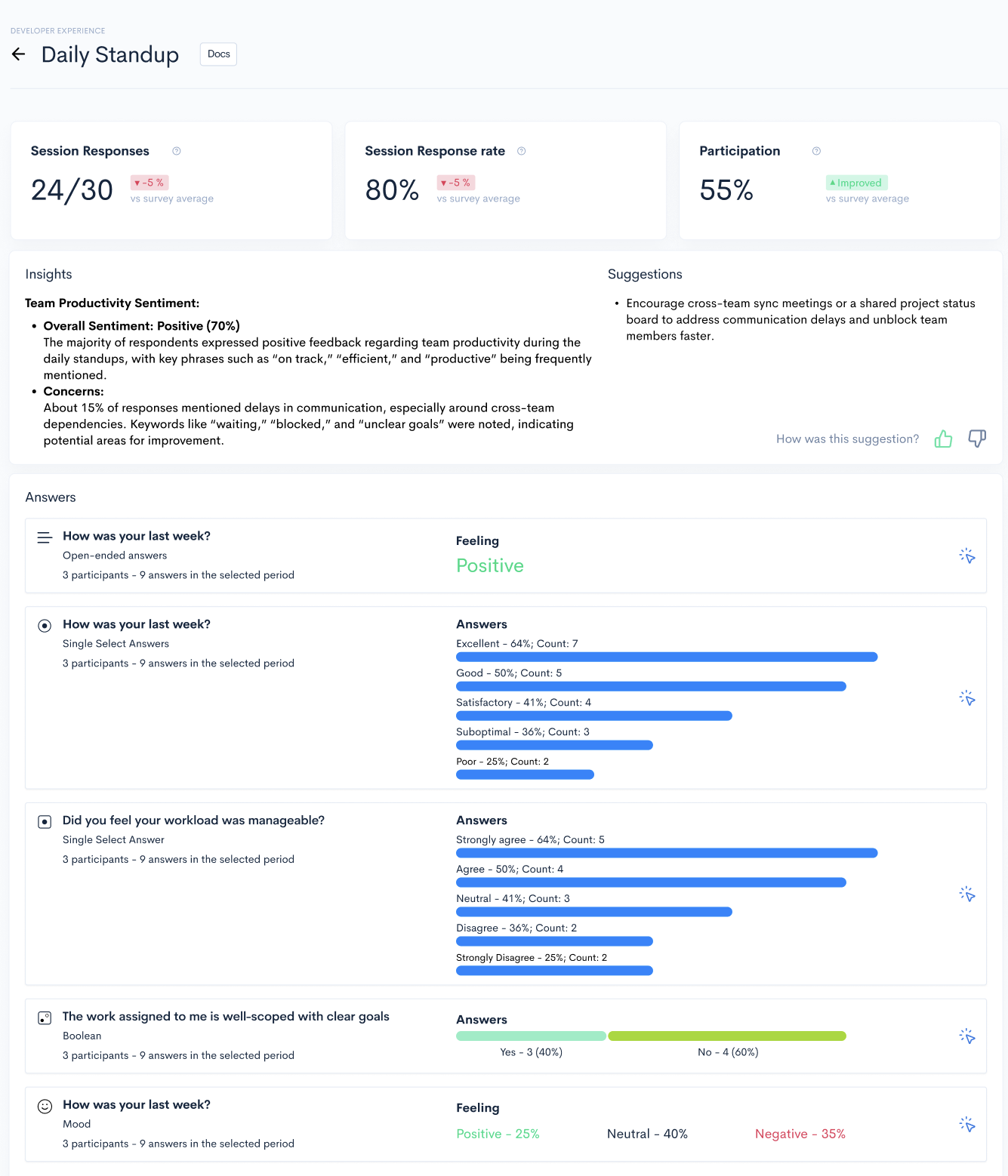
السلامة
Team dynamics, working practices and the conditions behind delivery numbers.
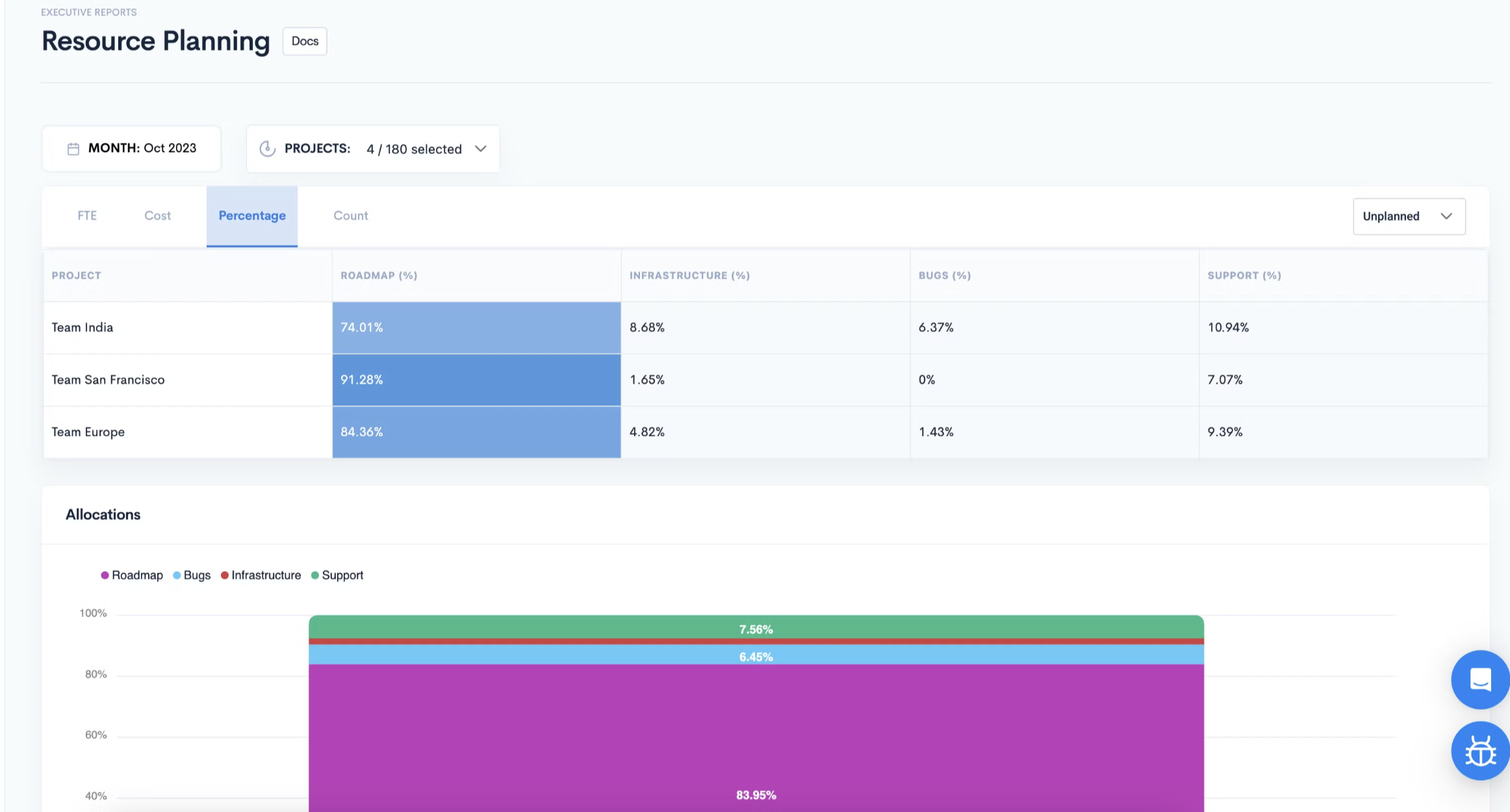
التخطيط
Align engineering work with product and business strategy.
Automation
Targets track key metrics against benchmarks, and notifications fire when a team hits a milestone or a threshold moves the wrong way. The work log removes the guesswork about where effort actually went.
How Jellyfish approaches the same problem
Jellyfish gathers engineering signals from commits and pull requests in Git and from tasks in Jira, then layers contextual data from calendars, product planning tools and HR systems to build a picture of what teams are working on and how long it takes.
The output is oriented toward allocation: work and resources mapped to projects, releases and business objectives. Their main reports cover alignment, investment distribution across roadmap, unplanned, infrastructure and support work, technical debt, product pillars, and productivity. Like Waydev, it requires no manual input from engineers.
الأسعار
| Plan | Price | What it includes |
|---|---|---|
| Waydev Pro | Enterprise quote | Delivery and Health reports, targets, notifications, role-based access, custom dashboards, up to 50 repositories and 6 months of history |
| Waydev Premium | Enterprise quote | Delivery, Health, Planning, Automation and Custom modules, SSO and SAML, team-level permissions, API access, up to 300 repositories and 36 months of history |
| Waydev Enterprise | Custom | Everything in Premium plus on-premise Git and ticketing integrations, self-hosted or cloud-hosted, custom engineering support and enterprise customer success |
| Jellyfish | Not published | Annual subscription, quoted after a demo |
Getting started with each
With Waydev, schedule a demo and run a proof of concept. You connect version control and issue tracking, and real-time integration covers GitHub, GitLab, Bitbucket, Azure DevOps, Jira, Azure Boards, ClickUp and more. The POC runs on your own history, so the first review uses your numbers rather than sample data.
With Jellyfish, access starts with a demo and an annual subscription. Integrations include GitHub, GitLab, Bitbucket, Jira, Aha! and Productboard, and deployment is cloud only.
Waydev aggregates and displays critical project and developer metrics in a way that is genuinely easy to digest. Tata Health, from the Tata Health case study
Common questions
Does Jellyfish offer DORA metrics?
Yes. Jellyfish tracks DORA metrics including lead time, deployment frequency and mean time to resolution.1 DORA coverage alone is not a reason to choose between the two platforms. Deployment model, data portability and depth of developer experience data are.
Is SOC 3 a higher level of certification than SOC 2?
No, and it is worth stating plainly. A SOC 3 report can only be issued after a clean SOC 2 Type II audit, and it is a public-facing summary of that same examination.4 The practical benefit is that Waydev’s SOC 3 report can be shared freely without an NDA, while a SOC 2 report typically cannot. Both platforms hold SOC 2.
Can we migrate historical data?
Waydev backfills from your existing version control and issue tracking history, up to 6 months on Pro and 36 months on Premium, so trend analysis starts on day one rather than after a quarter of collection.
Do engineers have to change how they work?
No, for either platform. Both read signals that your Git provider and issue tracker already produce.
Which is better for a finance-led reporting requirement?
Jellyfish, if software capitalization and R&D spend classification are the primary use case. Waydev, if delivery performance, developer experience and AI impact carry more weight than accounting output.
Compare the two on your own data
The fastest way to settle a platform decision is to point both at the same repositories and see which one answers your actual questions. Waydev runs that as a proof of concept before any commitment.
If you are still mapping the category, our overview of software engineering intelligence platforms covers how these tools differ, and the WAY framework explains how we combine DORA, SPACE and AI impact into one measurement model.
اطلب عرضًا توضيحيًا للمؤسساتConnects to your Git provider and reads your existing history.
Sources and verification
- Jellyfish, DevOps Metrics, on DORA coverage.
- Jellyfish product documentation on investment allocation and software capitalization.
- Jellyfish, G2 Fall 2026 recognition announcement.
- Secureframe, SOC 1 vs SOC 2 vs SOC 3, on the relationship between the two reports.
Competitor details last verified September 2026. Vendor capabilities change, so we recheck this page each quarter.
Jellyfish enterprise procurement checklist
Use this page as a vendor evaluation worksheet rather than a ranked alternatives list. Key evaluation areas: Investment classification, cost allocation traceability, finance reconciliation and deployment requirements.
| Evaluation stage | Evidence to request |
|---|---|
| Technical fit | Supported data sources, metric definitions and limitations |
| Security review | Deployment boundaries, access controls, data retention and security evidence |
| Proof of concept | Representative teams, acceptance criteria and verified results |
| Commercial review | Written quote, onboarding, renewal and exit terms |
Use the RFP generator و vendor scorecard. For broader market discovery, read our Jellyfish alternatives guide; for Waydev-specific fit, explore the commercial comparison.