





Engineering Intelligence Glossary
30 practical definitions for AI engineering, software delivery, developer experience and engineering economics.
Use these definitions as starting points for consistent team-level reporting. Every metric requires a stated unit, population, time window and data coverage. Definitions are practical conventions; implementations may differ. For the broader alphabetical archive, see the existing Waydev glossary.
- AI adoption rate
- Share of eligible engineers meeting a defined activity threshold for an AI tool within a stated period. Divide active eligible users by eligible users; disclose telemetry coverage.
- AI active user
- A user with at least one qualifying AI interaction in a specified period. Define what qualifies and whether automated agents are excluded.
- AI coding ROI
- Net incremental value attributable to AI divided by incremental AI costs, multiplied by 100%. Use credible baselines and include review, rework and infrastructure costs.
- AI-assisted change
- A software change with evidence of AI assistance. Attribution requires observable signals; missing evidence is unknown, not necessarily human-only.
- Autonomous agent change
- A change initiated or executed by an agent with a defined level of human oversight. Record the autonomy definition and review requirements.
- Agent acceptance rate
- Accepted agent outputs divided by eligible completed agent outputs. Define acceptance separately from merge and deployment.
- AI code survival
- Share of attributed AI-generated changes retained after a defined observation window. State how edits, deletions, and moves are handled.
- Token spend
- Cost associated with model input, output and other billable token categories. Include currency, model, period and billing basis.
- Cost per accepted change
- Allocated engineering cost divided by accepted changes in the same scope and period. Changes must be comparable in type and scope.
- Cost per pull request
- Allocated cost divided by the count of eligible pull requests. A cost indicator, not a measure of business value.
- Cost per feature
- Attributed engineering cost divided by completed features, or calculated for a single feature through allocated effort and expenses.
- تكرار النشر
- How often a service successfully deploys to production within a period; distinguish deployments from commits or merges.
- Change lead time
- Elapsed time from a defined code-change start, commonly commit, to successful production deployment.
- معدل فشل التغييرات
- Share of production deployments resulting in a failure that requires intervention. Define what qualifies as a failure.
- Failed deployment recovery time
- Elapsed time to recover from a deployment-caused failure. Report the incident boundaries and aggregation method.
- Deployment rework rate
- Share of deployments that are unplanned remediation of production problems. Use consistent classification criteria.
- Cycle time
- Elapsed time between a specified work-start event and a completion event. PR cycle time may use different boundaries than ticket cycle time.
- PR review latency
- Elapsed time between review request and first qualifying review response. Clarify business versus calendar hours.
- PR merge rate
- Share of eligible pull requests merged within a defined time window; account for still-open PRs and observation bias.
- Throughput
- Count of completed work units per period. Units should be comparable and linked to context, not used as individual quotas.
- Work in progress
- Number of work items started but not yet completed under a defined workflow.
- Code churn
- Code changed or removed within a defined observation window. Some churn reflects healthy iteration, not waste.
- Rework
- Additional effort required to revise, fix or redo previously completed work. Define events and avoid double counting.
- Technical debt
- Future cost or risk created by design and implementation compromises. Assess through evidence rather than a single activity metric.
- Developer experience (DevEx)
- How developers experience their work environment, including feedback loops, cognitive load and flow.
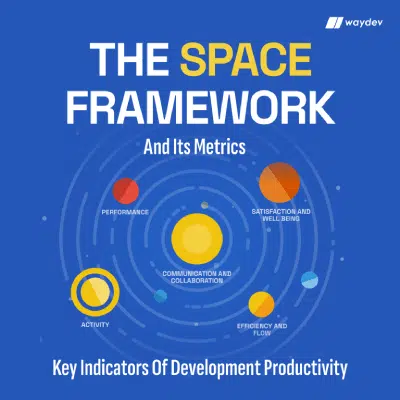
- إطار SPACE
- A multidimensional approach to developer productivity: satisfaction and well-being, performance, activity, communication and collaboration, and efficiency and flow.
- Engineering capacity
- Available time or resources for planned work after accounting for constraints, support and other obligations.
- KTLO
- Keep the lights on: work needed to operate and maintain existing systems. Classify separately from new investment where useful.
- Operating level agreement (OLA)
- An internal agreement specifying service expectations between teams, including ownership, targets, time windows and escalation.
- Engineering intelligence
- Contextual analysis of engineering data to understand delivery, quality, investment and team outcomes and inform decisions.
For deeper methodology, see engineering measurement frameworks و AI coding ROI research methods.
Put engineering knowledge to work
Explore Waydev Intelligence Lab for interactive assessments, or browse the Intelligence Library for more measurement guidance.
احجز عرضًا توضيحيًا