





CAPABILITY 01
Centro de gasto en IA
Centralize AI-related spend and usage analysis.
AI ENGINEERING FINOPS
Connect AI licenses, tokens, and model costs to engineering outcomes. Understand what your AI investment delivers.
WHY IT MATTERS
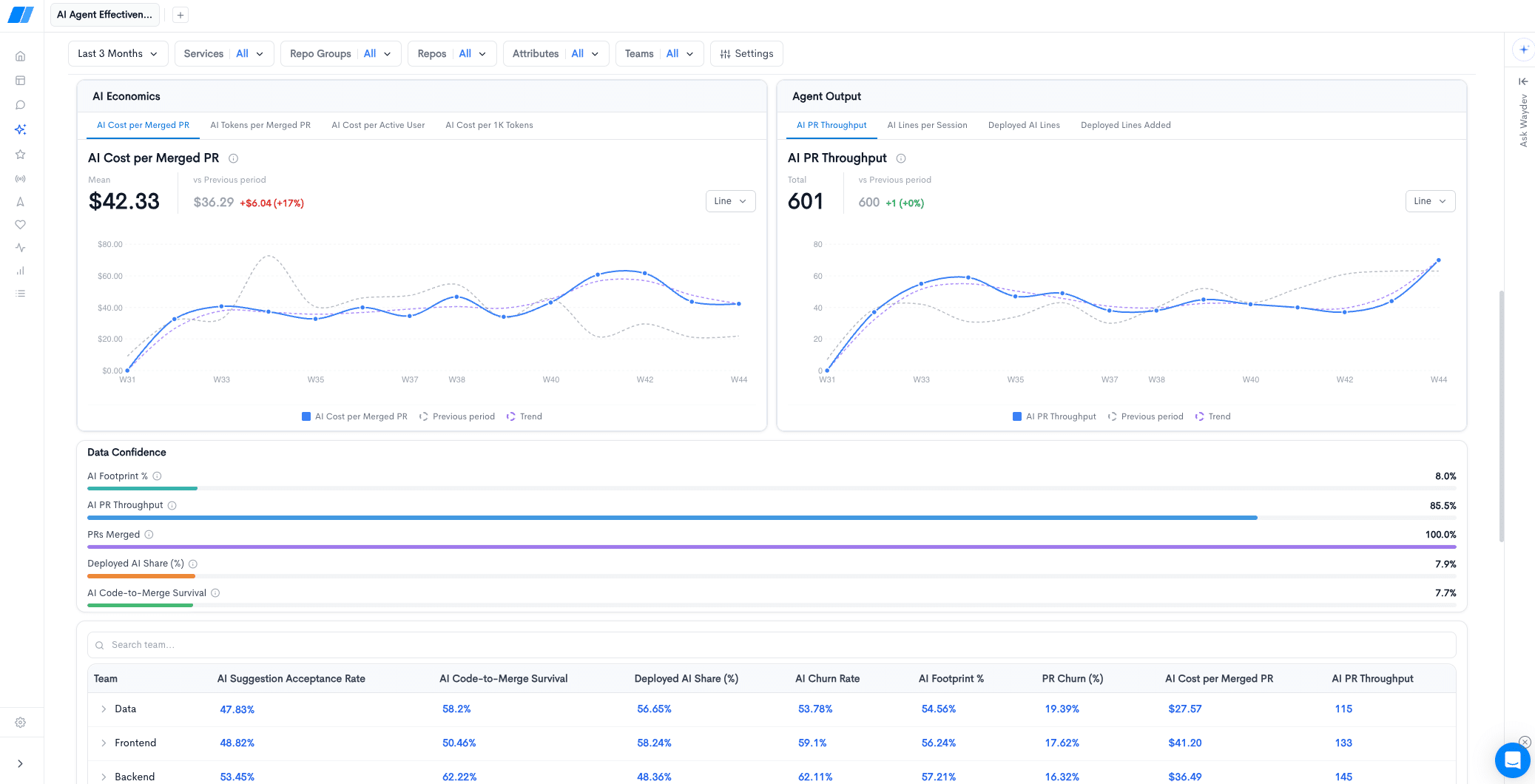
AI vendor invoices alone cannot explain value. Waydev can combine available spend signals with the engineering workflow, making cost conversations more meaningful while clearly distinguishing measured, estimated and allocated costs.
Review available model, license and token costs across tools and teams.
Put AI spend beside merged PRs and other engineering artifacts, with clear calculation boundaries.
Connect spend trends to teams, features or workstreams where the underlying data and mappings support it.
THE WAYDEV PLATFORM
Explore the Waydev capabilities in this category. Open any feature to see its metrics, workflows, and use cases.
Centralize AI-related spend and usage analysis.
Review AI licensing, token costs and spending trends.
Examine AI investment against feature-level context.
Understand relative effort and available cost signals.
Evaluate spending against meaningful outcomes.
Connect agent-related work and cost to delivery metrics.
BUILT FOR ENGINEERING LEADERS
Prioritize vendor and tooling investments with better cost context.
Understand spending, allocation and the definitions behind unit costs.
Find usage and cost trends worth investigating before changing policy.
Preguntas frecuentes
No. It is an operational unit-cost metric. ROI also depends on benefits, engineering labor, quality, reliability and other costs.
Comparisons depend on integrations and consistent measurement of usage, cost and work artifacts. Unknown data must be labeled.
Separate provider-reported costs, allocated costs and model-based estimates so users can audit the calculation.
Treat AI tooling as an engineering investment with an explicit cost boundary, source coverage and outcome baseline. More usage is not automatically greater productivity.
Separate provider-reported spend, allocated license costs and model-based token estimates. Show the period, pricing assumptions and missing sources.
Compare attributable AI spending against consistently defined merged PRs or initiatives. Review quality and rework alongside cost to avoid rewarding volume alone.
Define a baseline for delivery, review effort and reliability. Reconcile total program cost, attribution uncertainty and any verified financial benefit before reporting ROI.
Methodology guidance, not a claim that all vendors or cost components are available in every Waydev deployment.
EXPLORE WAYDEV
See how Waydev can connect the data, workflows and outcomes that matter to your organization. We’ll tailor the demo to your existing toolchain and priorities.