






Waydev Research · Transparent engineering AI measurement
AI Coding ROI Research Hub: methodology, metric definitions and reproducible reporting
AI adoption is observable; AI return on investment must be demonstrated. This resource explains how an engineering organization can evaluate the cost and impact of AI coding assistants and agents alongside delivery performance, software quality and Developer Experience—without treating code volume or tool activity as productivity.
Evidence status: This page publishes measurement definitions, a suggested data dictionary and a reproducible evaluation protocol. It is not a published multi-customer outcome dataset, and no real customer-level ROI observations are asserted here.
Read Waydev’s existing 2026 research protocol · Découvrir Waydev Brain
Research questions worth answering
- What does AI-assisted, reviewed and ultimately accepted engineering work cost—including licenses, tokens, orchestration and rework?
- How does AI tool use relate to change lead time, deployment frequency, failure and recovery, under a stable service definition?
- Does developer feedback indicate improved focus or increased review burden and cognitive load?
- Which types of work benefit from AI tools and where is the review, testing or incident cost increasing?
- How robust are observed changes to staffing, team mix, seasonality, feature complexity and changes in process?
Metric dictionary: minimum reproducible data
| Field | Meaning / recommended treatment |
|---|---|
period_start, period_end |
UTC observation period; record any missing intervals |
org_id, team_id, service_id |
Pseudonymous stable units; exclude identifying employee information from public datasets |
work_type, work_items |
Comparable change or task categories, including completed and reopened counts |
ai_tool, ai_active_users |
Tool family and active users with a stated activity threshold |
ai_license_cost, ai_usage_cost |
Currency, basis and sources for billed or allocated cost |
review_hours, rework_hours |
Measured or estimated time; record estimation method |
accepted_changes, deployed_changes |
Define accepted vs deployed separately; deduplicate merges/reverts |
change_lead_time, deployment_frequency |
DORA throughput measures at service level |
change_fail_rate, recovery_time, deployment_rework_rate |
DORA instability and recovery outcomes |
developer_feedback, missingness_rate |
DX/SPACE feedback with survey methodology and coverage caveats |
Worked ROI formula — illustrative, not a customer result
A useful starting point is net value = defensible incremental benefit − fully loaded incremental AI cost et ROI = net value / incremental AI cost × 100%. Benefits should reflect measurable avoided effort or higher-value work that actually materialized, not assumed value for every AI-written line.
Hypothetical example only: if verified additional benefit over a matched baseline were $25,000 and the combined incremental software, tokens, review, infrastructure and rework costs were $20,000, net benefit would be $5,000 and ROI would be 25%. These are made-up inputs for explaining a formula, not observations or Waydev customer performance.
Alternative when benefits cannot be monetized reliably: report cost per accepted change and production quality outcomes, with a confidence range, rather than inventing dollar savings.
Study design: from correlation to credible estimates
- Register hypotheses: specify the target outcomes and stop conditions before looking at results.
- Collect a baseline: record pre-adoption trends for comparable services, teams and work types.
- Choose a defensible comparison: use randomized rollout where practical; otherwise identify matched units and investigate differential pre-trends.
- Measure total costs: include licenses, consumption, review time, rework, infra and agent operations. State treatment of engineering labor costs.
- Evaluate multiple outcomes: accepted work, quality, DORA delivery metrics and SPACE/DX feedback; include negative outcomes and missing data.
- Report uncertainty: provide sample sizes, periods, statistical intervals where appropriate, sensitivity analyses and changes in team composition.
- Respect privacy: publish only approved, aggregated, anonymized results; do not make individual-developer surveillance the measurement goal.
What a future public dataset would include
The field dictionary above is a proposed export contract, not a claim that its rows already exist publicly. An evidence release should include a dated CSV/Parquet dataset or aggregate workbook, schema and units, inclusion criteria, participant counts, data completeness, data provenance, analysis scripts and a limitations section. Customer authorization and disclosure control are prerequisites.
Read the primary research and source definitions
- Waydev: Research Protocol, Metrics and Methods (2026) — published first-party methodology.
- DORA: Software Delivery Performance Metrics — up-to-date five-metric delivery definitions.
- SPACE Framework (Forsgren et al.) — multidimensional developer productivity methodology.
- The SPACE of AI (Microsoft Research) — evidence about how AI impact varies by work context.
How Waydev can support an evaluation
Use Tableaux de bord par prompt to bring together engineering metrics; Waydev Agent to investigate questions; AI Governance and Limits to understand controls; and the DORA/SPACE/DX Framework Guide to avoid one-dimensional interpretations.
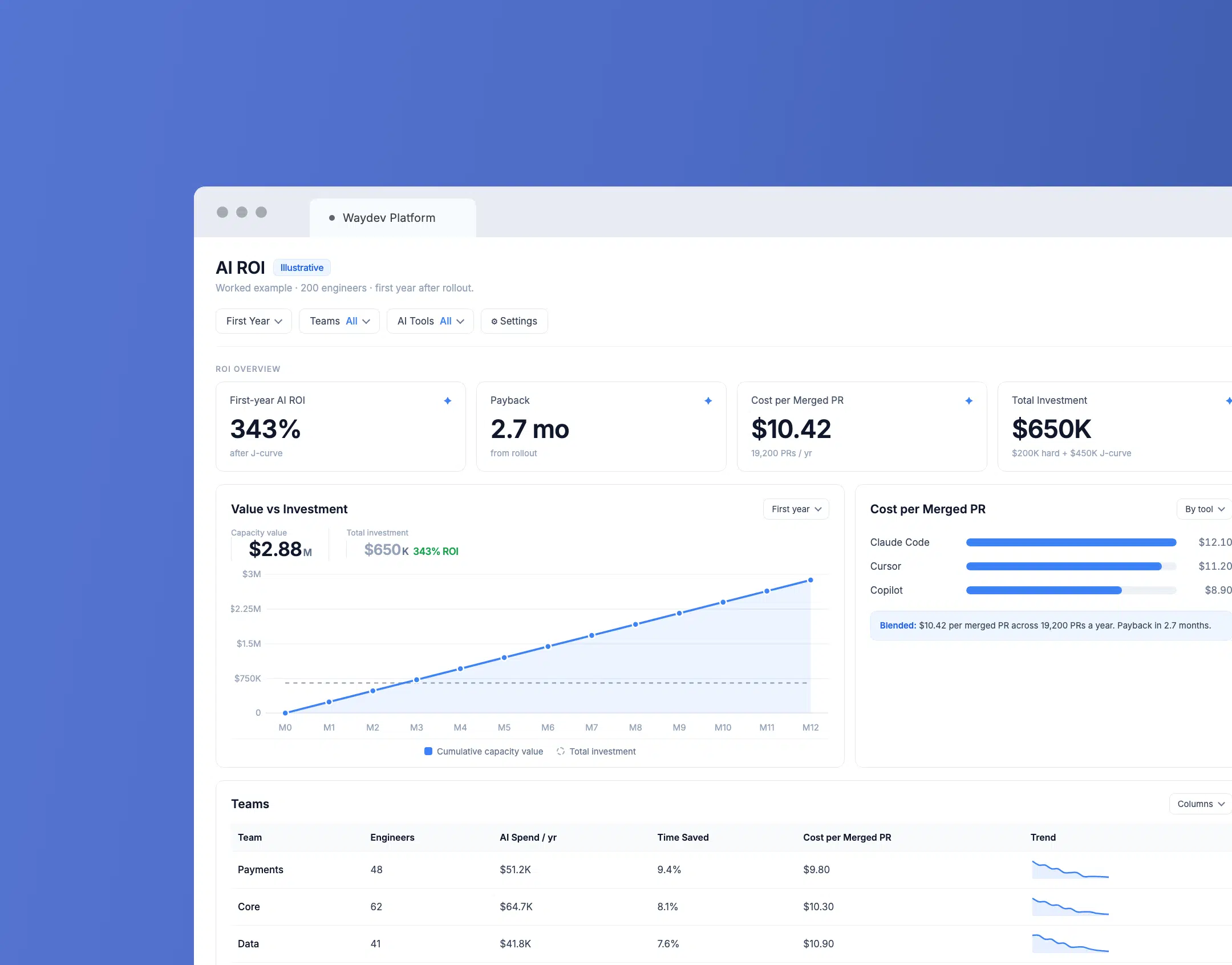
Related product capabilities: AI ROI analytics, Adoption de l’IA et Impact de l’IA. These are ways to investigate the measures described here, not evidence of a causal uplift by themselves.
Request a Waydev enterprise AI ROI measurement walkthrough →
Methodology hub, version 1.0, October 2026. No unpublished customer data or proprietary participant results are disclosed here. Commercial terms are available privately.