AI Impact · Engineering Judgment · AI ROI
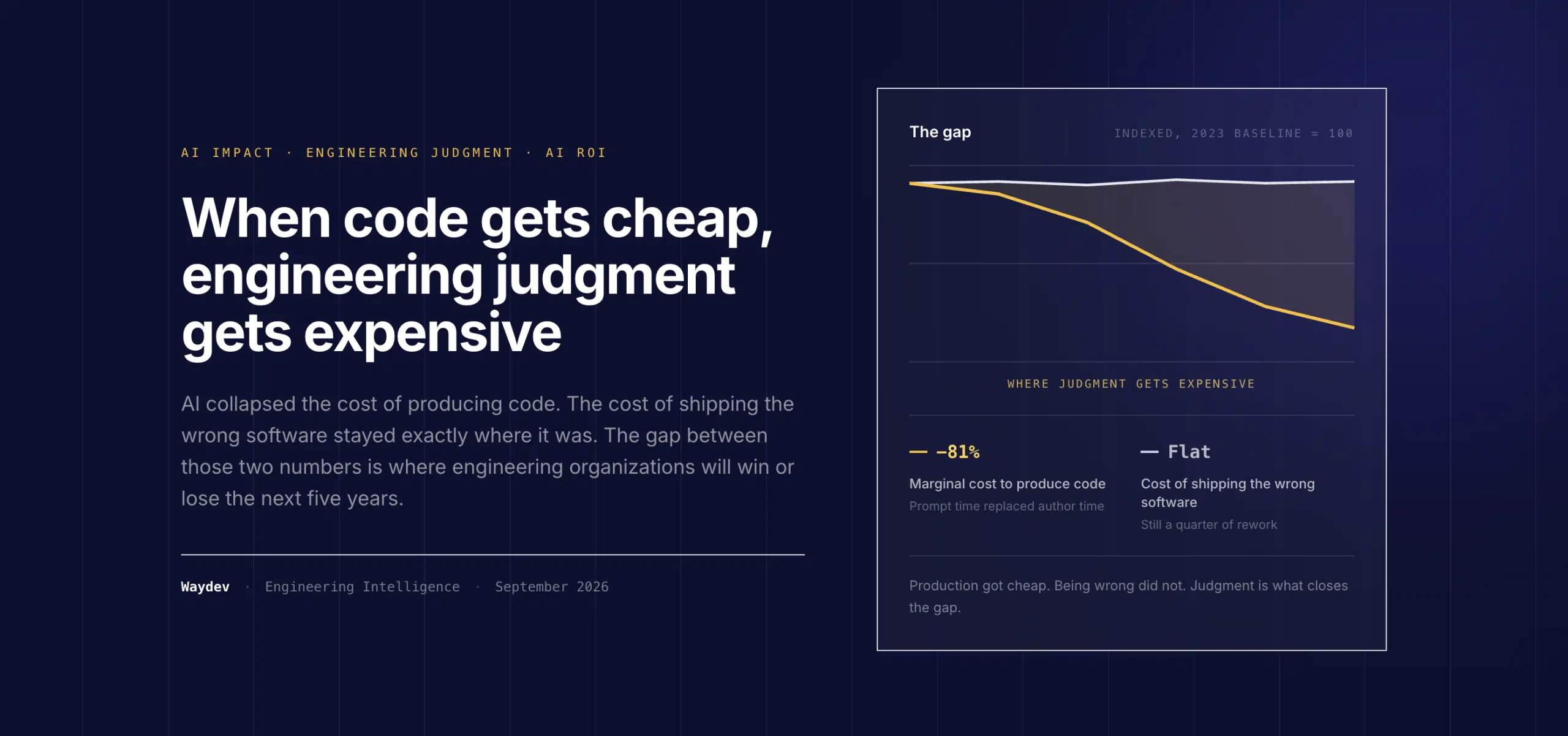
AI collapsed the cost of producing code. The cost of shipping the wrong software stayed exactly where it was. The gap between those two numbers is where engineering organizations will win or lose the next five years.
The industry keeps asking whether AI will replace software engineers. It is the wrong question, and it is distracting engineering leaders from the real shift happening inside their organizations.
Here is the question that actually matters: what happens to your engineering organization when the marginal cost of producing code approaches zero, but the cost of shipping the wrong software stays as high as it has ever been?
Because that is exactly where we are. AI coding assistants have collapsed the price of output. A mid-level engineer with the right tooling can generate in an afternoon what used to take a sprint. But a security flaw still costs the same to remediate. A bad architectural decision still compounds the same way. Technical debt still accrues interest, and now it accrues faster, because the volume of code entering your systems has exploded.
Cheap code does not make engineering cheap. It makes engineering judgment the most expensive line item you have.
What this covers
AI models are extraordinary pattern matchers. They produce clean syntax, standard integrations, and boilerplate at a speed no human can match. That is genuinely valuable, and the productivity gains are real.
But typing code was never the core difficulty of software engineering. The discipline has always lived in everything around the typing: understanding constraints, designing systems that hold up under change, and making trade-offs that stay sound years after the sprint ends.
AI compressed the easy part. The hard part is untouched, and in one important way it got harder: evaluating code you did not write demands more depth than writing it yourself, because you have to reconstruct the reasoning before you can judge it.
This is the trap hiding inside the productivity numbers. Organizations that read AI output as engineering progress are measuring the part of the job that just stopped being scarce.
Technical debt used to accumulate at the pace humans could write code. That ceiling is gone. A team leaning on AI without strong review discipline can now generate debt several times faster than before, and it arrives looking polished.
That is the uncomfortable part: the biggest risk of AI-assisted development is not code that is obviously broken. It is plausible code, produced in volume, that passes a glance and fails under load. Teams stitching together generated blocks without a cohesive architecture inherit systems nobody fully understands. When those systems fail in production, no prompt fixes the root cause, because nobody can articulate what the root cause is.
Illustrative. Generation costs keep falling while the cost of a bad architectural call, a security exposure, or an outage stays where it always was. Everything a leader should care about now sits in the space between the two lines.
We see the delivery signature of this pattern across engineering organizations on Waydev. AI adoption climbs, output metrics spike, and then a few months later review queues swell, rework rates climb, and cycle time quietly returns to where it started or gets worse. The code got cheaper. The system around it did not get any faster at absorbing it.
Leaders who only track output see a productivity miracle. Leaders who track the full delivery system see the truth: they traded a typing problem for a judgment problem.
Key takeawayThe biggest AI risk is not broken code. It is plausible code, produced in volume, entering systems faster than your review discipline can absorb it.
In the traditional model, delivery capacity was constrained by how many people you had writing code. In the AI-native model, code is abundant and the constraint moves to judgment. Three questions tell you whether your organization has it:
None of those are prompting problems. They are engineering problems, and they are exactly the problems AI cannot solve for you, because AI does not know your domain. It does not know why the payments service was split in 2021 or which shortcut will detonate under Black Friday load.
Someone with foundational depth has to catch that, and when code is cheap, those people stop being your producers and become your quality control, your risk management, and your competitive moat all at once. The role of every engineering discipline shifts with them:
Becomes the context that determines whether generated code fits the system or fights it.
weak architecture means AI amplifies the messBecome the constraints that keep machine-speed output inside the bounds you can maintain.
unstated standards are unenforced standardsBecome the feedback loop that tells you whether generated code does what the business needs.
coverage numbers are not verificationBecomes the judgment layer, where senior engineers audit AI output the way they would a confident junior’s pull request.
the new bottleneck, and the new risk surfaceThere is a tempting conclusion hiding in cheap code: fewer senior engineers, more prompt operators. The organizations that act on it will pay for it, because the skills AI commoditized are the ones juniors used to build depth with, and the skills it did not commoditize are the ones only depth produces.
If the bottleneck moved, your measurement has to move with it. Three shifts we recommend to every engineering leader navigating this:
Stop celebrating volume. Lines of code and PR counts were weak signals before AI. Now they are actively misleading, because AI inflates them for free. Measure outcomes: cycle time end to end, rework rates, escaped defects, and how long AI-generated code survives in production before it gets rewritten.
Instrument the judgment layer. Review latency, review depth, and how work distributes across senior engineers tell you whether your quality control is keeping pace with your new production capacity. If your best engineers are drowning in review while output climbs, you are accumulating risk, not velocity.
Measure AI impact, not AI adoption. Most organizations can tell you what percentage of engineers use AI tools. Almost none can tell you whether that usage improved delivery outcomes, where it introduced quality regressions, or what the ROI actually is. That gap is the difference between an AI strategy and an AI expense.
This is the problem Waydev was built around. Engineering intelligence for the AI era means connecting adoption data to impact data across the full delivery system, so leaders can see not just that their teams are using AI, but whether it is making the organization better.
AI Checkpoints show where AI-assisted work stalls or creates extra loops. Signals flag rising review time and rework before they show up in a quarterly report. And the ROI view puts spend beside verified delivery outcomes, in the language a CFO and a board can audit.
Every technology that made production cheaper made judgment more valuable. Calculators did not end mathematics; they moved mathematicians up the stack. Cheap printing made editors matter more. Cheap code makes engineering matter more.
The future is not humans versus AI. It is engineers who can think, amplified by machines that can generate, inside organizations that can measure the difference.
The leaders who win the next five years will not be the ones who generated the most code. They will be the ones who built organizations capable of absorbing cheap code safely: deep fundamentals, strong review systems, and measurement that tracks the whole delivery system instead of just the output.
Code became cheap. Engineering did not. The organizations that understand the difference are the ones worth betting on.
AI is replacing a task, not a profession. It has collapsed the cost of producing code, but the disciplines that make software succeed, such as system design, architectural trade-offs, and domain judgment, remain human work. Organizations still need engineers, and they increasingly need engineers with the depth to evaluate machine-generated output rather than just produce their own.
It can, and faster than human-written code ever did. AI produces plausible-looking output in volume, so teams without strong review discipline and architectural standards can accumulate debt at machine speed. The risk shows up in delivery data as rising rework, swelling review queues, and cycle times that revert months after adoption. Measuring those signals early is the difference between catching debt and inheriting it.
Shift from output metrics to outcome metrics. Track end-to-end cycle time, rework rates, escaped defects, and the survival rate of AI-generated code in production. Then instrument the judgment layer: review latency, review depth, and how review load distributes across senior engineers. Finally, connect AI adoption data to delivery impact so every dollar of AI spend maps to a measurable result.
Start with a pre-rollout baseline, then compare delivery, quality, and cost signals for AI-assisted work against it. License counts and acceptance rates prove access, not value. ROI appears when improved delivery or capacity shows up without a hidden rise in defects, rework, or review burden, priced against the full program cost. Waydev connects these layers so the comparison is auditable rather than anecdotal.
The opposite pressure is more likely. AI commoditized the tasks junior engineers used to build depth with, while making depth itself more valuable, because someone has to evaluate generated code for architectural fit, security exposure, and real business behavior. Senior judgment is becoming the constraint on how fast an organization can safely absorb AI output.
Waydev connects AI adoption with delivery performance, quality signals, and financial value across the engineering organization. Bring your baseline. We will show you the rest.
Book a demoWaydev is an AI-native engineering intelligence platform measuring AI adoption, impact, and ROI across engineering organizations, trusted by Fortune 500 companies including Dropbox, Caterpillar, and PwC.
Ready to unlock your SDLC productivity?