





How Waydev works
From your Git provider
to board-ready answers.
In days.
Connect your stack read-only. Waydev rebuilds your history at the commit and PR level, layers AI analysis on top, and answers in whatever framework your organization already speaks.
Most engineering intelligence platforms make you build dashboards, define metrics, and wait a quarter for data to accumulate. Waydev works the other way around. Your Git history already holds years of evidence about how your organization builds software. We read it, structure it, and let you ask questions of it.
For an enterprise, that changes the shape of the entire rollout. There is no instrumentation project, no change management for engineers, and no waiting period before the platform is useful. The five steps below walk through exactly what happens: what Waydev connects to, what data it touches, how the analysis works, and how the output reaches every level of the organization, from the team lead’s Monday standup to the CFO’s quarterly review.
Three products.
One measurement layer.
Waydev reads the work your teams and agents already do, then turns it into ROI you can defend, delivery you can improve, and answers you can trust.
Understand
AI ROI Intelligence
Connect AI spend to the outcomes it shipped
Optimize
Delivery Intelligence
Continuously improve how engineering ships
Maximize
Ask Waydev Agent
Ask anything. Every answer cites your numbers
One measurement layer for humans, AI, and agents building together.
Work-first. Agnostic. Yours.
Code hosting
GitHub
GitLab
Bitbucket
Planning
Jira
Azure DevOps
SonarQube
Operations
CI/CD
Slack
Teams
AI assistants
Claude
Codex
Cursor
And more
Copilot
Windsurf
. . . .
Step by step
Here is how it comes together.
Step 01 · Connect
Connect. Nothing changes.
Waydev connects to GitHub, GitLab, Bitbucket, and Azure DevOps through your existing provider tokens. Cloud, self-managed, and on-prem instances are all supported, which matters if your source control sits behind a firewall, as it does for most banks, telecoms, and regulated enterprises we work with.
The connection is read-only and scoped by you. You decide which organizations, groups, or repositories Waydev can see, using your provider’s own permission model. Access can be narrowed, audited, or revoked at any time from your side, without a support ticket.
Beyond source control, you can add Jira for planning and delivery context, and your AI coding assistants, including GitHub Copilot and Cursor, so the AI layer in Step 03 has real usage data to work with. Each integration is optional and independent: you can start with Git alone and expand later.
What you never do: install agents on developer machines, roll out IDE plugins, or change how your engineers commit, review, or ship. There is no per-developer setup and nothing for IT to package or maintain. Most engineers will never know the day you connected.
Cloud, self-managed, or on-prem
Scoped by your permission model
No agents or plugins
Step 02 · Measure
Measure. No cold start.
This is the patented part. Once connected, Waydev rebuilds your full Git history at the commit and pull request level, not just the surface metadata other tools skim. Every commit, every review, every merge across every connected repository is structured into a consistent data model, mapped to your teams and, if Jira is connected, to the initiatives that work belongs to.
For an enterprise evaluation, this has two consequences. First, no cold start: instead of waiting a quarter for new data to accumulate, you get months of baselines within days of connecting. A proof of concept produces real, historical findings in its first week, not a promise of findings later.
Second, your history is portable. Your baselines were never really inside your previous analytics vendor. They live in Git, and Waydev reads them from there. Switching platforms no longer means losing years of trend data or restarting your benchmarks from zero, which removes the single biggest hidden cost of changing vendors.
Team structures, repository groupings, and contributor mapping are configured during onboarding with your customer success team, so the numbers reflect your actual org chart rather than raw repository boundaries. Reorganizations are handled the same way: remap the teams and the history follows.
USPTO-patented Git analytics. Waydev holds a granted patent on Git-based engineering measurement, recognized by Gartner and ranked a Leader on G2.
Step 03 · Analyze
Analyze. Ask anything.
On top of the measurement layer, Waydev’s AI answers the questions your board is actually asking about AI-assisted development. Not just “are we using Copilot,” but “is it working, and what is it worth.” Because the AI layer sits on your own commit-level baselines, the answers are comparisons against your organization’s real history, not industry averages or vendor benchmarks.
Understand
AI Adoption
Who is using AI assistants, how deeply, and where adoption stalls, so enablement budgets go where they change behavior.
Optimize
AI Impact
What AI-assisted code does to velocity, review load, and quality, measured against your own pre-AI baselines.
Maximize
AI ROI
The dollar return on your AI tooling spend, in numbers finance will accept and can trace to the underlying data.
Day to day, the AI layer works in three modes. The Waydev Agent answers questions in plain language: a VP can ask “which teams slowed down after the reorg and why” and get an evidence-backed answer without building a dashboard. Signals push alerts to Slack when a metric drifts outside its normal range, so problems surface before the retro instead of after it. Goals track your chosen targets against actuals over time.
The operating principle: the platform does the monitoring, so your managers do the managing. Nobody’s job becomes running reports.
Step 04 · Express
Express. Any framework.
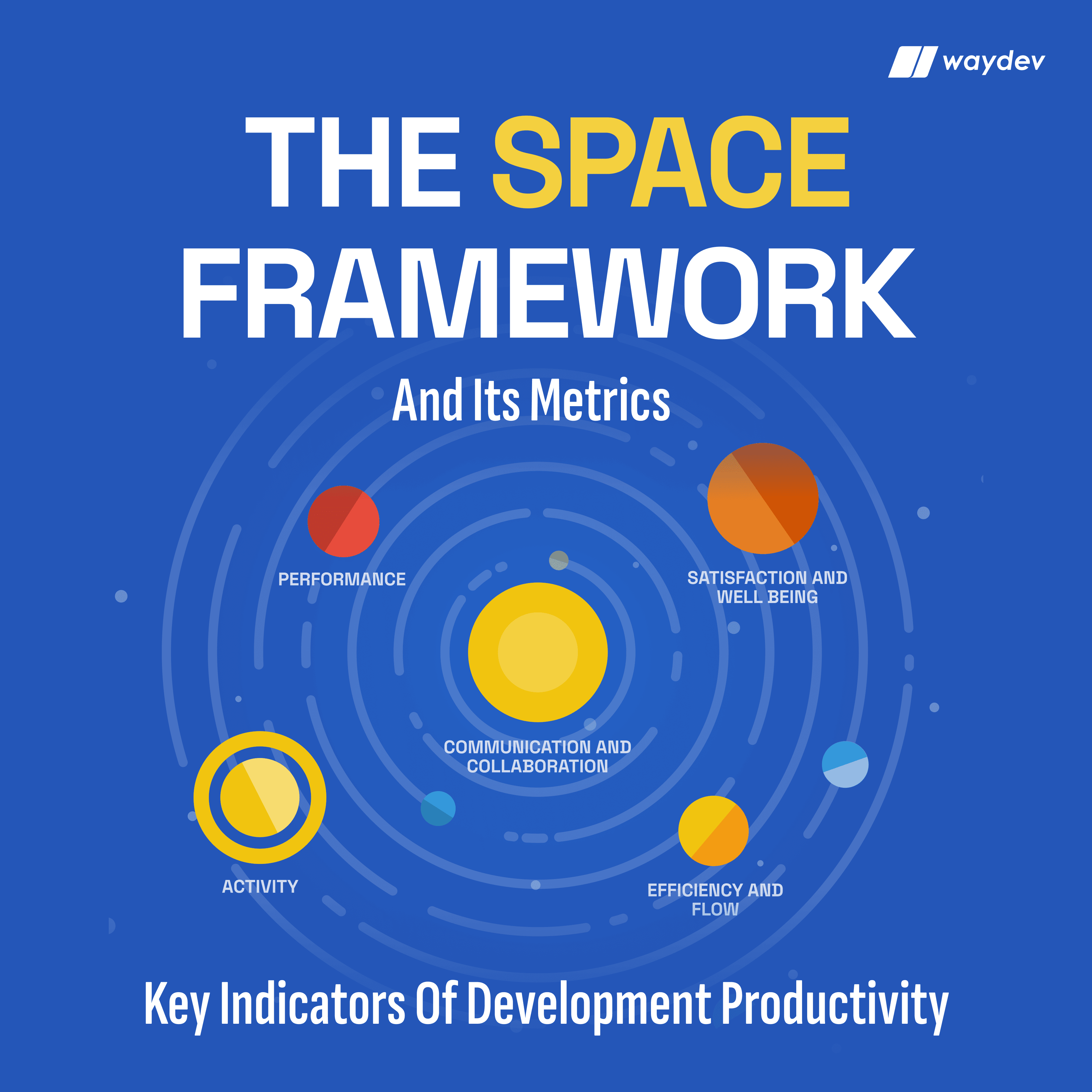
Large organizations rarely speak one measurement language. One division reports in DORA, another inherited SPACE from a previous CTO, a third adopted Core 4 last year. Waydev is framework-agnostic by design: the same underlying commit-level data answers in DORA with industry benchmarks, stays consistent with SPACE, maps to Core 4-style views, or follows The WAY Framework, our open methodology built on nine years of research with zero proprietary lock-in.
This is what makes standardization across divisions possible without a political fight. Nobody has to abandon the framework their reporting is built on. Each audience keeps its lens, and because every lens draws from the same data, the numbers reconcile when they meet in the same board deck.
It also de-risks the future. If leadership changes and the preferred framework changes with it, you switch the lens, not the platform. The data underneath never changes, only how it is expressed.
Step 05 · Operate
Operate. Every altitude.
The same source of truth serves the standup and the board meeting, so they finally agree with each other.
| Who | What they get |
|---|---|
| Executives | AI ROI, cost capitalization, and delivery health in board-ready reports. |
| Engineering Managers | Sprint health, review bottlenecks, and coaching signals without spreadsheet archaeology. |
| Product Leaders | Where engineering effort actually goes: features, debt, or keeping the lights on. |
| Studio | Custom dashboards and data exports when you need to slice it your own way. |
Security by architecture
Your source code never leaves. By design.
This is not a policy choice that could quietly change. It is how the platform is built: analysis runs on Git metadata, so your intellectual property never leaves your repositories in the first place. That single architectural fact is what makes Waydev’s security reviews with Fortune 500 companies and European financial institutions short instead of long.
Metadata only
Waydev analyzes who changed what, when, and how the work flowed. The contents of your files stay in your repositories.
Read-only, revocable access
Access flows through your provider’s own permission model, scoped to the repositories you choose. Revoke it any time.
SOC 2 audited
Independently audited controls with encryption in transit and at rest. Audit reports available under NDA.
Procurement-ready
Enterprise DPA, security questionnaires, and data protection documentation supplied as a standard package.
Governed access
Role-based access controls who sees which teams and reports, so visibility follows your org structure and policies.
Enterprise-proven
Trusted by Fortune 500 engineering and security teams, including regulated financial institutions in the US and Europe.
For enterprise teams
Evaluate small. Expand on evidence.
Enterprise adoption rarely starts with a company-wide switch, and it should not. The path we run with large organizations looks like this:
1
Security review first
Your security and procurement teams receive the compliance package up front: SOC 2 report, DPA, data protection overview, and answers to your questionnaire. Because no source code is stored, this is typically the shortest stage.
2
Scoped proof of concept
Pick a slice of the organization, often 30 to 50 engineers across representative teams, and connect only their repositories. No cold start means real findings on your own historical data in the first week.
3
Structured onboarding
Your customer success team maps teams and contributors, configures the frameworks and reports each audience needs, and sets the reporting cadence. The platform starts matching your org chart, not your repository list.
4
Expand on evidence
Rollout to further divisions is a scope change, not a new project. Connect the additional repositories and their history backfills the same way, inheriting the configuration and governance already in place.
The first weeks
Days to answers.
Not quarters.
DAY 1
Connect your Git provider read-only. Historical analysis starts immediately.
FIRST DAYS
Months of baselines appear as Waydev rebuilds your history at the commit and PR level.
FIRST WEEKS
Teams mapped, frameworks chosen, and your reporting cadence configured with your customer success team.
ONGOING
Signals watch for drift, the Agent answers ad-hoc questions, and reports ship themselves.
“We were looking at bugs, and we would ask how many tickets got reported resolved. But after Waydev came, we were able to get a little bit deeper.”
Engineering leader, via G2
“Waydev has outstanding customer support with super fast response times. Not only do they respond fast, they also act fast.”
Verified customer review, via G2
Questions. Answered.
Does Waydev read our source code?
Analysis runs on Git metadata, and Waydev never stores your source code. Access is read-only through your provider’s own tokens and can be revoked at any time.
How long until we see real data?
Days, not quarters. Because Waydev rebuilds your existing Git history, months of baselines are available shortly after connecting. There is no cold-start period where the tool waits for new data to accumulate.
We already use DORA. Do we have to change frameworks?
No. Waydev is framework-agnostic. Keep DORA with benchmarks, use SPACE-consistent or Core 4-style views, or adopt The WAY Framework. The data stays the same; only the expression changes.
Do our engineers need to install anything?
No agents, no IDE plugins, no workflow changes. Waydev connects at the provider level, so engineers keep working exactly as they do today.
Can Waydev measure our AI coding assistants?
Yes. Waydev tracks AI adoption, measures AI impact against your own baselines, and calculates AI ROI in terms your finance team will accept.
Our GitLab runs on-prem behind a firewall. Does that work?
Yes. Self-managed and on-prem instances of GitLab, GitHub, Bitbucket, and Azure DevOps are supported. This is a standard setup for the banks and telecoms we work with, and it is scoped during the security review before anything is connected.
What does our security team get for the vendor review?
A standard package: SOC 2 report under NDA, enterprise DPA, a data protection overview describing exactly what data is accessed and how it is processed, and completed answers to your security questionnaire. Because Waydev never stores source code, most reviews close quickly.
Can we control who inside our company sees what?
Yes. Role-based access inside Waydev controls which teams, reports, and levels of detail each user can see, so visibility can follow your management structure and internal policies.
How fast can we be fully operational?
Your reporting cadence is typically live within the first weeks, configured with your customer success team. Days to answers, not quarters.
Ready to see it on your data?
Connect your repos.
See answers in days.
A personalized demo on your use case, or a proof of concept on your own repositories. Both start with one call.