




Measure AI engineering ROI without losing delivery governance.
Banks, insurers and fintechs need more than AI adoption dashboards. Waydev links developer tooling spend and engineering workflow data to delivery predictability, review bottlenecks and change quality, with private model deployment options for controlled environments.
- AI engineering economics
- Change and delivery visibility
- Private inference
“Did AI tool adoption shorten review time for our payments teams without increasing rework or change risk?”
- Sources
- Approved Git, Jira, CI/CD and AI tools
- Analysis
- Delivery and quality trends
- Model
- Waydev SDLC 15B
- Private setup
- Customer-controlled inference
In its published case study, the tax and compliance software provider also describes an on-premises installation and the work required to validate its data. The results are historical self-reported observations, not guaranteed outcomes or evidence of bank regulatory compliance.
Understand software delivery across critical financial platforms
Measure the development process around business-critical systems while respecting existing release authorization and operational risk controls.
Payments and digital channels
Understand PR review latency, bottlenecks and delivery predictability across payment services, customer apps and core digital platform teams.
Policy and claims platforms
Compare software delivery flow, initiative dependencies and modernization engineering effort across teams maintaining regulated services.
Developer tooling and AI spend
Compare AI coding adoption, token or license costs where supported, review effort and quality guardrails before scaling tools enterprise-wide.
Waydev Brain for financial engineering organizations
Waydev Brain uses the Waydev SDLC 15B model for natural-language questions about connected engineering data. It can help leaders investigate metric changes, produce scoped reports and assess AI developer tool outcomes with evidence.
For qualifying enterprise deployments, private inference can run on customer-controlled hardware, including an air-gapped configuration, subject to infrastructure and security review. The private model does not require an external generative AI API when configured accordingly.
- Which platform groups have rising cycle time despite broader AI adoption?
- Where are payment service reviews creating release bottlenecks?
- How is AI coding spend changing alongside rework and deployment outcomes?
- Which modernization initiatives are drifting against their engineering targets?
Measure delivery gains alongside operational discipline
Review waiting, work in progress, cycle time and qualitative DX context.
Deployment and change quality signals interpreted alongside approved release controls.
License/token cost where supported, AI adoption and outcomes, with an explicit baseline.
Why engineering governance matters as AI adoption accelerates
Financial institutions need verifiable evidence of delivery quality, predictable change, and engineering investment efficiency. The following figures come from independent research, not from claimed Waydev customer results.
$5.56M average financial-sector breach cost
IBM’s 2025 Cost of a Data Breach study reports an average of $5.56 million for the financial sector. This is industry context for risk-aware engineering decisions, not an estimate of savings from Waydev.
Almost 5,000 technology professionals surveyed
Google’s 2025 DORA research finds that AI adoption can increase delivery throughput while also amplifying instability when underlying practices are weak. Banks should measure flow and stability together, not AI usage in isolation.
EU Digital Operational Resilience Act now applies
The EU Digital Operational Resilience Act has applied since 17 January 2025 and covers ICT risk management, incident handling and third-party risk. Waydev provides engineering data context, not regulatory certification.
What your team gets from the first conversation
This is not a generic product demo. Bring a banking domain such as payments, mobile banking, cards, lending or platform engineering, and we will scope the evidence required for a responsible decision.
A measurable engineering problem
Identify a review bottleneck, unpredictable delivery milestone, rework issue or AI tooling investment question. Agree on baseline metrics, observation window and limitations before presenting ROI.
Deployment and data boundaries
Review repository and work-tracking permissions, data residency, SSO and access roles, private inference requirements and procurement stakeholders. Security and regulatory decisions remain with your institution.
Proof-of-value and next steps
Agree on metrics and evidence a 30–45 day evaluation could produce, who needs to approve it, and how to estimate value net of licensing, integration and ongoing costs.
Turn engineering activity into investment and release decisions
Review initiative-level staffing and cost allocation, delivery targets, and changes in throughput by domain, where integrations support these measures.
Compare adoption and costs with review time, cycle time, rework and release outcomes. Separate correlation from measured impact.
Examine bottlenecks, aging pull requests, predictability trends and change quality signals without replacing your bank’s release approvals.
Start with one authorized engineering domain
- STEP 01Define scope and controlsSelect a digital banking, insurance or developer platform function. Agree on data classification, vendor assessment and authorized read permissions.
- STEP 02Measure baseline and AI adoptionEstablish delivery and quality metrics, compare AI-enabled work where supported and document confounding factors.
- STEP 03Review findings with stakeholdersPresent evidence and caveats to engineering, finance and security. Expand only if the proof-of-value meets agreed acceptance criteria.
Discuss a 30–45 day scoped evaluation where data and procurement readiness allow. This is a proposed process, not a fixed program or promised improvement.
Measure the value of reclaimed engineering capacity
A conservative starting point is quantifying whether engineering process improvements return meaningful time without increasing change risk. The estimate below is hypothetical and is not a claim of achieved customer results or guaranteed cost savings.
300 engineers × 1 hour(s) per month × 12 × $115 fully loaded hourly cost
Potential redeployable time, not headcount reductions or direct cash savings.
Net ROI requires validation: establish a comparable baseline, verify recovered time and business utility, account for quality and risk, then subtract Waydev licensing, integration, deployment and ongoing operating costs. Do not attribute every trend change to Waydev or AI tools.
DORA metrics are not EU DORA compliance
DevOps Research and Assessment (DORA) metrics describe software delivery. The EU Digital Operational Resilience Act (DORA) is a separate regulatory framework for financial institutions. Waydev does not automatically establish compliance with that regulation, nor replace risk, fraud, transaction monitoring or audit platforms.
Evaluate data residency, SSO/RBAC, integration privileges, vendor risk, audit logging, privacy obligations and approved release-management controls during procurement. Workforce-wide intelligence outside engineering is a separate possible custom project, not a standard deployment claim.
Frequently asked questions
Does Waydev measure bank transactions or detect fraud?
No. Waydev focuses on engineering delivery and AI development tooling, not transaction monitoring, credit decisions or fraud detection.
Does Waydev make us compliant with the EU DORA regulation?
No. Waydev engineering analytics and the EU Digital Operational Resilience Act are different. Regulatory compliance depends on the institution’s own controls and assessment.
Can Waydev Brain run in a private network?
Yes, subject to the chosen enterprise deployment configuration and architecture review, Waydev SDLC 15B supports private and air-gapped inference.
How should a bank measure engineering AI ROI?
Compare a defined baseline with review waiting, rework, delivery stability and AI costs. Value recovered capacity conservatively, and deduct all platform and operational costs before describing net ROI.
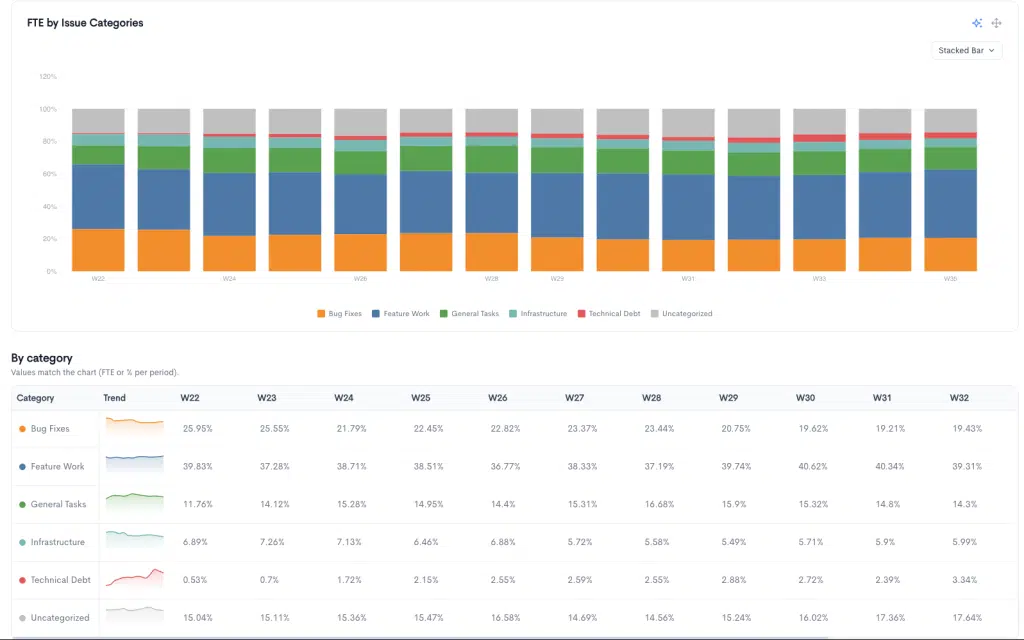
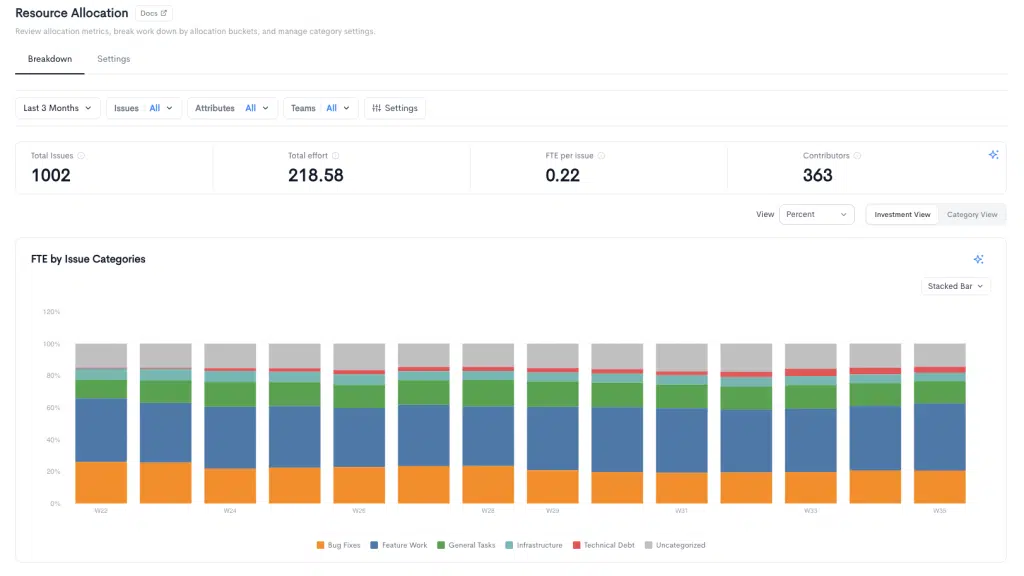
Financial services engineering ROI dashboards in Waydev
Real static screenshots from Waydev feature pages, with illustrative data. No video players.
Build an evidence-based AI engineering business case.
Discuss your platform scope, private deployment, baseline metrics and approval process.