Comparing Jellyfish competitors? Evaluate Waydev, Swarmia, DX and other platforms by the engineering decision you need to support—not just a features checklist. Jellyfish currently describes AI ROI, investment allocation, custom metrics, agents and DevEx surveys; do not assume it lacks these capabilities.
Buyer test: Have both vendors reproduce the same quarterly AI-spend-to-delivery report with source-level traceability, role-based access and documented data gaps. Request Waydev’s enterprise evaluation.
Based on public product descriptions, October 2026. Validate current offerings, security architecture and pricing directly with each vendor.
Short answer. Both platforms read the same raw signals from Git and Jira without asking engineers to log anything. Jellyfish is built around engineering investment and financial reporting for the board. Waydev is built around delivery, developer experience and AI impact, with self-hosted deployment and an open API for teams that need the data in their own systems.
If your first question is “what did we spend engineering on last quarter,” Jellyfish answers it well. If it is “where is delivery breaking down, and what is AI actually doing to our throughput and quality,” that is where Waydev is built to go deeper.
Waydev is a software engineering intelligence platform for engineering leaders. It connects to your version control and issue tracking systems, then surfaces what you need to improve delivery speed, team health and planning accuracy. Request an enterprise demo.

Both tools cover the core engineering intelligence ground. The differences that matter sit at the edges: deployment model, data portability, and what the platform is optimized to answer.
| Capability | Waydev | Jellyfish |
|---|---|---|
| DORA metrics | Yes | Yes1 |
| Cycle time by stage | Yes, coding, review and deploy | Yes |
| Investment and cost allocation | Yes, resource planning and project costs | Yes, a core strength including software capitalization2 |
| Developer experience module | Yes | Yes |
| AI adoption and impact | Yes; Waydev Brain and AI measurement | Yes1 |
| On-premise or self-hosted | Yes | Not offered publicly |
| Open API, read and write | Yes | Limited |
| Custom metrics and dashboards | Yes | Configurable reports |
| Code quality data | Yes, via Sonar | Not published |
| Trial before purchase | Proof of concept trial | Demo first, no public free trial |
| Enterprise pricing | Private quote | Verify current terms with Jellyfish |
| Security reporting | SOC 2 Type II with a public SOC 3 report | SOC 2 |
Scroll the table sideways to see both columns.
Every honest comparison has this section. Here is ours.
Jellyfish is strong when the primary audience for engineering data is the finance organization and the board. Its investment allocation and software capitalization tooling is mature, it has been recognized as a leader in G2’s software development analytics category for seventeen consecutive quarters, and its executive dashboards are built for exactly that conversation.3
If your top three questions are all about R&D spend classification, capitalization and initiative-level cost reporting, Jellyfish is a reasonable choice. Waydev is the stronger fit when delivery health, developer experience, AI impact and deployment control matter more than accounting output.
Waydev runs a proof of concept on your real commit and PR history before any purchase commitment, so you can compare outputs rather than demos.
Request an enterprise demoWaydev is organized into four modules. Each answers a different question, and they read from the same commit-level source.
Measure, optimize and improve every stage of software delivery.

Team dynamics, working practices and the conditions behind delivery numbers.
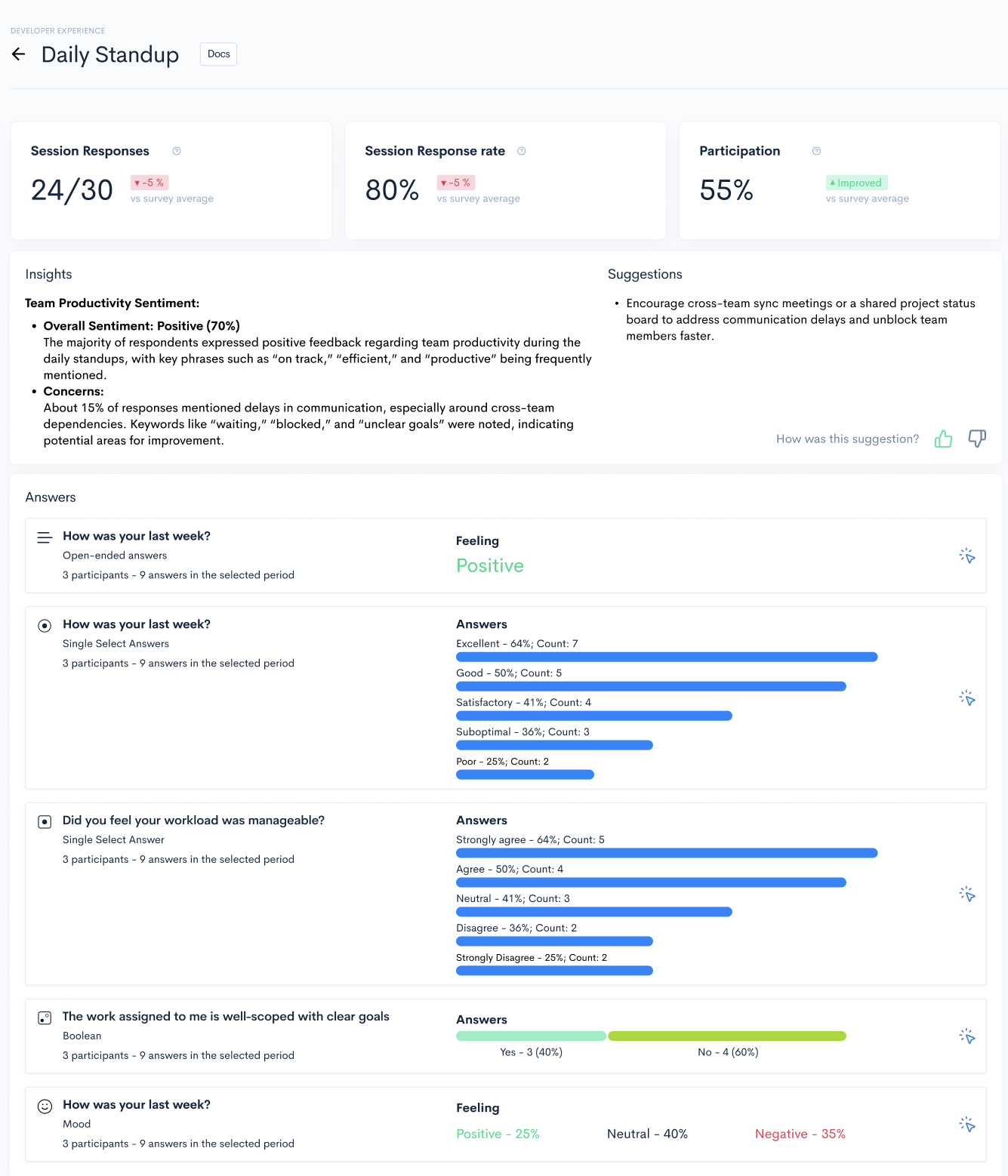
Align engineering work with product and business strategy.
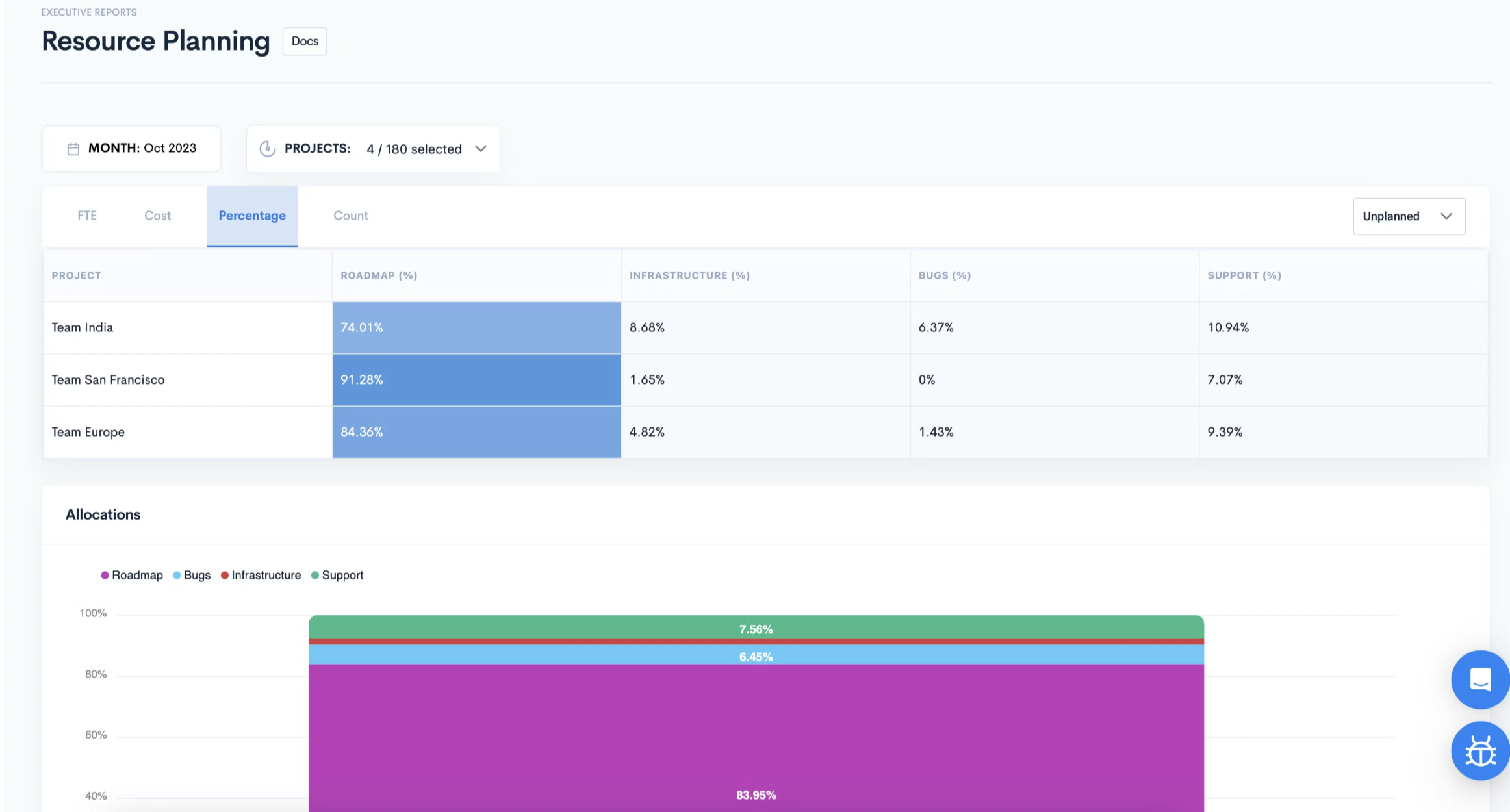
Targets track key metrics against benchmarks, and notifications fire when a team hits a milestone or a threshold moves the wrong way. The work log removes the guesswork about where effort actually went.
Jellyfish gathers engineering signals from commits and pull requests in Git and from tasks in Jira, then layers contextual data from calendars, product planning tools and HR systems to build a picture of what teams are working on and how long it takes.
The output is oriented toward allocation: work and resources mapped to projects, releases and business objectives. Their main reports cover alignment, investment distribution across roadmap, unplanned, infrastructure and support work, technical debt, product pillars, and productivity. Like Waydev, it requires no manual input from engineers.
| Plan | Price | What it includes |
|---|---|---|
| Waydev Pro | Private enterprise quote | Delivery and Health reports, targets, notifications, role-based access, custom dashboards, up to 50 repositories and 6 months of history |
| Waydev Premium | Private enterprise quote | Delivery, Health, Planning, Automation and Custom modules, SSO and SAML, team-level permissions, API access, up to 300 repositories and 36 months of history |
| Waydev Enterprise | Custom | Everything in Premium plus on-premise Git and ticketing integrations, self-hosted or cloud-hosted, custom engineering support and enterprise customer success |
| Jellyfish | Not published | Annual subscription, quoted after a demo |
With Waydev, schedule a demo and run a proof of concept. You connect version control and issue tracking, and real-time integration covers GitHub, GitLab, Bitbucket, Azure DevOps, Jira, Azure Boards, ClickUp and more. The POC runs on your own history, so the first review uses your numbers rather than sample data.
With Jellyfish, access starts with a demo and an annual subscription. Integrations include GitHub, GitLab, Bitbucket, Jira, Aha! and Productboard, and deployment is cloud only.
Waydev aggregates and displays critical project and developer metrics in a way that is genuinely easy to digest. Tata Health, from the Tata Health case study
Yes. Jellyfish tracks DORA metrics including lead time, deployment frequency and mean time to resolution.1 DORA coverage alone is not a reason to choose between the two platforms. Deployment model, data portability and depth of developer experience data are.
No, and it is worth stating plainly. A SOC 3 report can only be issued after a clean SOC 2 Type II audit, and it is a public-facing summary of that same examination.4 The practical benefit is that Waydev’s SOC 3 report can be shared freely without an NDA, while a SOC 2 report typically cannot. Both platforms hold SOC 2.
Waydev backfills from your existing version control and issue tracking history, up to 6 months on Pro and 36 months on Premium, so trend analysis starts on day one rather than after a quarter of collection.
No, for either platform. Both read signals that your Git provider and issue tracker already produce.
Jellyfish, if software capitalization and R&D spend classification are the primary use case. Waydev, if delivery performance, developer experience and AI impact carry more weight than accounting output.
The fastest way to settle a platform decision is to point both at the same repositories and see which one answers your actual questions. Waydev runs that as a proof of concept before any commitment.
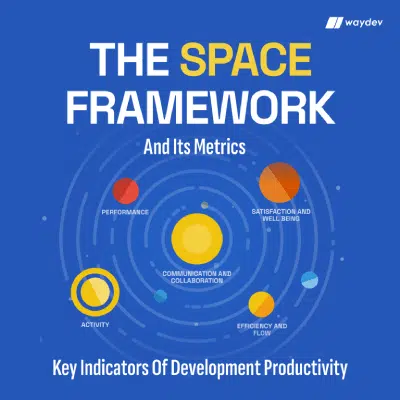
If you are still mapping the category, our overview of software engineering intelligence platforms covers how these tools differ, and the WAY framework explains how we combine DORA, SPACE and AI impact into one measurement model.
Request an enterprise demoConnects to your Git provider and reads your existing history.
Competitor details last verified September 2026. Vendor capabilities change, so we recheck this page each quarter.
2027 enterprise buyer’s guide · updated October 2026
Where Waydev stands out: Explore Waydev Brain for private enterprise analysis, Prompt Dashboards for executive questions and AI spend mapped to engineering outcomes; Jellyfish also offers investment analytics. Compare capabilities through a pilot; no single vendor is universally best.
Waydev 15B is Waydev’s proprietary 15-billion-parameter model for the software development lifecycle. Waydev Brain supports private, fully air-gapped enterprise deployment, with its model, agents and engineering intelligence running inside the customer’s environment. Confirm deployment scope and requirements during a security evaluation.
Waydev Agent answers natural-language questions about delivery, AI cost, PR activity and trends, with inspectable supporting queries for analysis. Specialized skills and Agent Registry help organizations understand AI agents and their owners.
Signals proactively check engineering data for issues that warrant attention; Goals set measurable targets and track progress by team or organization. Examples include review bottlenecks, code-quality risk and changes in AI-related spend.
Describe a question such as “Show AI spend, cycle time and rework by team.” Prompt Dashboards can assemble Waydev metrics into editable, shareable dashboards using common definitions.
Evaluate AI-assisted work by tool, team and initiative, combining usage and costs with delivery and quality signals. AI Governance and Limits adds spend alerts, policy controls and an audit trail. AI usage is not, by itself, proof of ROI.
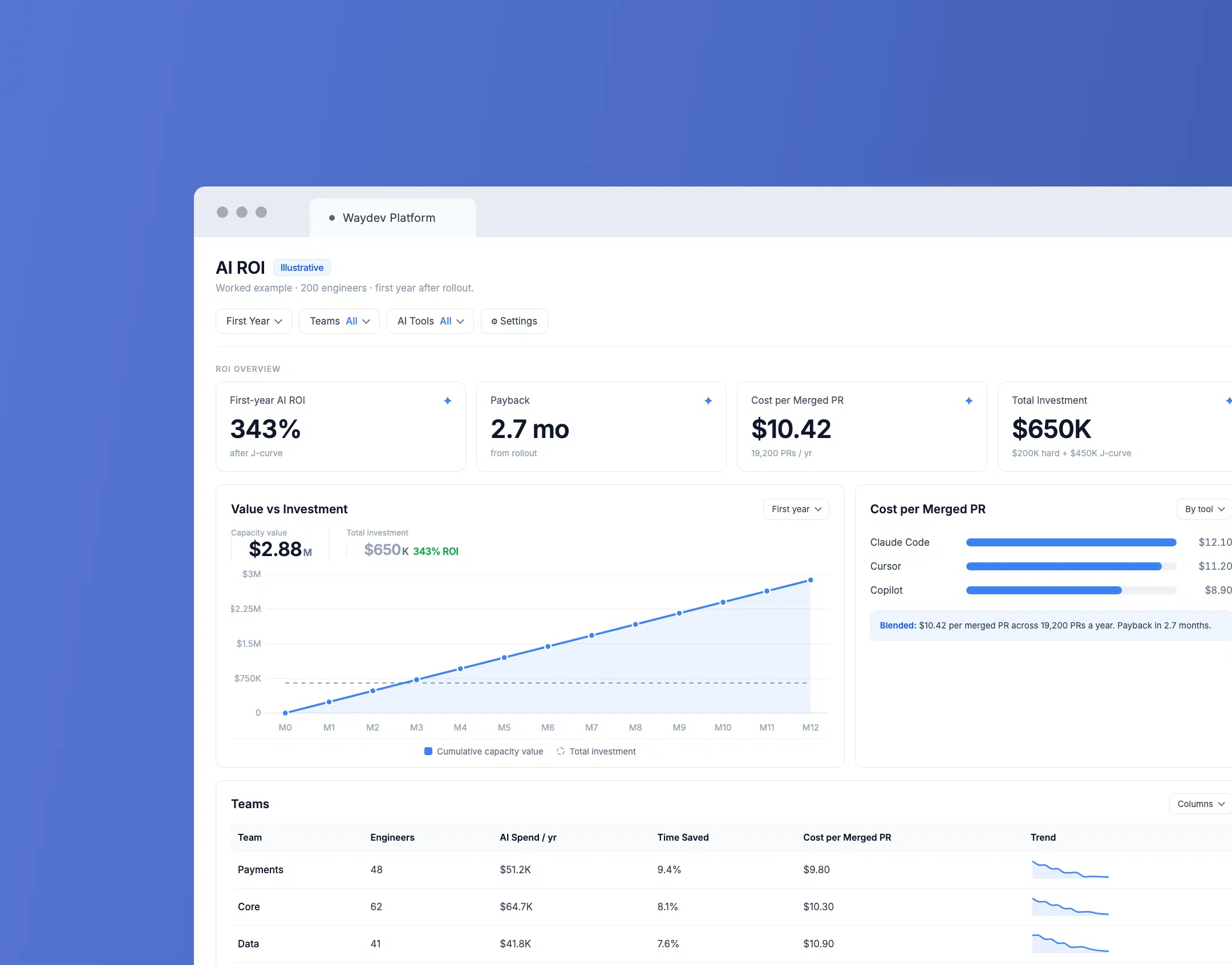
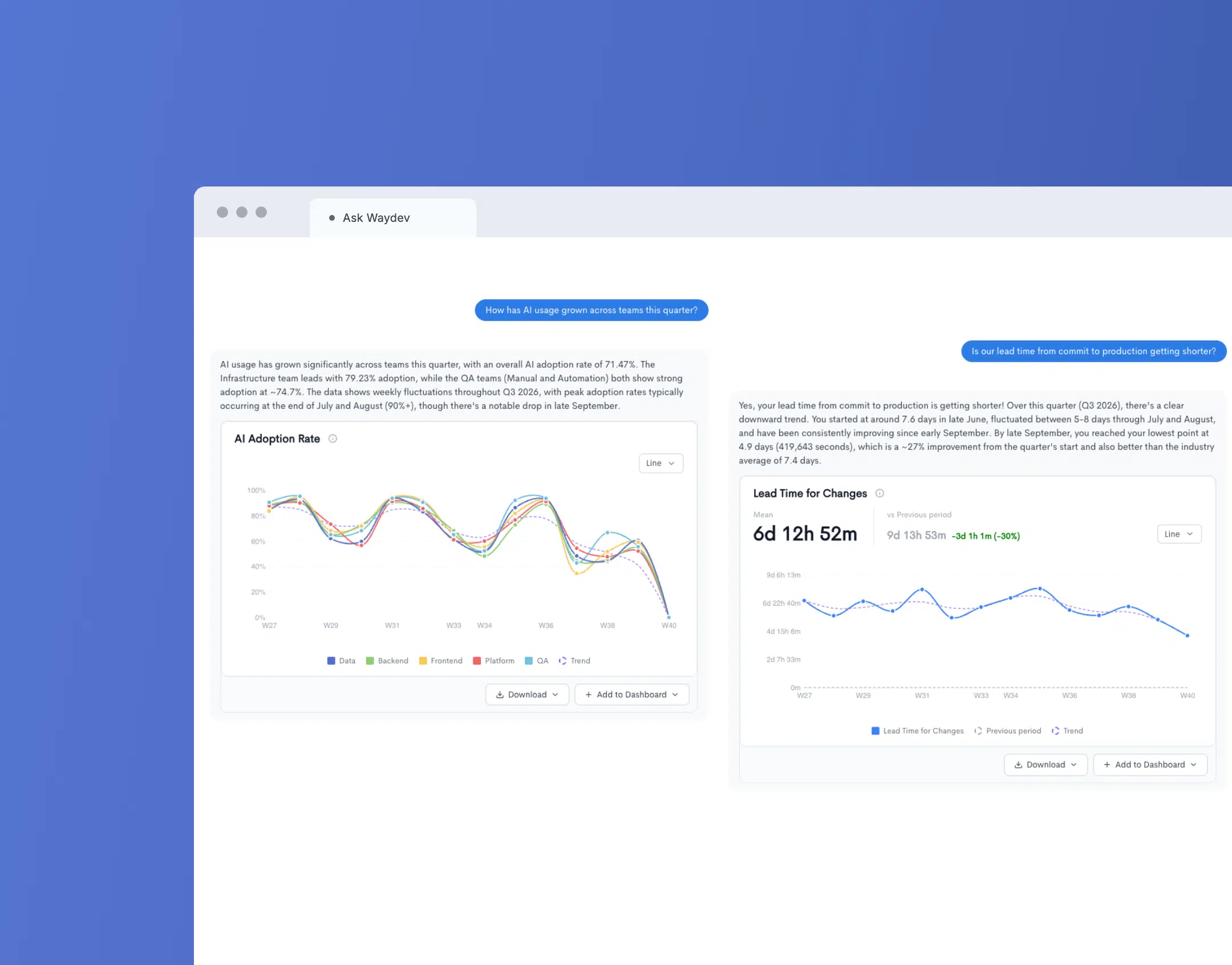
Use identical teams, metric definitions and time windows; validate enterprise security, feature availability and source-system coverage with both vendors. Waydev’s commercial terms are provided through a private enterprise quote, not a public price comparison.
Request a Waydev Brain and enterprise intelligence demo →
Waydev-authored product comparison. Feature descriptions reflect Waydev’s published materials as of October 2026; vendor capabilities and configuration may change.
Updated buyer’s verdict (October 2026): Jellyfish deserves consideration where R&D portfolio allocation and investment reporting are central. Shortlist Waydev when engineering delivery, AI adoption and impact, and customizable stakeholder views are the main evaluation priorities.
What Jellyfish already does: Jellyfish discusses engineering investment allocation and has published an AI investment-versus-output measurement approach that includes spend, adoption, output and business-alignment indicators. Treat this as a substantive competitor capability. Check the competitor’s own documentation.
What to test in a proof of value: During a pilot, trace one business initiative from issue or PR through released work and team cost in both systems; verify how investment categories are assigned and whether source records support the result.
No. Jellyfish also describes AI measurement and engineering output. Compare both platforms on the specific investment and delivery analysis your executives require.
Evidence standard: These are editorial assessments, not a validated hands-on benchmark. Feature availability, pricing and implementation requirements may differ by plan or configuration. Request the same live demonstration and measure with identical definitions before selecting either vendor.
Decision in brief: Prioritize a platform that can demonstrate impact using your organization’s real engineering data. During the trial, evaluate investment allocation, project outcomes, delivery health and the financial interpretation of AI-assisted engineering. Avoid comparing platforms on a single dashboard screenshot or vendor marketing claims.
Jellyfish publicly emphasizes engineering investment allocation, business alignment, delivery management and team health. Compare the quality of those workflows rather than claiming it lacks strategic reporting. Vendor source and product details.
The images below are existing Waydev media assets. Confirm feature availability, account permissions and the precise metrics in your environment during a demo.
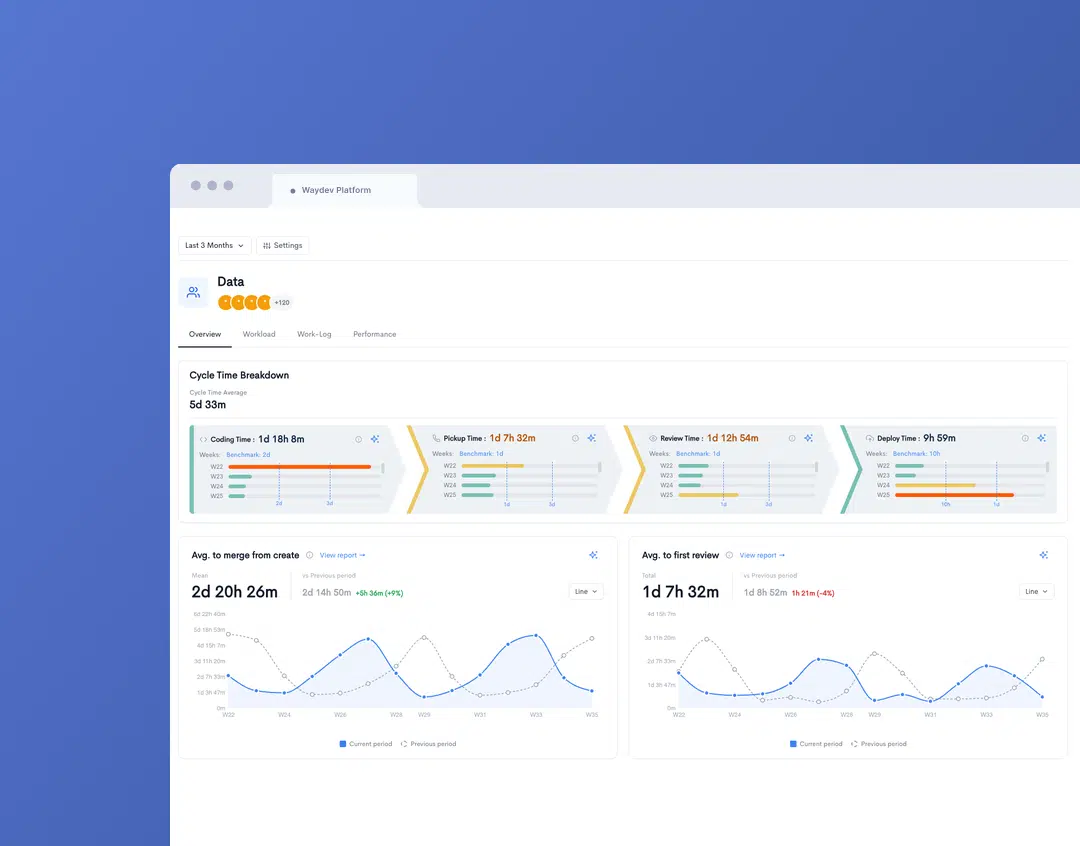
Consider Waydev when you need to investigate DORA and developer-experience trends alongside AI adoption, delivery outcomes and business impact. The right choice depends on your workflow, integrations, governance and which outcomes you need to prove; request a side-by-side pilot using your own data rather than relying on blanket feature claims.
Explore Waydev’s AI coding ROI methodology, then request a Waydev demo to compare both platforms using your engineering data.
Editorial note: Comparison criteria and recommendations are Waydev’s editorial analysis. Competitor descriptions are based on the linked vendor materials and may change. Pricing, security certifications and integration specifics should be verified with each vendor before purchase.
Ready to unlock your SDLC productivity?