





Find the collaboration friction hidden across time zones.
Distributed teams need clarity about pull-request reviews, delivery handoffs, blocked work and AI tooling impact. Waydev connects approved engineering signals to help leaders improve flow without relying on presence tracking or individual activity scores.
- Async delivery visibility
- Review handoffs
- Team-level signals
“Which cross-time-zone handoffs increased review waiting this sprint, and where is rework growing?”
- Sources
- Git, Jira and CI/CD sources
- Analysis
- Waydev SDLC 30B
- Focus
- Review waiting
- Decision
- Delivery context
Use team-level cycle-time, review and developer-experience evidence to start constructive conversations. Waydev measures software engineering workflows; it is not a time-tracking or productivity surveillance application.
Where remote engineering teams lose momentum
Separate collaboration delays from coding time, and investigate the right intervention rather than adding status meetings.
Review handoffs across time zones
A PR submitted after the reviewer’s workday sits in a queue. Examine first-review wait, team ownership and the change in rework after review.
Cross-team dependencies
A release depends on several teams in different locations. Follow initiative, issue and PR signals to identify blocked work and improve handoff expectations.
AI-assisted development
Coding assistants may accelerate drafting while review capacity stays fixed. Compare adoption and delivery-quality trends before concluding that AI improved outcomes.
Ask Waydev Brain about distributed delivery, not online status
Waydev Brain uses the domain-specialized Waydev SDLC 30B approach for natural-language questions about connected software engineering data. Use private or customer-controlled deployment options subject to technical scoping.
Waydev Brain overviewWaydev SDLC model documentation
Waydev’s current documented intelligence is for software engineering. Broader workforce analysis can be explored through separately scoped data connections, permissions, evaluation and governance; it is not presented here as an out-of-the-box feature.
Questions engineering leaders can ask
- Which teams saw longer PR review queues after moving to asynchronous work?
- Which initiatives face repeated cross-team handoffs this month?
- Did AI-assisted work correlate with faster reviews or more rework?
- Where do sprint and delivery data disagree with reported progress?
Evaluate distributed engineering outcomes together
Time until first review, review iterations and handoff delays by approved team.
Cycle time, active-work aging, initiative milestones and release consistency.
Team-level process friction and human context rather than isolated individual scores.
A practical distributed team evaluation
- STEP 01Select an engineering workflowChoose repositories, reviewer groups, time zones and a process to improve; define privacy and permissions.
- STEP 02Establish a baselineCompare review wait, cycle time and rework over a representative period, accounting for the work mix.
- STEP 03Run and validate a changeAdjust review rotations or handoffs, then compare flow, quality and developer feedback.
Pilot timing, data availability and implementation complexity are established jointly during technical scoping. No outcome rate is guaranteed.
Put a value on reclaimed review and coordination time
Treat regained time as potential engineering capacity, not a payroll cut. Verify that the change improves delivery quality and team experience. The example below is hypothetical and should not be treated as achieved customer results.
120 engineers × 1.5 hour(s) per month × 12 × $95 fully loaded hourly cost
Potential redeployable time, not headcount reductions or direct cash savings.
Net ROI requires a comparable baseline, verification of real reclaimed time and useful work, and deduction of Waydev licensing, integrations, deployment and ongoing operations. AI-related results need appropriate quality and attribution controls.
Frequently asked questions
Does Waydev measure whether remote employees are online?
This page is about software-delivery and collaboration metrics from authorized engineering integrations, not presence monitoring.
Can it investigate PR reviews across regions?
With authorized source-control and issue-tracking data, engineering leaders can examine review wait times and cross-team dependencies.
Can Waydev Brain analyze the whole workforce today?
Its documented foundation is engineering intelligence. Cross-functional use cases require separately scoped enterprise data, permissions and integrations.
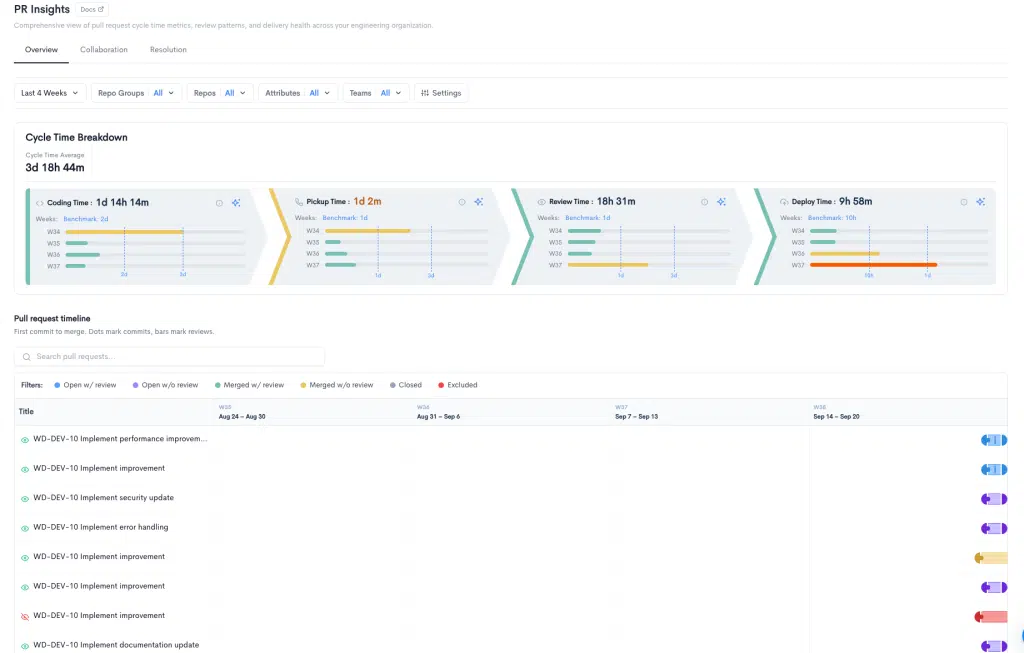
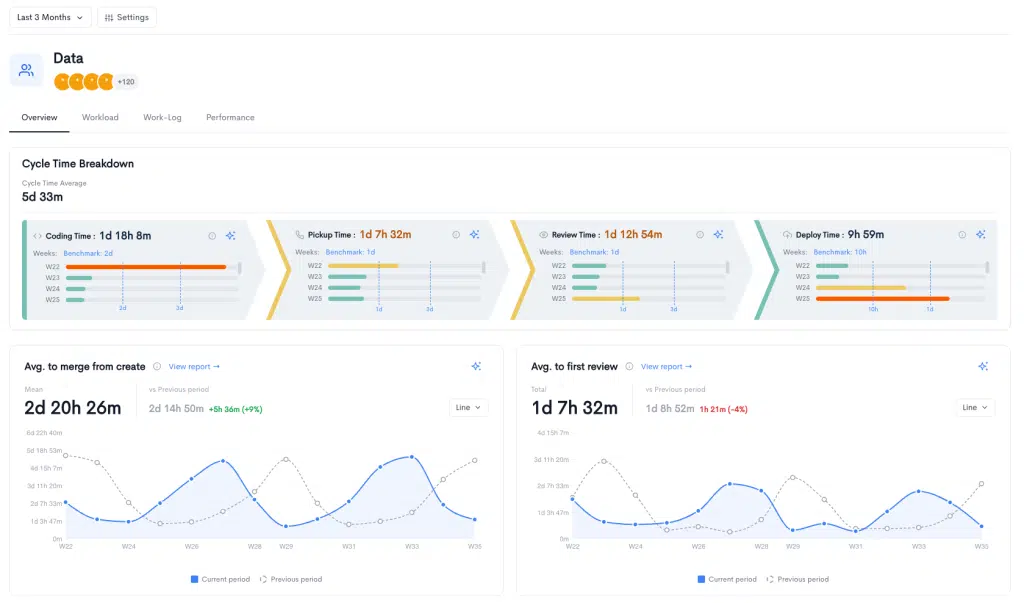
Distributed software delivery dashboards in Waydev
Real static screenshots from Waydev feature pages, with illustrative data. No video players.
Improve the flow of distributed engineering.
Walk through your Git and issue-tracking setup, review handoffs, and a measurable team-level pilot.