Waydev and BlueOptima are often shortlisted together, and they are built on opposite premises. BlueOptima measures the effort individual developers put into code and benchmarks it against a global dataset. Waydev measures the system that developers work inside, and what it delivers. Neither is a feature gap. It is a philosophical difference, and it should decide your evaluation faster than any feature table.
The short version: if you need to assess individual or supplier output against a benchmark, BlueOptima was built for that and we were not. If you need to know whether your delivery is improving, where it is blocked, and what your AI investment returned, that is what we built.
| Waydev | BlueOptima | |
|---|---|---|
| Unit of measurement | Teams, projects and the delivery system. | The individual developer’s coding effort. |
| Core metric | Standard frameworks: DORA, SPACE, Core 4, combined by the WAY Framework. | Coding Effort, proprietary, plus function point style measures. |
| Benchmarking | Against your own history and other teams inside your organization. | Against a global cross-company dataset. |
| Typical buyer | VP Engineering, CTO, and increasingly the CFO on AI spend. | Vendor management, sourcing and procurement, alongside engineering. |
| AI measurement | Adoption, impact and ROI as three separate layers across Copilot, Cursor, Claude Code and Codex. | Ask for their current AI roadmap directly; this area moves quickly. |
| Pricing | Published, per active contributor, unlimited users and teams. | Enterprise quoted, with a stated minimum organization size. |
BlueOptima details from its public materials as of September 2026. Verify current capabilities and pricing directly with them before deciding.
You are governing outsourced or contract delivery. If a systems integrator bills you for 200 developers, you need an independent view of what those developers produced, and you need it at the individual level because that is the unit of the contract. This is the strongest case for BlueOptima and we do not compete for it.
You need external benchmarking. Comparing against a cross-company dataset is something an internal platform cannot do. If your board wants to know how you compare to the wider market rather than to your own past, that requires somebody’s global dataset.
You are doing due diligence on an acquisition. A one-off, external assessment of an engineering organization you do not yet run is a different job from continuously improving one you do.
This is a deliberate product decision, not a missing feature, so it is worth stating the reasoning rather than just the position.
Effort-based metrics have a well-known failure mode. Once developers understand that a number derived from their commits affects how they are assessed, the number stops describing reality and starts describing what people think will score well. You get smaller, more frequent commits, less pairing, less time spent on the unglamorous work that keeps a codebase healthy, and a quiet reluctance to help someone else since that effort lands in another person’s column. The measurement survives; the information does not.
There is a practical dimension too. In much of Europe, individual productivity monitoring engages works council consultation and data protection obligations, and rollouts that skip that conversation tend to stall. Any vendor selling into those markets should tell you this before the contract, not after.
Our position
If ranking individual developers is your requirement, we are the wrong vendor and we would rather say so now than a quarter into a contract. We build for improving systems and unblocking teams, which is also what the research behind DORA and SPACE consistently supports.
One nuance worth keeping. We do have contributor insights, because a manager preparing for a one to one needs context on what someone has been working on. That is a coaching input, not a ranking, and the difference between the two is the whole argument on this page.
AI: AI Adoption, AI Impact and AI ROI kept apart so tool spend never gets reported as productivity, plus the Waydev Agent for predicted outcomes.
Delivery: DORA metrics, cycle time by stage, pull request insights, merge quality, velocity and sprint commitment.
Health: Insights, internal benchmarking, hygiene, and Developer Experience surveys for what system data cannot see.
Planning and finance: Bird’s-Eye View, resource planning, project costs, resource allocation and cost capitalization.
Studio: custom dashboards, custom metrics with your own formulas, custom reports, targets, notifications and a two-way API.
It connects to GitHub, GitLab, Bitbucket and Azure DevOps including their self-hosted counterparts, plus Jira, CI systems and Sonar code quality data. Full list on the integrations page. It runs cloud, self-hosted or fully on-premise, and offers enterprise deployment options, with scale and customer-reference requirements confirmed during procurement.
Coding Effort is proprietary. If your leadership standardizes on it, that vocabulary only computes inside one product: it cannot be reproduced by another vendor, benchmarked against an outside standard, or explained to your CFO without a login. The WAY Framework is deliberately the opposite. Work-first, Agnostic, Yours. It combines DORA, SPACE and Core 4 rather than replacing them, so if you leave us your targets and your board narrative still work. We hold the same reservation about DXI, DRIVE and APEX, and we say so on those comparison pages too.
| Plan | Price | Included |
|---|---|---|
| Pro | Private enterprise quote | Delivery and Health reports, Targets, Notifications, role-based access control, custom dashboards. Up to 50 repositories and 6 months of history. |
| Premium | Private enterprise quote | Delivery, Health, Planning, Automation, Studio and AI modules. Team-level permissions, SSO and SAML, API access. Up to 300 repositories and 36 months of history. |
| Enterprise | Custom | Everything in Premium plus on-premise Git and ticketing integrations, self-hosted or cloud-hosted, SAML SSO, dedicated engineering support and customer success. |
Unlimited users and unlimited teams on every plan. See the pricing page. BlueOptima quotes on request, so a like-for-like comparison needs a quote from them.
Step 1
Decide which question you are actually replacing. If part of your BlueOptima use is supplier governance, that part may need to stay. Be explicit about it before the migration rather than discovering it afterwards.
Step 2
Translate effort-based reporting into outcome-based reporting before you switch the old tool off. Coding Effort does not map onto cycle time or change failure rate, and leadership will notice if the numbers in their deck change shape without explanation.
Step 3
Tell your engineers what changed. Moving from individual effort measurement to team and system measurement is good news for them, and saying so out loud recovers trust that effort scoring often costs.
Step 4
Run a proof of concept on your own repositories with history backfilled, and run both platforms in parallel for a cycle before cutting over.
Does Waydev measure individual developer productivity?
No, and we will not build it. We provide contributor context for coaching conversations, not effort scores or rankings for assessment.
Can Waydev benchmark us against other companies?
We benchmark teams against your own organization and your own history. Cross-company benchmarking is BlueOptima’s territory, and with DORA pausing its annual survey, external benchmarks are getting scarcer across the board.
Does Waydev offer a free trial?
We do not have a free self-serve tier. We run proof of concept engagements on your own repositories with your history backfilled, which tells you more than a trial on a demo tenant would.
Can Waydev run on-premise?
Yes, on the Enterprise plan, including on-premise Git and ticketing integrations, with SAML single sign-on. Details on the security page.
See it on your own data
We will connect your systems and backfill your history so you can see your own delivery, quality and AI numbers before committing to anything. You keep the analysis either way.
More comparisons: Jellyfish · LinearB · DX · Swarmia · Allstacks · GitClear · Comparison hub
Further reading: The WAY Framework · DORA metrics · SPACE Framework Playbook · Measuring developer productivity · Pricing
2027 engineering intelligence buyer’s guide (updated October 2026)
Compare code-centric effort analysis with team-level delivery, developer experience and explainable AI engineering intelligence.
Waydev Brain uses Waydev’s own 15-billion-parameter model designed for the SDLC and supports private, fully air-gapped deployment inside an enterprise environment. Confirm architecture and requirements during a pilot.
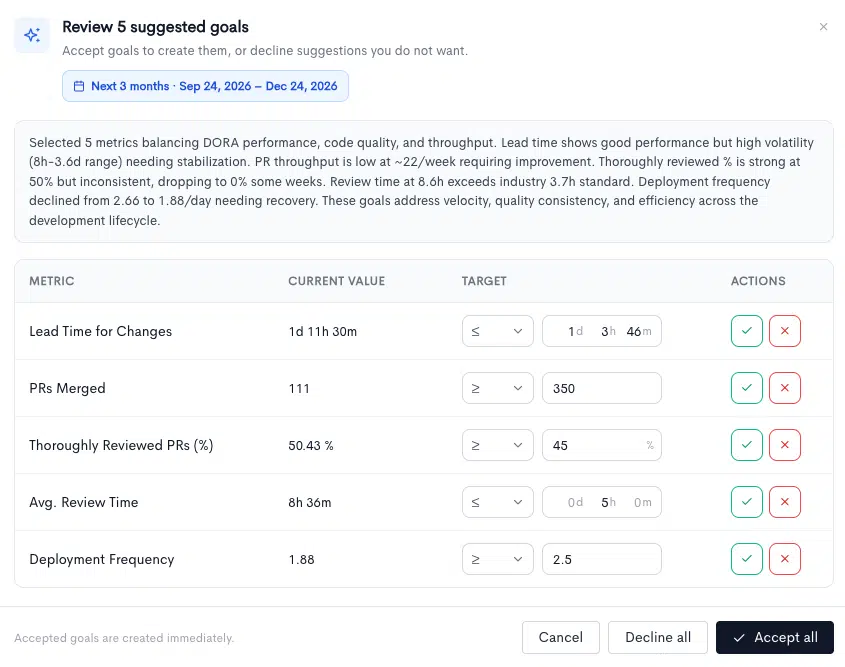
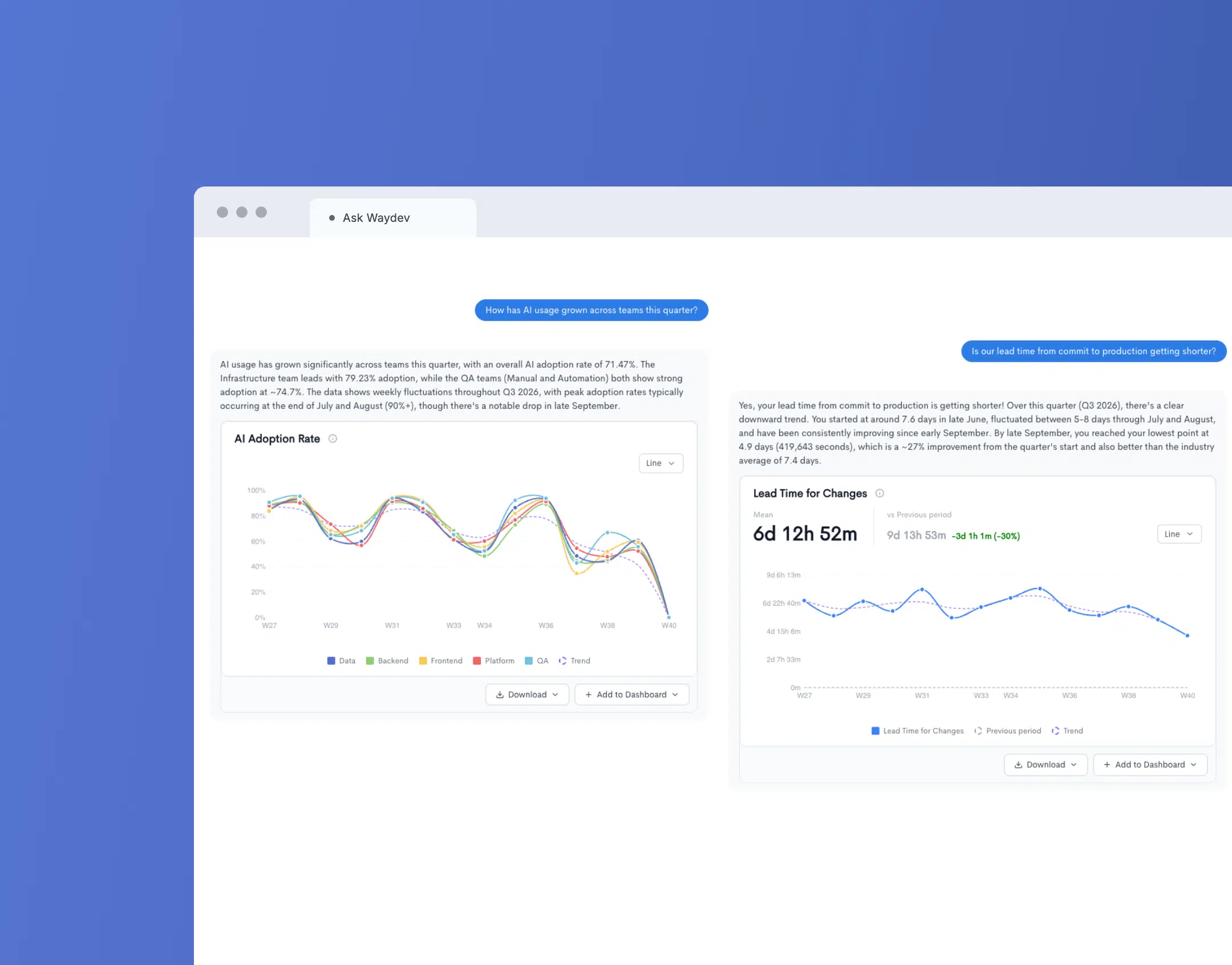
Waydev Agent answers questions grounded in connected engineering data. Signals identify issues proactively. AI-suggested Goals turn meaningful metrics into measurable targets.
Prompt Dashboards produce editable charts from natural-language questions. Waydev combines AI Adoption, Impact, Spend, ROI, DORA and DX while AI Governance helps teams monitor budgets and policies.
Private enterprise pricing: request a tailored quote rather than relying on public price comparisons. Request a Waydev Brain demo.
Waydev editorial verdict, October 2026: BlueOptima emphasizes code-based effort measurement, including Actual Coding Effort and maintainability-related signals derived from source-code changes. Waydev offers a different evaluation lens through team-level delivery, developer experience and AI adoption or impact. These approaches are not interchangeable measures of individual worth or business value. See the competitor’s published materials.
What to test before buying: Ask both providers to explain the denominator of every productivity score and how large refactors, maintenance work and AI-generated changes affect it. Do not rank individual engineers by one composite metric.
No. Code-effort measurements describe changes and complexity. ROI requires attributable business outcomes and fully loaded cost; use complementary metrics for delivery and quality.
Method: comparison of publicly described vendor capabilities and buyer evaluation criteria; not an independent hands-on product benchmark. Confirm plan availability, integrations, prices and procurement details with each vendor.
Quick answer: Assess how each platform defines productivity and handles team context, rework, code quality and responsible measurement. If you are comparing BlueOptima with Waydev, run a side-by-side evaluation using the same teams, data window and success criteria. See the vendor’s official site for the current BlueOptima offering rather than relying on outdated feature or pricing claims.
These are existing Waydev product media assets, not independent proof that a particular buyer will achieve a financial or productivity uplift.
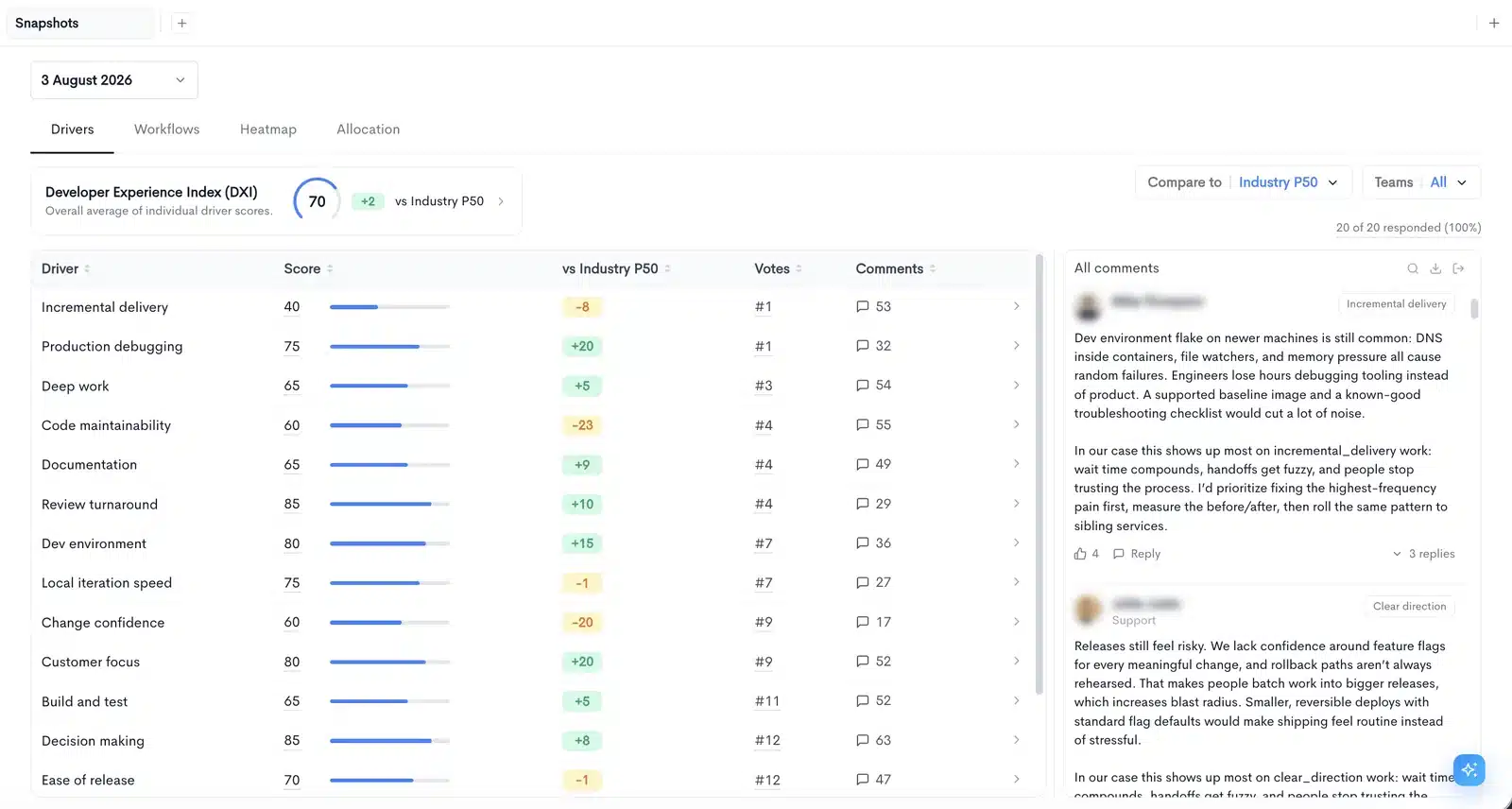
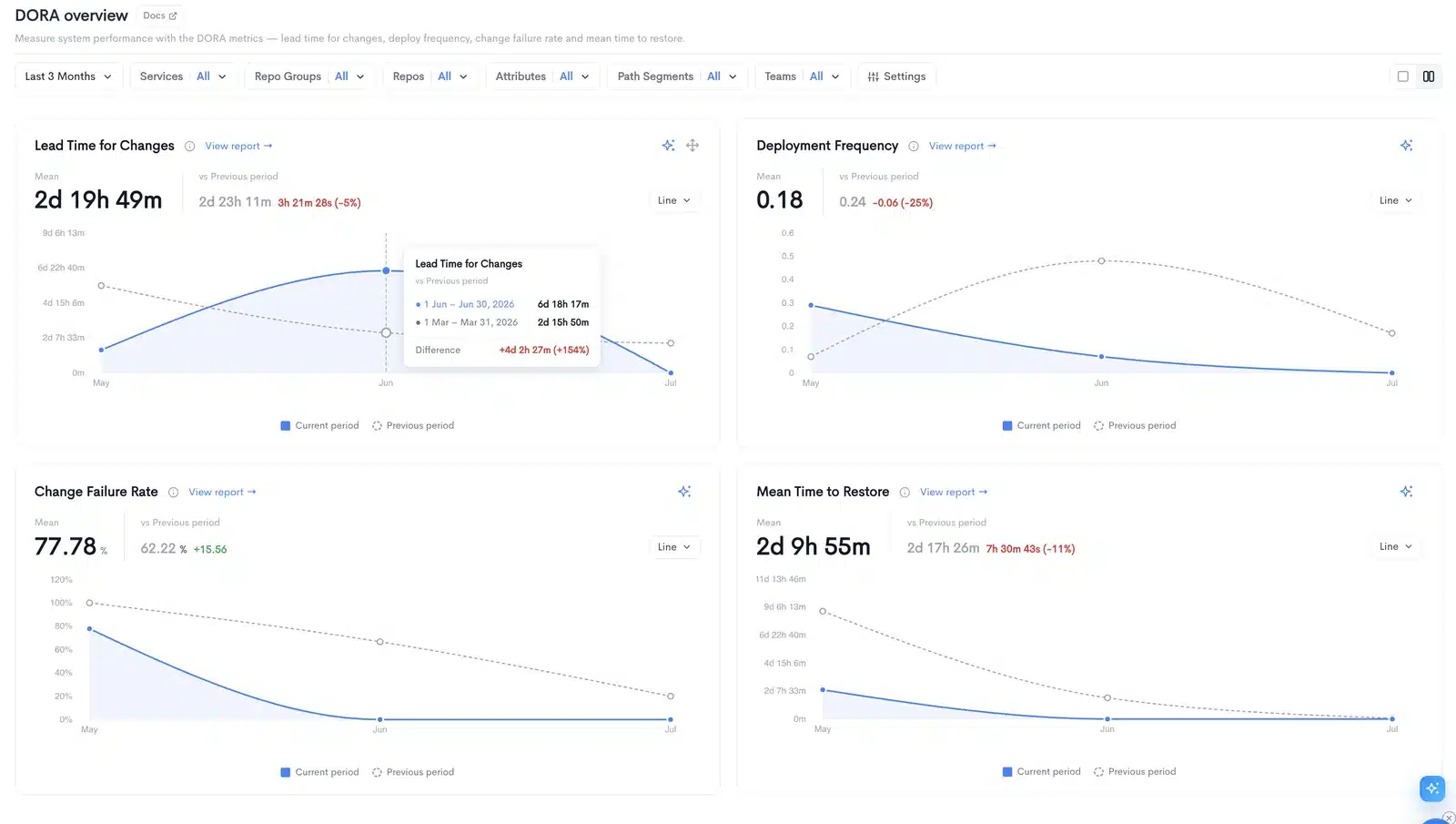
Waydev combines engineering delivery metrics, developer-experience reporting and measurement of AI coding tool adoption, impact, spend and ROI in one engineering intelligence offering. That does not automatically make it the right replacement for every specialized product. The decision should follow your priority use case, security review, required integrations and a real pilot.
Read Waydev’s methodology for measuring AI coding ROI or request a Waydev demo with your own engineering data.
Editorial transparency: Waydev publishes this comparison. Competitor product availability and pricing can change. Verify vendor-specific claims against current vendor documentation before procurement.
Ready to unlock your SDLC productivity?