Boards are asking for proof. CFOs are asking for ROI. Two very different platforms have emerged to answer them, one measuring AI across the whole enterprise, one going deep where the spend and the risk actually live. Here is an honest comparison.
Every engineering leader we talk to is being asked some version of the same question: “We approved the AI budget. Is it working?”
The question sounds simple. Answering it has spawned an entire category, and within that category, two fundamentally different philosophies. Larridin, founded in 2024 and backed by Andreessen Horowitz, measures AI adoption horizontally across the whole enterprise: sales, marketing, finance, and engineering. Waydev, building engineering intelligence since 2017, measures it vertically, going as deep as possible into the one function where most enterprise AI spend and most enterprise AI risk actually lives: software engineering.
Both approaches are legitimate. They solve different problems for different buyers. This article lays out where each one fits, as fairly as we can manage while obviously being one of the two companies involved.
Larridin positions itself as the measurement layer for enterprise AI. Its platform spans four areas: adoption measurement (which teams use AI and how fluently), workflow optimization (mapping business processes to find automation opportunities), spend intelligence (consolidating licenses, model calls, and token costs), and developer intelligence (connecting to GitHub and Jira to gauge engineering output).
Its strongest ideas come from its founders’ background in third-party measurement. Russ Fradin was an early executive at comScore, and Larridin borrows that playbook: just as advertisers needed an independent party to verify what publishers claimed, enterprises need an independent party to verify what AI vendors claim. Add shadow AI discovery for the CISO and fluency scoring for the CHRO, and you have a genuinely broad platform that gives every leader in the building a number to bring to the board meeting.
If your primary problem is that AI tools have proliferated across every department and nobody can even list them, let alone value them, that breadth is exactly what you need.
Waydev is an AI-native engineering intelligence platform. We connect to the systems where engineering work actually happens, Git providers, code review, project management, CI/CD, and coding agents themselves, and we turn that activity into answers: how AI is changing delivery velocity, code quality, review load, team health, and cost per outcome.
We have been doing this since 2017, which matters for one specific reason: benchmarks. Measuring AI’s impact requires knowing what your organization looked like before AI. Waydev holds nearly a decade of longitudinal engineering data and a USPTO patent on Git analytics, and our benchmarks are built from Fortune 500 engineering organizations. When our platform tells a CTO that AI-assisted pull requests are shipping 40% faster but carrying twice the rework rate on a specific team, that claim stands on years of baseline data, not a quarter of it.
The AI-native relaunch of our platform added the layer this moment demands: AI adoption and impact measurement, conversational analytics through Ask Waydev, automated risk detection through Signals and AI Checkpoints, and ROI reporting designed for the CFO conversation, not just the standup.
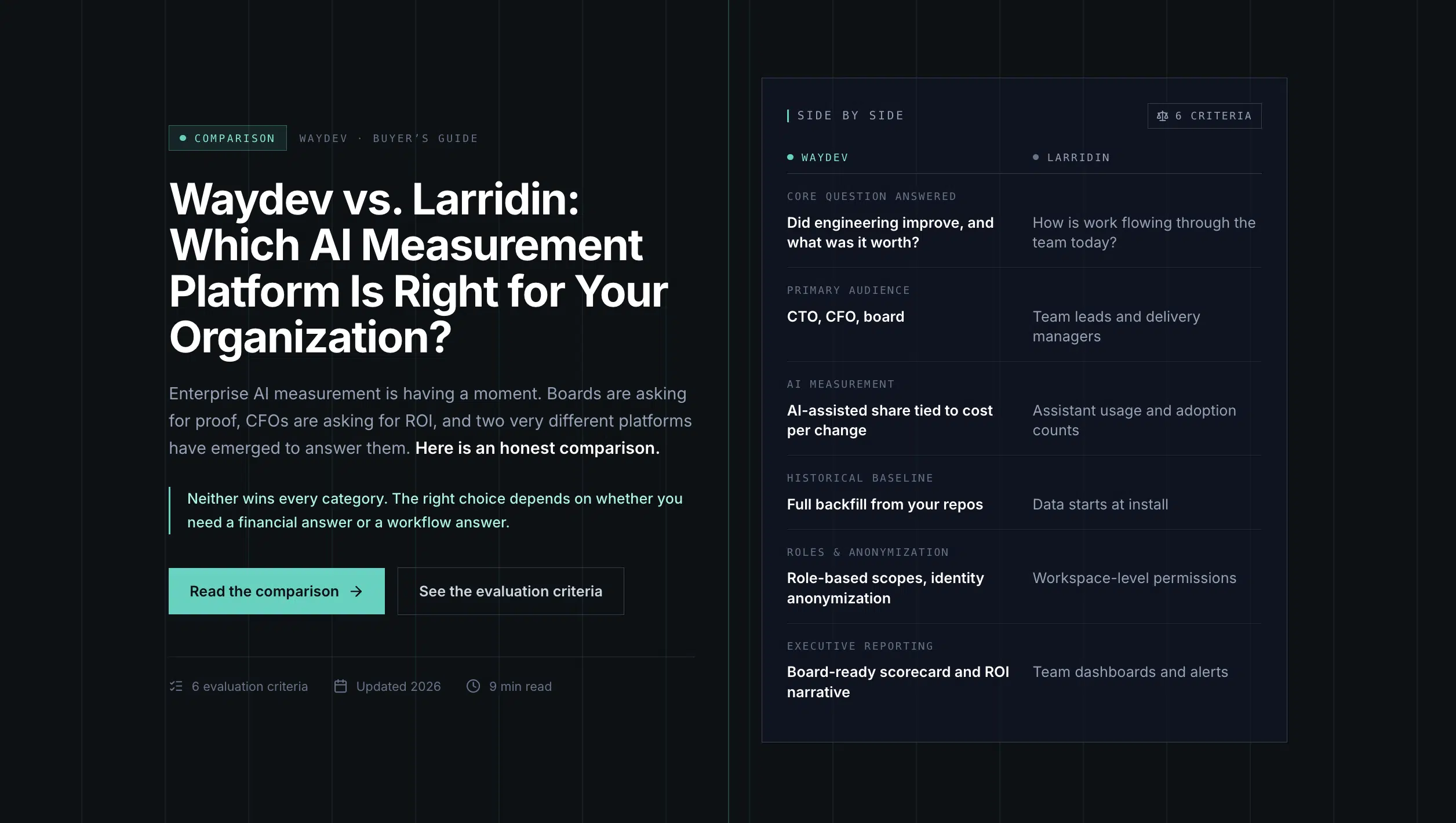
Larridin answers “is AI working across my company?” Waydev answers “is AI working in my engineering organization, exactly where, exactly why, and what should I do about it?”
Those sound similar. They are not.
Engineering is where the hardest version of the AI measurement problem lives. Marketing AI produces content you can read. Sales AI produces emails you can count. Engineering AI produces code whose value or damage may not surface for months, inside a system of reviews, tests, deployments, and incidents that no generic adoption dashboard can see. Industry data from the first half of 2026 makes the stakes concrete: while AI has driven task throughput up dramatically, incidents per pull request have more than tripled and review times have exploded. Measuring engineering AI by seat activity and token spend, without the delivery and quality context underneath, produces exactly the kind of number that looks great in a board deck and hides a reliability crisis.
A horizontal platform treats developer intelligence as one module among four. For us, it is the entire company.
Green marks the platform with the clearly stronger capability. Neutral rows are context, not contest.
We would rather tell you this than have you discover it in a demo.
You cannot get the second column from seat counts and token meters. You get it from a decade of engineering data with an AI-native analytics layer on top.
Yes, and some organizations will. A horizontal adoption layer for the CIO and a vertical intelligence layer for engineering are complementary, not exclusive. The mistake is assuming the horizontal layer’s engineering module replaces the vertical one. It answers “are developers using AI?” It does not answer “is AI making engineering better?” Those are different questions, and the second one is the expensive one.
The AI measurement category is young, crowded, and consolidating fast. Observability vendors are entering from production. Horizontal platforms like Larridin are entering from the CIO’s office. We think the winners will be the platforms that answer the hardest questions with the deepest data, and in engineering, depth takes years to build.
Larridin is a credible company with experienced founders solving a real problem. If your problem is enterprise-wide AI visibility, talk to them. If your problem is proving and improving AI’s impact on how your organization builds software, that is the problem we have spent nine years preparing for.
Connect your repos and your AI coding tools, and get an AI impact read your CFO and your staff engineers will both sign off on.
Book a Waydev demoReady to unlock your SDLC productivity?