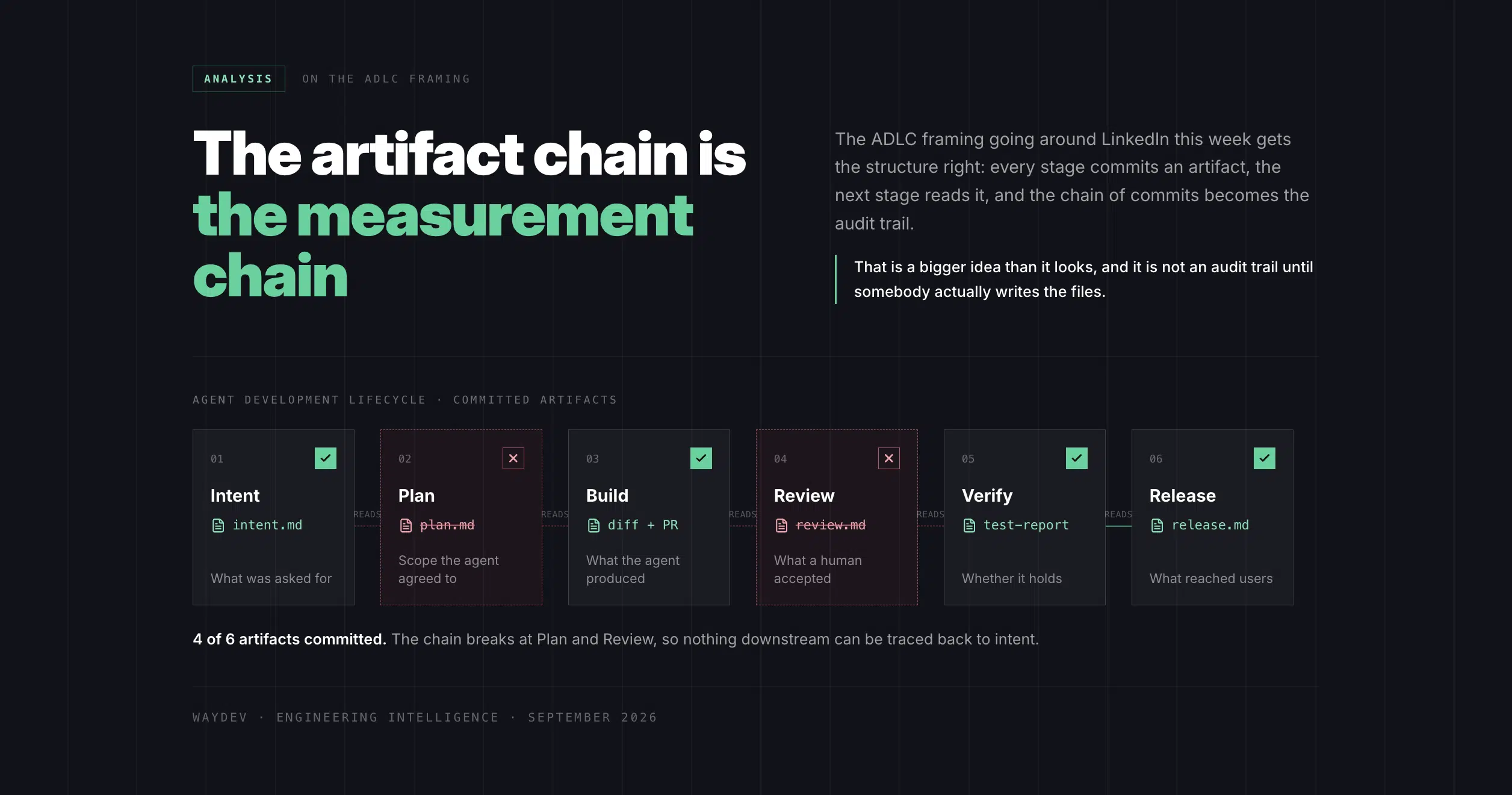
Agents can build software without limit. Your ability to trust it has a limit.
Satya Nadella just described a world where any business can describe what it needs and have agents build it. Software development is where that world showed up first. Here is what it means for the AI SDLC, and what engineering leaders should be measuring before the factory runs at full speed.
This week Satya Nadella published a long post on X titled “The Infinite SaaS Factory.” The headline idea is Copilot as an operating system for work: a front end (the “head”) sitting on a governed, “headless” layer that exposes business logic, context and systems of record to agents. Add a managed runtime where generated code runs safely inside the company, and any team can describe a missing module and have it built on top of the systems they already run.
Most of the coverage will focus on CRM, ERP and the future of business SaaS. The more interesting part for engineering leaders is a few sentences near the top. Nadella points to software development as one of the first areas to adopt agents at scale, and notes that GitHub has seen repo creation, pull request and commit activity accelerate as agentic development has grown.
“More agents don’t make systems of record less important.”
Satya Nadella, The Infinite SaaS Factory. His point: they make trusted places to hold information, coordinate changes and manage state matter more.
That is the lesson every engineering organization is living through right now. The SDLC was the pilot program for the infinite SaaS factory. What happened to engineering is a preview of what will happen to every function that starts building with agents.
When building gets close to free, the constraint moves. It moves out of writing code and into everything around it. Four pressure points show up first.
Nadella’s model has three layers: the head where people and agents express intent, a headless layer of business context and logic, and the systems of record underneath. Map that onto engineering and the picture gets very concrete.
Most companies have invested heavily in the top layer, buying seats for coding assistants and agents. The bottom layer already exists: Git, Jira, CI pipelines, deployment logs. The middle layer is the one almost nobody has built, and it is the one that decides whether agents help or hurt.
An agent with no engineering context does exactly what Nadella warns against. It works around the system instead of with it. It does not know which team owns a service, which patterns your org has standardized on, or which parts of the codebase are fragile. Nadella makes the same point about business apps: exposing existing APIs to a model is not enough. The context itself has to be designed for AI.
The shiftNadella argues systems of record must be rebuilt for an agentic world: able to handle high-volume agent access, pull context together across data sources, and work natively with assistants. Apply that to the SDLC and four requirements fall out.
One line in the post deserves more attention than it will get. Nadella says the goal is not to use an LLM for everything: spend tokens where intelligence adds value, and rely on deterministic software where it is faster, cheaper and more reliable.
That is the right discipline for the AI SDLC too. Linting, formatting, dependency checks, test execution and most measurement do not need a model. Design, debugging unfamiliar code and reasoning across systems often do. Teams that let agents burn tokens on deterministic work will see AI costs climb while delivery stays flat.
An infinite factory without a system of record is just an infinite backlog of things nobody can explain.
Alex Circei, CEO, Waydev
If agent activity is about to multiply, the metrics you report need to survive it. These are the signals we recommend engineering leaders put in place now.
Nadella’s vision is that every business will soon build software the way engineering teams do today. That makes engineering the proving ground. The organizations that figure out how to measure, govern and trust agent-built software now will be the ones ready when the rest of the company starts building too.
The infinite SaaS factory is a real opportunity. But a factory is only as good as its quality control, and in software, quality control starts with knowing what was built, by whom, at what cost, and whether it worked.
Build the system of record for your AI SDLC
See how agents and engineers are changing your delivery, from adoption and output to quality and cost per outcome, in one trusted view.
Book a demoSource: Satya Nadella, “The Infinite SaaS Factory,” published on X (@satyanadella), October 2026.
Ready to unlock your SDLC productivity?