




Back To All

15 engineering leaders building the agent stack

October 10th, 2026
Topics
2026
Agents
Agile Data-Driven
AI
AI ADOPTION
AI Agents
AI IMPACT
AI ROI
AI SDLC
Share Article

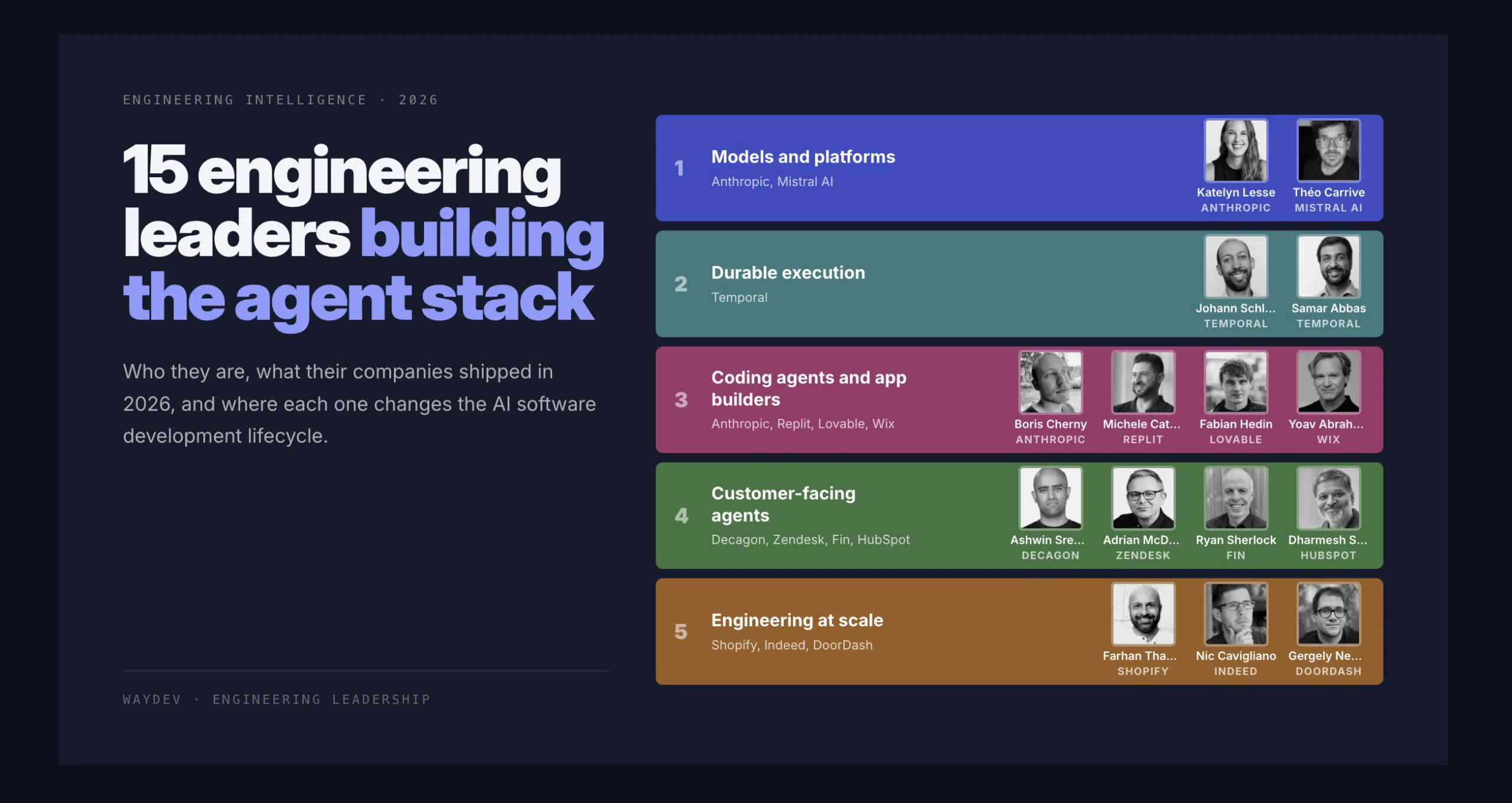
15 engineering leaders building the agent stack

Who they are, what their companies shipped in 2026, and where each one changes the AI software development lifecycle.

Original list by William Sharman-Beech, shared on LinkedIn as “15 engineering leaders worth following”. Profiles researched and expanded in October 2026; sources at the end.

The AI SDLC, stage by stage

Every leader on this list changes at least one stage of how software gets made. We use seven stages throughout:

  • Plan. Turning intent into specs and tasks an agent can act on.
  • Build. Writing code, or the platforms agents write code on.
  • Review. Checking changes before they merge, by people or agents.
  • Test. Verifying that what was built actually works.
  • Deploy. Shipping changes to production safely and quickly.
  • Operate. Keeping agents and systems reliable under real load.
  • Measure. Knowing whether AI is improving outcomes, not just output.
LeaderPlanBuildReviewTestDeployOperateMeasure
Katelyn LesseAnthropic
Théo CarriveMistral AI
Samar AbbasTemporal
Johann Schleier-SmithTemporal
Boris ChernyAnthropic
Michele CatastaReplit
Fabian HedinLovable
Yoav AbrahamiWix
Ashwin SreenivasDecagon
Adrian McDermottZendesk
Ryan SherlockFin
Dharmesh ShahHubSpot
Farhan ThawarShopify
Nic CaviglianoIndeed
Gergely NemethDoorDash
Leaders per stage31125763

Build is crowded, with 11 of the 15 leaders. Review has only 2, and Plan and Measure only 3 each: these are the stages most engineering organizations are still figuring out.

1

Models and platforms

The layer every other company here builds on: model APIs, agent runtimes and the connectors that let agents reach real code and systems.

Katelyn Lesse

Head of Platform Engineering
Anthropic

Leads the teams that turn Claude into APIs, developer tools and infrastructure for autonomous software. Her focus is the practical side of useful agents: durable sessions, secure execution, access to external systems and carefully managed context.

AI SDLC lens

  • Plan
  • Build
  • Review
  • Test
  • Deploy
  • Operate
  • Measure

She draws a clear line in the AI SDLC: people own motivation, product taste and customer trust, while agents take implementation, testing, review and incident investigation. Her platform is the runtime that makes that split safe, with sandboxed execution and governed access to code and systems.

Background

Led Connect engineering at Stripe, where she helped guide Accounts v2, and was a senior engineering director at Betterment. At Anthropic she first led the Claude Developer Platform team before taking over platform engineering. AI Engineer

Shipped in 2026

  • Grew the platform from little more than the Messages API into a managed agent layer plus MCP connectors, which every Anthropic product, Claude Code included, runs on. AI Engineer
  • Championed the May 2026 acquisition of Stainless, the SDK company, to strengthen how agents connect to data and tools. Anthropic
  • Laid out an “ecosystem, not a walled garden” strategy on Sequoia’s Training Data podcast (July 2026), including self-hosted sandboxes with Modal, Vercel and Cloudflare. Sequoia
Anthropic builds the Claude family of models. Its platform serves thousands of companies through the API, the developer platform and MCP.

Follow and read more

Théo Carrive

VP Engineering
Mistral AI

Runs engineering at Europe’s best-funded AI lab during its biggest scale-up year, as Mistral moves from open-weight models into enterprise products, its own compute and sovereign AI deals.

AI SDLC lens

  • Plan
  • Build
  • Review
  • Test
  • Deploy
  • Operate
  • Measure

Mistral supplies the model layer under coding and review agents, with a twist that matters for regulated teams: open weights, on-premise deployment and European hosting. For banks, governments and enterprises that cannot send source code to a US cloud, that is what makes an AI SDLC possible at all.

Shipped in 2026

  • Closed a €3 billion Series D on 8 September 2026 at a post-money valuation above €21 billion, the largest round ever raised by a European tech company. Tech Insider
  • Raised $830 million in debt in March 2026 to build Nvidia-powered data centers in Europe. Texxr
  • Acquired Koyeb (February 2026) and industrial-simulation startup Emmi AI (May 2026), and opened a site in Munich with TU Munich. Wikipedia
Mistral AI was founded in Paris in April 2023. It reports operating in 20 countries and serving more than 125 large enterprises, including Airbus, ASML and HSBC.

Follow and read more

2

Durable execution

Agents that run for hours or days fail in ordinary ways: timeouts, outages, lost state. Temporal keeps them running, and quietly powers several other companies on this list.

Samar Abbas

Co-founder and CEO
Temporal

Has spent his career on one problem: making long-running workflows survive failure. His argument is that agentic AI rarely fails because the models are weak; it fails on old problems like state and error handling.

AI SDLC lens

  • Plan
  • Build
  • Review
  • Test
  • Deploy
  • Operate
  • Measure

Temporal sits in the operate stage of the AI SDLC. Agents that open PRs, run test suites or wait on a human approval can take hours or days; Temporal preserves their state, retries failed steps and lets them pick up where they stopped. Several coding-agent companies on this list run on it.

Background

Worked on Amazon Simple Workflow Service, led development of Microsoft’s Durable Task Framework, then built the Cadence orchestration engine at Uber with Maxim Fateev. The two founded Temporal in 2019, and Abbas became CEO in 2024. RuntimeWire

Shipped in 2026

  • Raised a $300M Series D at a $5B valuation in February 2026, then a $550M Series E at $12.55B on 14 September 2026. GeekWire
  • Open-source installs passed 43 million in August 2026, up 134% since January, and the team doubled to 570 people. Press release
  • Customers include OpenAI, Cursor, Lovable, Replit, NVIDIA, Salesforce, Shopify and DoorDash. The Next Web
Temporal is an open-source durable execution platform with a managed offering, Temporal Cloud, headquartered in Bellevue, Washington.

Follow and read more

Johann Schleier-Smith

AI Technical Lead
Temporal

Brings deep database and systems experience to Temporal’s work on reliable AI workflows, the bridge between how agent frameworks are written and how they survive production.

AI SDLC lens

  • Plan
  • Build
  • Review
  • Test
  • Deploy
  • Operate
  • Measure

His work brings durability into the build stage: developers write agents with the frameworks they already use, and the integrations make those agents crash-safe by default instead of something bolted on before release.

Background

Co-founder and CTO of if(we), the social platform for meeting new people, which supported 300 million users in more than 200 countries. Studied physics and mathematics at Harvard, and later did research on serverless computing at UC Berkeley. MLconf

Shipped in 2026

  • Temporal’s OpenAI Agents SDK integration reached general availability in March 2026. Unite.AI
  • A Vercel AI SDK integration gives TypeScript developers the same durability guarantees. Unite.AI

Follow and read more

3

Coding agents and app builders

The tools that shorten the distance between an idea and working software, for professional engineers and for people who have never written code.

Boris Cherny

Creator and Head of Claude Code
Anthropic

Talks about coding agents as a way to shorten the distance between having an idea and seeing it work, and is unusually open about how he works day to day.

AI SDLC lens

  • Plan
  • Build
  • Review
  • Test
  • Deploy
  • Operate
  • Measure

His workflow covers most of the SDLC: have the agent explore the repo and propose a plan before editing, keep a shared CLAUDE.md of team rules, give the agent a way to verify its own work, and run loops that handle code review feedback and PR rebases on a schedule. His role has shifted from writing code to reviewing and merging it.

Background

Author of O’Reilly’s Programming TypeScript (2019). Worked in finance, then at Meta as a tech lead for Facebook Groups before moving to Instagram. Started Claude Code as a side project after joining Anthropic’s Labs team in September 2024. AI Engineer

Shipped in 2026

  • Marked one year since Claude Code’s general availability on 8 June 2026 with a retrospective thread. Recap
  • Says 80 to 90 percent of Claude Code’s own code is now written by Claude Code. Recap
  • Shared his favorite under-used features in March 2026, including scheduled loops, hooks and coding from the mobile app. Inside

Follow and read more

Michele Catasta

President and Head of AI
Replit

Writes about the engineering behind Replit Agent, including harness design and how to evaluate and improve agents at scale. One of the clearest voices on evals that actually predict production quality.

AI SDLC lens

  • Plan
  • Build
  • Review
  • Test
  • Deploy
  • Operate
  • Measure

Catasta owns the test and measure stages of an agent’s own SDLC. Replit verifies generated apps with static analysis, tests, API checks and agent-written Playwright browser tests, which then become regression coverage. ViBench measures the outcome that matters: does the app work when someone clicks it.

Background

Head of Applied Research at Google X and Google Labs, working on the coding abilities of PaLM and PaLM 2. Earlier a research scientist at Stanford, PhD from EPFL, and co-founder of the search engine Sindice. Joined Replit in June 2023. AI Engineer

Shipped in 2026

  • Architected and led the 2024 launch of Replit Agent, which drove more than two orders of magnitude of revenue growth. RAISE Summit
  • Released ViBench, a public vibe-coding benchmark that scores whether the generated app actually works (Code w/ Claude, May 2026). Code w/ Claude
  • Published Replit’s approach to continual learning for agents, through automated evals and trace analysis. Essay
Replit is an AI software creation platform. In March 2026 it reported more than 50 million users and raised $400 million at a $9 billion valuation.

Follow and read more

Fabian Hedin

Co-founder and CTO
Lovable

Builds the engine that turns a plain-language description into a running app, and the platform underneath that lets AI agents and developers build and operate software together.

AI SDLC lens

  • Plan
  • Build
  • Review
  • Test
  • Deploy
  • Operate
  • Measure

Lovable collapses plan, build and deploy into one conversation: a written idea becomes a deployed full-stack app. That moves the SDLC to people who were never in it, and it makes review and ownership of AI-built apps a new question for engineering leaders.

Background

Frontend lead at Depict.ai, founder and CEO of Tentium, and founder and CTO of the proptech company TenFAST. Co-founded Lovable in Stockholm with Anton Osika in November 2023. HumanX

Shipped in 2026

  • Took Lovable to a $6.6 billion valuation in under two years. Voyado
  • Spoke in 2026 at London Tech Week, WeAreDevelopers World Congress (“Under the Hood of Building on Lovable”) and HumanX Europe. WeAreDevelopers
Lovable is a full-stack AI app builder that grew out of Osika’s open-source GPT Engineer project, and one of the fastest-growing software companies on record.

Follow and read more

Yoav Abrahami

CTO, Wix Enterprise
Wix

Helped start Wix in 2006 and has shaped its move from a no-code website builder to a code-first platform that AI agents can now build on directly.

AI SDLC lens

  • Plan
  • Build
  • Review
  • Test
  • Deploy
  • Operate
  • Measure

His SLO-first architecture is the operate-stage lesson for the AI era: when agents ship more changes, systems need reliability boundaries built in. Wix Headless turns the platform into a backend that agents can build and deploy on, not just humans.

Background

Long-time Chief Architect at Wix and the architect behind Velo, Wix’s developer platform. Led the shift to microservices with a reliability-first “split by SLO” pattern, dividing Wix into a public system and an editor system. Wix DevCon

Shipped in 2026

  • Wix Headless exposes a full business backend through REST APIs and MCP, so any AI agent can provision a working business on Wix. Wix on LinkedIn
  • Base44, Wix’s AI platform that builds fully functioning apps, sits alongside the Wixel AI design tool. Yahoo Finance

Follow and read more

4

Customer-facing agents

Customer service is the busiest battleground for production agents in 2026, and it is where agents get their own build, test and release cycle.

Ashwin Sreenivas

Co-founder and President
Decagon

Shares what it takes for customer service agents to look up information, take action and handle real customer requests rather than just answer FAQs.

AI SDLC lens

  • Plan
  • Build
  • Review
  • Test
  • Deploy
  • Operate
  • Measure

Decagon treats agent behavior like software with its own lifecycle. Duet gives teams a build, QA and deploy loop for agent workflows, so changes to how an agent handles customers are tested before they reach production.

Background

Previously founded Helia, a real-time video AI startup acquired by Scale AI in 2020. Co-founded Decagon with Jesse Zhang in August 2023. Wikipedia

Shipped in 2026

  • Decagon raised a $250 million Series D in January 2026 at a $4.5 billion valuation. Wikipedia
  • Opened Decagon Dialogues 2026 with a keynote on agentic commerce, alongside Duet, a tool for building, testing and deploying agent workflows. Decagon
Decagon builds AI agents that handle customer interactions across chat, email and voice.

Follow and read more

Adrian McDermott

CTO
Zendesk

Has written about how AI is changing customer expectations and the technology needed to meet them. His view: AI should build what support teams could not do before, not just automate what they already did.

AI SDLC lens

  • Plan
  • Build
  • Review
  • Test
  • Deploy
  • Operate
  • Measure

Zendesk’s Resolution Learning Loop keeps improving agents after release, and reasoning controls let teams audit an agent’s chain of thought. Outcome-based pricing makes measurement the center of the lifecycle: you pay for resolutions, not activity.

Background

Has led Zendesk’s product management and engineering teams since 2010. Before that he was CTO at Attributor, running web-crawling and content-identification systems. A Yorkshireman based in San Francisco. Modern CTO

Shipped in 2026

  • Architected Zendesk’s Autonomous Service Workforce strategy, building on the 2025 Resolution Platform. BDM interview
  • Runs Zendesk’s M&A himself: Ultimate and Unleash in 2024, and Forethought in 2026, now built into Zendesk AI Agents. BDM interview
  • Moved Zendesk toward outcome-based pricing for AI agents instead of per-seat pricing. Modern CTO

Follow and read more

Ryan Sherlock

Sr. Director of Engineering
Fin

Leads infrastructure and core technology at Fin. His Rails World talk opened up the work behind keeping tests, deployments and shipping fast as agents produce more and more code.

AI SDLC lens

  • Plan
  • Build
  • Review
  • Test
  • Deploy
  • Operate
  • Measure

This is the downstream bottleneck of the AI SDLC. When agents write more code, CI time, flaky tests and deploy queues become the limit. His work is about keeping test and deploy throughput ahead of agent output, so speed gains are not lost waiting on the pipeline.

Shipped in 2026

  • Intercom renamed itself Fin on 12 May 2026, after its AI agent; Intercom remains the helpdesk product. Trending Topics
  • Salesforce completed its acquisition of Fin on 10 September 2026, a deal valued at about $3.6 billion. Salesforce
  • Fin expanded into specialized roles, starting with Fin for Sales, and launched Fin Operator, an agent that manages and tunes other agents. CreateWith
Fin serves more than 30,000 companies and reports an average resolution rate of 76%, powered by its own customer-service models.

Follow and read more

Dharmesh Shah

Co-founder and CTO
HubSpot

Builds Agent.ai alongside his work at HubSpot and shares his experiments in making agents useful and accessible to more builders, not just engineers.

AI SDLC lens

  • Plan
  • Build
  • Review
  • Test
  • Deploy
  • Operate
  • Measure

Agent.ai opens the build stage to non-engineers: his line is that you don’t need to be a coder to be an agent builder. It also works as a live signal for HubSpot about which agents people actually use before they become product.

Background

Co-founded HubSpot with Brian Halligan in 2006. His earlier side project ChatSpot was acquired by HubSpot for $1 and became Breeze Copilot. Boston Globe

Shipped in 2026

  • Launched Agent.ai at INBOUND 2024 as a network of AI agents with a low-code builder. HubSpot
  • Grew it past 1.1 million users and 1,000 public agents, far beyond his original 100,000-user goal. CX Today

Follow and read more

5

Engineering at scale

Leaders running large engineering organizations through the shift to AI-written code, where the hard problems are reliability, platforms and culture.

Farhan Thawar

VP and Head of Engineering
Shopify

One of the most candid voices on what AI-first engineering looks like inside a large company, from token budgets to hiring.

AI SDLC lens

  • Plan
  • Build
  • Review
  • Test
  • Deploy
  • Operate
  • Measure

Shopify is the reference case for org-wide AI adoption: AI tools are expected, allowed in interviews, used by non-engineering teams through Cursor, and connected to internal systems through MCP. The open question he keeps returning to is measurement: how to use AI more efficiently, not just more.

Background

Joined Shopify through the acquisition of Helpful.com, where he was co-founder and CTO. Previously CTO of Mobile at Pivotal and VP Engineering at Pivotal Labs, with earlier roles at Microsoft. Studied at Waterloo, MBA at Rotman. LeadDev

Shipped in 2026

  • Champions Shopify’s “reflexive AI usage”, with no cap on AI token spending for engineers. Pragmatic Engineer
  • Argues AI-first is not about cutting headcount; Shopify has been hiring 1,000 interns. Pragmatic Engineer
  • Known for company-wide habits like Meeting Armageddon and the Delete Code Club. Tank Talks

Follow and read more

Nic Cavigliano

Technical Fellow
Indeed

Asked what happens when an agent experience faces 10x growth, his answer came down to three things: clear boundaries, backpressure and graceful degradation.

AI SDLC lens

  • Plan
  • Build
  • Review
  • Test
  • Deploy
  • Operate
  • Measure

His three principles are an operate-stage checklist for any agent going from pilot to peak traffic: define what each agent may touch, slow inputs down before systems fall over, and fail in a way users can still work with.

Indeed is one of the world’s largest job sites, which makes its agent experiences a real test of scale.

Follow and read more

Gergely Nemeth

Sr. Engineering Manager, Developer Platform
DoorDash

Works on the developer platform that DoorDash engineers build on, the layer that decides how fast a large org can adopt agents without losing reliability.

AI SDLC lens

  • Plan
  • Build
  • Review
  • Test
  • Deploy
  • Operate
  • Measure

Developer platform teams are where the AI SDLC becomes policy: which agents get access to which repos, how AI-generated changes flow through CI and deploy, and the paved roads every product team inherits.

Background

Known in the Node.js community as a co-founder of RisingStack, the Node.js consultancy and engineering blog.

DoorDash is the local delivery platform, now running shared infrastructure across Wolt and Deliveroo. It is also a Temporal customer.

Follow and read more

What the list tells us

Reliability is the new frontier

Temporal’s valuation more than doubled in seven months, and it now runs under Replit, Lovable, Shopify and DoorDash. Nic Cavigliano and Ryan Sherlock make the same point from the inside: scale breaks agents before intelligence does.

The bottleneck moved downstream

Most of Claude Code is written by Claude Code, and its creator now spends his time reviewing and merging. When code generation is cheap, review, testing and deploy throughput decide how fast a team really ships.

Agents get their own lifecycle

Decagon’s Duet, Replit’s ViBench and Zendesk’s learning loop all treat agent behavior as software that needs building, testing and release discipline, measured on outcomes like resolutions and working apps.

Measurement is the open question

Shopify removed limits on AI tokens; Zendesk prices on resolutions. Both point to the same gap: leaders need to see what AI adoption actually changes in delivery, quality and cost.

Ready to unlock your SDLC productivity?

Request a Demo Call