The headcount survived. The people who couldn’t explain what the headcount produced did not.
Updated September 2026. The original version of this piece ran in December 2025 and predicted that 2026 would separate teams that turned AI into leverage from teams that were just busy. It did. It also separated the leaders.
In 2023 the fear was that AI would gut engineering teams. Fewer developers, smaller budgets, the end of the hiring boom.
Look at who is actually leaving engineering organizations in 2026. It isn’t the engineers. It’s the people running them.
VP of Engineering and CTO seats are turning over fast. Some of it is voluntary. A lot of it isn’t. The story the departing leader tells is usually strategic misalignment. The story the CEO tells the board is simpler: we spent seven figures on AI tooling, activity went up, and nobody could tell me what we got for it.
That is the real reality check of the AI era. Not fewer engineering jobs. A far shorter fuse for engineering leaders who can’t connect spend to outcomes.
Let’s be precise, because the hype cycle has made precision rare.
AI works. Prototyping is faster. Boilerplate is nearly free. Documentation gets written. Onboarding shrinks. In the teams and workflows where it fits, the lift is real and repeatable. Then you zoom out, and it mostly disappears.
A company running five AI assistants in parallel does not ship five times more value. Leaders keep treating this as a measurement problem. It’s a systems problem. Engineering output was never constrained by how fast people type.
AI makes execution cheaper. It does nothing to make decisions better. Every dollar spent on the first without fixing the second buys you faster confusion.
Every AI productivity pitch assumes the same causal chain: faster execution leads to better outcomes. That chain has a missing link, and the missing link is the organization itself.
AI amplifies whatever it’s placed into. Drop it into a team with clear priorities, tight feedback loops, and real ownership, and gains compound month over month. Drop it into a team where planning is vague, priorities shift weekly, and nobody owns the outcome, and you get more code, faster, pointed in more directions at once.
This is why measuring AI impact became the question that ended careers this year. It isn’t hard because the data is missing. It’s hard because the honest answer for many organizations is that AI made their existing dysfunction visible at higher resolution. The tool didn’t fail. The system did, and now there’s a dashboard proving it.
A leader who can’t show the board where AI is landing and where it isn’t has, by definition, lost visibility into their own organization. Boards noticed.
The fewer-engineers argument assumes markets stand still. They don’t.
When every competitor has access to the same models, the same assistants, and the same agents, efficiency stops being an advantage and becomes the entry fee. Nobody wins by doing the same work slightly cheaper. You win by shipping the right thing before the competition figures out it’s the right thing.
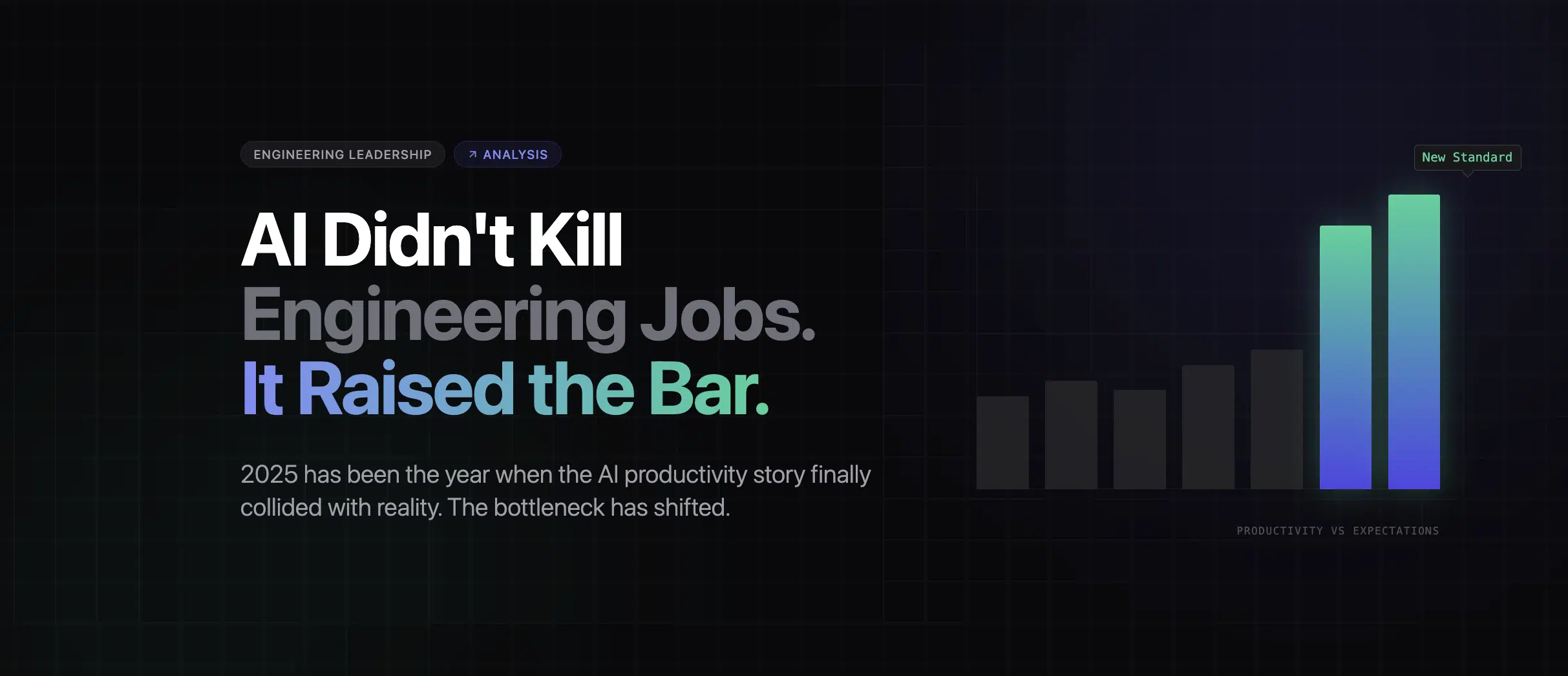
Shorter cycles raise expectations. A six-month roadmap becomes a six-week experiment. Product asks for more bets, not fewer. The bar doesn’t come down. It goes up, for everyone, at the same time.
Demand for engineers didn’t drop. In many companies it rose, precisely because AI changed the pace of competition. The companies cutting engineers in 2026 aren’t doing it because AI made them efficient. They’re doing it because they never had a system that could turn speed into outcomes, and the market stopped waiting.
For twenty years the engineering bottleneck lived in execution: writing the code, debugging it, translating a spec into something that runs. Entire management structures were built around protecting that constraint.
The new bottlenecks are choosing the right work, sequencing initiatives correctly, keeping engineering effort aligned with business outcomes, and making good decisions under speed and uncertainty. None of those are solved by another seat license.
This is why two companies with identical tools, identical budgets, and comparable talent are getting opposite results. The difference isn’t access to technology. It’s clarity, judgment, and whether anyone can see the system they’re running.
The question was never whether engineers would be replaced. It was which engineers would turn AI into real leverage.
Technical depth still matters. It just stopped being sufficient. The engineers pulling ahead understand the business well enough to know which problems are worth solving fast and which aren’t worth solving at all. They evaluate trade-offs quickly, operate comfortably with incomplete information, and own outcomes rather than tickets.
AI handles more of the how. Engineers are increasingly valued for the why and the what next.
The same shift applies one level up, with less forgiveness.
The VP of Engineering role used to be about capacity: hire well, unblock teams, keep the machine running. That job description is being rewritten in real time. The leaders keeping their seats in 2026 can answer three questions with data, not anecdotes:
Leaders who can answer those are getting bigger mandates. Leaders who can’t are getting replaced by someone who claims they can. That’s the turnover you’re seeing. It isn’t a layoff. It’s a re-underwriting of the role.
AI didn’t eliminate engineering work. It removed the excuses. What’s left is a clear view of which teams turn speed into outcomes, and which ones were always just busy.
The gap between teams that compound AI and teams that merely use it is no longer a forecast. It’s visible in delivery data, in board decks, and in the inbox of every recruiter covering engineering leadership.
Same technology. Very different results. The companies that come out ahead won’t be the ones that adopted first. They’ll be the ones that could see what adoption did, and acted on it before the board asked.
If you can’t measure it, someone else will be hired to.
Waydev measures AI adoption, impact, and ROI across your engineering organization, from tool usage to delivery outcomes to cost per accepted change.
Request a free trial See it in actionReady to unlock your SDLC productivity?