| Scale briefing | Waydev · Migration series · No. 06 |
Let’s say the honest thing first: Swarmia was probably the right choice when you bought it. Clean setup, fast time to value, a fair price, and working agreements your teams actually adopted. The problem is not the product. The problem is that you are no longer the company that bought it. Somewhere between 50 engineers and 300, the questions changed, the stakeholders changed, and the compliance requirements changed. This guide is about recognizing that moment, and moving through it without losing a single baseline.
The pattern, by org size
|
50 engineers |
Swarmia shinesA handful of teams, one office or one timezone cluster, a VP who knows every lead by name. Team-level dashboards and working agreements are exactly the right instrument. If this is you, honestly, stay put. |
|
150 engineers |
The first strainsTwenty teams, a management layer, the first works council conversation, the first board question about engineering efficiency. Team dashboards multiply but stop adding up to an organizational picture. Someone starts exporting to spreadsheets to build the exec view by hand. |
|
300+ engineers |
The ceilingMultiple business units, security review cycles, granular access requirements, a CFO asking about AI ROI, and privacy obligations that need anonymization, not goodwill. The tool that was refreshingly simple at 50 is now simply insufficient. This guide is for you. |
Section 01
2027 migration buyer’s guide · Waydev product capabilities current as of October 2026
The migration decision: Compare your historical developer-experience feedback, engineering delivery trends and AI investment assumptions. A switch is a chance to deploy engineering intelligence that connects team and AI-agent work, delivery, costs and proactive action.
Waydev Brain is powered by Waydev’s own 15-billion-parameter model built for software engineering intelligence. For organizations with strict data-control requirements, Waydev offers a private, fully air-gapped deployment model. Review actual hosting, model access and data-handling requirements in your security evaluation.
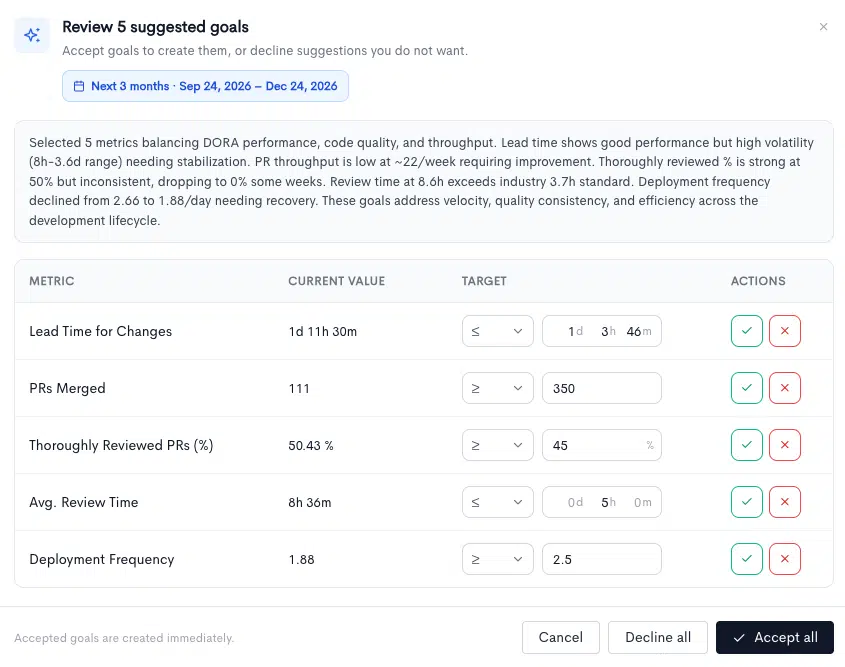
Waydev Agent supports natural-language analysis of connected engineering data. Signals identify meaningful delivery changes and risks. Goals provide measurable team targets, including AI-suggested goals. Prompt Dashboards create editable dashboards from requests in plain language.
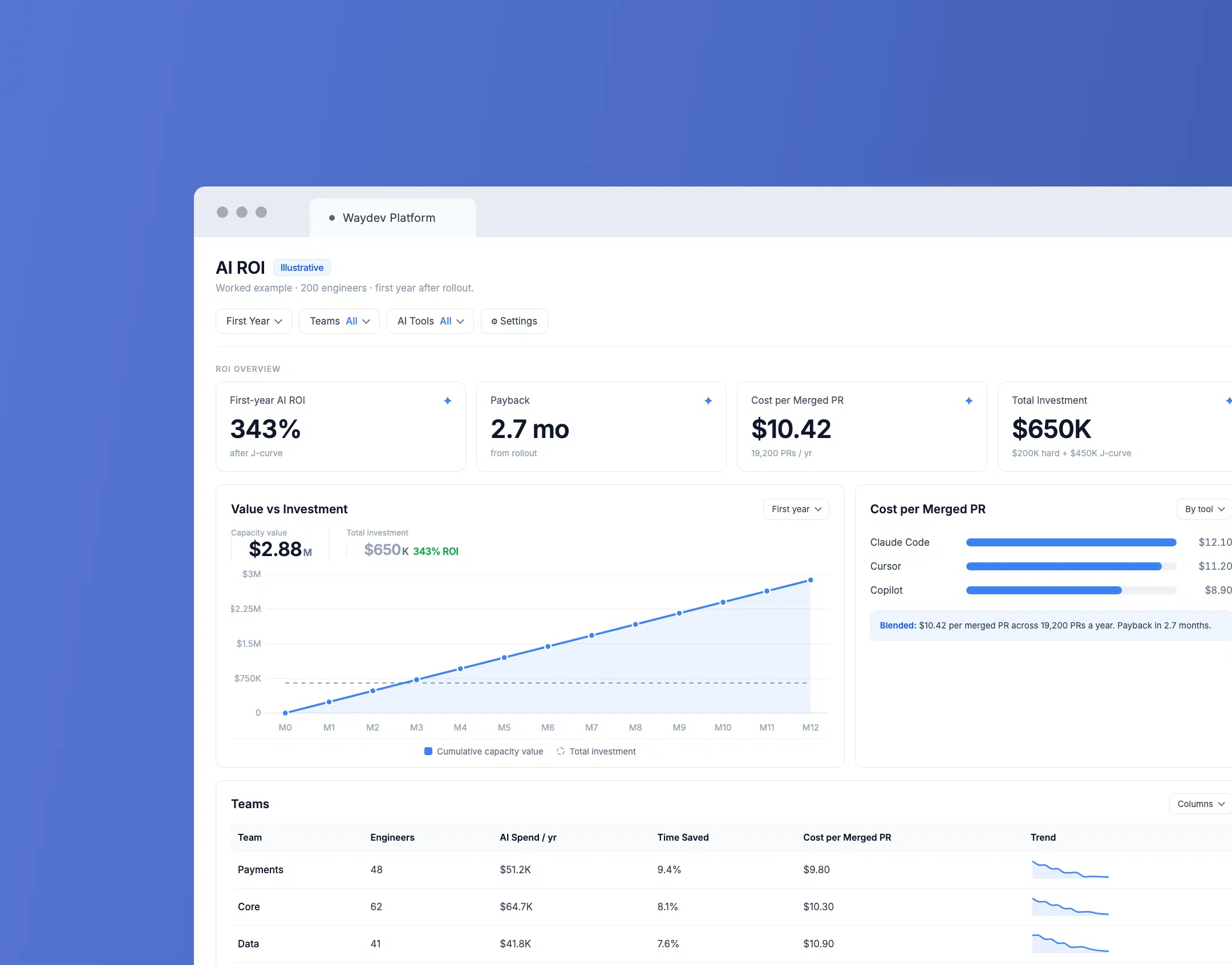
Waydev helps correlate AI tool adoption and cost with delivery and quality outcomes, while governance features support enterprise controls. Usage is not equivalent to return on investment: validate the measurement definitions and attribution method using your own data.
Review the Swarmia comparison and evaluation criteria. Waydev enterprise pricing is provided through a private quote. Request a Waydev Brain migration demo.
Published by Waydev. This is an evaluation framework, not a guarantee that historical data, configurations or third-party licenses transfer automatically.
Every Swarmia-to-Waydev conversation we have follows one of three threads, and usually all three. None of them is a criticism of Swarmia’s execution. They are consequences of the segment it was built to serve.
| 01 |
The governance ceilingAt enterprise scale, who sees what stops being a settings toggle and becomes a legal requirement. European works councils, privacy reviews, and security teams need role-based access with real anonymization: executives see org-level trends while individual-level data is restricted or anonymized by policy. This is where mid-market tooling strains first, and it is often the deal-breaker your legal team discovers last. Waydev’s roles and anonymization model has been approved by works councils at Fortune 500 scale. |
| 02 |
The aggregation ceilingSwarmia’s unit of analysis is the team, and at 10 teams that is the right unit. At 40 teams, leadership needs the org-level layer: business units compared, initiatives tracked across teams, board-ready reporting, and answers that do not require a staff engineer to assemble slides. Waydev delivers the executive layer natively, and Waydev AI collapses the reporting cycle entirely: leadership asks the question in plain language and gets the answer in seconds, in the meeting. |
| 03 |
The AI ROI ceilingAt your scale, the AI tooling spend is a real budget line, and the board question is no longer “are developers using Copilot” but “what is the return, per tool, per team, per dollar.” Adoption counts do not answer that. Waydev measures AI adoption, impact, and ROI in the delivery path: how AI-assisted work moves through review, into production, at what quality, against what spend. That is the answer that survives a CFO’s follow-up questions. |
Tools have a native altitude. Swarmia flies beautifully at team level. The moment your questions moved to the organizational level, you started asking the tool for something it was never shaped to give.
Section 02
Nothing your teams love about Swarmia is lost. Every capability transfers, and the enterprise layer your org has been improvising in spreadsheets arrives on top.
| Swarmia capability | Waydev equivalent | What scale adds |
|---|---|---|
| DORA and flow metrics | ✓ DORA, SPACE, DX | Industry benchmarks, org and business-unit rollups |
| Working agreements | ✓ Goals & AutoGoals | Targets standardized across 40 teams, tracked automatically, suggested from your own baselines |
| Slack notifications | ✓ Signals | AI-evaluated checks, not just threshold pings: risky PRs, stalled work, review bottlenecks |
| PR and cycle time insights | ✓ Review workflow + Git analytics | Commit-level depth, USPTO-patented, for the conversations that need the actual work |
| Investment views | ✓ Business alignment | AI-inferred from the work itself, board-ready, no manual categorization upkeep |
| AI usage tracking | ✓ AI adoption / impact / ROI | Return measured per tool, per team, down to the spend, tied to delivery outcomes |
| Basic access controls | ✓ SSO, RBAC, anonymization | Role-based visibility with anonymization, approved by works councils at enterprise scale |
| Historical trends | ✓ History rebuild | Rebuilt directly from your Git provider. Switching costs nothing historical |
Connect GitHub, GitLab, Bitbucket, or Azure DevOps and Waydev processes your full commit and PR history from source. Cycle time trends, DORA baselines, and year-over-year comparisons rebuild automatically. The years you spent in Swarmia are not locked in Swarmia, because the source of truth was always your repositories.
The core of it
Your teams keep everything they liked: the metrics, the targets, the Slack nudges. Your leadership gets what Swarmia was never built for: the org-level picture, the governance layer, and the AI ROI answer. That is not a lateral move. That is the tool catching up to the company.
Section 03
Someone on your team will say it: “Swarmia is simpler, and the teams like it.” Take that seriously, because it is true, and it is also the trap.
Simplicity that fits your questions is a virtue. Simplicity that cannot answer your questions is a constraint wearing a virtue’s clothes. The test is not which tool is simpler. The test is: can the tool answer what your CFO, your works council, and your board are asking this year? If the honest answer is “we export to spreadsheets and assemble it manually,” then the simple tool is already generating complexity. It just moved the complexity onto your staff.
And the switch does not sacrifice the team experience. In the parallel run below, your engineering managers judge that for themselves. Managers vote with usage, and that vote settles the objection better than any argument.
Section 04
Swarmia is a healthy product with a fair price, so your deadline is contractual. Work backward from renewal, and let the comparison make the decision.
| When | Move | Outcome |
|---|---|---|
| T minus 90 days | Write down the unanswered questions. Every leadership request Swarmia could not answer natively last quarter: exec rollups, AI ROI, allocation views, anonymized reporting. Count the spreadsheet hours spent compensating. | Your real requirements, and your real total cost |
| T minus 60 days | Connect Waydev to production repos. Read-only against Git, coexists with Swarmia, history processes automatically. Loop in legal early for the anonymization review if you operate in Europe. | Side-by-side baselines within days |
| T minus 30 days | Run both at two altitudes. Three EMs use both for weekly reviews. Leadership asks both platforms the same three questions from your list. Judge team experience and executive answers separately. | Evidence at the level where the gap actually is |
| Renewal | Decide with leverage. Switch with the memo below, or stay knowing exactly what you are deferring and what it costs in staff time. Either way, no more renewing by default. | The right platform for the company you are now |
Internal memo template for sign-off
Ahead of our Swarmia renewal, we ran Waydev in parallel on our production repositories for 30 days, evaluated by engineering managers at the team level and by leadership at the organizational level. I recommend we switch to Waydev at renewal.
Swarmia served us well at our previous scale. At our current size, we need capabilities it does not provide natively: organization-level and business-unit reporting, role-based access with anonymization that satisfies our privacy obligations, and AI adoption and ROI measurement our board is requesting. Waydev provides all three, preserves everything our teams use today, and rebuilt our historical baselines directly from Git, so we lose no trend data.
Waydev is used by Fortune 500 engineering organizations including American Express and PwC, holds a USPTO patent in Git analytics, and is recognized by Gartner in the Developer Productivity Insight Platforms category. The budget is already approved: it was paying for Swarmia, plus the internal hours we currently spend building executive reporting by hand.
This is the most common concern and the easiest one to test. In the parallel run, your managers use both tools for real weekly reviews and judge for themselves. Everything they use daily transfers: metrics, targets, Slack notifications. What changes is that leadership stops asking them to compensate for the missing executive layer with manual reporting.
No. The source data lives in your Git provider, not in Swarmia. Waydev processes your full commit and PR history on connection, so trends and year-over-year comparisons rebuild from source.
Directionally yes, exactly no. Platforms draw metric boundaries slightly differently, for example where cycle time starts and ends. During onboarding we reconcile definitions against your Swarmia baselines so leadership understands every delta before the switch, not after.
Setup is comparable: connect your Git provider and project management tools, and data flows the same day. Where enterprise platforms traditionally get heavy is configuration and reporting, and that is exactly what Waydev AI removes: leadership asks questions in plain language instead of anyone building dashboards. Technical setup takes one to two weeks, with full rollout in 30 to 60 days.
Role-based access and anonymization controls are built in: individual-level data can be restricted or anonymized while leadership keeps org-level visibility. This model has been reviewed and approved by works councils and legal teams at enterprise scale. Bring legal into the evaluation at T minus 60, not at signature.
Waydev tracks AI adoption, impact, and ROI across engineering: who is using Copilot, Cursor, and agentic tools, how AI-assisted work moves through review and into production, at what quality, and what the spend returns, connected to delivery outcomes at the PR level.
Thirty days, your production repositories, both platforms side by side. Your managers judge the team experience, your leadership judges the answers, and you walk into renewal knowing instead of guessing. If Swarmia still fits, keep it. At your size, we like our odds.
Ready to unlock your SDLC productivity?