Founder log / 001 / Waydev, 2017 to 2026
Two years without a single paying customer. A database breach on my birthday. Y Combinator in the same twelve months. And a category that swallowed more than half a billion dollars while we stayed bootstrapped.
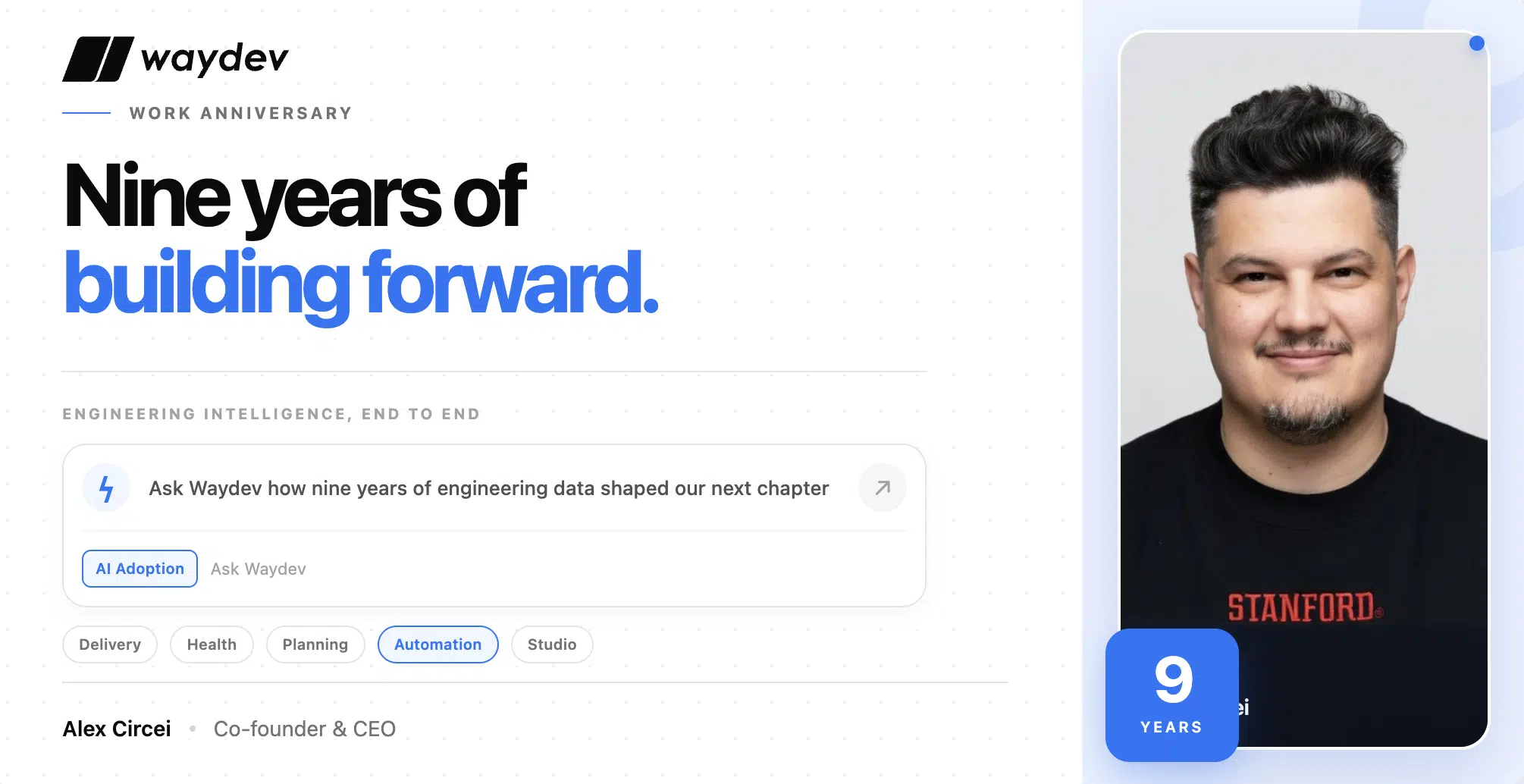
It is the end of July. Most of you are probably on a beach somewhere, and honestly, good for you. I am in Europe for the summer, and something about this season always makes me reflective. Maybe it is because I turned 40 this year. Maybe it is because on March 14, 2017, we incorporated Waydev, and nine years is the kind of number that stops you.
So I have been sitting with our story. The Developer Productivity Insight market, as Gartner now calls it. Our market. When I look back I can pick out a handful of highlights, and the highlights are real. But believe me, the highlights do not come close to telling you what this journey actually was.
Founders publish the highlight reel because the highlight reel is safe. It gets shared. It does not require you to admit that for long stretches you had no idea whether any of it was going to work. The problem is that the highlight reel is also useless. Nobody has ever been helped by a timeline of good news.
So this is the other version. The one with the two silent years in it, the breach, the year of apologizing, the decision to rebuild a working product from zero. Let me try to tell it properly.
In 2017, engineering was already the largest line item on most technology budgets and the least measured thing in the entire business. Finance had dashboards. Sales had dashboards. Marketing had attribution models arguing with each other. Engineering had a headcount number, a roadmap, and a lot of feelings.
That gap was the whole thesis. Every engineering organization on earth was already producing an enormous, honest, timestamped record of its own work, sitting right there in Git. Nobody was reading it. Leaders were making seven and eight figure decisions on the basis of who sounded most confident in the room.
Our mission then was exactly what it is now: help companies move from feeling-driven to data-driven. That sentence has not changed by one word in nine years. Everything else about the company has changed at least twice.
What I did not understand in 2017 is that betting on a category before it exists is not one bet. It is two. You are betting that the problem is real, and separately, you are betting that buyers will recognize it as a problem in time for you to still be alive. The first bet we won early. The second one almost killed us.
Two years. Let that sink in.
Two years of building, pitching, and getting ignored, while GitPrime, the giant in our space, was closing deals everywhere. Two years of demos that ended with “this is interesting, send me something and I will circle back.” Two years of watching a competitor define the language our buyers used, because they got there first and had the budget to teach the market.
People imagine that phase as dramatic. It is not. It is unbelievably boring. It is the same week repeating: ship something, show it to fifteen people, get polite interest from twelve, get a hard no from two, get silence from one, and start again on Monday. The danger is not that you quit in a blaze of despair. The danger is that you slowly stop believing your own pitch, and the people across the table can hear it.
What kept us going was not optimism. It was a small number of engineering leaders who kept taking our calls even though they were not buying. They were not being nice. They were confirming, over and over, that the pain was real and the tooling was not there yet. That is the only signal that matters when the revenue line is flat at zero.
Then in 2019, GitPrime sold to Pluralsight for $170 million, and I remember exactly how that felt. Part of me was celebrating, because it meant the market we bet everything on was real, and now the whole industry knew it. Part of me was thinking: they just sold for $170 million and we are still fighting for our first contracts.
You never forget the people who believed in you when nobody else did.
But we got them. Our first paying customers. I still remember those names. They took a risk on an unknown company with a thin product and a founder with an accent, and they gave us the only thing that actually saves a startup, which is revenue with feedback attached to it.
My birthday. I am not joking, exactly on my birthday, our product was hacked. Attackers got into our database and stole OAuth tokens. My phone would not stop ringing. GitHub’s security team. Our customers. Journalists.
You want to know what a founder’s worst nightmare feels like? It feels like that morning. It is not fear exactly. It is a very cold, very specific understanding that the trust you spent three years accumulating, one careful conversation at a time, is being spent down by the minute while you are still trying to work out what happened.
We had a choice in the first hours, and I want to be honest about how tempting the wrong option was. We could go quiet, handle it privately, and hope the story stayed small. Or we could publish everything: what happened, what was taken, what we were doing about it, and when. We published. The breach is public, our disclosure is public, and I am not hiding from it today either.
It took us almost a year to recover. A year of rebuilding trust, rebuilding infrastructure, and rebuilding ourselves. There were nights I did not know if we would make it. Not “will we hit the target” uncertainty. “Will this company exist in six months” uncertainty.
I do not romanticize it. It was the worst thing that has happened to me professionally and I would undo it if I could. But it made us who we are, and it taught me three things I would not have learned any other way.
Before that year, security lived somewhere in the backlog next to the other important things nobody schedules. After it, security became the first question in every design review. When you sell to Fortune 500 engineering organizations, your security posture is not a compliance checkbox you clear at the end of the deal. It is the deal.
Customers do not forgive you because you said sorry well. They forgive you because six months later, nothing has gone wrong, and twelve months later, nothing has gone wrong, and eventually they stop bracing. Trust is rebuilt in the boring months that follow, not in the incident report.
Publishing the full timeline felt like handing our competitors ammunition. What actually happened is that a few customers told us it was the reason they stayed. Buyers assume every vendor will eventually have an incident. What they are really evaluating is how you behave during one.
Here is the twist. That same brutal year, Y Combinator accepted us into the W21 batch. From the hardest moment of my life to the most validating one, inside the same twelve months.
I have thought a lot about why that happened. My honest read is that we were not accepted despite the breach. We were accepted with the breach fully on the table, because by then we could show exactly how we had handled it, and because we had customers who had stayed through it. A company that survives its worst week in public is a different kind of evidence than a company that has not had one yet.
And around that time we crossed $1 million in ARR. When that number hit, I just sat there. After everything, we were still standing. More than standing.
A few years later we were negotiating seven-figure deals with Fortune 50 companies, and today Waydev runs inside organizations like American Express, Dropbox, Caterpillar, and PwC. The kid from Romania who took two years to find his first customer.
Now let me tell you the part that makes me proudest, and maybe a little crazy.
Except for Y Combinator, we never took a dollar of institutional capital. Zero. Meanwhile, look at what happened around us.
Capital raised in the Developer Productivity Insight category
Exits not shown above: GitPrime sold to Pluralsight for $170M in 2019. DX took investment from ICONIQ, the fund behind Snowflake and Datadog, and was later acquired by Atlassian. Add the rounds and the exits together and more than half a billion dollars has moved through this category.
And we are still here. Independent. Profitable on our own terms. Built on revenue, discipline, and pure stubbornness.
I will say it without hesitation, and I know how it sounds: we have the best product in this market. Not because we outspent anyone. We could not outspend anyone. But when you cannot burn investor money on promises, you are forced to build only what customers actually pay for. Every single feature in Waydev exists because a real engineering leader needed it. That is the whole secret.
And watch what is happening around us. GitPrime, absorbed. DX, absorbed. Consolidation everywhere. Nine years in, we are the ones still standing on our own two feet.
I am not going to tell you bootstrapping is better. It is not better. It is slower, it is lonelier, and there were at least three moments where a funded competitor took a deal from us purely because they could put more people in the room. If you are choosing your path, choose with your eyes open.
But constraint does something to a product that capital cannot buy, and this is the part founders ask me about most.
The other side of it, which I will also say plainly: we grew slower than we could have. There are markets we entered late. There are features our customers waited too long for. Discipline has a price and we paid it. I would still make the same choice, but I want the tradeoff on the record.
The strangest transition in this whole story is the one from “cannot find a first customer” to “negotiating seven-figure contracts with Fortune 50 companies.” Those two things happened to the same company with roughly the same amount of money in the bank.
What changed was not our ability to sell. It was what we were selling into. Enterprise engineering organizations had crossed a threshold: they had thousands of developers, an eight or nine figure engineering budget, and a board asking questions that nobody in the building could answer with data. At that scale, our product stopped being a nice dashboard and started being the only way to answer the question.
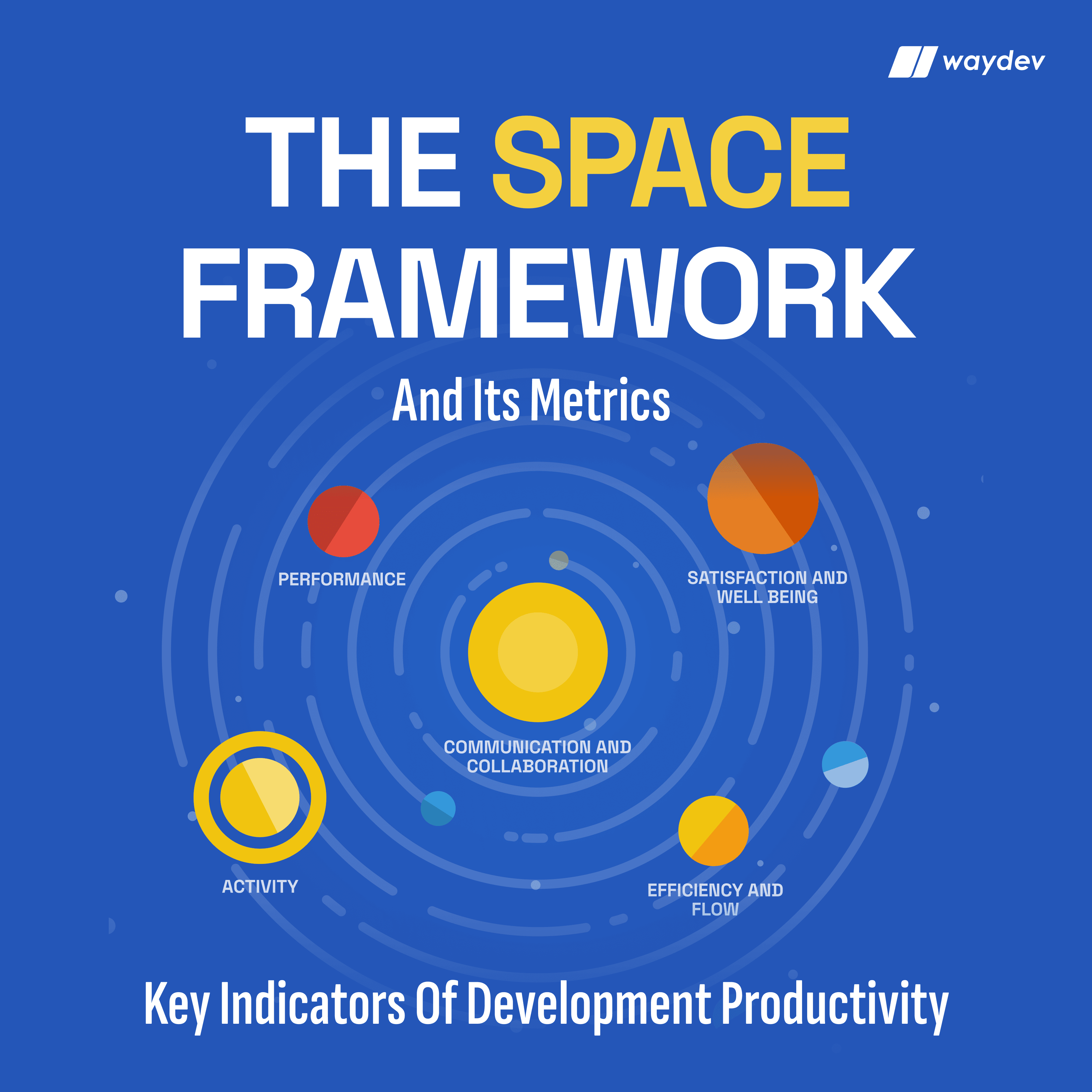
Three things made enterprise possible for a company our size. First, the security work we were forced into after the breach turned out to be exactly what a Fortune 500 security review demands, and we had already been living it for years. Second, we went deep on the frameworks the industry actually trusts, SPACE and DORA, instead of inventing our own vocabulary that a buyer would have to defend internally. Third, we protected the underlying technology properly, including a USPTO patent on our Git analytics work, which matters more in procurement conversations than most founders expect.
The recognition followed rather than led: Gartner coverage, G2 standing, and eventually a Magic Quadrant around the market itself. None of that is why we built any of it, but it is what made a bootstrapped company legible to a buyer who has to justify the decision to a committee.
The market changed. Not slowly. Violently.
For years our mission had been the same, and it has not moved one inch. But the questions moved completely. Engineering leaders used to ask me about velocity and cycle time. Now they grab my arm at conferences and ask something different:
How much of the AI code we are generating actually reaches production? What is my AI cost per PR when an agent writes it? Am I getting ROI, or just a token bill?
Think about how strange those questions are compared to 2017. For nine years, the unit of engineering work was a human being writing code. Every metric in the category, ours included, quietly assumed that. Then in about eighteen months a meaningful share of the code entering production stopped originating with a person typing it, and every assumption underneath the measurement layer went soft at the same time.
The problem is not that AI made engineering faster. It is that it made engineering unmeasurable by the old instruments. Commit counts inflate. Cycle time compresses without telling you whether quality moved. A team can look twice as productive and be shipping twice as much rework. Meanwhile the cost side, which used to be a predictable salary line, is now a variable token bill that nobody can attribute to a team, a repository, or a business outcome.
The old Waydev could not answer that. Honestly, nothing built before this era could. Every tool in our category, including ours, was designed for a world where the developer was the only author.
So last year we made the scariest decision since founding the company. We rebuilt Waydev from zero as an AI-native platform, with our own agent at the heart of it.
I want to be precise about what “from zero” means, because a lot of companies say it and mean a redesign. We kept nine years of engineering intelligence: the data model, the integrations, the analytics engine, the accumulated understanding of how real engineering organizations actually work. We rebuilt everything above it. Not a chatbot glued on top of old dashboards. An agent that knows your engineering organization and can answer the way a trusted VP of Engineering would.
Concretely, that means it tells you how much AI-generated code ships to production, breaks down AI cost per PR and per team, catches risks before you find them in some quarterly report, and answers follow-up questions in the same conversation instead of sending you to build another chart.
Around the agent we have been shipping the rest of the system: the WAY Framework for reasoning about AI adoption, impact, and ROI together instead of one at a time. AI Checkpoints for verifying what actually made it into production. Signals and Snapshots so leaders see change as it happens rather than in a retro. Goals and AutoGoals so a target is a live object in the system, not a slide. And a Waydev MCP server, because the honest conclusion of the last two years is that your engineering intelligence has to be available to the agents your teams are already using, not just to a browser tab.
Was it terrifying? Yes. We had a working, profitable product and we chose to rebuild it while customers depended on the old one every day. There is no version of that decision that feels responsible while you are making it. It only looks obvious afterwards.
We did not throw away nine years of engineering intelligence. We gave it a brain.
If you want proof that the community part of this journey is real, look at our Product Hunt history. Eleven launches. Seven Launch of the Day awards. Here are the ones I remember most clearly.
| Date | Launch | Result |
|---|---|---|
| Aug 2018 | Waydev, the original | 5th |
| 2019 | Waydev 2.0 | 1st |
| 2020 | Waydev 3.0 | 3rd |
| Oct 2025 | Waydev AI | 4th |
| Apr 2026 | The New Waydev | 3rd |
| May 2026 | Waydev Agent | 4th |
The 2020 one is the entry I am most attached to, and it is easy to miss why. Waydev 3.0 took 3rd place in the middle of our recovery from the breach. That team was rebuilding infrastructure, answering angry emails, and re-earning trust, and they still shipped something good enough to place. That tells you everything about the people I have been lucky enough to work with.
The two most recent ones sit two weeks apart, which was not the plan and is not a scheduling model I recommend. Three award-winning launches in seven months, alongside coverage from TechCrunch, TNW, and DevOps.com for the April relaunch.
Every single launch, same butterflies, same refreshing the page every two minutes. Some things never change, and I hope they never do.
Here is the thing that gives me chills. Gartner has released its Magic Quadrant for our market. Nine years ago this category barely had a name. I used to spend the first ten minutes of every sales call explaining that the category existed at all. Today it is a boardroom conversation with an analyst quadrant drawn around it.
That shift is bigger than any single company in it. When Gartner puts a quadrant around a market, budget lines get created, procurement processes get written, and buyers stop asking whether they need this and start asking who they should buy it from. Every founder who spent years explaining a category to people who did not want the explanation knows exactly how large that difference is.
And we are ready. Ready to help enterprises finally make the switch to being truly data-driven. Track developer sentiment. Validate it with the SPACE and DORA frameworks. Then amplify everything through AI transformation, measured properly, with the cost and the impact on the same page.
If you are three months into something and it is not working yet, these are the things I would want someone to have told me.
Two years of no revenue told us our packaging and positioning were wrong. It did not tell us the problem was fake. Learn to separate those two signals, because founders quit over the second one when they are actually looking at the first.
When GitPrime sold for $170 million it felt like losing. It was the single strongest proof we ever got that we were in the right market. The feeling and the fact pointed in opposite directions.
Your worst day becomes a smaller story when you are the one telling it accurately and first. The disclosure we published during the breach is still online, and it has cost us far less than hiding it would have.
Nobody forgives you because of your incident report. They forgive you because a year of nothing going wrong slowly replaces the memory of the day something did.
Not being able to afford the wrong feature is an underrated advantage. Every feature we shipped had a customer attached to it, and that is why the product holds together nine years later.
We leaned on SPACE and DORA rather than inventing terminology our champions would have to defend internally. Making your buyer’s internal argument easy is most of enterprise sales.
Ours has been identical for nine years while the product has been rebuilt more than once. If you cannot tell those two apart, every market shift feels like an identity crisis.
We tore down a profitable product while it was still working. That is the only time you can afford to do it, and it is exactly when it feels least justifiable.
Most of what we have today came from being in the room for the ninth year. Not from a brilliant quarter. From nine years of not disappearing.
Nine years ago I could not get a single company to pay for this vision. Today Fortune 500 companies run on it, and the biggest analyst firm in the world put a quadrant around our market.
I do not think the interesting part is behind us. The measurement problem in front of this industry is harder than the one we started with. When a growing share of production code is written by agents, the questions get more fundamental, not less: what is a team’s output, what is a fair cost of delivery, what does seniority mean, what should a leader actually be accountable for. Nobody has settled answers. We intend to be the company that produces them, with data rather than opinions.
The first nine years were about surviving long enough to matter. The next nine are about defining what this market becomes.
Trust me. We are just getting started.
Alex Circei is the CEO and Co-Founder of Waydev, the AI-native engineering intelligence platform.
Ready to unlock your SDLC productivity?