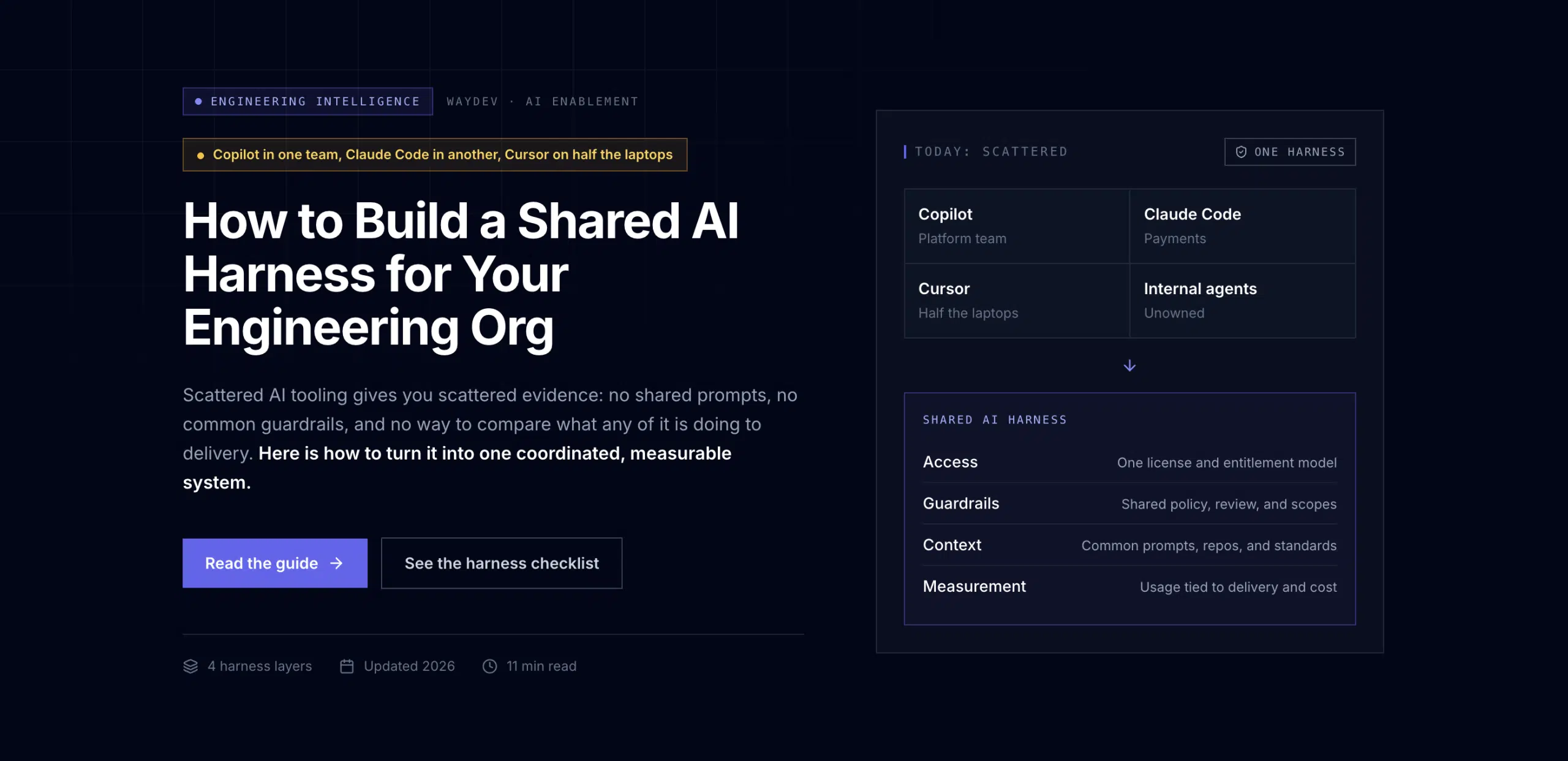
Copilot in one team, Claude Code in another, Cursor on half the laptops. Here is how to turn scattered AI tooling into one coordinated, measurable system.
I am going to show you how to turn the AI coding tools, agents, and workflows spread across your engineering organization into one coordinated, measurable system.
What most engineering orgs have today looks very different. Copilot licenses in one team. Claude Code in another. Cursor on half the laptops. Individual prompts, private workflows, and personal setups that never reach anyone else.
Each engineer teaches their AI how the codebase works and how the team ships. The context, corrections, and workflows they create stay locked in private chats.
One engineer briefs Claude Code with the architecture. Another asks Cursor to refactor a service it has never seen. A third rebuilds a review workflow from memory. Every session contains a slightly different version of your engineering organization, and leadership has no visibility into any of it.
We built that shared layer with Waydev. It sits underneath Claude Code, Copilot, Cursor, Codex, or whichever tools your teams choose, measuring adoption, impact, and ROI while carrying engineering context and standards between them.
Let’s build one.
We’ll start with a weekly engineering intelligence brief that arrives on Monday already knowing what changed: where AI adoption moved, which projects accelerated, which risks grew, and what the delivery data says about next week.
By the end, your organization will have:
✓ one place every leader and agent can retrieve the current state of engineering;
✓ operating standards that survive new tools and model changes;
✓ a weekly intelligence brief anyone on the leadership team can run;
✓ shared checkpoints and signals that improve as teams use them;
✓ a review loop that turns one team’s improvement into the org’s new baseline.
Do not begin by instrumenting the entire organization. Prove the harness on one repeatable workflow, then expand it each time you find another process worth measuring.
01
An AI coding tool can write, refactor, and ship code. It still needs an environment that explains how engineering happens inside your company, and leadership needs an environment that explains what all of that activity adds up to.
A useful engineering AI harness answers five questions:
A dashboard screenshot can answer some of these questions for one meeting. An engineering intelligence harness makes the answers structured, persistent, and available to everyone.
The adoption data is queryable. The standards survive tool changes. Work leaves an audit trail. Proven workflows become reusable instead of disappearing when the sprint closes.
This is why the same AI tools can produce completely different outcomes across two companies. The models may be identical. The measurement environment is not.
The tools supply the acceleration. The harness supplies the accountability.
02
Trying to measure the entire organization first can leave you with weeks of dashboards and no proof that the harness improves a single decision.
Start with a workflow that has four properties:
A weekly engineering intelligence brief fits.
The inputs already exist, but they are scattered across Git activity, pull requests, sprint boards, and people’s heads. The output is useful across leadership, and a VP of Engineering can quickly tell whether the brief is accurate.
Define the contract before building the workflow.
Inputs
Process
Output
Boundary
If the workflow still changes every time someone runs it, keep it manual. A process should become repeatable before it becomes shared infrastructure.
03
This is where the Work-first principle of the WAY Framework comes in. Do not build your memory layer on surveys or self-reported adoption. Build it on the work itself: commits, pull requests, reviews, and delivery flow.
Connect your Git provider, and Waydev builds the memory automatically. Every repository, every team, every AI-assisted line of code becomes part of a queryable history instead of a one-time report.
Then use Ask Waydev as the retrieval layer. Instead of injecting every metric into every meeting, leaders ask questions in plain language: which teams accelerated after adopting Claude Code, where AI-generated code is driving rework, which projects are trending toward their deadline and which are drifting.
Give leadership a small, stable entry point and deeper context on demand.
This keeps the full history of your engineering organization available without turning every Monday meeting into a dashboard tour.
04
Data tells you what happened. Policy tells the system how your organization expects AI-assisted work to be handled.
This is what AI Checkpoints encode. A starting policy set looks like this:
Keep the first policy short enough that people will maintain it. There are three levels of control:
01
Convention
Asks teams to follow a preference.
02
Checkpoint
Makes the rule durable across tools, teams, and quarters.
03
Automated gate
Blocks the action when failure would be costly.
“Track AI adoption” can begin as convention. “AI code never merges without review” deserves enforcement at the pipeline boundary. Do not try to describe every possible behavior. Encode the few invariants that should survive every model, team, and reorg.
05
Now turn the accepted procedure into a reusable capability instead of one person’s Monday ritual.
A general “engineering analyst” sounds useful, but it is difficult to test and easy to misuse. A weekly intelligence workflow has clear inputs, outputs, and stopping conditions.
The work data supplies the facts. The checkpoints supply the judgment. The workflow supplies the repeatable sequence.
One good dashboard session can produce one useful insight. A packaged workflow makes the method available to every leader next Friday. And because Waydev exposes this through MCP, the same capability is available inside Claude Code, Cursor, or whichever agent your teams already live in.
06
Do not treat the first successful brief as finished infrastructure.
Run the workflow, review the brief, and diagnose each correction at the right layer:
| Missing data | Connect the missing repository or integration. |
| Wrong context | Improve team and project mapping. |
| Repeated mistake | Improve the workflow definition. |
| Unsafe behavior | Strengthen the checkpoint or gate. |
| Weak deliverable | Sharpen the output contract. |
| Stale signals | Improve baselines and data hygiene. |
If the brief misses a delivery risk because a repository was never connected, rewriting the prompt will not fix the system. Fix the data path.
If it keeps burying risks below minor updates, sharpen the output contract.
If someone tries to turn team-level insight into individual surveillance, strengthen the policy and the permission boundary.
The useful question is: which part of the environment allowed this mistake?
Fix that layer, then run the same week again. The correction should outlive the brief that exposed it. This is how engineering judgment compounds. You teach the system once, then make the improved behavior available to every future run instead of repeating the correction in private meetings.
07
Once the brief, the checkpoints, and the workflow survive review, share them across teams.
This is where the harness becomes multiplayer, and where the other two principles of the WAY Framework do their work.
Agnostic
Platform teams can measure Copilot next to Claude Code next to Cursor with the same yardstick. The tools can change quarterly. The measurement layer keeps getting smarter underneath them. When the next model ships, you compare it against your own baselines within a week instead of starting a new evaluation from zero.
Yours
Your delivery data, your baselines, and your standards stay inside your boundary. Sharing an insight should never mean flattening permissions or exposing one team’s data to another. A shared harness only works when the boundary around “shared” remains explicit.
Shared measurement also raises the stakes. A weak metric can now misdirect every team, so treat your baseline definitions like production. Review every change before it becomes the org-wide standard. Keep checkpoints narrow. Test workflows against real weeks of data.
Once a change survives review, roll it out. Then choose the next repeatable workflow and make the shared baseline better again.
The complete progression is:
Work data → context → policy → workflow → review → org default
Start with one recurring question this week. “Is AI actually making us faster?” is a good one. Define its inputs, output, and review boundary. Answer it manually once, correct it, then turn the accepted method into a workflow your whole leadership team can run.
The models will keep changing. Your organization’s memory, standards, and proof of impact should not reset with them.
Get started
Build a shared AI harness for your own engineering org
Connect your Git provider and Waydev builds the memory automatically: adoption, impact, and ROI measured on the work itself, across every AI tool your teams use.
Ready to unlock your SDLC productivity?