| Due diligence briefing | Migration series · No. 05 |
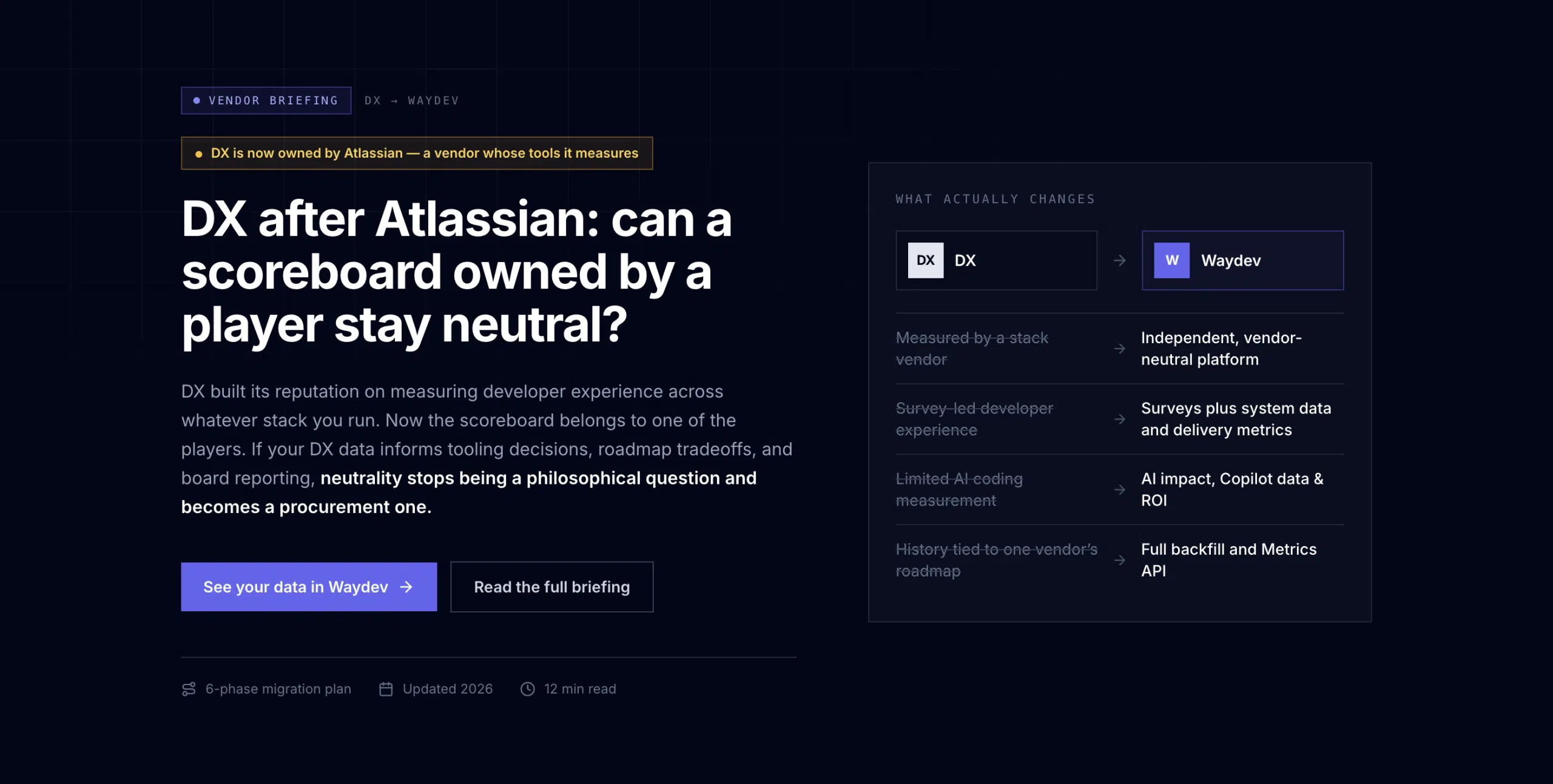
Atlassian acquired DX for one billion dollars and is integrating it into the Atlassian System of Work, alongside Bitbucket, Compass, and Rovo Dev. Congratulations to the DX team. It was a great outcome for them. Whether it is a great outcome for you is a separate question, and it deserves the same diligence you would apply to any vendor whose ownership, incentives, and roadmap just changed overnight.
|
I. DX is no longer an independent referee. It is now owned by a vendor whose developer tools it measures, including the AI coding assistant Atlassian sells against Copilot and Cursor. |
II. The roadmap now serves the suite. Integration into the Atlassian System of Work means suite adoption gets priority. Standalone customers on GitHub or GitLab stacks should plan for second-class status. |
|
III. DX’s methodology was survey-first before the acquisition and remains so. Sentiment is a lagging, quarterly, self-reported signal. AI-era measurement requires continuous telemetry from the work itself. |
IV. Leaving carries no historical cost. Waydev rebuilds your full metric history directly from your Git provider, and a 30-day parallel run settles the question on your own data. |
Section 01
Atlassian’s own announcement describes the logic plainly: DX identifies where teams struggle, and Atlassian’s tools fix the bottlenecks. Executives called it an end-to-end flywheel. Read that sentence again as a customer. The diagnostic is now owned by the pharmacy.
None of this requires bad faith from anyone at DX or Atlassian. It is structural. When the measurement layer and the tooling layer share a P&L, three conflicts appear on day one, whether or not anyone intends them.
Conflict 01 · AI measurement
Atlassian sells Rovo Dev against Copilot, Cursor, and Claude Code. DX measures AI tool impact. When your benchmarks compare Rovo Dev to its competitors, who signs off on the methodology?
Conflict 02 · Bottleneck attribution
The flywheel monetizes findings through Atlassian products. When the data shows friction in Jira workflows, will the recommendation be to fix Jira, or to buy more Atlassian?
Conflict 03 · Stack neutrality
DX now sits in a collection with Bitbucket and Compass. If we run GitHub or GitLab, what is the committed roadmap for our stack, in writing, for the next 24 months?
Measurement you can trust has one requirement above all others: the party doing the measuring must have nothing to sell you based on the result.
Section 02
Acquired products do not stay the products you bought. They become features of the acquirer’s strategy. Atlassian’s own record makes the pattern concrete, and it is the record your leadership should weigh when a vendor says nothing will change.
2012 · HIPCHAT
Acquired as a category leader in team chat. Discontinued in 2019, with the IP sold to Slack, the competitor it was meant to beat. Customers migrated twice.
2019 · AGILECRAFT, NOW JIRA ALIGN
Absorbed into the suite as the enterprise agility layer. Years later, community forums still document integration and sync friction. Absorption is a long road even when the product survives.
2025 · THE BROWSER COMPANY, THEN DX
Two acquisitions in one month, over 1.6 billion dollars combined, both framed around the AI era. DX enters an integration queue, not a vacuum. Integration queues have priorities, and standalone customers rarely set them.
THE PATTERN
Tiered repackaging, suite-first roadmaps, and pricing built to pull you deeper into the ecosystem. Atlassian’s CTO has already said the plan is to take DX downmarket with tiered pricing. Enterprise customers know what happens to the product they bought when it gets repackaged for everyone.
Section 03
Set the ownership question aside for a moment. DX’s foundation was always the survey: rigorous, research-backed, and genuinely useful for understanding how developers feel. The limitation was never the rigor. It was the instrument.
|
Survey-first (DX) How developers feelQuarterly cadence. Self-reported. Response rates decay as survey fatigue sets in. Sentiment lags the events that caused it, and it cannot tell you which PRs slowed down, which AI-generated code needed rework, or what changed last Tuesday. Best at: surfacing friction developers are conscious of and willing to report. |
Work-first (Waydev) What the work showsContinuous telemetry from commits, PRs, reviews, and deployments, USPTO-patented at the Git level. AI adoption, impact, and ROI measured in the delivery path, daily, per team and per tool. Signals push findings to Slack the day they emerge. Best at: measuring what is actually happening, including what nobody thought to report. |
In the AI era this distinction is decisive. A developer’s survey response cannot tell you whether Cursor-assisted PRs merge faster or get reworked more. The work can. If you value the qualitative layer, keep running lightweight pulse surveys internally. But the system of record for engineering performance should be built on the work, measured by a party with no stake in the answer.
The core of it
Waydev is independent, bootstrapped, and profitable. We measure GitHub the same way we measure Bitbucket, and Rovo Dev the same way we measure Copilot, because we do not sell any of them. That is not a feature. It is the precondition for trusting the numbers.
Section 04
| DX capability | Waydev equivalent | The difference |
|---|---|---|
| Core 4 / DORA metrics | ✓ DORA, SPACE, DX frameworks | Grounded in continuous Git telemetry, plus industry benchmarks |
| AI measurement | ✓ AI adoption / impact / ROI | Vendor-neutral. Every AI tool measured identically, ROI down to the spend |
| Developer experience insight | ✓ DX analysis + Signals | Friction detected in the work itself, pushed to Slack daily, not surveyed quarterly |
| Executive reporting | ✓ Executive reports | Plus Waydev AI: leadership asks in plain language, answers in seconds |
| Team-level dashboards | ✓ Team dashboards + Goals | Commit-level operational depth for EMs, targets that track themselves |
| Enterprise controls | ✓ SSO, RBAC, anonymization | Roles and anonymization approved by works councils at enterprise scale |
| Historical baselines | ✓ History rebuild | Rebuilt directly from your Git provider. Leaving costs nothing historical |
Years of DX survey responses are DX’s data structure, not yours to rebuild from source the way Git history is. Export your survey result summaries before any platform transition, and if the qualitative pulse matters to your org, run a lightweight quarterly survey internally. Waydev complements it with the quantitative layer. What you should not do is keep the entire measurement stack captive to preserve a survey archive.
Section 05
You do not need to move this quarter. You need to start asking questions this quarter, so that renewal is a decision and not a default.
NOW
AI benchmark neutrality, roadmap commitments for non-Atlassian stacks, and pricing protection through the repackaging. Ask for answers in the contract, not on a call. You get written commitments or a clear signal. Both are useful.
T MINUS 60 DAYS
Read-only against Git, coexists with DX, history processes automatically. Export DX survey summaries as a safety net. Side-by-side baselines within days.
T MINUS 30 DAYS
Three EMs run weekly reviews in each platform. Leadership asks the same question of both: what is our AI spend returning, per tool, per team? A decision made by evidence, not inertia.
RENEWAL
Switch with the memo below, or stay with written protections you did not have before. Either outcome beats renewing by default.
Internal memo template for sign-off
Following DX’s acquisition by Atlassian and its integration into the Atlassian System of Work, our engineering measurement layer is now owned by a vendor whose developer tools it measures, including AI coding tools that compete with the ones our teams use. After a 30-day parallel evaluation on our production repositories, I recommend we migrate to Waydev at renewal.
Waydev covers the frameworks we rely on, including DORA, SPACE, and developer experience analysis, and adds continuous work-level telemetry, vendor-neutral AI adoption and ROI measurement, and a conversational interface. As an independent, bootstrapped, and profitable vendor, Waydev has no competing products and no acquisition-driven roadmap risk. Our historical baselines rebuilt directly from Git, so we lose no trend data.
Waydev is used by Fortune 500 engineering organizations including American Express and PwC, holds a USPTO patent in Git analytics, and is recognized by Gartner in the Developer Productivity Insight Platforms category. The budget is already approved: it was paying for DX.
It brings resources, and if your entire stack is Atlassian, the integration may genuinely serve you. The concern is structural, not personal: a measurement platform inside a tooling vendor inherits that vendor’s incentives. If your stack includes GitHub, GitLab, Copilot, Cursor, or Claude Code, you are now measured by a company that sells against parts of your stack. Weigh that the way your CFO would weigh an auditor who also sells the products being audited.
Waydev replaces the quantitative core and the AI measurement layer, with developer experience analysis built on the work itself. If quarterly sentiment pulses matter to your org, keep running a lightweight internal survey alongside. What changes is that your system of record stops depending on self-reported, quarterly, decaying-response data.
Quantitative history, no: the source data lives in your Git provider, and Waydev rebuilds trends and year-over-year comparisons from source on connection. Survey history, partially: export your DX survey summaries before transition, as that archive is not reconstructable from Git.
Yes, and you should. Waydev connects read-only to GitHub, GitLab, Bitbucket, or Azure DevOps, so the platforms coexist without conflict. A 30-day parallel run on production repositories is the strongest evaluation you can do.
Waydev is SOC 2 certified and never stores source code. SSO and RBAC are standard, with role-based access and anonymization controls on top, a model works councils and legal teams have approved at enterprise scale. Full documentation is available for CISO review before any data flows.
Fair question, and you should ask it of every vendor. Waydev is bootstrapped and profitable, which means no investors requiring an exit and no timeline forcing one. That is the strongest structural protection that exists in this category, and it is verifiable: no venture rounds, nine years of independent operation, Fortune 500 customers including American Express, Dropbox, Caterpillar, and PwC.
Thirty days, your production repositories, both platforms side by side. Ask each one what your AI spend is returning, per tool and per team, and compare the answers. One of us has a horse in that race. It is not Waydev.
Ready to unlock your SDLC productivity?