Key takeaways
The pressure on engineering budgets going into 2027 is structural rather than cyclical: IT budgets are broadly flat while the AI bill grows.
You will be asked three questions in this planning round: what does engineering cost, what did it deliver, and what did the AI investment return.
Cutting cost and destroying capacity look identical on a spreadsheet and diverge about two quarters later. Knowing which one you are doing requires unit costs, not headcount totals.
The AI line item is the most exposed thing in your budget, because it is new, large, and mostly unmeasured.
Whatever the macro picture does, the leaders who keep their budgets are the ones who can show the arithmetic.
Most advice about surviving a downturn assumes a 2008-style event: demand collapses, funding dries up, everyone cuts. That is not the pressure engineering leaders are under going into the 2027 planning cycle. The squeeze is structural. Budgets are flat or growing slowly, the AI bill inside them is growing quickly, and finance has started asking what the second one bought. You do not need a recession for that to be a difficult conversation.
Three constraints define this planning round, and none of them require a forecast to be true. You can verify all three inside your own organization this week.
Figure 1
The squeeze, and where it lands
Illustrative shape of the pressure, not measured data. Plot your own lines: tooling spend, infrastructure spend and headcount cost over the last four quarters.
The AI bill is new and largely unbudgeted. Licences were often approved mid-year, outside the normal planning cycle, sometimes on a card. In this round they become a real line item that someone has to defend.
The downstream costs of AI landed somewhere else. Agents create more services, more telemetry and more query load, and that bill arrives on the platform budget rather than the AI budget. We wrote about that mismatch in the AI bill nobody budgeted. If your observability spend bent upward when agentic coding rolled out, you have found an AI cost attributed to the wrong owner.
Scrutiny has moved from headcount to return. The question is no longer only how many engineers you have. It is what the whole function produced against what it cost, which is a harder question and a better one.
| The question | What a weak answer sounds like | What you need to have |
|---|---|---|
| What does engineering cost us? | A headcount number and a tooling total. | Cost split by initiative, and by new value versus maintenance versus unplanned work. See project costs and resource allocation. |
| What did we get for it? | A list of shipped features and a velocity chart. | Delivery trend with quality beside it: cycle time by stage and DORA metrics over four quarters. |
| What did the AI spend return? | Seat counts, acceptance rates, and a developer survey saying people like it. | Adoption, impact and ROI as three separate numbers, against total cost. |
The weak answers are not wrong, they are just not answers to the question asked. Every one of them describes activity or sentiment rather than cost against outcome, and finance has learned to spot the substitution.
Before cutting anything, split your spend by what it produces. Most engineering organizations discover that the proportion going to unplanned work is larger than anyone assumed, and that it is the cheapest thing to reduce because nobody chose it in the first place.
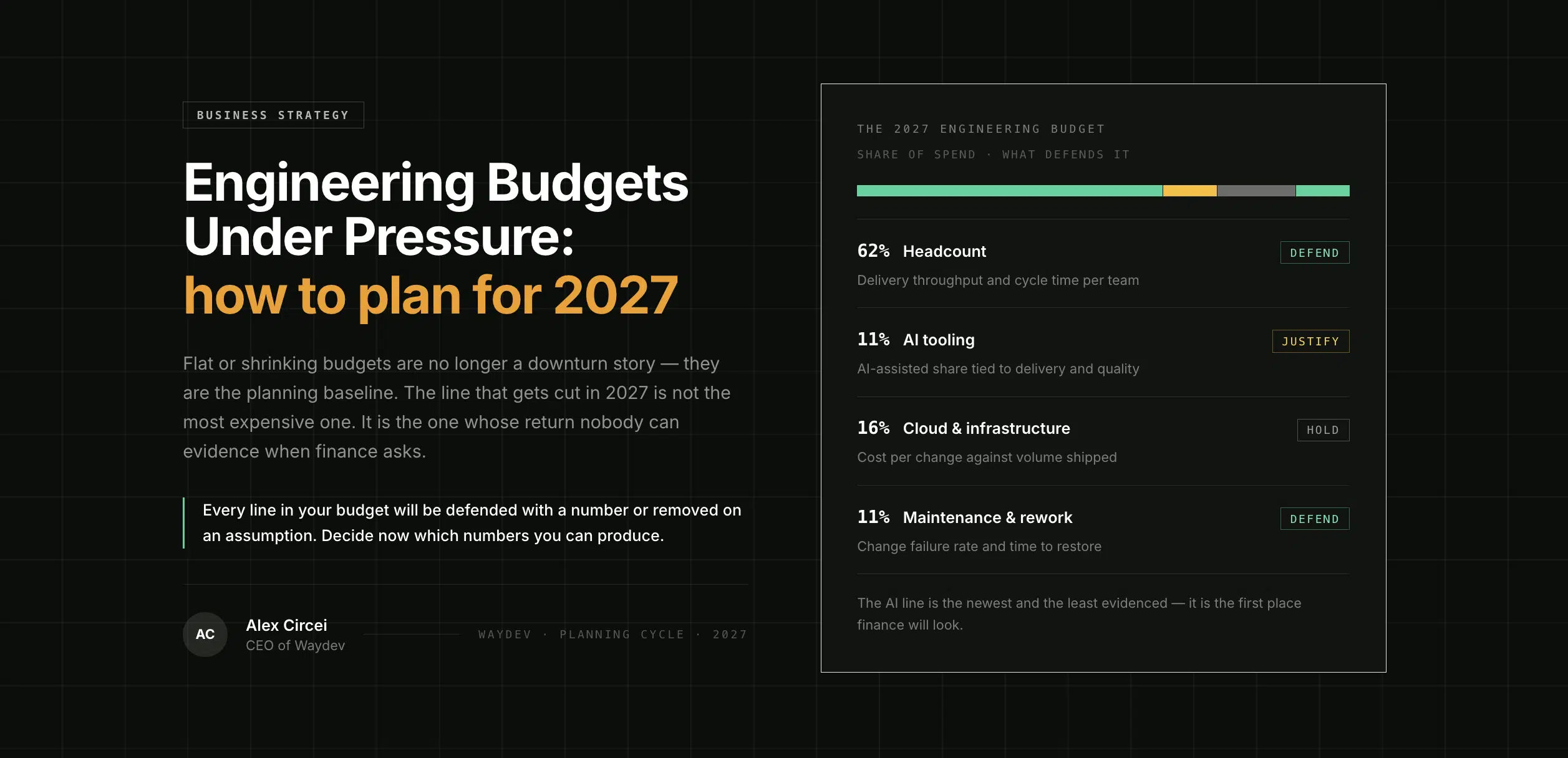
Figure 2
Split the budget by what it produces, then decide
Proportions are illustrative. Generate your own split before making any decision from this.
Two calculators will get you a defensible number quickly without buying anything: the cost of rework and the cost of change failure rate. If you want the per-unit view, we walked through the method in how to calculate cost per feature. For the reporting side, cost capitalization turns qualifying effort into something finance can book rather than expense, which is often the single largest lever available and one many engineering leaders never pull.
This is the part most downturn advice gets wrong. On a spreadsheet, a cut that removes waste and a cut that removes capability look the same: a smaller number. They diverge about two quarters later, when the second one shows up as slower delivery, more incidents and the quiet departure of the people who were holding things together.
| Cuts that remove waste | Cuts that remove capacity |
|---|---|
| Reclaiming silent licences on tools nobody opens | Cutting tooling that people use daily to save a per-seat fee |
| Reducing unplanned work by fixing its upstream causes | Deferring maintenance, which converts this year’s saving into next year’s incident |
| Killing initiatives that have not moved in two quarters | Spreading everyone across more initiatives to look efficient |
| Pipeline and infrastructure controls that cut spend without cutting signal | Reducing senior review capacity, which is the constraint agentic coding already strains |
| Consolidating overlapping tools that do one job twice | Freezing all hiring including the backfill for a departing staff engineer |
The right-hand column is seductive because it is fast and the damage is deferred past the current quarter. The way to tell them apart in advance is to know your unit costs and your review load before you decide, not after.
The AI budget is the most exposed thing you have in this planning round: new, large, growing, and in most organizations unmeasured. That combination attracts attention. It is also, awkwardly, the line item you most want to keep.
The mistake is answering an ROI question with adoption data. Seat counts and acceptance rates prove the tools are being used, not that anything improved, and a CFO hears the substitution immediately. Keep adoption, impact and ROI as three separate answers, and include the downstream costs, telemetry, infrastructure and review overhead, in the total rather than only the licence fee.
One timing warning that matters more than anything else on this page. A before-and-after comparison needs a before. If your AI rollout is underway and nobody captured the delivery baseline first, that data is being overwritten now and cannot be reconstructed later. The method is in the AI ROI playbook, and the AI ROI calculator will get you a first number today.
Budget pressure produces uncertainty, and uncertainty is what makes good engineers start answering recruiter messages. Three things help, and none of them cost money.
Say what you know and admit what you do not. People who are not told anything fill the gap with worse assumptions than the truth. Leaders who share the actual constraints, including the uncomfortable ones, keep more of their team than leaders who go quiet.
Make decisions from evidence and show the evidence. If prioritisation calls are visibly based on data rather than on who argued hardest, they feel fair even when they are unwelcome. That is most of what people mean when they say they trust a leader.
Keep asking what is in their way. Developer Experience surveys next to your delivery data catch the friction that shows up in attrition long before it shows up in Git. During a squeeze this is the cheapest retention work available, because most of what frustrates engineers costs nothing to fix and is invisible from above.
Figure 3
What to do, in what order
Track four things through the year and you will know within two quarters whether you cut waste or capability: the share of effort going to unplanned work, cycle time by stage, change failure rate, and cost per unit delivered. If cost fell and all four held, the cut was real. If cost fell and cycle time and failure rate rose, you moved the expense rather than removing it, and the bill arrives later with interest.
The short version
You do not need a recession to be under budget pressure. A flat budget with a growing AI bill inside it is enough. The leaders who come out of this planning round with their funding intact are the ones who can show what engineering costs, what it delivered, and what the AI spend returned, as three separate numbers.
Go into planning with numbers
Connect your repositories and we will backfill your history, so you arrive at the budget conversation with your own cost, delivery and AI figures rather than estimates. You keep the analysis either way.
Cost and planning: Project Costs · Cost Capitalization · Resource Planning · Resource Allocation · Business Alignment · Cost per feature
Calculators: AI ROI · Cost of rework · Cost of technical debt · Cost of change failure rate
Further reading: The AI bill nobody budgeted · Why your AI ROI is not showing up · The WAY Framework · Engineering Leaders Handbook
Ready to unlock your SDLC productivity?