GitClear and Waydev both answer a question almost every engineering leader is being asked in 2026: is the AI investment actually producing durable work? We answer it at different altitudes. GitClear works from the line of code upward. Waydev works from delivery, quality and cost downward. This page explains the difference honestly, including the cases where GitClear is the better purchase.
Worth saying up front: we cite GitClear’s research in our own writing. Their Maintainability Gap work, and the earlier code quality reports behind it, are among the most useful public datasets on what AI is doing to codebases, and they are cited well beyond this industry. We are not going to pretend a company whose findings we quote is not worth taking seriously.
GitClear’s core idea is Diff Delta: rather than counting lines changed, it assesses how much durable change a commit actually contained, with lineage awareness so that moves, renames and reformatting are not mistaken for new work. On top of that it attributes changed lines to the model that produced them across the major AI coding tools, then scores that output against rework, defects and review time.
Three things follow from that, and all three are genuine strengths.
Line-level AI attribution
Most platforms, including ours, measure AI impact by comparing cohorts and time windows. GitClear goes down to which model wrote which line. If your question is specifically “which model earned its inference spend,” that resolution is real and it is unusual.
Research credibility
Their multi-year analysis of hundreds of millions of changed lines, showing refactoring and code reuse declining as AI authorship rises, is the most cited public evidence in this area. That research arm is a real moat and a good reason to trust their methodology.
Self-serve, with a free tier
They publish per-developer pricing, offer a free starter tier, and you can be connected in minutes without a sales call. We do not have a free tier, and for a team that wants to try something this afternoon that is a decisive advantage.
| Waydev | GitClear | |
|---|---|---|
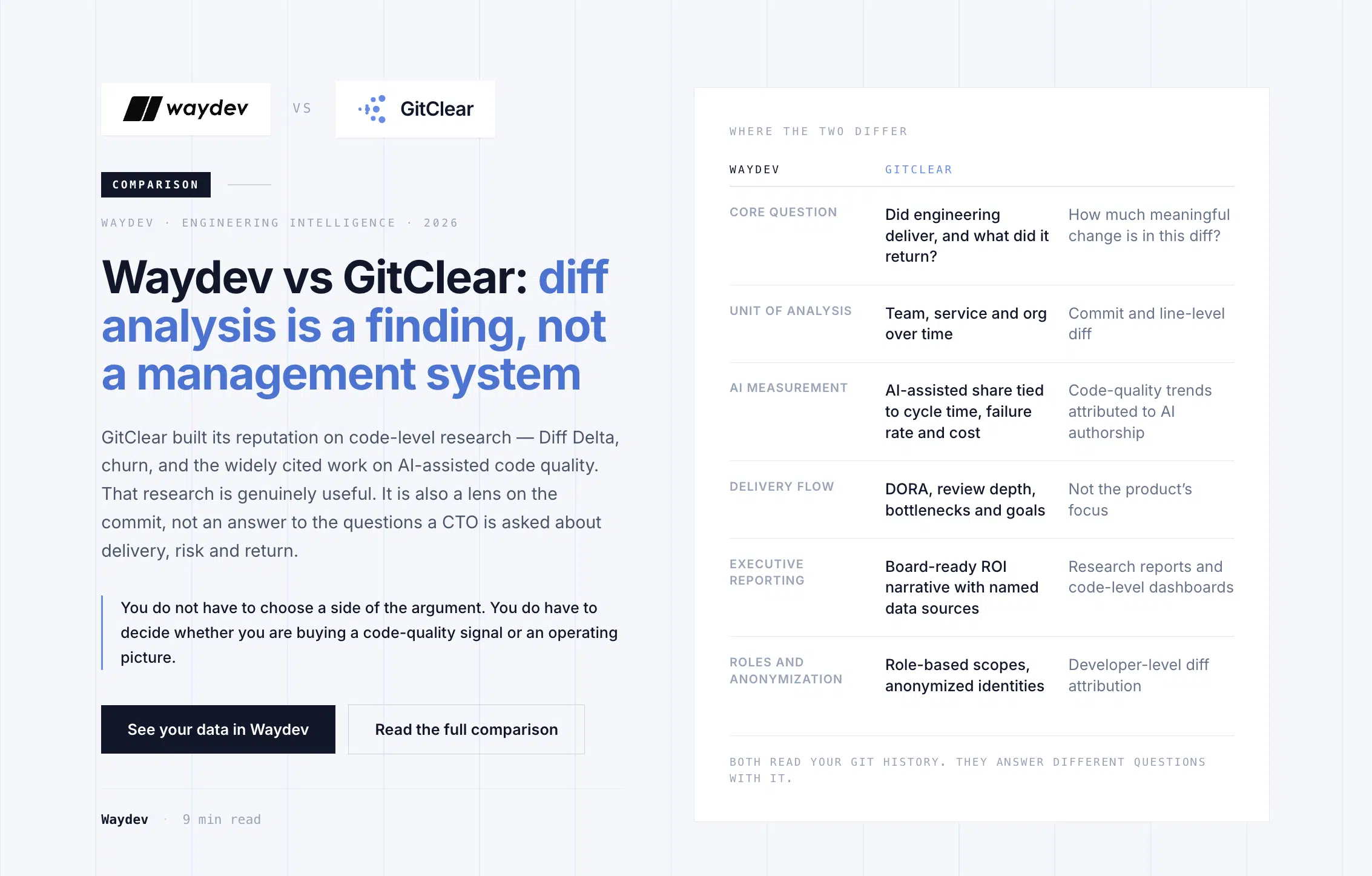
| Unit of analysis | The change and the delivery system around it: PRs, cycle time stages, tickets, deployments, cost. | The line of code, scored for durability with Diff Delta. |
| AI measurement | Adoption, impact and ROI as three separate layers across Copilot, Cursor, Claude Code and Codex. | Line-level attribution to the model, scored against rework and defects. |
| Framework | WAY: combines DORA, SPACE and Core 4, owns no proprietary index. | Diff Delta, a proprietary and trademarked metric. |
| Planning and finance | Cost capitalization, project costs, resource planning and allocation. | Not the focus of the product. |
| Qualitative signal | Developer Experience surveys alongside system data. | Survey capability alongside deep code analysis. |
| Deployment | Cloud, self-hosted or on-premise including on-premise Git and ticketing. | Cloud. Check current options if on-premise is mandatory. |
| Buying model | Published per active contributor pricing, POC-led, no free tier. | Self-serve with a free tier and published per-developer pricing. |
GitClear details drawn from its public materials as of September 2026. Verify current capabilities and pricing directly, since both products move quickly.
Strip away the feature lists and the choice is about which question you are being asked.
If the question is “is the code our AI tools produce any good, and which model produces the best of it”, that is a code-level question and GitClear was built for exactly it. Line-level attribution scored for durability is a better instrument than anything a delivery-level platform can offer, ours included.
If the question is “did our engineering organization get faster, did quality hold, and what did it cost”, the answer does not live in the diff. It lives in the join between Git, tickets, deployments and finance: cycle time broken into stages, change failure rate, review load, capitalizable effort, and AI ROI against tool spend. That is where we built.
The test
Who asked you the question? If it was a staff engineer or an architect worried about the codebase, start with code-level analysis. If it was your CFO or your board, start with delivery and cost. Buying the wrong altitude is the most common mistake in this category, and it is expensive in wasted quarters rather than licence fees.
Diff Delta is a genuinely thoughtful metric, and the lineage awareness that stops moves and renames inflating the number is exactly the kind of engineering most vendors skip. It is also proprietary, which is worth thinking through before you standardize on it.
If your leadership learns to think in Diff Delta, that vocabulary only computes inside one product. It cannot be reproduced by another vendor, benchmarked against an outside source, or explained to your CFO without a login. This is the same reservation we hold about Core 4’s DXI, Cortex’s DRIVE and LinearB’s APEX, and it is why the WAY Framework deliberately owns no metric of its own. Not a criticism of the metric’s quality, a point about what happens to your reporting on the day you change vendor.
Your central question is code quality and durability rather than delivery performance.
You want to compare models against each other at line level and decide where inference spend goes.
You want to start today, self-serve, without a procurement process.
You are a smaller team where planning, capitalization and executive reporting are not yet the problem.
The AI question is being asked by the board, not the architecture group
We keep adoption, impact and ROI as three separate answers, in arithmetic finance can audit, alongside the delivery metrics that show whether throughput gains survived contact with quality.
You need planning and finance in the same platform
Cost capitalization, project costs, resource allocation and resource planning running off the same dataset as your delivery metrics.
Deployment and scale are constraints
On-premise and self-hosted deployment including on-premise Git and ticketing, SAML SSO, team-level access control, and a platform built to run past 10,000 active contributors. In production at American Express, Dropbox and PwC.
You want the measurement vocabulary to stay yours
The WAY Framework builds on DORA, SPACE and Core 4 rather than replacing them. If you leave us, your targets and your board narrative still work, which is a promise we put in writing on our own alternatives page.
These are not mutually exclusive purchases, and at a large enough organization running both is defensible: code-level durability analysis for the engineering conversation, delivery and cost intelligence for the leadership one. If budget forces a choice, pick the altitude that matches whoever is asking for the number, and revisit in a year.
Does Waydev do line-level AI attribution like Diff Delta?
We measure AI impact at the change and delivery level rather than scoring individual lines with a proprietary index. If per-line model attribution is your requirement, say so in a demo and we will tell you honestly whether we fit.
Is Waydev cheaper than GitClear?
No. GitClear is self-serve with a free tier and lower per-developer pricing. We are an enterprise platform with a broader scope and a published price to match. Compare on what each answers rather than on the line item.
Do you agree with GitClear’s research findings?
Broadly yes, and we cite it in our own writing on code churn. Rising duplication and falling refactoring as AI authorship grows matches what we see in customer data. As with any single-source dataset, read the figures as directional and check the pattern against your own repositories.
Decide on your own repositories
We will connect your systems and backfill your history so you can see your own delivery, quality and AI numbers. Run GitClear’s free tier alongside it and compare what each one answers. You keep our analysis either way.
More comparisons: Jellyfish · LinearB · DX · Swarmia · Allstacks · Cortex · Comparison hub
Further reading: The WAY Framework · Code churn and AI code churn · DORA metrics · Measuring AI ROI in engineering · AI ROI calculator
Ready to unlock your SDLC productivity?