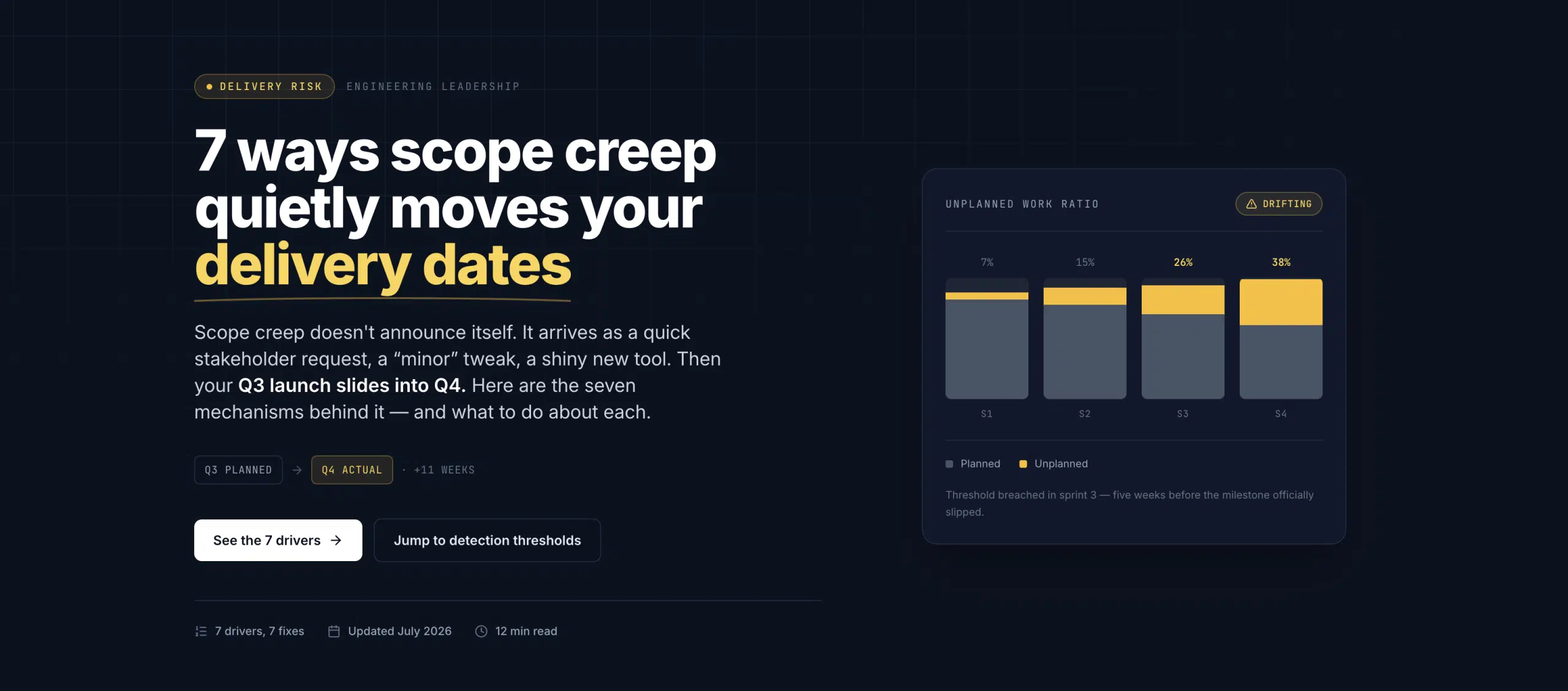
Scope creep doesn’t announce itself. It shows up as a quick stakeholder request, a “minor” requirement tweak, or a shiny new tool that suddenly feels essential. And before you know it, your Q3 launch is sliding into Q4. Here are seven specific ways uncontrolled scope expansion pushes software delivery dates, and what engineering leaders can do about each one.
Waydev is an engineering intelligence platform built for engineering leaders who need hard numbers on scope, delivery risk, and team performance. It’s not a project tracker. It’s the layer that sits on top of your Git data, Jira, and sprint workflows to surface the signals your delivery dates depend on.
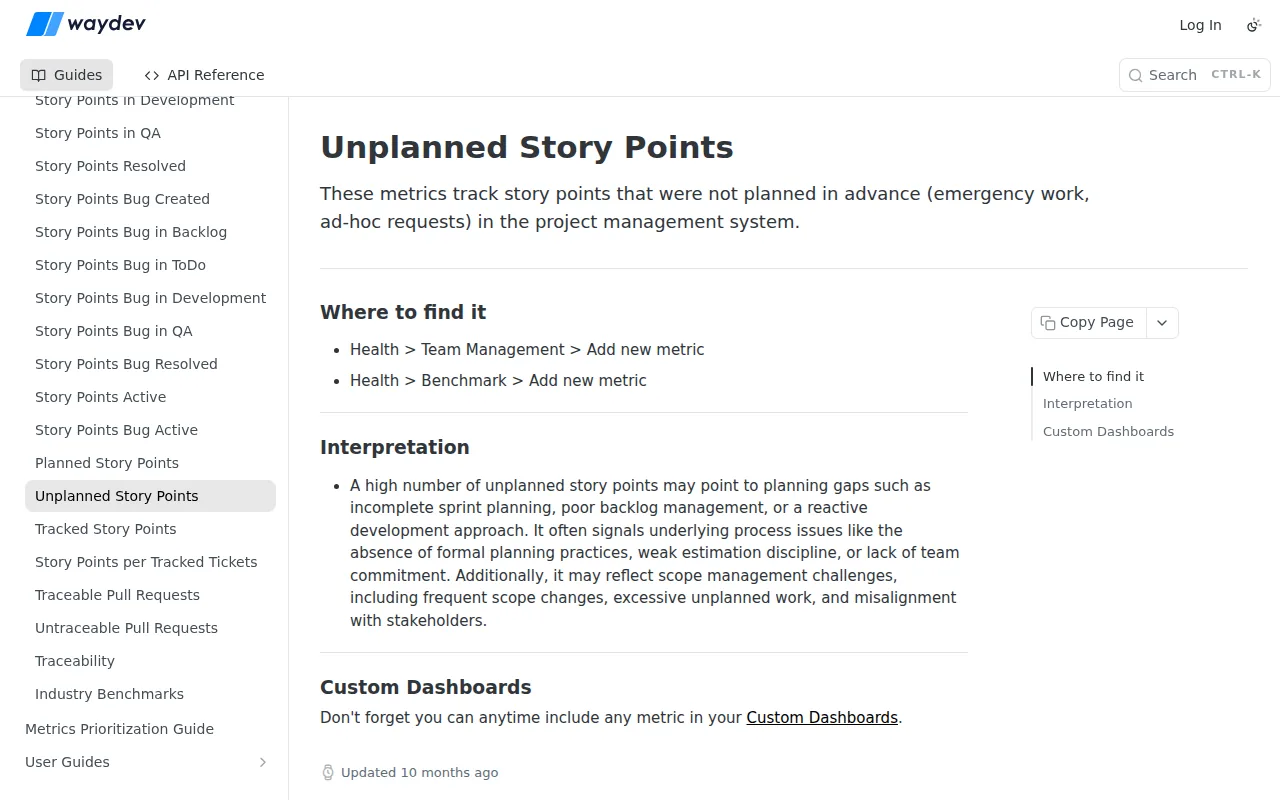
What makes Waydev the right tool for scope creep specifically? Most research on this topic lists the drivers without ever putting numbers on them. Waydev’s AI Checkpoints and Predict & Improve features are designed to close that gap. They convert qualitative signals, a rising backlog, slipping velocity, unplanned story points stacking up, into measurable delivery forecasts your CFO and board can actually read.
Engineering leaders at Fortune 500 companies including American Express, Dropbox, and PwC use Waydev to track delivery metrics and get early warning on delivery risk. It’s a Y Combinator alum (W21), holds a USPTO patent in Git analytics, and is recognized by Gartner and G2. Nine years in the engineering intelligence space gives Waydev a depth of signal most newer tools simply don’t have.
The platform’s Velocity Report shows scope changes at the sprint level in real time. When a team’s unplanned story points start climbing, Waydev flags it before it cascades into a missed milestone. That’s the difference between catching scope creep in week two versus discovering it at the sprint review.
The one caveat: Waydev is built for engineering organizations with real data volume. Teams under 20 engineers may find the depth of its analytics exceeds their current needs. But for mid-market and enterprise orgs managing complex, multi-team delivery, it’s the clearest signal source available.
Stakeholder influence is one of the most common drivers of scope expansion in software projects. A VP sees a competitor ship a feature. A product director attends a conference. Someone on the leadership team has a new idea on Monday morning. Each of these moments can translate into a mid-sprint priority change that the engineering team has to absorb.
The problem isn’t the request itself. It’s that most teams don’t have a formal mechanism to evaluate what the request actually costs. When a stakeholder adds one feature, they rarely subtract another. The sprint gets stuffed. The team pushes through. The delivery date moves.
According to case study research on scope creep impact on project timelines and deliverables, stakeholder influence consistently appears as one of the top drivers of timeline overruns in software projects. The mechanism is straightforward: priorities change faster than delivery capacity, and without a gate, every priority becomes equally urgent.
What makes this particularly hard to contain is organizational politics. Engineers don’t always feel helped to push back on a VP’s request. Product managers may not want to be the person who says no. So the request lands in the backlog, work begins informally, and the sprint scope expands without anyone formally approving the change.
The fix isn’t to block stakeholder input. It’s to make the cost visible before the work starts. Engineering leaders who track sprint-level scope change data can walk into any stakeholder conversation with a concrete answer: “Adding this now moves the delivery date by X days.” That’s a very different conversation than “it’s complicated.”
Pro Tip: Before your next sprint planning session, pull your last three sprints’ scope change data. If more than 15% of story points shifted after planning closed, you have a stakeholder alignment problem, not a capacity problem.
Change management is the formal process that decides whether a new requirement gets added to the current scope or deferred. When it’s weak, or nonexistent, scope creep moves from occasional to structural. Every request becomes a priority. Every addition feels small. And the sum of all those small additions pushes delivery dates by weeks or months.
Research from ResearchGate identifies weak change control mechanisms as one of the key structural drivers of scope creep. The pattern is consistent: teams with no formal change request process accumulate additions continuously, with no single decision point where the cost gets evaluated. By the time the impact shows up in missed milestones, the additions are already built in.
The damage isn’t just to delivery dates. Inadequate change management creates ambiguity about what “done” actually means. Engineers build to one spec, stakeholders expect another, and QA finds a third interpretation in the documentation. Each misalignment adds rework, and rework is invisible in most project tracking tools unless someone is specifically watching for it.
A formal change control process doesn’t have to be bureaucratic. At its core, it’s three things: a written record of what’s being added, an impact assessment on timeline and budget, and a decision from someone with authority. Without all three, every request is effectively approved by default the moment someone starts working on it.
Engineering leaders building out this process can use Waydev’s sprint data to quantify the before-and-after. How much unplanned work entered each sprint? How did that correlate with delivery slippage? Those numbers make the case for a formal change gate far more persuasively than any process argument.
New technology creates new scope. This is one of the more counterintuitive drivers of delivery delays, but it’s real. A new AI model ships mid-project and suddenly the original architecture feels outdated. A framework update promises to simplify the integration the team just spent three weeks building. A competitor ships something using a tool your team hasn’t evaluated yet.
Each of these moments generates a pull toward rework. And unlike stakeholder-driven scope creep, this type often comes from inside the engineering team itself. Developers want to use the best tools. That instinct is good for long-term code quality. It’s bad for delivery dates when it triggers mid-project rewrites.
Research specifically calls out technological advances as a driver of scope creep in project management, noting that evolving tools expand what teams believe is possible, and therefore what stakeholders begin to expect. The gap between “what we scoped in January” and “what AI tools can now do in July” becomes a source of pressure to reopen finished requirements.
This is especially acute in AI-assisted development right now. Engineering teams evaluating new coding assistants, testing integration tools, or piloting agent-based workflows mid-project face real decisions about whether to absorb the learning curve into the current sprint or defer it. Neither choice is free.
The usable defense is a technology freeze date. Agree, before the sprint kicks off, that no new tools or frameworks enter the delivery pipeline after a specific point. Evaluate new technology in a separate research track. This isn’t anti-innovation, it’s protecting the current delivery while keeping a structured path for adoption in the next cycle. When engineering leaders want to evaluate the impact of tool changes on delivery performance, Waydev’s Velocity Report shows exactly how sprint throughput changed across different periods.
Scope creep and timeline disruptions have a recursive relationship. Scope expands, timelines slip. Slipped timelines create pressure to cut corners or add resources. New resources need onboarding time. Onboarding takes focus away from delivery. The original slip compounds into a larger one.
This compounding effect is what makes timeline disruptions so costly. A two-week scope addition at week four doesn’t add two weeks to the delivery date. It adds two weeks plus the cost of the context switch, plus the time to re-plan dependent work, plus the buffer the team needs to recover. The actual impact is typically two to three times the nominal delay.
Deployment frequency and change failure rate tend to move together, not independently. Teams under scope pressure tend to batch more changes, which increases the risk of each deployment and slows recovery when something breaks. The timeline disruption isn’t just from the added work, it’s from the delivery quality degradation that follows.
What engineering leaders often miss is that timeline disruptions from scope creep are detectable early. When sprint velocity drops two sprints in a row while backlog volume stays constant or grows, you’re watching a timeline disruption forming in real time. The problem is that most tools surface this data after the milestone has already moved.
Key Takeaway: A two-week scope addition mid-project rarely costs just two weeks, cascading rework, context switching, and recovery time typically double or triple the actual delivery impact.
Budget overruns are often treated as a financial problem. But for engineering leaders, they’re a delivery problem. When a project burns through its budget before it reaches completion, the delivery timeline doesn’t just stretch, it stops. Teams get reallocated. Contractors get cut. Approvals for the next phase get delayed while finance figures out where the money went.
Scope creep is a direct path to budget overrun. Every uncontrolled addition consumes engineering hours that weren’t planned for. Those hours cost money. When the unplanned additions are small and frequent, the classic pattern of scope creep, the overrun accumulates gradually until it hits a threshold that triggers a budget review. That review takes time. During that time, delivery stalls.
The relationship between scope and cost is why effective software project planning builds cost estimation directly into scope management. When a change request comes in, the answer isn’t just “when can we do it”, it’s “what does this cost and who approves the budget adjustment.” Teams that skip this step discover the cost at the worst possible time: during a quarterly financial review.
For engineering leaders presenting to CFOs and boards, this is where engineering intelligence data becomes a board-level asset. Waydev’s project cost tracking connects engineering hours to delivery milestones, making it possible to show exactly when unplanned work began consuming budget that was allocated to planned features. That’s not a project management conversation, it’s a financial governance conversation.
The caveat worth naming: budget overruns often lag scope creep by several weeks. By the time finance flags the overage, the damage to the delivery timeline is already done. Early detection, at the sprint level, before the budget impact surfaces, is the only way to avoid the stall.
Burnout is the delayed consequence of sustained scope pressure. When teams repeatedly absorb unplanned work, work longer hours to protect delivery dates, and skip technical debt paydown to ship faster, the cumulative effect shows up in output quality and then in output volume. Engineers slow down. Reviews take longer. More bugs reach QA. Deadlines slip even when the scope stops growing.
This is the mechanism most delivery post-mortems miss. They identify the scope additions that caused the timeline to slip, but they don’t capture the human capacity degradation that made the last three sprints slower than the first three. Burnout is invisible in most engineering dashboards unless you’re specifically tracking output trends over time at the team level.
Scope creep drives burnout through a specific pattern: constant context switching. When new requirements arrive mid-sprint, engineers shift focus. Unfinished work sits in limbo. Partially built features accumulate. The cognitive overhead of tracking multiple half-done threads is exhausting in a way that simply working long hours isn’t. Research consistently names team burnout as both a consequence of uncontrolled scope and a driver of further timeline slippage.
The usable signal to watch is the ratio of unplanned to planned work across consecutive sprints. When that ratio climbs steadily over six to eight weeks, you’re watching burnout build. The team isn’t failing, they’re absorbing structural pressure that wasn’t in the original delivery plan. Catching this pattern early, before the burnout affects output quality, is the difference between a course correction and a full replan.
Engineering leaders managing teams across multiple projects can use Waydev to track this signal at the org level. When multiple teams show rising unplanned work ratios in the same period, it’s usually a sign of a systemic planning or stakeholder alignment problem, not a team performance problem. That distinction matters for how you intervene.
Most organizations can describe scope creep qualitatively. Very few can measure it. And without measurement, you can’t manage it, you can only react to it after the delivery date has already moved. The goal is to shift from reactive to predictive: catching scope expansion when it’s a signal, not when it’s a crisis.
The table below maps each scope creep driver to a measurable signal and the decision threshold that should trigger executive intervention. These are leading indicators, not summary judgments. One bad sprint is a signal. Two consecutive bad sprints is data.
| Scope Creep Driver | Measurable Signal | Detection Tool | Intervention Threshold |
|---|---|---|---|
| Stakeholder Influence | Mid-sprint priority changes per sprint | Velocity Report (Waydev) | >15% of story points changed after planning closes |
| Inadequate Change Management | Unplanned story points ratio | Unplanned Story Points (Waydev) | Ratio exceeds 20% for two consecutive sprints |
| Technological Advances | Refactor percentage vs. new work ratio | Code Impact (Waydev) | Refactor spike >30% without a planned tech debt sprint |
| Timeline Disruptions | Deployment frequency trend | Delivery Metrics (Waydev) | Frequency drops two sprints in a row while backlog grows |
| Budget Overruns | Engineering hours vs. planned budget | Project Costs (Waydev) | Actual hours exceed planned by >10% at sprint midpoint |
| Team Burnout | Velocity trend over 6–8 weeks | Velocity Report (Waydev) | Velocity declining while sprint scope stays constant |
| Stakeholder + Change (combined) | Two or more metrics improved simultaneously | Signals (Waydev) | Any two metrics in yellow triggers steering committee review |
The key insight from enterprise program management is that no single metric is reliable in isolation. Effort variance can come from underestimation. Velocity drops can come from capacity issues. The detection signal is two or more indicators moving together. That’s when scope creep is almost certainly the cause.
Executive visibility matters here. The teams who can see scope creep clearly are deep in execution and often have an incentive not to surface it. The leaders who need to act have authority but not visibility. Closing that gap is exactly the problem Waydev’s Ask Waydev and AI Checkpoints features are built to solve, giving engineering VPs and CTOs a real-time view of delivery risk without requiring them to dig through sprint data manually.
For organizations managing programs above nine months in duration, a standing steering committee item on cumulative scope drift is worth adding. Green means all metrics are within threshold. Yellow means one or two are improved. Red means three or more are improved or one is significantly past threshold. The status is determined by data, not by judgment, which removes the political pressure to declare green when the numbers say otherwise. You can also track scope-related risk across projects using RAG status reporting, which maps scope changes to green, amber, and red thresholds with clear decision criteria for each.
The usable payoff: engineering programs that detect scope drift in month three can typically recover by month six. Programs that detect it in month nine are usually managing budget exhaustion. Early detection isn’t just about knowing sooner, it changes the incentives across the entire team. When scope drift is a standing agenda item, teams manage it more carefully without anyone having to ask.
For teams that want to go deeper on software project planning as a prevention layer, the 10-step software development project planning guide from Waydev covers how to structure requirements, set scope boundaries, and build the planning foundations that make scope management tractable from day one.
Scope creep is the gradual, uncontrolled expansion of a project’s requirements beyond what was originally agreed. It delays software delivery because each addition consumes engineering time, creates rework, and disrupts sprint planning. The impact compounds: one small addition causes context switching, which slows throughput, which pushes the delivery date, which then pressures the team to cut quality elsewhere. Most teams underestimate this compounding effect until a milestone has already slipped.
Look at two signals together: unplanned story points per sprint and sprint velocity trend over six to eight weeks. If unplanned work is rising while velocity is flat or falling, scope creep is the most likely culprit. If velocity is falling while sprint scope looks stable, burnout from earlier scope pressure may already be affecting output. A single bad sprint is noise. Two consecutive sprints with both signals improved is a pattern worth investigating.
Legitimate requirement changes go through a formal evaluation: written record, impact assessment on timeline and budget, and approval from someone with authority. Scope creep skips that process. A requirement change that adds a week to delivery and gets formally approved is a managed change. The same addition absorbed informally into a sprint without any impact assessment is scope creep. The feature may be identical, the difference is whether the cost was visible before the work started.
Delivery throughput and stability metrics measure how consistently a team ships working software. When scope creep is active, deployment frequency tends to drop as teams batch more work to accommodate additions. Change failure rate often rises because rushed integrations introduce defects. These movements in delivery data appear before missed milestones show up in project status reports, making them useful leading indicators of scope-driven delivery risk rather than lagging summaries of what already went wrong.
No, and trying to eliminate it entirely creates its own problems, rigid scope in a fast-moving market produces the wrong product on time. The realistic goal is controlled scope change: a formal process that evaluates every addition before it enters the sprint, makes the delivery cost visible to stakeholders, and requires explicit approval. Agile teams need guardrails for changes, not a freeze on all new input. The discipline is in the gate, not in blocking requests.
An engineering intelligence platform like Waydev connects sprint data, Git activity, and delivery metrics to surface scope-related signals in real time. It tracks unplanned story points, velocity trends, and code impact patterns to detect scope expansion early, often weeks before a milestone shows the strain. For executive leaders, it translates these signals into delivery forecasts and risk indicators that connect engineering performance to business outcomes without requiring manual data aggregation across tools.
Scope creep doesn’t cause one missed deadline. It causes a chain of them, each one harder to explain to a board that expected the product three months ago. The seven drivers above don’t operate in isolation. Stakeholder influence opens the door. Weak change management holds it open. Burnout slows the team down just when delivery pressure is highest. The teams that manage this well aren’t the ones with the strictest process or the most disciplined stakeholders. They’re the ones who can see scope drift early, in data, before it becomes a delivery crisis. If you want to build that visibility into your engineering org, explore how Waydev’s AI Checkpoints and Signals features turn sprint-level data into the early warning system your delivery dates need.
Ready to unlock your SDLC productivity?