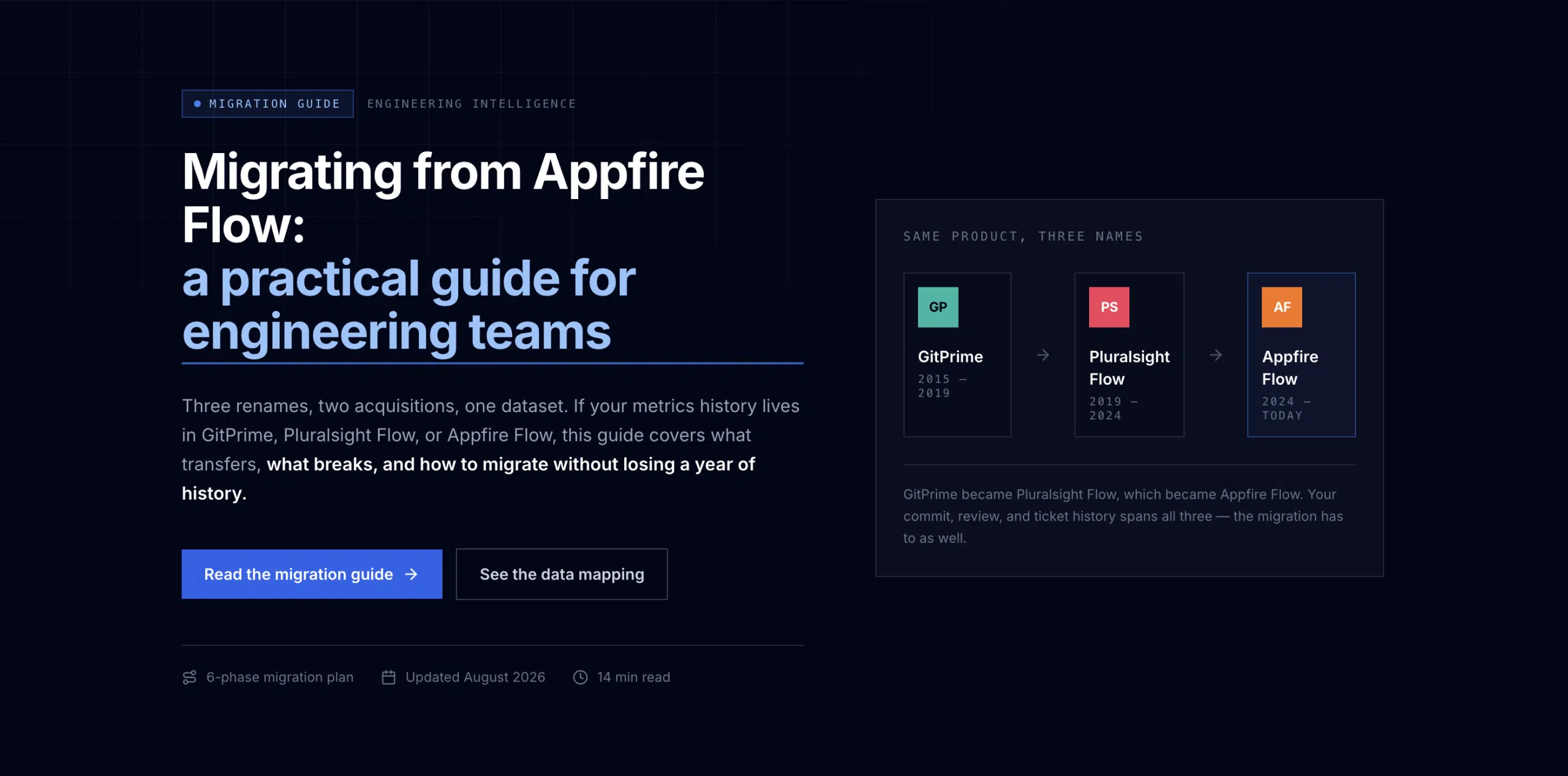
GitPrime defined the Git analytics category, and then it spent a decade being renamed. Pluralsight acquired it in 2019 and it became Pluralsight Flow. Appfire acquired Flow, and today the product GitPrime users are actually running is Appfire Flow. Meanwhile the category around it grew up: what used to be called development analytics is now software engineering intelligence, Gartner covers it as Developer Productivity Insight Platforms, and the buying question has shifted from “how fast do we ship” to “what did our AI investment actually change.” This is the up-to-date map of who leads that market in 2026.
Four shifts define the 2026 landscape, and they explain most of what follows.
AI measurement became the buying trigger
Boards approved large AI tooling budgets and now want evidence. Measuring AI adoption, impact and ROI is the reason most 2026 evaluations start, where DORA dashboards were the reason in 2021.
Consolidation reached the top of the market
Atlassian acquired DX for a reported billion dollars. Appfire absorbed Flow. The independents that remain compete on depth and neutrality against platforms attached to much larger suites.
Everyone shipped a proprietary framework
Core 4 at DX, DRIVE at Cortex, APEX at LinearB, WAVE at Uplevel. Each arrives with a maturity assessment and one platform built to run it. The WAY Framework is our answer, and its defining decision is that it owns nothing: it combines DORA, SPACE and Core 4 and stays yours if you leave.
The neutral benchmark got thinner
DORA paused its annual survey this year. Your own longitudinal baseline is now worth more than any industry percentile, which changes what you should optimize a tool choice for.
| Tool | Known for | Framework | Compare |
|---|---|---|---|
| Waydev | AI adoption, impact and ROI from Git-first system data; on-premise option; published pricing | WAY, portable, owns no metrics | All comparisons |
| Appfire Flow | The GitPrime lineage, now inside Appfire’s Atlassian-ecosystem portfolio | Code-level metrics heritage | Flow to Waydev |
| Jellyfish | Investment allocation and R&D reporting for large organizations | Allocation model | vs Waydev |
| LinearB | Workflow automation around PRs plus delivery metrics | APEX, proprietary | vs Waydev |
| DX (Atlassian) | Survey-plus-system measurement, author of Core 4 and DXI, now part of Atlassian | Core 4 with proprietary DXI | vs Waydev |
| Swarmia | Developer-friendly working agreements and team-level insights | DORA and SPACE aligned | vs Waydev |
| Allstacks | ML delivery forecasting and risk; 2026 Gartner MQ Visionary | Supports DORA, SPACE, Flow, SAFe | vs Waydev |
| Cortex | Internal developer portal with a metrics layer on top of its service catalog | DRIVE, proprietary | vs Waydev |
| Uplevel | Composite scores blending Git, calendar and survey data | WAVE, proprietary | Comparison hub |
| Hatica, Typo, Harness SEI | Newer and adjacent entrants worth screening in specific situations | Varies | Hatica, Typo, Harness |
Landscape accurate as of September 2026, based on each vendor’s public materials. Capabilities change quickly in this market; verify current details before a purchase decision.
Waydev is the AI-native engineering intelligence platform, in production at Fortune 500 organizations including American Express, Dropbox and PwC, and built to scale past 10,000 active contributors. It reads your GitHub, GitLab, Bitbucket and Azure DevOps data, cloud or on-premise, and turns it into metrics without any manual input from engineers.
What the platform covers today:
AI: AI Adoption, AI Impact and AI ROI across Copilot, Cursor, Claude Code and Codex, kept as three separate measurements so spend never gets reported as productivity, plus the Waydev Agent for predicted outcomes.
Delivery: DORA metrics, cycle time by stage, pull request insights, merge quality, velocity and sprint commitment.
Health: Insights, benchmarking against your own organization, hygiene, and Developer Experience surveys for the things system data cannot see.
Planning and finance: Bird’s-Eye View, resource planning, project costs and cost capitalization.
Studio: custom dashboards, custom metrics with your own formulas, custom reports, targets and notifications, plus a two-way API.
It is all organized under the WAY Framework: Work-first, Agnostic, Yours. The framework combines DORA, SPACE, Core 4 and the AI measurement research rather than replacing them with a proprietary index, which means your measurement vocabulary survives a vendor change. In a year when every competitor launched an index that only their product can compute, that is the structural difference.
Pricing is published on the pricing page: Pro from $348 per year per active contributor, Premium from $648 with the full module set including AI, SSO and API access, and Enterprise with on-premise deployment. Unlimited users and unlimited teams on every plan, billed per active contributor rather than per seat. On G2, Waydev holds High Performer and Highest User Adoption (Mid-Market) badges in Software Development Analytics.
Where it is not the fit: teams of a handful of engineers who want a free tier will be better served elsewhere. Waydev earns its keep from roughly fifty engineers upward, and most from a few hundred.
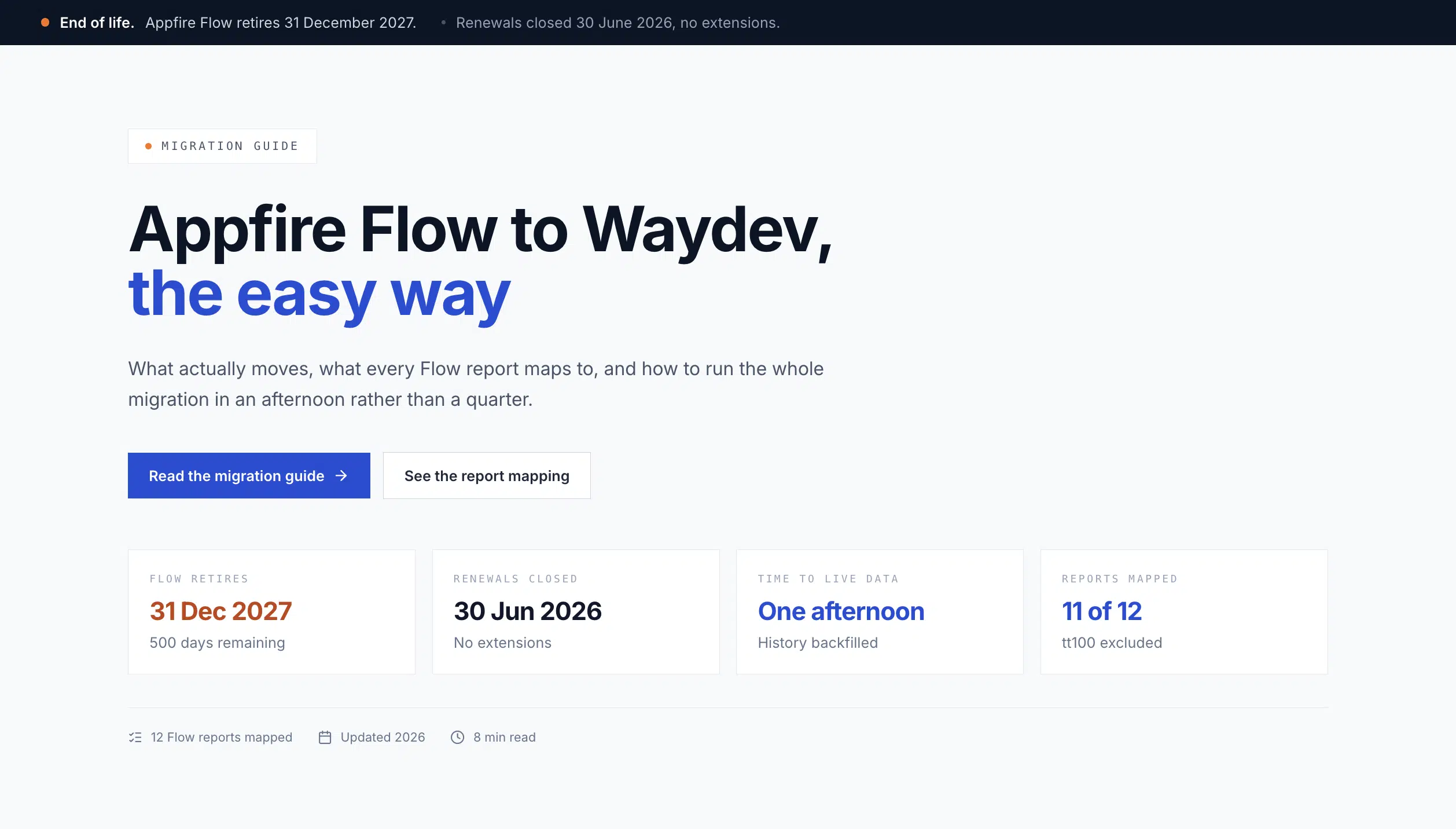
The original. GitPrime pioneered code-level metrics like churn, impact and review reaction time, and much of the category’s vocabulary traces back to it. Under Pluralsight the product broadened; under Appfire it sits inside a large portfolio of Atlassian-ecosystem tooling. If you are a long-time Flow customer, the practical questions in 2026 are roadmap investment, how the product fits Appfire’s portfolio strategy, and whether its code-level heritage covers the AI measurement questions your leadership is now asking. We wrote a detailed, honest migration guide from Appfire Flow covering metric mapping and historical baselines, and a shorter quick-start version.
Jellyfish built its position on investment allocation: showing executives where R&D effort goes across roadmap, maintenance and support, and it now positions itself around intelligence for AI-integrated engineering, with a customer base it states at more than a thousand companies. It is strongest where the primary buyer is finance-adjacent leadership that wants allocation and R&D reporting. It is weakest where teams want deep, code-level delivery diagnostics and customizable reporting, and it has no on-premise offering, which removes it from some regulated evaluations. Full breakdown in Waydev vs Jellyfish.
LinearB pairs delivery metrics with workflow automation, and its PR-level automations are genuinely liked by teams that live in the pull request flow. In 2026 it also has APEX, its own AI-era framework, which follows the proprietary pattern: the framework and the platform are the same purchase. Evaluate whether the automation value outweighs the framework lock-in for your organization. The detailed comparison is at Waydev vs LinearB, and there is a practical LinearB migration guide if you are switching.
DX combined researcher credibility with a survey-plus-system measurement model, published Core 4, and was acquired by Atlassian for a reported billion dollars, the deal that told the whole market a framework can be a moat. The open question for buyers is what independence means now: the measurement layer and the toolchain being measured belong to the same company, and DXI, the index at the center of Core 4, remains proprietary. If you run a deeply Atlassian shop, the integration story may outweigh that. If neutrality of measurement matters to you, it will not. Comparison at Waydev vs DX.
Swarmia is the developer-sympathetic entry: working agreements, team-level insights, and a deliberate stance against individual surveillance that engineers tend to trust. It aligns with DORA and SPACE rather than inventing an index, which we respect. Where it fits less well is the executive and finance layer at enterprise scale, which is where cost capitalization, resource planning and board reporting live. Details at Waydev vs Swarmia.
Allstacks approaches the category from value stream intelligence: ML forecasting of whether initiatives will land, delivery risk detection, and one of the earlier automated cost capitalization products. It was named a Visionary in the 2026 Gartner Magic Quadrant for Developer Productivity Insight Platforms. Pricing is not published, so every evaluation is sales-led. If delivery forecasting is your primary problem, it belongs on your shortlist; the fuller picture, including where we concede, is in Waydev vs Allstacks.
Cortex is an internal developer portal first and a metrics product second: DRIVE, its framework, runs on top of its service catalog, which means the measurement value depends on adopting the portal. Uplevel blends Git, calendar and survey signals into WAVE composite scores, a design that surfaces interesting patterns but makes the arithmetic hard to audit. Both follow the proprietary framework pattern described above. Cortex comparison at Waydev vs Cortex; for Uplevel and the rest of the field, start at the comparison hub.
Readers of the earlier versions of this article will notice some names are gone, and that is deliberate.
Gitalytics is no longer on the market as a standalone product. The early Git analytics generation consolidated hard.
Code Climate Velocity has faded from the competitive conversation as Code Climate refocused its business. If you are an existing customer, verify the product’s current status and roadmap directly; our archived comparison is at Code Climate alternatives.
SonarQube and Codacy were never really in this category. They are code quality and static analysis tools, and excellent at it, but they answer “is this code healthy,” not “how is engineering performing and what did AI change.” Many Waydev customers run Sonar alongside us, and we pull its code quality data into the same view as Git and ticketing signals.
Question 1
Can it separate AI adoption from AI impact from AI ROI? A single composite AI score is how token spend gets reported as productivity. If the platform cannot show you the three layers independently, it cannot answer the question your board is asking.
Question 2
Is the framework portable? If the central metric cannot be computed by anyone else, benchmarked outside the vendor, or explained to your CFO without a login, it is not a framework, it is a funnel. GitPrime’s own history is the cautionary tale: the product changed hands twice, and customers whose reporting depended on its proprietary metrics renegotiated from weakness each time.
Question 3
Does deployment match your security posture? On-premise and self-hosted options decide regulated evaluations before features are ever discussed.
Question 4
Can you model the cost before a sales call? Published per-contributor pricing versus sales-led quoting is a difference in how the vendor expects to win: on the product, or in the negotiation.
The short version
GitPrime’s descendants and competitors now form a real market, and the differentiator has moved twice: from Git metrics to delivery intelligence, and now to proving AI ROI. Pick the platform that answers the 2026 question, in a framework you can take with you.
Decide on your own data
Connect your repositories and we will backfill your history, so you are comparing platforms on your own delivery and AI numbers rather than anyone’s demo tenant.
All comparisons: Appfire Flow · Jellyfish · LinearB · DX · Swarmia · Allstacks · Cortex · Hatica · Typo · Harness · BlueOptima · Port · Code Climate · GitPrime legacy comparison · Comparison hub
Further reading: The WAY Framework · DORA metrics · DORA pauses the annual survey · Measuring AI ROI in engineering · AI ROI calculator · Pricing
Ready to unlock your SDLC productivity?