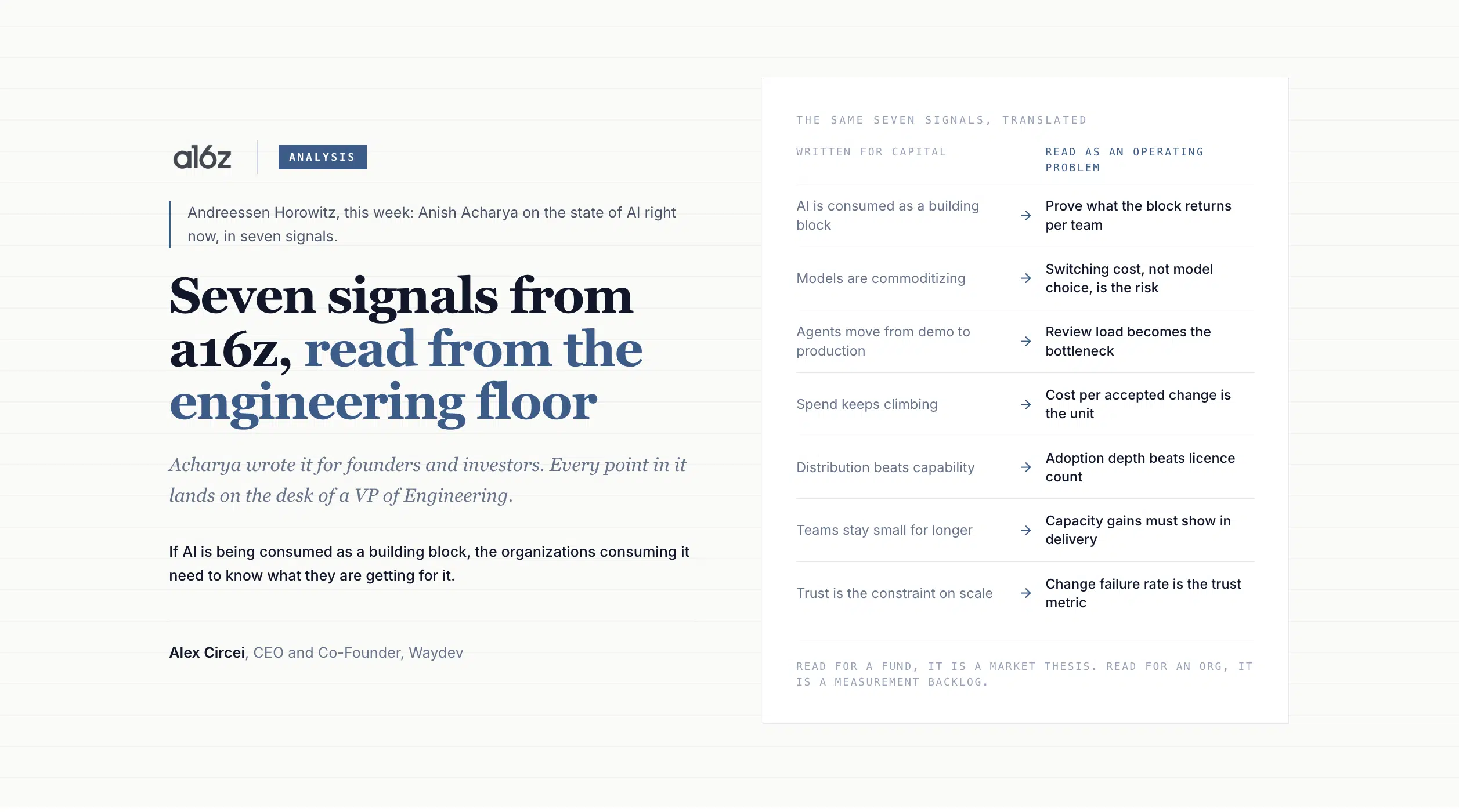
Andreessen Horowitz, this week: Anish Acharya on the state of AI right now, in seven signals.
Acharya wrote it for founders and investors. Every point in it lands on the desk of a VP of Engineering.
Andreessen Horowitz published a summary this week of Anish Acharya’s view on where AI stands right now. It is framed for people raising and deploying capital, but read it again with an engineering organization in mind and it turns into a list of operating problems.
If AI is being consumed as a building block, then the organizations consuming it need to know what they are getting for it. That is the entire premise of engineering intelligence, and it is why we built Waydev the way we did. Here is how each of the seven signals translates when you run an engineering org rather than a fund.
THE SIGNALThe old risk was that a founder’s vision outran the team’s ability to execute. Leaner teams now cover far more ground, so the risk has flipped to whether people are dreaming big enough.
For engineering leaders this is a capacity question. If your team can ship three times more than it could two years ago, your roadmap should look different. Most roadmaps do not.
The reason is that nobody has a reliable read on how much capacity AI actually freed up. Teams feel faster, but feeling faster is not a planning input.
The first job of engineering intelligence is to turn that feeling into a number: how much of your delivery is now AI-assisted, how cycle time moved on that work, and where the reclaimed hours went. Once you have that, you can raise the ambition of the roadmap on evidence instead of optimism.
THE SIGNALBusiness sophistication among founders is lower than it used to be. Technical depth is dramatically higher, and it turns out to be upstream of everything else going right.
The same shift is happening at the executive table inside companies. CTOs are being asked questions that used to belong to the CFO: what is the return on the AI tooling spend, which teams are getting value, should we buy more seats or fewer.
Deeply technical leaders are being handed a business reporting problem they never trained for. That gap is where an engineering intelligence platform earns its place. It should let a technical leader answer a board-level question without building a finance function inside the engineering org.
THE SIGNALThe two-horse model race became three in a matter of weeks. Developers follow whichever model is best right now, so no lab can count on holding its edge for long.
Your engineers behave exactly the same way. Walk any engineering floor and you will find one team on Claude Code, another on Cursor, a third on Copilot, and a fourth quietly running something nobody approved. That is not a discipline problem. It is what happens when the frontier moves monthly.
The mistake is standardizing before you understand. Measure across all of it instead: adoption and impact per tool, per team, per repository. By the time you crown a winner, the ranking has usually changed.
Build the measurement layer first, then let the tools compete inside it.
THE SIGNALThe bubble debate feels fully discussed. The more interesting question is whether we are underestimating this. High-end GPU pricing is rising on aging hardware, which suggests demand is outpacing supply.
I see the mirror image inside enterprises. Leadership teams are cautious about AI spend because they cannot prove the return, so they under-invest. Then they conclude AI is overhyped because the results were modest.
The ceiling they hit is a measurement ceiling, not a technology ceiling. The organizations getting outsized results are not the ones that spent the most. They are the ones that could see where AI worked, funded more of that, and cut the rest.
THE SIGNALNo amount of coding agents makes Nike not Nike. Network effects, scale, and brand survive cheap intelligence. The exception is the integration moat, where the advantage came purely from how painful it is to switch.
This is the most important signal for anyone buying developer tools right now, and I take it personally as a vendor. If your engineering analytics platform keeps you only because migrating off it would hurt, coding agents are about to remove that reason.
So what is durable in engineering intelligence? Depth of historical data across your organization, which an agent cannot regenerate. A methodology leaders trust, which is why we published the WAY Framework as an open standard rather than a black box. And being the system of record that procurement, security, and finance have already cleared. Those are earned rather than locked in.
THE SIGNALSome models are literal and precise. Others are open-ended and creative. A single model cannot be both, so organizations end up needing a portfolio rather than one default.
If your teams run a portfolio, your measurement has to be model-aware. A team that gets excellent results from a precise model on refactoring work may get worse results using that same model for greenfield exploration.
Averaging everything into one AI productivity number hides exactly the signal you need. Break impact down by tool and by type of work, and watch for the moment a model that used to help a team starts costing it time, well before the quarter closes.
THE SIGNALIntelligence is now a building block, the way cloud storage became one. Labs are staying in the engine room and leaving the packaging work, where the real value sits, to the companies building products on top.
Acharya’s example is Dropbox building an easy file-sharing product on top of storage it did not own. Dropbox happens to be a Waydev customer, so the analogy is not abstract for us.
We do not train models. We take the intelligence the labs produce and package it into something an engineering executive can act on: what to buy, what to cut, which teams need help, and what to tell the board. That packaging layer is where the value landed in every previous platform shift, and this one is no different.
Read together, the seven signals describe an environment where AI capability is abundant, cheap, and constantly changing hands. In that environment the scarce resource is not intelligence. It is the ability to see clearly what intelligence is doing inside your own organization.
That is the bet we have been making at Waydev since 2017, long before the current wave, and it is the bet behind the new version of the platform we launch this week. Engineering intelligence used to mean measuring how fast humans shipped code. Now it means measuring how well humans and AI ship together, and proving it to the people who sign the checks.
The labs will keep building the engines. Our job is to make sure you know where the car is going.
Alex Circei is CEO and Co-Founder of Waydev, an AI-native engineering intelligence platform measuring AI adoption, impact, and ROI across engineering organizations. Waydev is headquartered in San Francisco and serves engineering teams at American Express, Dropbox, Caterpillar, and PwC.
Ready to unlock your SDLC productivity?