By Alex Circei, CEO and Co-Founder of Waydev
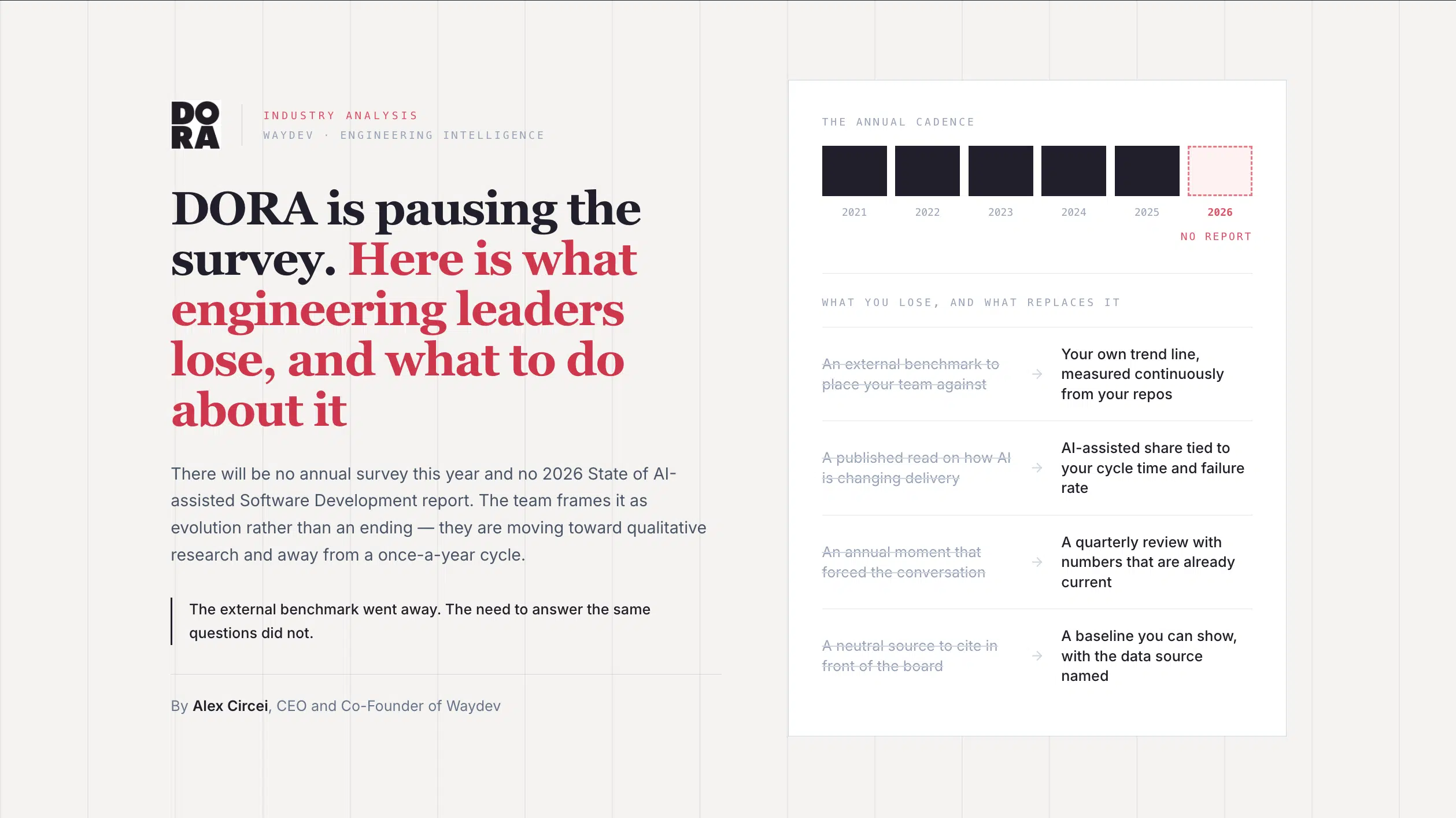
DORA announced this week that it will not run an annual survey this year, and that there will be no 2026 State of AI-assisted Software Development report. The team framed it as the next step in DORA’s evolution rather than an ending: they have been leaning harder into qualitative and observational research, and they want to move faster than a once-a-year survey cycle allows.
Read the announcement carefully and you notice what it does not say. It does not say DORA is shutting down. The community, now past 5,000 members, continues. The AI Capabilities Model and the core model continue. The research program continues.
What is being retired is a ritual: the annual survey, the annual dataset, the annual report that landed every September and gave the entire industry something to argue about for the next three months.
That ritual mattered more than most people realized, and it is worth being honest about what disappears with it.
Figure 1
Twelve consecutive years of public survey data, then a gap
For over a decade, starting in 2014, DORA surveyed engineering organizations worldwide and turned the responses into a public dataset. The 2025 report drew on nearly 5,000 technology professionals plus more than a hundred hours of interviews. Nicole Forsgren, Jez Humble and Gene Kim built the methodology, Accelerate turned it into a book, and Google Cloud kept it running after acquiring DORA in 2018.
The four metrics that came out of it, later five with reliability, became the closest thing our industry has to a common language for delivery performance. Deployment frequency. Lead time for changes. Change failure rate. Time to restore. Every engineering intelligence vendor, including mine, computes DORA metrics. Every VP of Engineering has been asked about them in a board meeting, and they still anchor most board-level engineering dashboards.
But the metrics were never the valuable part. Any competent team can compute deployment frequency from their own pipeline.
What DORA provided that nobody else did was the denominator. It told you where you stood relative to thousands of other organizations, measured the same way, in the same window, by a party with no product to sell you.
That is the piece that goes away.
I want to be fair to the decision, because I think it is more right than wrong.
An annual survey has a structural problem in an AI cycle. The 2025 report was already describing a world that had moved by the time most leaders read it. Fieldwork happens in the spring, analysis over the summer, publication in the autumn, and then teams cite the findings for another twelve months. That is a two-year-old picture of a landscape that now reshapes itself every quarter.
Figure 2
The lag: an annual instrument measuring a quarterly landscape
Self-reported survey data compounds the lag. Asking developers how much AI helped them is a measurement of perception, and perception has been the weakest part of the AI productivity conversation from the beginning. The gap between how fast engineers feel they are moving and what the system data shows has been one of the most consistent findings in this space. DORA knows this, which is presumably why they have been shifting toward observational work.
So the direction is sound. Faster, more continuous, less dependent on a single annual instrument. I would probably make the same call.
Three things, and none of them are small.
The neutral benchmark
DORA was the last widely trusted comparison set that was not produced by someone trying to sell you a platform. Now the benchmarking role falls to vendors, analysts and consultancies, all of whom have incentives. I run one of those vendors. You should discount what I say accordingly, and you should discount what my competitors say too. That is a worse epistemic position for the industry than the one we had.
The shared vocabulary
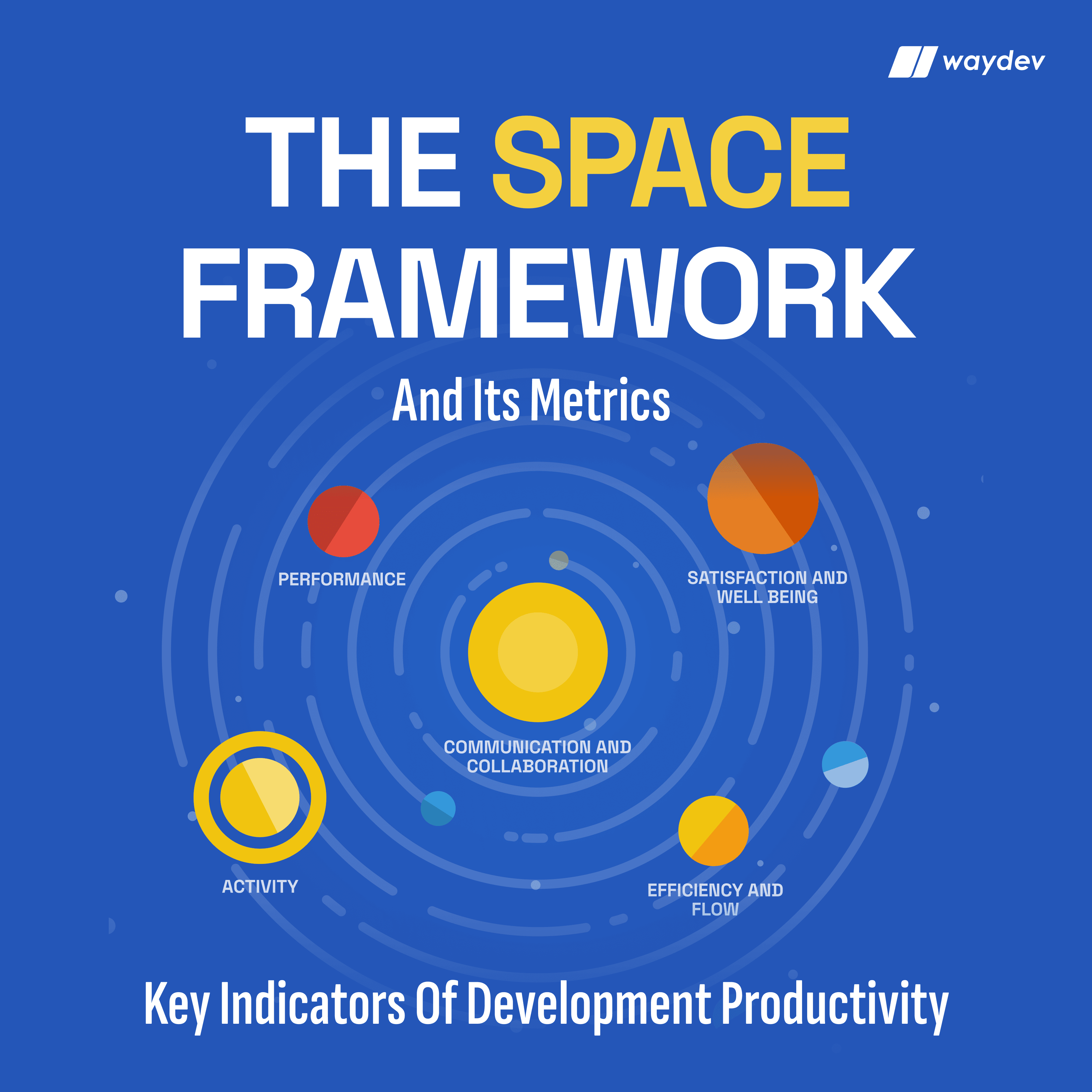
The reason DORA metrics show up in board decks is that a report published once a year, in public, for over a decade, made them the default. Frameworks that lose their annual refresh tend to calcify. In five years the four metrics may be treated the way SPACE is treated now: respected, cited, rarely operationalized.
The forcing function
The annual report gave engineering leaders a scheduled excuse to reassess. Budget season, report season, board season. Take that away and measurement quietly slides down the priority list, especially at organizations where it was never a strong practice to begin with.
The practical response is not to wait for whatever DORA publishes next. It is to stop outsourcing your baseline.
| Move | Why it matters now |
|---|---|
| Build your own longitudinal record | Industry benchmarks answer “are we normal.” Your own trend answers “are we improving,” which is the only question a board actually cares about. |
| Keep the five metrics, stop treating them as the scoreboard | They are diagnostics for flow and stability. They were never designed to prove an AI investment paid for itself. |
| Separate AI adoption from AI impact | Conflating the two is the most common mistake I see, and it produces the token-consumption leaderboards DORA itself has warned about. |
| Add your own qualitative loop | A structured quarterly conversation with fifteen engineers beats any survey instrument you could buy. Copy this part of DORA’s shift directly. |
| Instrument the AI-specific failure modes | Verification overhead, integration friction, skill degradation. These never show up in deployment frequency. They show up later in the incident channel. |
If you want the long version of the first move, we published a framework for measuring AI impact on delivery that walks through baselining, a companion piece on measuring AI adoption across large engineering organizations, and a piece on DORA metrics in the AI era that covers what the four keys can and cannot tell you once agents are writing code.
The timing point is worth stating bluntly. Baselines are only possible before behavior fully shifts. Every month of unmeasured AI adoption is pre-AI comparison data you lose forever, and with no public dataset arriving this year, nobody is going to reconstruct it for you.
Figure 3
Three measurements, not one composite score
Seat counts, active and silent users, acceptance rate, share of work with AI involvement. Tells you whether the tools are being used. Tells you nothing about whether they helped.
Cycle time, review load, rework rate, change failure rate, incident volume after adoption. This is where an AI throughput gain either survives contact with quality or does not.
Changed delivery economics against tool and platform cost. Only meaningful once the two layers above are measured separately, and only credible if finance can audit the arithmetic.
I said above that you should discount what vendors tell you. So let me be specific about what we are doing rather than ask you to take a position on trust.
When DX published Core 4 and was acquired by Atlassian for a billion dollars, the market drew one conclusion: the framework is the moat. Own the language leaders think in and you own the shortlist. Within months Cortex had DRIVE, LinearB had APEX, Uplevel had WAVE. Each one arrives with a maturity assessment and a platform that happens to be the only thing built to run it.
That was already the wrong direction for buyers. With DORA’s annual survey paused, it becomes actively dangerous. The neutral reference point is gone at exactly the moment every vendor is trying to install its own vocabulary as the replacement.
| Framework | Author | Portability |
|---|---|---|
| DORA | Independent research, now Google Cloud | Fully portable. The reason it won. |
| Core 4 | DX, now Atlassian | DXI is proprietary. Quiet lock-in. |
| DRIVE | Cortex | Requires a service catalog to measure. |
| APEX | LinearB | PR-centric, tied to its own instrumentation. |
| WAVE | Uplevel | Composite scores, needs calendar and survey data. |
| WAY | Waydev | Portable by construction. Owns no metrics. |
Our answer is the WAY Framework, and the one decision that defines it is that it owns nothing. Work-first, Agnostic, Yours. It combines DORA, SPACE, Core 4 and the AI measurement models rather than competing with them, it measures the work itself from system data at the source, and your organization’s measurement language stays your property. We do not ask you to adopt a proprietary index whose definition lives inside our product. If you leave us, your targets, your board narrative and your managers’ vocabulary all still work.
The test
A framework you cannot take with you when you leave the vendor was never a framework. If it cannot be computed by someone else, benchmarked against something outside the vendor, or explained to your CFO without a login, it is not a framework. It is a funnel.
That principle matters more this year than last. DORA’s metrics were portable, which is precisely why they became the industry default. Whatever fills the gap should meet the same standard.
On the AI question specifically, we built adoption, impact and ROI as three separate measurements rather than one composite score, for the reason in Figure 3: conflating them is how you end up rewarding token spend and calling it productivity. DORA’s own research has been warning about that trap. We agree with it, and we would rather our customers be able to check our numbers against an independent source than depend on us for the definition.
DORA established that engineering performance is measurable, that it is a systems property rather than an individual one, and that AI amplifies whatever your system already is. Those findings hold whether or not a survey runs this year.
What changes is that the industry no longer has a shared referee. Every organization now has to build its own evidence base, and the ones that do not will end up making AI investment decisions on vibes and vendor decks. Given how much capital is currently being committed to AI tooling on exactly that basis, that is not a small risk.
DORA is not retiring. The annual ritual is. The measurement work it made mandatory now belongs to you.
Build your own baseline
Our playbook for measuring AI adoption, impact and ROI covers the metrics, the operating model, and a 90-day plan to a board-ready ROI story. Written for VPs of Engineering, CTOs and platform leaders who own the AI budget. It does not assume a data team.
Keep reading: DORA metrics · The WAY Framework · DORA metrics in the AI era · DORA Metrics Playbook · Waydev vs the alternatives
Alex Circei is CEO and Co-Founder of Waydev, the AI engineering intelligence platform trusted by Fortune 500 companies including American Express, Dropbox and PwC. Waydev has been building Git-first engineering analytics since 2017 and holds a USPTO patent in Git analytics. Read the founder story.
Ready to unlock your SDLC productivity?