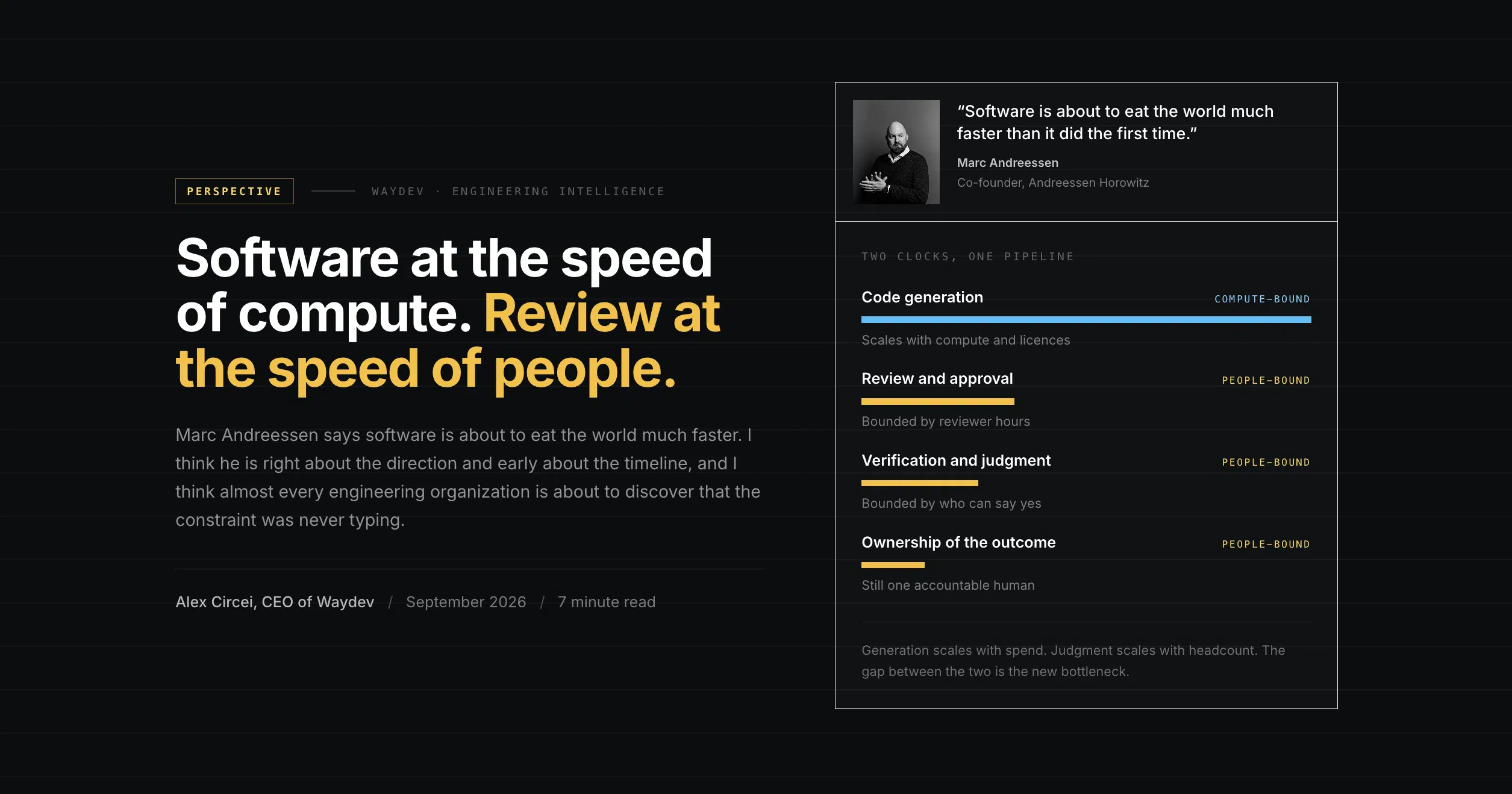
Bessemer surveyed 175 functional leaders across more than 100 portfolio companies and concluded that engineering org design is now a competitive variable. I think that is right, and I think the report understates how much of the work it implies is measurement work that almost nobody has started.
Bessemer’s talent team published Talent trends for the AI-native C-suite, built on a survey of nearly 175 functional leaders across more than 100 portfolio companies, with input from Artisanal Talent and a set of operating advisors. It covers five functions. I want to spend most of this on the engineering section, because it contains a number that should reorganize how you think about hiring.
Code generation is up 180%. Code review is up 30%.
Everything else in the engineering half of that report is downstream of those two numbers.
A six-fold difference in growth rates between two adjacent stages of the same pipeline is not a tooling gap. It is a capacity mismatch, and capacity mismatches resolve themselves as queues.
Figure 1. The figures Bessemer cites from research on productivity effects across generations of AI coding tools. Writing code and shipping code are not the same activity, and only one of them got faster.
The report’s framing is that the question engineering leaders now face is whether they have actually redesigned the organization to take advantage of AI, or whether they are running a 2022 team structure inside a 2026 product environment. That is the right question, and the honest answer in most companies is the second one.
Look at what a typical org chart optimizes for. Ratios of engineers to managers, sized around how much implementation one person could produce. Scoping practices built around multi-week estimates of typing effort. Review treated as a peer courtesy rather than a staffed function with its own capacity plan. Every one of those assumptions was calibrated against the constraint that just moved.
Figure 2. My reading of what the 180 and 30 figures imply for org shape. Bessemer’s point about coordination overhead shrinking is in here too, and it is the one most leaders will find politically hardest.
You cannot keep a 2022 ratio of implementers to reviewers and call the result an AI-native engineering org.
The single most copyable thing in the whole report is one paragraph about method. The engineering leaders getting the clearest results start with a deliberately small team, sometimes an undersized scrum of three or four engineers, measure the output that team can actually hit, and only then scale the model across the organization. They track tooling and token cost against output gain, and roll the practice out further only when the return is positive.
That is a controlled experiment. It is also, in my experience, the part that gets dropped first, because the pilot produces an enthusiastic team and a good demo, and nobody wants to be the person who asks for the denominators.
Figure 3. The controlled rollout pattern described in the report. Note that both the numerator and the denominator have to be measured, which is why most organizations quietly skip to the last box.
One of their operating advisors, Jessica Popp, puts the obligation plainly: “Leaders can’t just evangelize AI.” The responsibility is to show that each use case delivers a positive and measurable return. I would go further and say that in 2027 this stops being a leadership virtue and becomes a reporting requirement, because boards have started asking and the answers so far have been embarrassing.
The archetype the report describes for engineering leadership is the player-coach builder, sometimes called the Super IC: someone deeply involved in the codebase, using the tools personally, shipping alongside the team, while still making the architectural and organizational calls. Shopify’s Farhan Thawar is quoted on the urgency of harnessing agents this year, and the report argues the leader who can do both people-scaling and this transition will pull ahead.
I agree with the archetype. I run a company where I am still close enough to the work to have opinions about it, and I would not hire an engineering leader in 2026 who could not open a terminal.
But there is a specific failure mode worth naming, because it is going to produce some spectacular flameouts over the next eighteen months. A leader who is personally 10x more productive with agents can mistake their own throughput for the system’s throughput. They ship impressively, their pull requests pile into a review queue their team is already struggling with, and the organizational work of restructuring ratios and rebuilding quality gates gets postponed because the leader is busy demonstrating that the new way works.
Personal fluency is necessary and it is not the job. The job is the system. The tell in an interview is whether a candidate talks about what they built with agents, or about what changed in their team’s numbers after they did.
The cross-functional numbers in the report are as interesting as the engineering ones. Ninety percent of their portfolio’s engineering teams are actively deploying AI. Only 24% of finance leaders are, with data quality, system fragmentation, security and compliance cited as the blockers. Forty-nine percent of companies say they are already delivering more without adding headcount, and 86% of leaders expect AI to meaningfully change how their team operates within twelve months.
Figure 4. Adoption by function, from the report. The spread between engineering and finance is the practical reason so many AI programmes cannot produce a credible return number.
That spread has a consequence the report does not draw out. If engineering is at 90% and finance is at 24%, then the function that would normally validate an ROI claim is the function least equipped to evaluate it. Engineering makes the claim, finance lacks the instrumentation to check it, and the number that reaches the board is unverified by anyone independent of the programme that produced it.
Bessemer’s own recommendation, that the return on tooling and token spend should be treated as a leadership metric rather than an IT line item, only works if somebody outside engineering can audit it.
| The 2022 engineering leader | What the report describes | |
|---|---|---|
| Primary constraint | Engineering hours available to write code | Review, verification and specification capacity |
| Unit of planning | The quarter, the sprint, the estimate | The day or the week, with roadmaps compressed accordingly |
| Org design | Inherited ratios, mid-level management for coordination | Ratios as a live variable, smaller autonomous pods, less coordination overhead |
| Measured on | Delivery against plan | Delivery, plus a defensible return on tooling and token spend |
| Personally does | Reviews the architecture, reads the dashboards | Ships in the codebase while making the structural calls |
| Customer contact | Escalations and the occasional QBR | Expected, and increasingly formalized through forward deployed roles |
The blurring the report describes is real and it runs in both directions. Product leaders are expected to understand model performance. Engineering leaders are expected to spend more time with customers. The Forward Deployed Engineer, along with the Field CTO and Field CISO variants, is the structural expression of that: technical people moved closer to the front line because the front line now asks technical questions a traditional sales engineer cannot answer.
One of their operating advisors, Barak Turovsky, makes the point that the most consequential AI decisions a CEO makes are about operating model design rather than model selection. I think that will read as obvious in three years and it is not obvious yet.
The report suggests turning interviews into working sessions, which is right. Here is my version for an engineering leadership hire.
The report is written for CEOs hiring executives, so it naturally frames the answer as a person. Find the right leader and the org design follows. In my experience the causality runs the other way at least as often. Leaders inherit measurement systems, review cultures and ratio assumptions that they cannot see well enough to change, and a brilliant hire dropped into an uninstrumented organization spends their first year arguing from anecdote like everyone else. The hire matters enormously. Give them a baseline and an instrument panel on day one and they will matter twice as much.
The sentence I keep coming back to is the framing about running a 2022 team structure in a 2026 product environment. It is a good question precisely because most leaders cannot answer it with evidence. They know their tools changed. They can feel that the shape of the work changed. Very few can show you what happened to their ratios, their review capacity, their rework rate or their cost per shipped change over the same period.
Org design is a competitive variable now, as Bessemer says. Variables are things you measure. That is the part of this that is not a hiring problem.
Source: Bessemer Venture Partners Talent Team, Artisanal Talent and Atlas Editors, Talent trends for the AI-native C-suite, September 2026, based on a survey of nearly 175 functional leaders across more than 100 portfolio companies. The 180% and 30% figures are cited in that report from research published by CEPR on productivity effects across generations of AI coding tools. Quoted and paraphrased contributors include Bessemer Operating Advisors Jessica Popp and Barak Turovsky, and Shopify’s Farhan Thawar. Figures 1 to 4 are my own; Figure 2 is my interpretation rather than a model proposed by Bessemer.
Ready to unlock your SDLC productivity?