





Waydev
AI-native engineering intelligence for CTOs, VPs of Engineering, and large technology organizations.
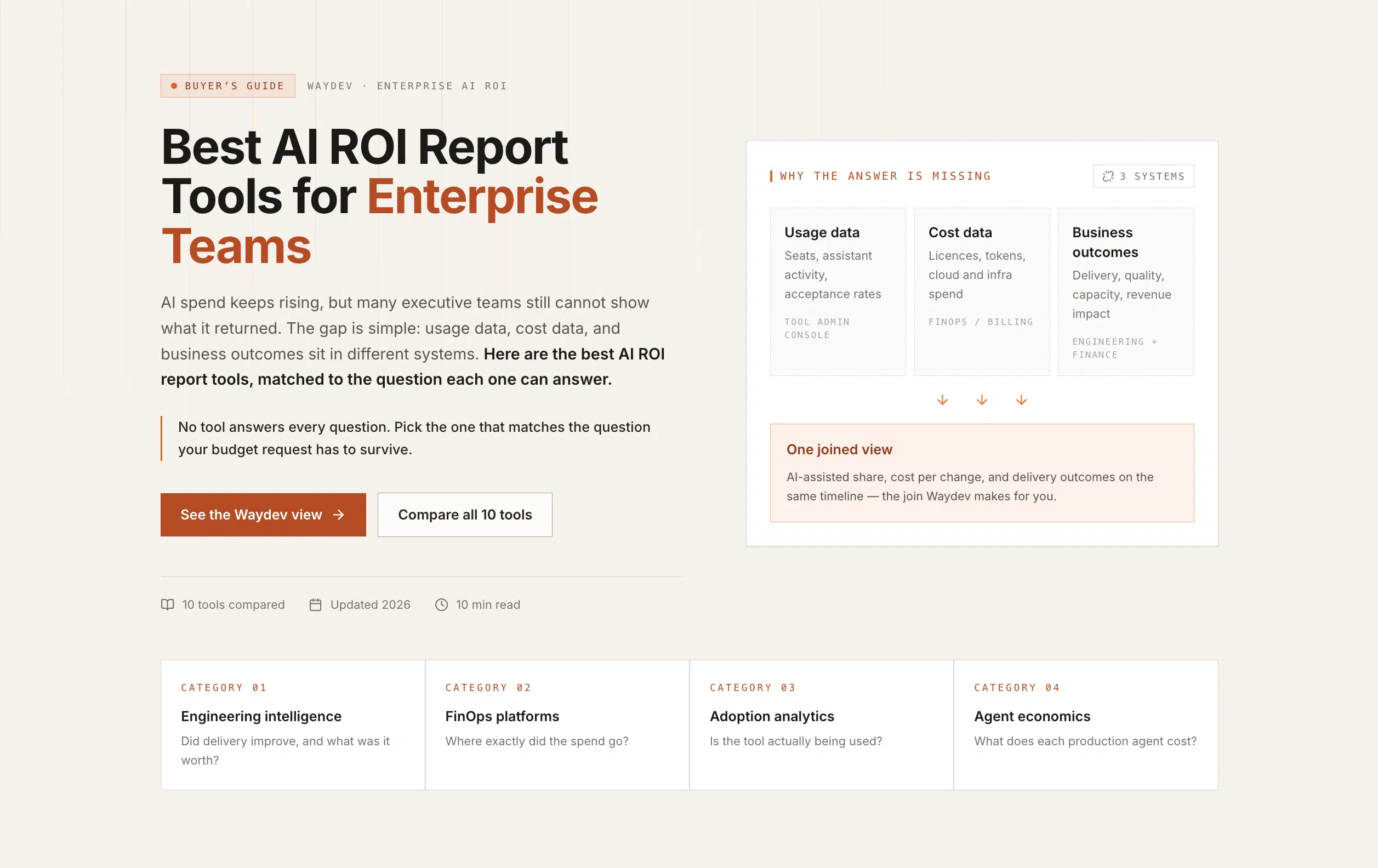
Waydev connects AI adoption to delivery speed, quality, team capacity, and financial value. We built it for the question boards now ask out loud: did our AI coding investment make software delivery better, and by how much?
Ask Waydev turns Git, project, review, deployment, and AI tool data into answers without sending leaders hunting through static dashboards. AI Checkpoints surface quality risk before it merges. Signals flag bottlenecks in Slack. Predict & Improve turns delivery trends into an action list.
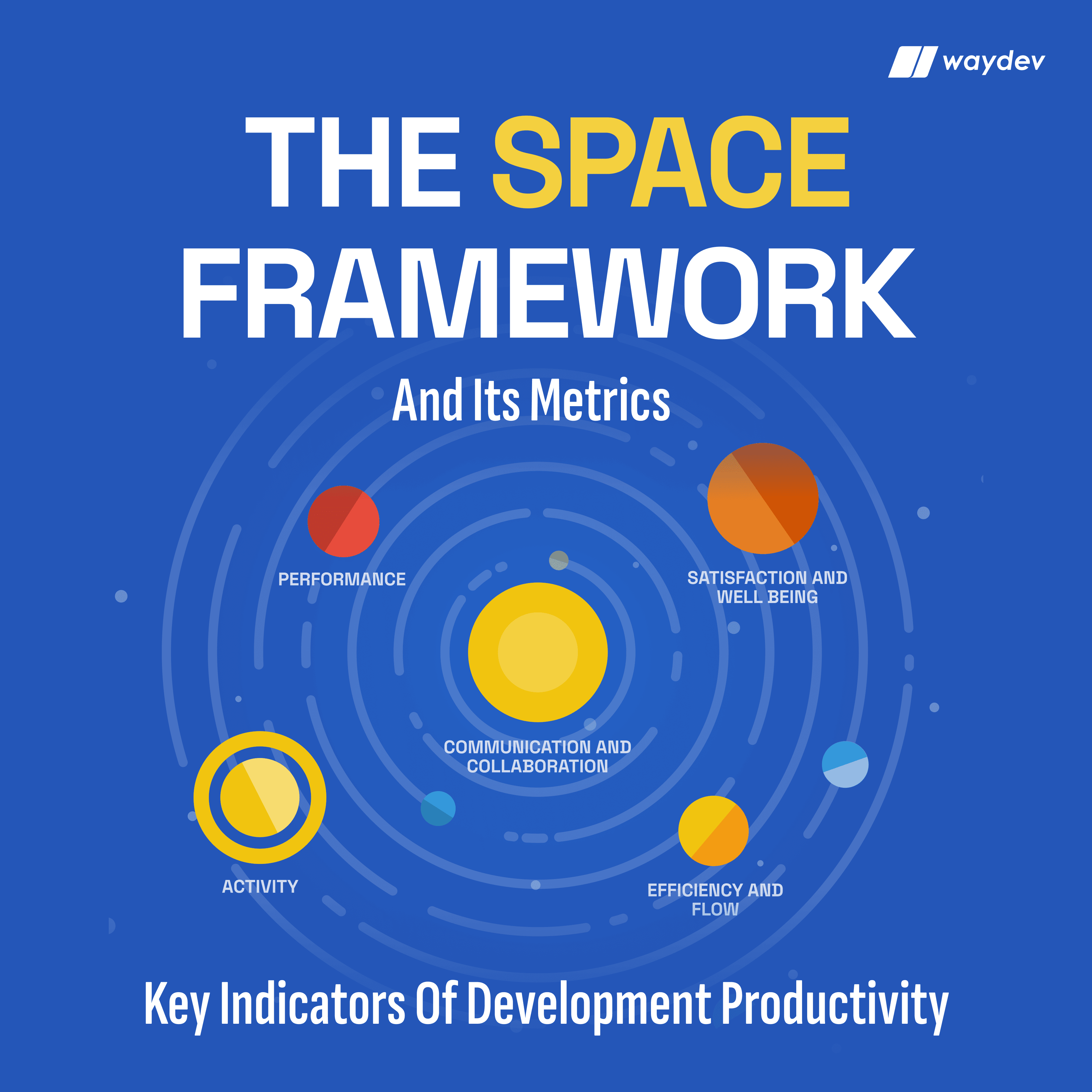
It supports established engineering measurement frameworks and connects to GitHub, GitLab, other repository and DevOps systems, Jira, Cursor, GitHub Copilot, and MCP. The output is granular visibility at the team, repository, product, and investment level, never a ranking of individual engineers.
Nine years in engineering intelligence, a USPTO patent in Git analytics, and enterprise customers including American Express, Dropbox, and PwC sit behind that. For a finance-ready rollout, our guide on how to prove AI coding ROI to the board shows how to set baselines and keep measured value separate from assumptions, and our walkthrough on measuring AI adoption across large engineering organizations covers the usage layer underneath it.
Adoption, delivery, quality, and team-level ROI in one board-ready view.
More than you need if the only goal is watching model tokens or cloud spend.
CloudZero
Cost allocation by customer, product, and feature for engineering and finance teams.
Its strength is allocation. CloudZero maps AI, cloud, Kubernetes, and SaaS costs to business dimensions such as products, customers, teams, and transactions. A CFO can ask what a single feature costs to run instead of accepting one large cloud bill.
That fits shared infrastructure and multi-tenant products, and it supports unit economics when AI usage moves with volume. The company describes a financial control plane that links spend to business context, which is the right tool when gross margin is the concern.
Allocation and unit economics across cloud, Kubernetes, SaaS, and AI.
It cannot tell you whether employees used their AI licenses, or what those licenses produced.
Finout
Enterprise FinOps for teams that already run cost governance at scale.
Its best use is consolidation. Finance and cloud teams bring AI costs into existing views of cloud, Kubernetes, and SaaS spend, so the business reviews one budget instead of treating every model provider as its own project. It makes sense when procurement, finance, and platform engineering already share cost controls.
The distinction matters. A cost report can show that an AI program spent less this month. It cannot show, on its own, that the program shipped safer software or reached customers sooner.
Consolidated cloud and AI spend inside one governance model.
Needs an established FinOps function, and says nothing about cycle time or rework.
Larridin
Adoption, proficiency, and governance evidence for a company-wide budget defence.
Its model goes past logins. Larridin frames impact as utilization multiplied by proficiency multiplied by value, which is useful when adoption is high but productivity is flat. Leaders get to ask whether staff use the tools well, not only whether seats are active.
It also addresses shadow AI. Unapproved tools sit outside the official budget, and audits routinely surface more of them than expected, so discovery becomes part of the ROI model. Missing usage means missing cost and missing risk data.
Utilization, proficiency, value, and governance across many business functions.
Custom enterprise pricing makes the buying process heavy for smaller teams.
Nebuly
Analytics for live internal or customer-facing conversational agents.
Nebuly analyzes what people ask an agent, which teams use it, where users get stuck, and whether tasks reach completion. Product and CX leaders get outcomes instead of conversation volume.
For an internal agent it shows adoption by department and where training is needed. For an external agent it surfaces churn signals, upsell interest, and recurring customer needs, which connects agent use to revenue questions.
Agent adoption, task success, and the intent signals inside conversations.
Requires deployed conversational agents. Limited value for coding assistants or delivery metrics.
A cost report proves you spent less. It never proves you shipped better.
Revenium
Production agent economics where cost, revenue, and task success are measured together.
Its reports connect telemetry to customers, products, agents, models, and task types. Teams compare estimated value against compute cost, inspect spikes, and review profitability by customer or product tier. Budgets and anomaly views help too, and a product team might discover that one agent is looping or calling an external API far too often.
The caveat is setup. Cost sources need manual registration, and report quality depends on attribution metadata such as customer, product, and task. Without those tags you get cost with nothing to compare it against.
Agent cost, revenue, margin, and budget control for AI sold inside a product.
Needs well-tagged telemetry before the ROI view means anything.
Vantage
Self-serve AI and cloud cost visibility for teams without a FinOps function.
Finer tracking is not the same as better allocation, and that trade-off is easy to miss when a vendor leads with token-level detail. Vantage has shallower allocation depth than dedicated FinOps platforms, which is a fair price for speed of setup.
Fast, self-serve spend visibility with granular token tracking.
Will not satisfy a finance team that needs cost per customer, product, or transaction.
Worklytics
Observed work data for leaders facing a large AI license renewal.
Its angle is observed work data, linking AI spend to time saved and output expressed in dollars. That lets procurement test a claim like “we need every seat again” against real work patterns, and it helps separate broad adoption from meaningful use. A high login count has never proved that a tool changed business results.
Workforce-level value realization and time-to-output evidence for renewals.
Scope. It will not replace code-level analysis or cloud cost allocation.
Exceeds AI
Code-level impact analysis across several AI development tools.
Its differentiator is attribution at the commit and pull request level, with support for GitHub, Cursor, Claude Code, GitHub Copilot, and Windsurf. Engineering leaders can compare AI-touched code against everything else while tracking quality and later rework.
That depth matters because metadata alone cannot show which lines came from an AI tool. A fast pull request still creates technical debt if much of the code gets rewritten two sprints later, and longitudinal tracking is what exposes that delayed cost.
Commit, PR, tool, and code-level outcomes with provenance.
Narrower than an enterprise governance system or customer-level unit economics.
Faros AI
Causal analysis across team structure, project complexity, and delivery conditions.
Instead of treating every delivery change as an AI effect, Faros looks across the factors that might explain the result. That helps an executive team avoid claiming ROI when the real cause was a process change or a shift in project mix. It suits organizations with mature telemetry and shows how individual output, organizational throughput, quality, and workflow strain move together.
System-wide delivery analysis with attention to confounding factors.
Less close inspection of commits and pull requests than a specialized code-level platform.