Aligning engineering efforts with business objectives means connecting what your engineers ship to the outcomes your company is actually chasing, revenue, retention, market share, so that both sides can point to the same numbers instead of arguing from different ones. Most misalignment traces back to two things: teams talking past each other in different vocabulary, and nobody tracking the metrics that would settle the argument with data.
How do you justify engineering investment to the business with data? Track the metrics executives already care about: cycle time (how fast code reaches production), deployment frequency, change failure rate, and project cost variance. Map each one to a business outcome, for example, a shorter cycle time enabling faster revenue capture.
A platform like Waydev surfaces these numbers in one place, which gives a Head of Engineering a data-backed case for headcount, tooling, or infrastructure spend instead of an opinion.
Misalignment between engineering and business teams usually comes from three sources. Business and engineering teams use different terminology for the same problem, which produces misunderstandings that look like disagreement but are actually translation failures. Siloed operations reduce the cross-team communication that would normally catch a mismatch early. Priorities diverge by default: business teams optimize for immediate market impact, while engineering optimizes for long-term stability, and neither side is wrong.
Regular cross-functional meetings close most of this gap on their own. A lack of unified goals is what lets departments drift apart quietly over a quarter until the drift becomes a visible problem in a board deck.
Misalignment between engineering and product teams causes delays and frustration that show up first in morale and burnout risk, long before they show up in a missed deadline. High cycle times are usually the earliest visible symptom: delivery slows, review periods stretch, and developer satisfaction drops in step with it. Left unaddressed, these delays inflate project costs and drag on overall business performance.
The reverse is just as measurable. Aligning engineering efforts with business objectives improves both productivity and team engagement, and the resulting gains in project outcomes and business performance are the strongest argument for treating alignment as a first-class initiative rather than a soft goal.
Metrics give alignment a shape both sides can see. Defining explicit, measurable business objectives, growing market share, improving customer satisfaction, lets business leaders state what they actually want, and a data-driven approach is what confirms engineering effort is moving those numbers rather than just staying busy.
The duration from first commit to production release. Tracking it surfaces the exact stage where work stalls, coding, review, or deployment, so the fix targets the real bottleneck instead of a guess.
Faster cycle time is not just an engineering metric. Quicker feature releases mean faster market adaptation and, often, faster revenue capture, which is the translation a CFO actually needs to hear.
High code quality minimizes technical debt and keeps a project sustainable long past its first release. It shows up as fewer bugs, a more stable product, and fewer emergency fixes pulling engineers off planned work.
Measure it with concrete indicators like bug volume and Change Failure Rate (CFR), which tracks how often a production change fails. Both give a clear read on where quality is slipping before it becomes a customer-facing incident.
How often a team ships, and a direct proxy for how quickly it can act on user feedback and shifting market conditions. Frequent deployment is what makes an engineering culture adaptive rather than reactive.
Waydev’s DORA metrics report gives visibility into lead time, change failure rate, and deployment frequency together, benchmarked against industry norms, so you know whether a number is actually good or just familiar.
| Metric | What it measures | Business outcome it supports |
|---|---|---|
| Cycle time | First commit to production release | Faster revenue capture, quicker response to market shifts |
| Code quality / CFR | Bug volume, share of changes that fail in production | Fewer emergency fixes, capacity freed for new features |
| Deployment frequency | How often the team ships to production | Faster response to user feedback, stronger competitive position |
| Project cost variance | Actual spend against planned budget per initiative | Predictable engineering ROI the finance team can plan around |
Scroll the table sideways on a small screen.
Aligning engineering with business goals is what makes resource allocation, planning, and cost control actually work, because every one of those decisions needs a shared definition of what matters. Three strategies do most of the work: goal setting and prioritization, resource allocation and planning, and cost monitoring and control.
Clear, well-defined goals link every engineering task to the company’s broader strategy, so resources go where the business impact is highest rather than where the loudest team asked first.
Involve engineering teams in goal setting itself. Ownership follows buy-in, and teams that helped set a goal align their daily work to it without being told to.
Alignment requires deliberately putting the right resources on the right projects at the right time. Without that discipline, teams overcommit or sit underused, and both outcomes raise project cost.
With Waydev’s Resource Allocation and Resource Planning, leaders visualize team capacity, spot gaps, and reallocate as business demands shift, keeping critical projects on track without burning teams out.
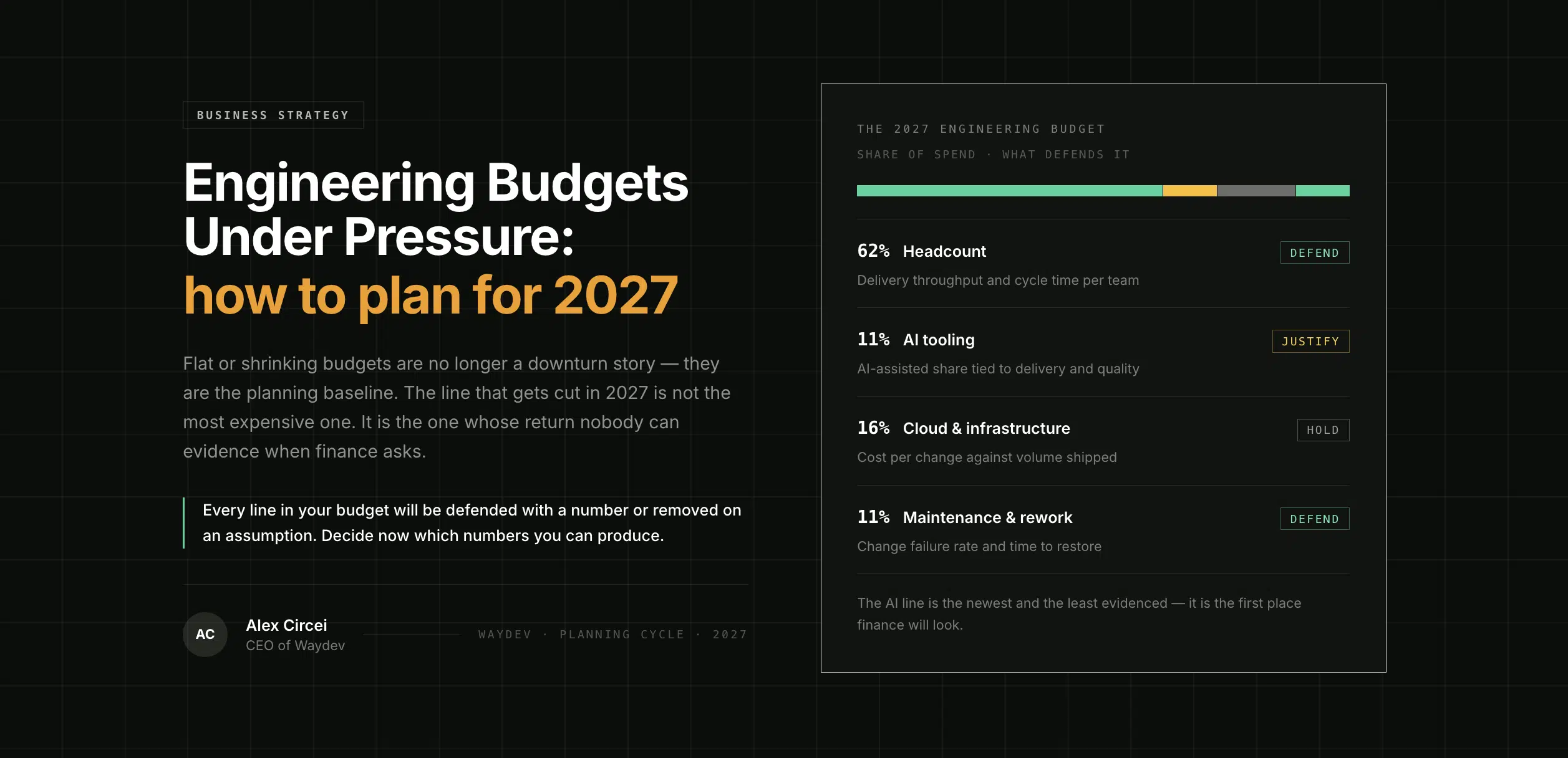
Cost overruns derail strategic goals and limit future investment. Watching spend closely is what keeps financial discipline and engineering ROI in the same conversation.
Waydev’s Project Costs feature shows the financial side of engineering work in real time, so leaders can act on overspend while there is still time to correct it, and report cost variance with the same confidence as a delivery metric.
Alignment isn’t a meeting you hold once. It’s a set of numbers both sides agree to look at, and a habit of looking at them together.
Track the metrics executives already care about: cycle time, deployment frequency, change failure rate, and project cost variance. Map each metric to a business outcome, such as shorter cycle time enabling faster revenue capture. A platform like Waydev surfaces these numbers in one place, giving you a data-backed case for headcount, tooling, or infrastructure spend rather than an argument built on intuition.
Three things, most often together: different terminology producing translation failures rather than real disagreement, siloed operations that block the communication that would catch drift early, and genuinely different priorities, with business optimizing for immediate market impact and engineering optimizing for long-term stability.
Cycle time, code quality (including Change Failure Rate), deployment frequency, and project cost variance. Together they cover speed, stability, responsiveness, and financial predictability, which is the full set a business audience actually asks about.
Regularly and structurally, not only when something has already gone wrong. Recurring cross-functional reviews, paired with shared metrics both sides trust, catch drift while it is still a small adjustment rather than a quarter-ending surprise.
Aligning engineering efforts with business objectives comes down to a small number of practices: setting clear goals, prioritizing deliberately, and reviewing progress on a cadence rather than by accident. Data-driven decision-making, measured against well-defined metrics, is what turns “we think we’re aligned” into “here’s the number that proves it,” and that shift is what makes engineering a visible driver of business performance rather than a cost center defending its budget every quarter.
Continuous improvement is the operative phrase. Alignment isn’t a project with an end date; it’s a habit of regular evaluation and adjustment that keeps paying off for as long as you keep doing it.
Connect your repositories and get cycle time, DORA metrics, resource allocation and project cost in one view, the same data your business stakeholders will ask for.
Schedule a DemoBuild the data-backed case for your next engineering investment.
Ready to unlock your SDLC productivity?