Waydev Research · Transparent engineering AI measurement
AI adoption is observable; AI return on investment must be demonstrated. This resource explains how an engineering organization can evaluate the cost and impact of AI coding assistants and agents alongside delivery performance, software quality and Developer Experience—without treating code volume or tool activity as productivity.
Evidence status: This page publishes measurement definitions, a suggested data dictionary and a reproducible evaluation protocol. It is not a published multi-customer outcome dataset, and no real customer-level ROI observations are asserted here.
Read Waydev’s existing 2026 research protocol · Explore Waydev Brain
| Field | Meaning / recommended treatment |
|---|---|
period_start, period_end |
UTC observation period; record any missing intervals |
org_id, team_id, service_id |
Pseudonymous stable units; exclude identifying employee information from public datasets |
work_type, work_items |
Comparable change or task categories, including completed and reopened counts |
ai_tool, ai_active_users |
Tool family and active users with a stated activity threshold |
ai_license_cost, ai_usage_cost |
Currency, basis and sources for billed or allocated cost |
review_hours, rework_hours |
Measured or estimated time; record estimation method |
accepted_changes, deployed_changes |
Define accepted vs deployed separately; deduplicate merges/reverts |
change_lead_time, deployment_frequency |
DORA throughput measures at service level |
change_fail_rate, recovery_time, deployment_rework_rate |
DORA instability and recovery outcomes |
developer_feedback, missingness_rate |
DX/SPACE feedback with survey methodology and coverage caveats |
A useful starting point is net value = defensible incremental benefit − fully loaded incremental AI cost and ROI = net value / incremental AI cost × 100%. Benefits should reflect measurable avoided effort or higher-value work that actually materialized, not assumed value for every AI-written line.
Hypothetical example only: if verified additional benefit over a matched baseline were $25,000 and the combined incremental software, tokens, review, infrastructure and rework costs were $20,000, net benefit would be $5,000 and ROI would be 25%. These are made-up inputs for explaining a formula, not observations or Waydev customer performance.
Alternative when benefits cannot be monetized reliably: report cost per accepted change and production quality outcomes, with a confidence range, rather than inventing dollar savings.
The field dictionary above is a proposed export contract, not a claim that its rows already exist publicly. An evidence release should include a dated CSV/Parquet dataset or aggregate workbook, schema and units, inclusion criteria, participant counts, data completeness, data provenance, analysis scripts and a limitations section. Customer authorization and disclosure control are prerequisites.
Use Prompt Dashboards to bring together engineering metrics; Waydev Agent to investigate questions; AI Governance and Limits to understand controls; and the DORA/SPACE/DX Framework Guide to avoid one-dimensional interpretations.
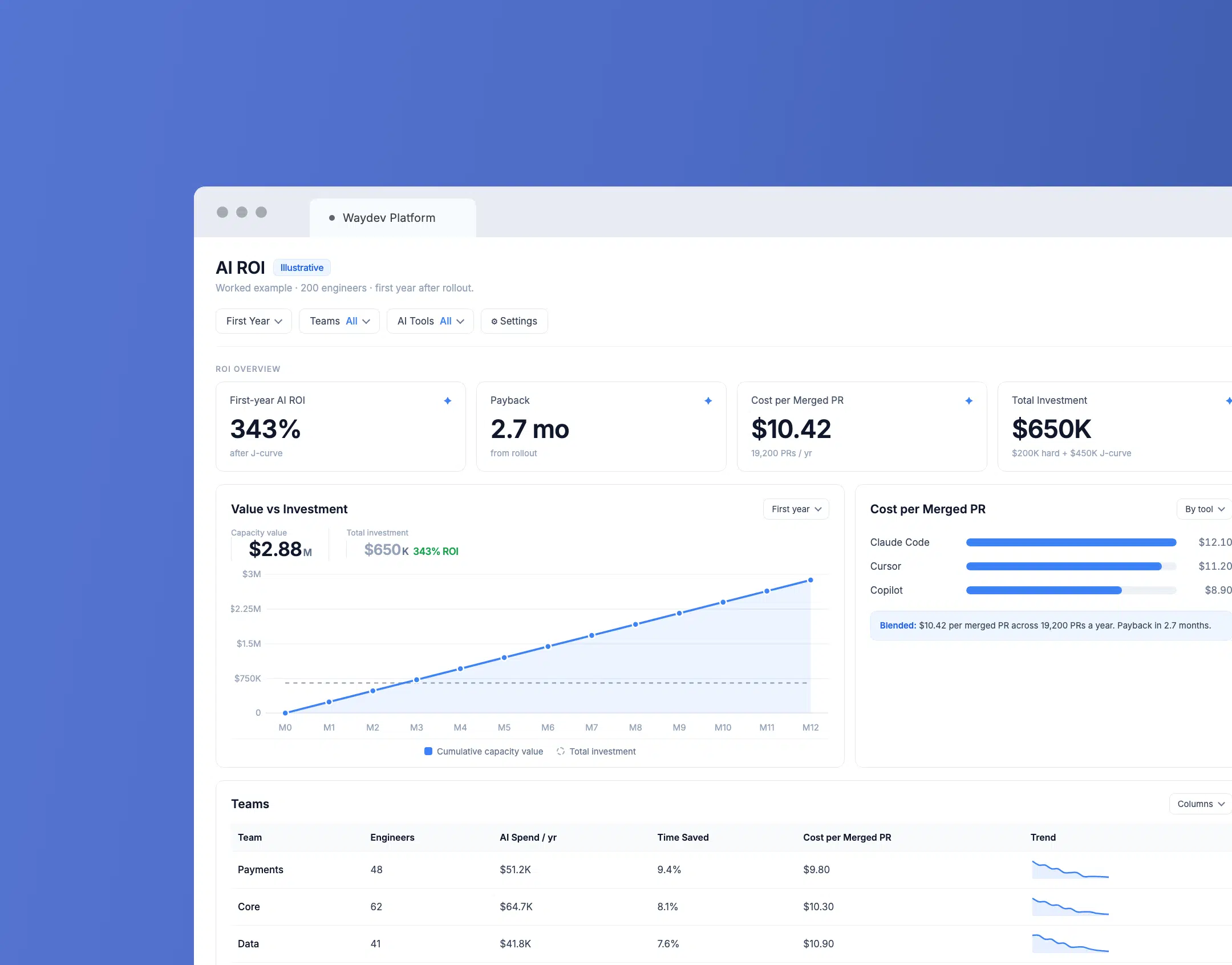
Request a Waydev enterprise AI ROI measurement walkthrough →
Methodology hub, version 1.0, October 2026. No unpublished customer data or proprietary participant results are disclosed here. Commercial terms are available privately.