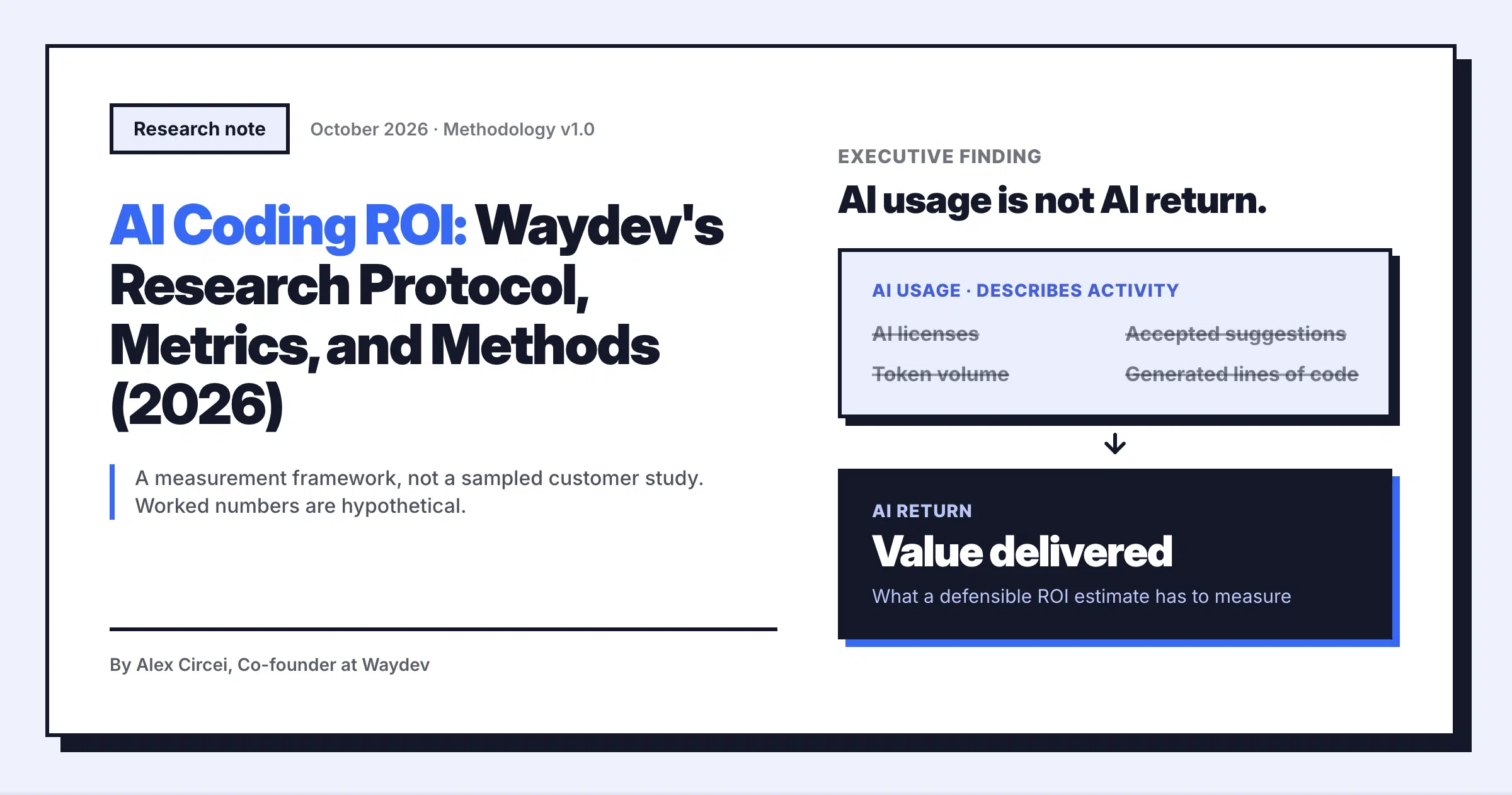
Research statusThis is Waydev’s original measurement framework for evaluating AI coding return on investment, not a study reporting outcomes from a sampled set of customers. We have not published a verified cross-customer productivity uplift or dollar ROI estimate here. Worked numbers below are explicitly hypothetical.
Executive finding
AI usage is not AI return
AI licenses, accepted suggestions, token volume and generated lines of code describe activity, not value delivered. For a defensible ROI estimate, a team must examine accepted changes reaching production, delivery time, rework, reliability, developer experience and fully loaded spend over the same observation window. We propose a measurement unit: cost per accepted production change, segmented by work type and quality. It is a proposed operational metric, not a universal industry standard.
External evidence
What external evidence says and does not say
GOOGLE CLOUD · DORA 2025
Google Cloud’s 2025 DORA State of AI-assisted Software Development draws on nearly 5,000 survey respondents and more than 100 hours of qualitative data. Its central finding is that AI tends to amplify an organization’s existing capabilities, making workflow and platform quality important for outcomes. This does not establish a universal financial ROI figure for coding assistants.
METR · RANDOMIZED TRIAL, EARLY 2025
In METR’s randomized trial of early-2025 tools, 16 experienced open-source developers completed 246 tasks, and AI-allowed work took 19% longer on average in that particular setting. This result should not be generalized to every team, model generation or task. Together, these findings make causal attribution, task segmentation and honest uncertainty essential.
The scorecard
Waydev’s proposed seven-measure AI ROI scorecard
1ADOPTIONWeekly active users, workflow coverageWhether teams actually use paid AI tools
2DELIVERYLead time, review wait, deployment frequencyWhether work moves through the SDLC faster
3QUALITYChange failure, defects, rework/churnWhether throughput comes with hidden costs
4OUTCOMEAccepted changes reaching production by work classOutput that passes validation and reaches users
5COSTLicenses, inference/tokens, integration, oversightFully loaded AI investment
6EXPERIENCEDeveloper survey measuresFriction and sustainable adoption
7BUSINESSTime-to-value, validated capacity or revenue impactBusiness benefit, with attribution limitations
Definition
Definition: cost per accepted production change
FORMULA
Cost per accepted production change = (engineering effort cost + AI tool and inference cost + review/rework and infrastructure cost) / accepted changes released to production.
Use a consistent definition of “accepted,” account for rollbacks and severity, and segment by feature, bug fix, migration and operational change. Avoid rewarding tiny change size or incentivizing surveillance of individuals.
FORMULA
Incremental ROI = (attributable benefit from AI-enabled workflows − incremental AI program cost) / incremental AI program cost.
Benefit must be costed conservatively and should not count time saved as cash savings unless it is actually redeployed, avoids additional hiring, or produces a measurable financial result. Report a range when benefits cannot be confidently monetized.
Consider a hypothetical team releasing 100 comparable accepted changes per month. Without AI, fully loaded delivery cost is $200,000, or $2,000 per accepted change. With AI, suppose delivery cost becomes $195,000 and tool plus governance costs total $15,000. Fully loaded cost then becomes $210,000, or $2,100 per accepted change, a 5% increase rather than an ROI gain. If the team instead ships 120 changes at the same $210,000 with unchanged quality, cost per accepted change becomes $1,750, but even then higher change count alone does not prove higher revenue or business value.
Synthetic example. Not Waydev customer data.
Research design
Research design: how to test AI’s incremental effect
1Preregister hypotheses.Example: AI-assisted teams improve median lead time without increasing severity-weighted change failure or rework.
2Fix units and scope.Specify repositories, teams, services, work classes and AI tools. Describe exclusions before measuring.
3Establish a baseline.Use multiple delivery cycles before rollout where feasible, and document organizational changes.
4Compare like with like.Prefer randomized rollout or matched cohorts; account for team size, task complexity, release calendars, seasonality and incidents.
5Join system events.Connect AI telemetry, source control, PR reviews, CI/CD, issue trackers, production deployments, finance and surveys with governed identifiers.
6Publish uncertainty.Show denominators, missing-data rates, confidence intervals where appropriate, and sensitivity to cost assumptions.
7Check for harm.Audit rework, security, quality, developer experience and measurement gaming, not only cycle-time improvements.
Transparency
Data provenance and limitations
FIRST-PARTY CONTRIBUTIONThe operational metric definitions, scorecard, illustrative model and study design on this page were assembled by Waydev.
EXTERNAL EVIDENCEGoogle DORA’s 2025 report and METR’s early-2025 randomized trial are cited and attributed above.
NOT MEASURED IN THIS PUBLICATIONWaydev customer-level AI impact, actual customer ROI, representative industry lift, or causally identified financial gains. The example is synthetic. This framework should be validated with an explicitly defined dataset before any benchmark or performance promise is made.
FAQ
Questions engineering leaders should ask
What is the best single metric for AI coding ROI?
There is no universal single metric. Cost per quality-adjusted, accepted production change is a useful proposed operational lens, but it should be paired with business outcomes, reliability and developer experience.
Can accepted AI suggestions prove productivity?
No. Suggestion acceptance measures tool use and interactions, not whether the change safely reached production or produced business value.
How do we avoid attributing ordinary improvements to AI?
Use matched or randomized cohorts, consistent time windows, work-type segmentation, documented confounders and sensitivity analysis.
Does this research prove Waydev users achieve a positive ROI?
No. This publication defines a testable measurement method. It does not report verified Waydev customer outcomes.