Engineering measurement · DORA · SPACE · Developer Experience
Use DORA to understand how reliably software reaches production, SPACE to evaluate developer productivity across human and technical dimensions, and DX to discover the friction and experience affecting teams. These frameworks overlap, but they answer different questions. No single productivity score can replace them.
How Waydev Brain helps engineering leaders investigate signals →
| Lens | Primary question | Practical use | Limitation |
|---|---|---|---|
| DORA | Are changes delivered efficiently and safely? | Deployment, throughput and stability | Does not explain morale or all causes of delays |
| SPACE | How productive and sustainable is engineering work? | Satisfaction, outcomes, activity, collaboration, flow | Requires multiple measures; not one universal index |
| DX/DevEx | What helps or hinders engineers doing good work? | Tooling, cognitive load, feedback and flow | Perception data needs pairing with operational evidence |
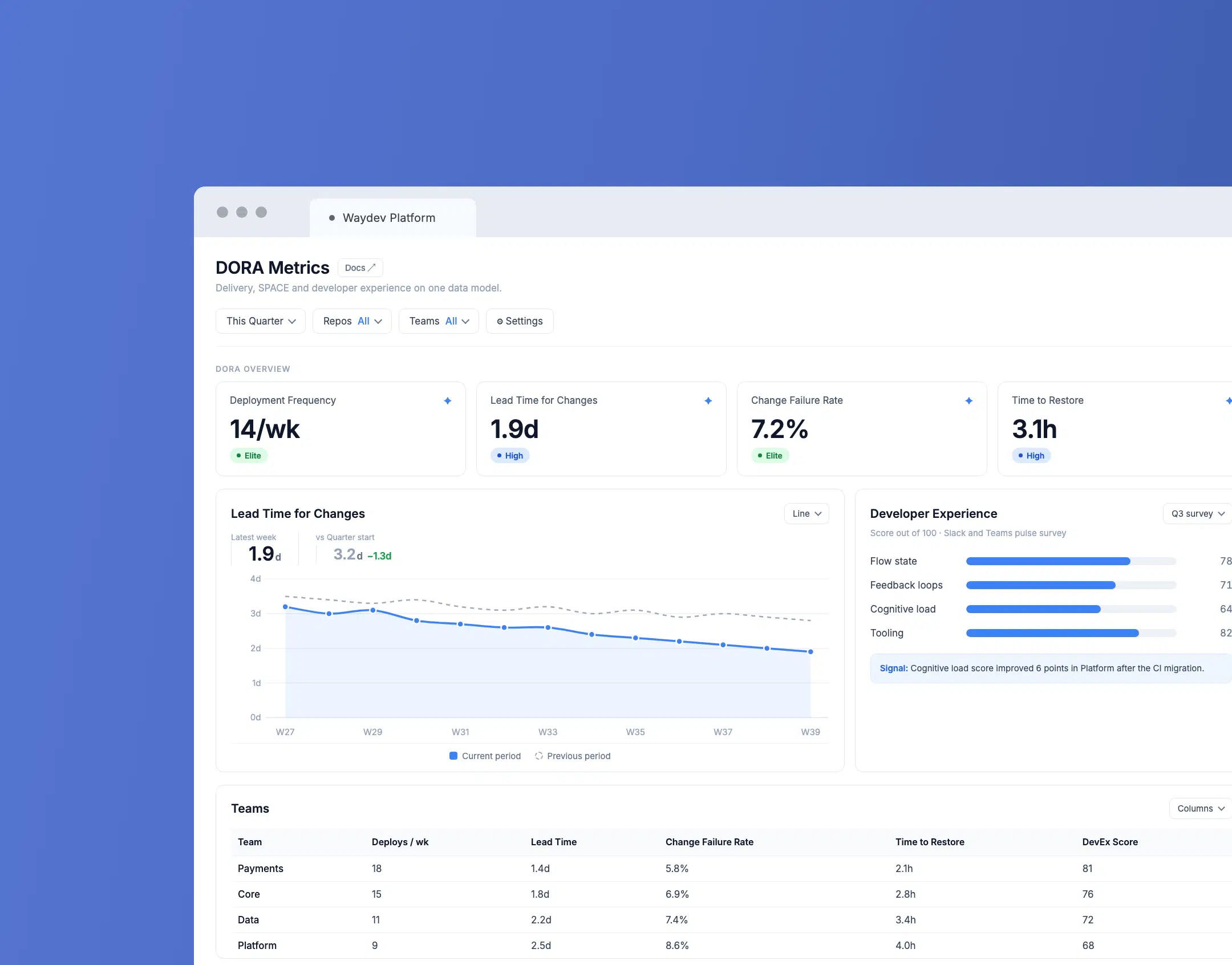
DORA’s current model has five metrics, evolved from the original four keys. The 2026 DORA Quick Check explicitly includes deployment rework rate. DORA groups three metrics under throughput and two under instability:
Use service-level definitions, consider the deployment boundary, and interpret scores alongside architecture and change risk. See the official DORA definitions and 2026 Quick Check update. For a practical Waydev walkthrough, read Waydev’s DORA Metrics guide (existing article).
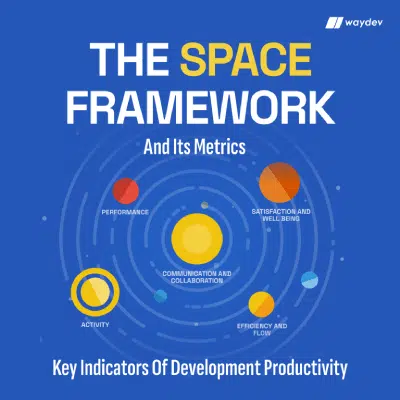
The SPACE framework was introduced by Forsgren and colleagues to guard against reducing developer productivity to single activity counts:
Read the original SPACE research and Waydev’s SPACE Framework explanation.
Developer Experience complements DORA and SPACE by finding obstacles to productive work: long builds, brittle dependencies, unclear ownership, poor documentation, review queues and interruptions. Combine qualitative surveys or interviews with evidence such as CI wait times and PR reviews. Avoid treating a subjective answer as a precise financial KPI.
Resources: Developer Experience overview and nine practical DX metrics.
| Week 1 | Define services, teams, repositories, deployment events and data ownership. Record coverage and missing data. |
| Week 2 | Baseline five DORA metrics and validate outliers against logs and incidents. |
| Week 3 | Survey or interview developers. Select SPACE dimensions and DX bottleneck indicators. |
| Week 4 | Prioritize two or three interventions and monitor leading/lagging changes; report caveats. |
Waydev combines engineering data with Signals, Goals, Prompt Dashboards and conversational Waydev Agent queries. Waydev Brain offers an enterprise AI intelligence layer with a proprietary 15B SDLC model and air-gapped deployment option. Feature eligibility and source coverage should be established in a pilot.
Do not rank individual developers by commits, PRs or AI tokens. Avoid comparing unlike teams without normalizing for work types, on-call burden and service maturity. Treat hypotheses as hypotheses; improvements require investigation, not just chart correlation.
See DORA, SPACE, DX and AI data in a Waydev demo →
Framework sources: DORA and Microsoft Research / ACM Queue. Updated October 2026.