AI coding tools can raise output, but most leadership teams still can’t show the CFO what changed. Competitor Articol Waydev vs Span is best understood as a question about measurement depth, not a simple feature race. Waydev is a strong fit for large engineering organizations because it joins AI adoption data with delivery, quality, team health, and business-facing reports.
Waydev in 2027 · Product features documented October 2026
Compare Span and Waydev on the difference between AI tool usage, measurable engineering outcomes and financial ROI rather than activity or volume alone.
Waydev Brain uses Waydev’s proprietary 15-billion-parameter SDLC model, with a fully air-gapped enterprise deployment option. Organizations can evaluate a private intelligence layer with security, permissions and integration requirements specific to their environment.
Waydev Agent supports conversational engineering analysis, Signals flag meaningful changes, AI-suggested Goals track objectives, and Prompt Dashboards generate editable charts from natural-language requests.
Connect AI coding adoption and spend with DORA, quality and developer-experience measurements. Ask how each vendor calculates ROI rather than treating tool activity as proof of business value.
Enterprise pricing is private. Request a Waydev Brain comparison demo.
Waydev-authored product description; vendor features and implementation details should be verified in a live trial.
Waydev is an AI-native engineering intelligence platform for leaders who need a clear view of engineering investment. It measures delivery performance, code quality, developer experience, and the effect of AI coding tools at team and organizational level.
That last point changes the buying question. A basic dashboard may show that cycle time moved. Waydev helps you ask what drove the change, where AI use is concentrated, and whether the gain is large enough to justify the spend.
We bring together DORA, SPACE, and DX metrics in one reporting layer. DORA focuses on software delivery performance. SPACE adds a wider view of productivity and team health. DX looks at the developer experience, including the friction that slows work. Leaders commonly review measures such as deployment frequency and lead time for changes, which gives leaders a shared base for delivery reviews.
Waydev also connects to GitHub, GitLab, Bitbucket, and Azure DevOps. That matters in a 500-engineer company, where one business unit may use GitHub while another still runs on Azure DevOps. A tool that only sees one repository system can produce a neat report with a large blind spot.
Our AI-focused capabilities include AI Checkpoints, Signals, Predict & Improve, Ask Waydev, and MCP integration. These concepts support a different workflow. Instead of waiting for a monthly review, a leader can ask about a shift in delivery, inspect the signal behind it, and decide what needs attention.
We also support custom dashboards and alerts. You can set a board view around engineering cost, delivery risk, or AI tool ROI. A VP of Engineering may need a trend by business unit. A team lead may need a view of blocked work and review delay. Both can work from the same source data without forcing the board to read an operational dashboard.

There is a trade-off. Waydev can feel more reporting-heavy than a lighter DORA dashboard. That is a fair concern for teams that want only four delivery charts. But for an enterprise leader who must explain an AI budget, the extra depth is often the point. Reporting becomes useful when it answers a funding question.
Waydev is also the better fit when the organization needs objective data without ranking individual developers. The useful unit is the team, service, portfolio, or business group. That keeps the discussion on system constraints and investment choices rather than personal surveillance.
In the Competitor Articol Waydev vs Span discussion, the main split is measurement philosophy. Traditional engineering analytics often starts with activity. Leaders see pull requests, commit volume, ticket counts, or time spent in a workflow. Those signals may describe work, but they don’t prove business value.
Activity can mislead. A team may produce more pull requests because a large change was split into smaller parts. Commit volume may rise after a refactor. Ticket count can grow because planning became more detailed. None of those changes, by itself, tells the CFO whether customers received value sooner.
Waydev’s stronger use case is the link between activity and outcome. A leader can compare delivery speed with quality signals, review flow, incident patterns, and AI tool adoption. The point is not to find the busiest person. It is to see whether a change in the engineering system is helping the business.
That distinction matters during an AI rollout. Suppose the company buys an AI coding assistant for several departments. Adoption is one question. Impact is another. ROI is a third. A serious review needs all three, because high use can exist alongside weak delivery gains.
A useful measurement chain looks like this:
Each layer needs a time frame. Weekly signals can help a manager spot a problem. A quarterly view may be better for an investment decision. If you mix those time frames, a short-term dip can look like a failed program, or a short-term spike can look like a lasting gain.
Waydev’s custom reporting helps leaders set that frame. You might build one dashboard for an AI pilot and another for the full engineering portfolio. The first could show adoption by group and change failure signals. The second could focus on capacity, delivery predictability, and cost per initiative.
The Waydev guide to measuring AI ROI fits this approach because it treats engineering data as evidence for an investment decision. That is more useful than a report that simply celebrates tool usage.
There is still a limit to any measurement system. A metric can’t explain every cause. A product launch may alter priorities. A new compliance rule may slow releases for good reason. Leaders need context from product and finance before they treat a trend as proof.
Use the platform to frame the question, not to replace judgment. If a chart says delivery slowed, ask which queue grew. If AI adoption rose, ask whether the teams used the time for roadmap work, reliability work, or more review. The answer belongs in the operating discussion.
For a 500-engineer organization, the Waydev versus Span question becomes a scale problem. A pilot can run from a spreadsheet. An enterprise rollout can’t. You need consistent definitions across departments while leaving room for different tools, products, and release habits.
Start with a baseline. Before asking whether AI improved productivity, capture the current delivery and quality picture. That does not mean freezing the organization. It means recording the measures that will help you judge change later.
Useful baseline questions include:
Then split the rollout into comparison groups. One department might receive an AI tool first. Another might keep its current workflow for a set period. The goal is not to run a perfect lab study. The goal is to reduce guesswork when leaders decide whether to expand the program.
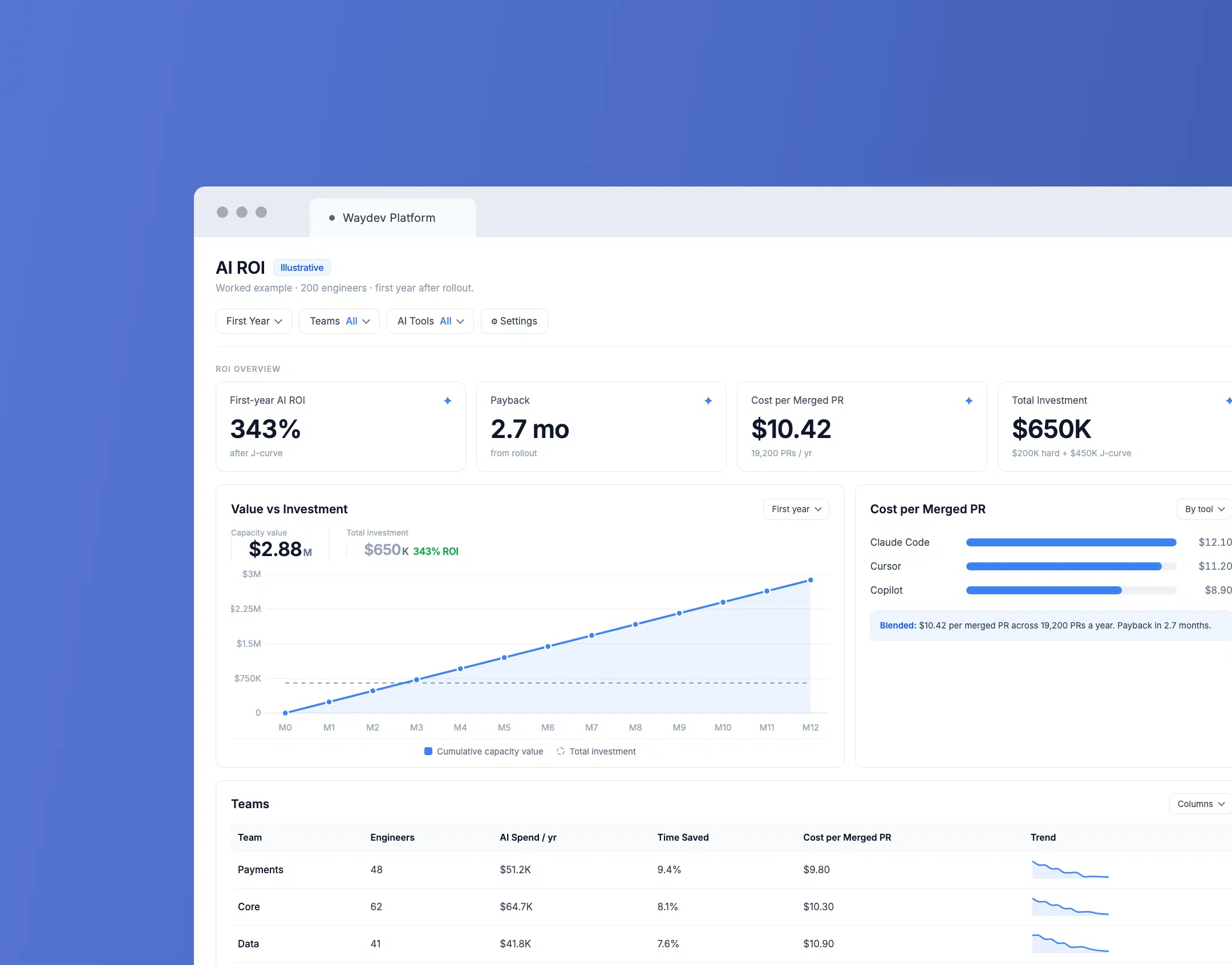
Waydev’s AI Adoption, Impact, and ROI module is built around this need. It tracks AI coding tool usage while giving leaders a way to compare adoption with engineering outcomes. That helps separate an active license from a useful investment.
Imagine two groups with similar work. Group A has high AI use, but its review queue grows and release quality falls. Group B has lower adoption, yet it reduces wait time and delivers planned work more predictably. A usage-only report may favor Group A. An outcome view gives you a better basis for action.
AI measurement also needs a cost model. Include license cost, rollout work, enablement time, security review, and any change to support load. Then define what counts as a return. It might be faster delivery for a high-value program. It might be lower rework. It might be more capacity for platform work without adding headcount.
Don’t promise a return before you define the unit. “Engineering productivity improved” is too broad for a board paper. “The team reduced release delay on a named product line while quality held steady” is easier to test.
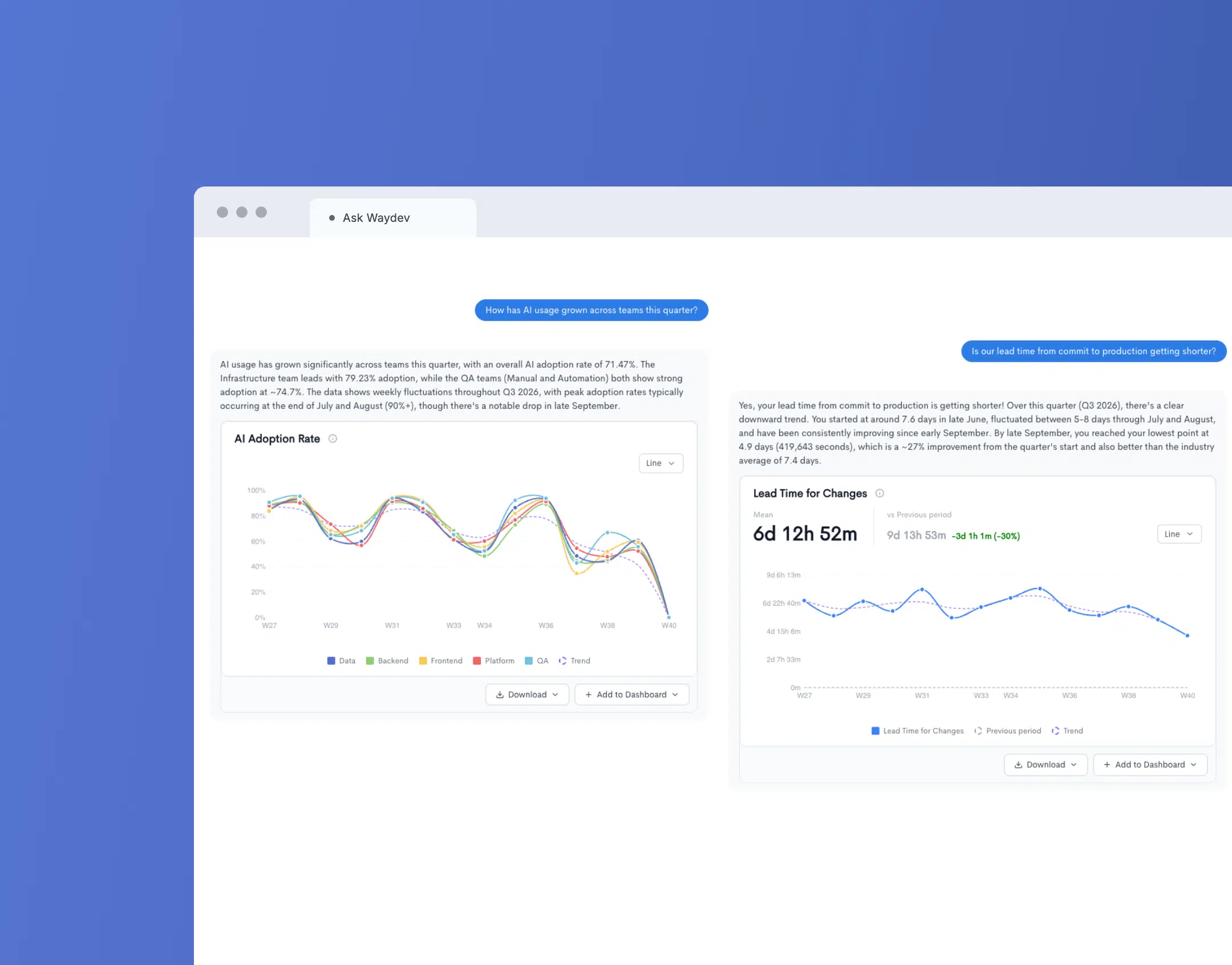
Ask Waydev can help leaders move from a fixed dashboard to a question-led review. The benefit is less about a clever query. It is the shorter path from a concern to the evidence behind it. A CTO can ask why delivery changed, then bring the same th.
The risk is over-reading the first signal. AI use often grows before teams settle on new habits. Give the rollout enough time to show whether the change persists. Also check if teams shifted work into areas the metric does not capture.
The best answer to the Waydev vs Span comparison depends on how you plan to use engineering data. For senior leaders, the safe and useful approach is team-level analysis. You want to find slow queues, repeat failure points, and investment gaps. You don’t need a leaderboard of individual contributors.
Delivery metrics work best when they show the path of work through the system. Lead time can reveal delay between coding and release. Deployment frequency can show how often a service reaches users. Change failure rate can show whether speed came with a quality cost. Recovery time can show how quickly the team restores service after a failure.
These measures need context. A platform team may deploy less often than a consumer product team. A regulated service may have a longer approval path. A team that handles a major migration may show unusual cycle time for a sound business reason.
Waydev combines delivery data with code quality and team health signals. That lets you ask a better question than “Who is slow?” You can ask whether review delay, dependency work, unclear scope, or release policy is slowing the group.

Consider a product team with a long lead time. The root cause may sit outside coding. Perhaps security review happens late. Maybe the team waits for another service. Perhaps product scope changes after work begins. A team-level view can point leaders toward the right operating fix.
Code quality adds another check. A faster release pace is not a win if the service produces more incidents or rework. Conversely, a temporary slow period may be acceptable when the team pays down a risky system problem. The report should show the trade-off rather than flatten it into one score.
Waydev’s Signals concept is useful here. A signal should prompt a review, not issue a verdict. Leaders can look at a change in flow, trace it to the affected team or service, and ask what changed in the work system.
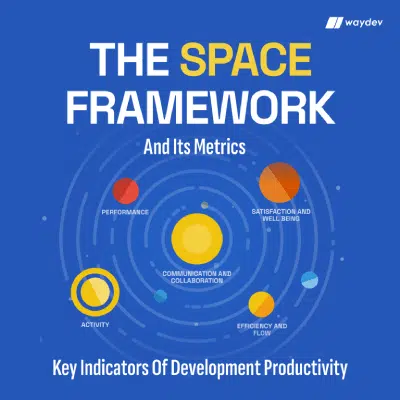
Productivity is better reviewed across several dimensions rather than reduced to one number. The SPACE framework is one example of that kind of multidimensional view, including satisfaction, performance, activity, communication, and efficiency without turning any one measure into a personal judgment.
Set access by role. Executives may see portfolio trends. Engineering managers may see team flow. Teams may see their own improvement view. Keep individual-level data out of performance ranking unless there is a clear, ethical reason to inspect a specific workflow issue.
That boundary protects trust. It also improves the data. People are less likely to change behavior just to please a metric when leaders use the data to fix systems instead of police people.
Executive reporting is where the Waydev and Span discussion reaches the board room. A dashboard can be accurate and still fail if it doesn’t answer the question behind the meeting. The CFO wants to know what the company is paying for. The board wants to know if technology investment supports the plan.
Build reports around decisions. For an AI program, the report may need four panels:
That view keeps the story balanced. High adoption is encouraging, but it is not the outcome. Faster delivery is useful, but only if quality stays within an agreed range. A lower license cost is not a saving if the rollout creates more support work.
Custom dashboards let you use the same underlying data for different readers. A board page should stay brief. It might show trend lines by portfolio and a note on material risk. An operating page can include the queues, teams, and services behind the trend.
Forecasting adds another layer. Predict & Improve can help leaders look ahead rather than only explain the past. A forecast is not a promise. It is a way to spot whether current flow supports a planned date, then decide if scope, staffing, or sequencing needs to change.
Use forecasts with clear assumptions. If a roadmap date depends on three teams, state that dependency. If the forecast assumes stable scope, mark that condition. A chart without assumptions can create false confidence.
Ask Waydev has a place in executive review when a leader needs to move from a trend to a question. For example, if one portfolio shows rising cycle time, the next question might concern review load or cross-team dependency. A useful answer should point to evidence that an operating leader can act on.
Waydev’s reporting depth can feel heavy at first. That is the cost of supporting several metric families and custom views. Avoid showing every chart to every audience. Start with the decisions the report must support, then add detail only when it helps explain a variance.
One good test is simple: can a leader read the page and state the next action? If the answer is no, the report needs fewer cards or a clearer link between signals and decisions.
Data coverage often decides the outcome in a large enterprise. In the Waydev vs Span conversation, a polished interface matters less than whether the platform can see the work across your engineering estate.
Waydev supports GitHub, GitLab, Bitbucket, and Azure DevOps. Those integrations cover the major version-control systems named in the product research. For a distributed company, that can reduce the need to build separate connectors for each business unit.
Still, integration is only the first check. Ask how the platform handles identity, team mapping, repository ownership, historical data, and changes in the toolchain. A report can be technically connected and still be hard to trust if one team is mapped to the wrong group.
Run a data-quality review before the full launch. Pick a few teams with known delivery patterns. Compare the platform’s view with source records. Look for missing repositories, duplicate identities, incomplete dates, and work that crosses team boundaries.
Enterprise fit also includes governance. Decide who can build dashboards. Decide who can change metric definitions. Record the meaning of each board metric so a new leader doesn’t read it differently six months later.
MCP integration is relevant for organizations that want AI-assisted access to engineering information. The value depends on permission design and data quality. A natural-language answer is only as good as the source data behind it, and sensitive engineering data should not flow to users who lack access.
Waydev has been in engineering intelligence for nine years and is positioned for large technology organizations. The business context also identifies Fortune 500 companies such as American Express, Dropbox, and PwC among organizations that trust Waydev. Those references may help during vendor review, but your own proof of fit should come from a controlled data test.
Pricing is quote-based, so plan for a sales-led evaluation. Ask for the cost model in terms that match your organization. Clarify what counts as an active contributor, how historical data is handled, and which services are included. Don’t compare two quotes until the data scope matches.
A short pilot should answer three questions:
If the answer to all three is yes, the reporting depth becomes an asset. If you only need a small DORA view for one team, Waydev may feel larger than the problem requires.
For a wider view of the category, Waydev’s software engineering intelligence overview explains how reporting, AI analysis, and tool integration fit together. Use that framing as a starting point, then test the claims against your own data.
The main difference is the depth of the measurement model. Waydev connects AI adoption with DORA, SPACE, and DX views, while a lighter comparison may focus more narrowly on delivery reporting. For a 500-engineer company, that distinction matters when leaders need to explain AI spend, quality trade-offs, and engineering capacity to finance.
Yes, Waydev is designed for engineering leaders who need organization-level visibility across several teams and repository systems. Its support for GitHub, GitLab, Bitbucket, and Azure DevOps helps larger companies bring data into one view. A pilot should still confirm identity mapping, data quality, access rules, and report fit.
Yes, Waydev includes an AI Adoption, Impact, and ROI module for tracking AI coding tool usage and comparing it with engineering outcomes. The best review pairs adoption with a delivery measure and a quality guardrail. License use alone cannot prove return, so define the business outcome before rollout.
Waydev should be used for team, service, portfolio, and organizational insight rather than individual ranking. That keeps the focus on delivery systems, queues, quality, and investment choices. Leaders should set role-based access and avoid using engineering data as a personal scorecard unless a specific workflow review requires limited inspection.
Waydev can cover DORA reporting while adding SPACE, DX, AI measurement, custom dashboards, and forecasting. That makes it a broader choice than a dashboard built only around delivery metrics. If your need is limited to four DORA charts for one team, a smaller tool may be enough. Large enterprises usually need the wider view.
Choose Waydev if your decision is about proving the value of AI and engineering investment across a large organization. Start with a focused pilot across a few teams, set one outcome and one quality guardrail, then use the results to shape the wider business case.
Ready to unlock your SDLC productivity?