





Engineering Intelligence / Analysis
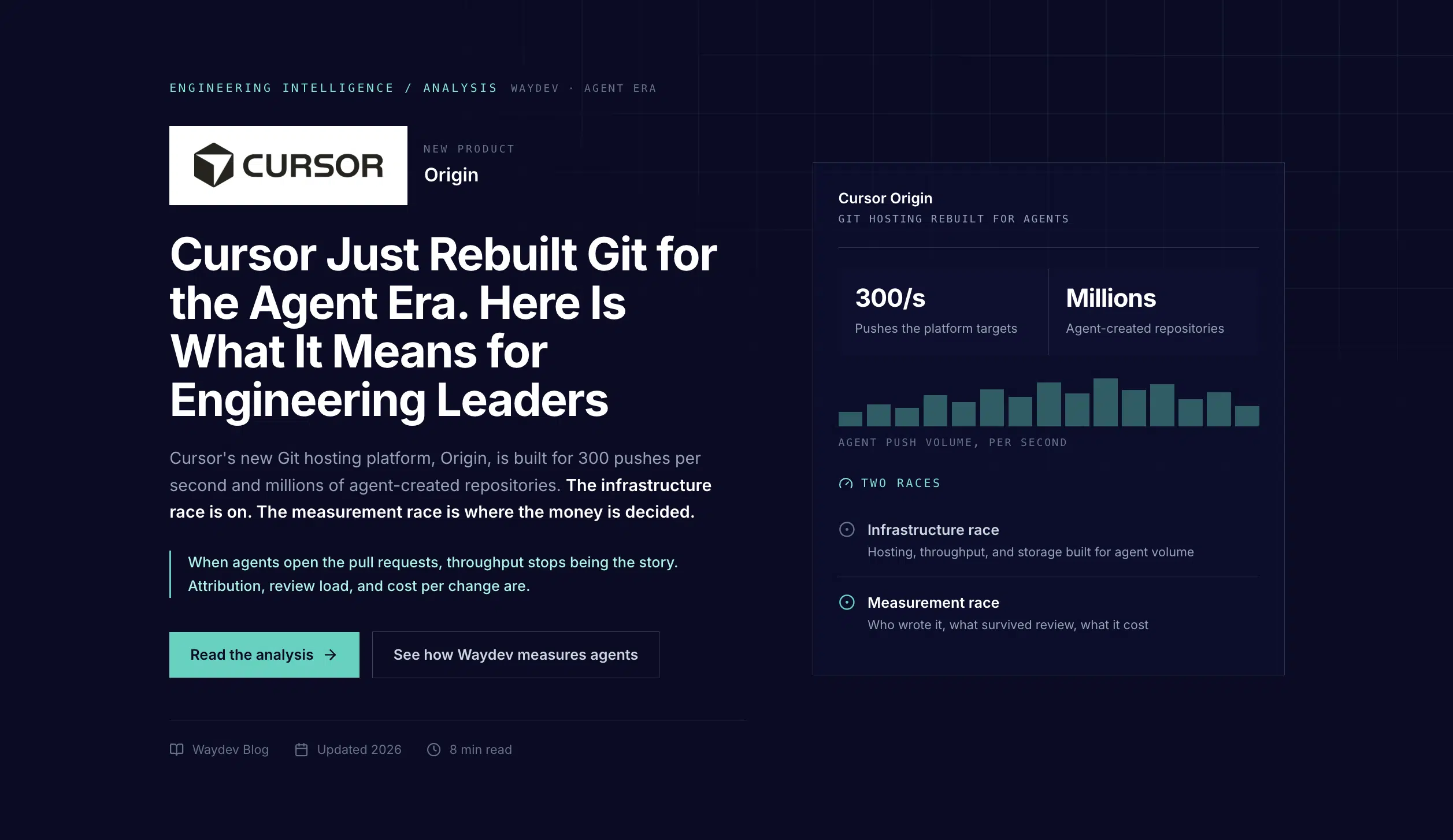
Cursor’s new Git hosting platform, Origin, is built for 300 pushes per second and millions of agent-created repositories. The infrastructure race is on. The measurement race is where the money is decided.
On August 18, Cursor published one of the most technically interesting engineering posts of the year: “Git at any scale.” In it, they announced Origin, their own Git hosting platform, built on a new storage system called Continuity that replaces the consensus-heavy architecture GitHub pioneered with a write-ahead log stored in S3.
If you lead an engineering organization, you should read it. Not because you need to understand three-phase commit or rendezvous hashing, but because of what the post quietly confirms: AI agents have changed the volume and shape of software work so dramatically that even Git hosting, the most stable layer of the entire stack, is being rebuilt from scratch.
At Waydev, we measure how engineering organizations adopt AI and what it actually returns. Here is our read on what Origin means, and what it does not solve.
01 / The architecture shiftThe part Cursor got right
The core argument of the post is that Git hosting architectures designed in the 2010s were built for a world of human-paced development. Three replicas per repository, consensus on every push, repositories treated as pets rather than cattle. That model worked when a busy repository saw dozens of pushes per day.
Why is this so hard? Because Git’s data model fights distribution at every turn. A repository is a directed acyclic graph: commits point to trees, trees point to files and subtrees, commits point to parent commits. You cannot know the next object you need until you have fetched the previous one. Spread those objects across a network and every hop becomes a round trip. This is why the obvious ideas, distributed key-value stores and networked filesystems, have failed repeatedly over fifteen years of attempts.
Fig. 1 — Why Git resists naive distribution
In 2026, it breaks in both directions. Enterprise monorepos absorb so much CI and agent traffic that three replicas cannot serve the reads. At the same time, agents spin up millions of tiny, often throwaway repositories that do not justify three replicas each. Cursor’s answer is elegant: make S3 the source of truth, treat on-disk repositories as a warm cache, and scale replicas from one to hundreds depending on load.
Fig. 2 — Two generations of Git hosting
The mechanics matter for one reason: durability. In Continuity, a push is never acknowledged until it is fully persisted to the write-ahead log, and it only becomes visible once its reference transaction lands in the log’s index. Every push is linearized. That single design decision is what gives the system its complete, replayable history of every state the repository has ever been in.
Fig. 3 — Anatomy of a push in a WAL-first system
The numbers they share are striking. Their system sustains over 300 pushes per second on a single repository, with every push linearized and fully persisted before acknowledgement. That is not a throughput target for human developers. That is infrastructure sized for fleets of agents committing code around the clock.
Fig. 4 — Push throughput, single repository (as reported by Cursor)
02 / The enterprise viewWhat this means for the enterprise stack
Three implications stand out for engineering leaders, and none of them are about storage internals.
Your version control landscape is about to splinter
For a decade, the question was GitHub or GitLab, with Bitbucket and Azure DevOps in the mix for specific enterprises. Now Cursor is entering hosting, and they will not be the last AI company to do so. When your agents, your IDE, and your repository host all come from the same vendor, the convenience is real, but so is the lock-in. Expect teams, and especially agent workflows, to pull work across multiple hosts again.
Auditable history is becoming table stakes
Continuity stores every push as a permanent write-ahead log entry. Cursor can replay every state a repository has ever been in, with full provenance for every push. Regulators and boards are already asking which code was written by agents and which was reviewed by humans. Infrastructure that preserves an immutable change history makes that audit trail possible at the storage layer.
More throughput is not more value
Agents mean more code, more PRs, more CI runs, and Cursor’s infrastructure can ingest that flood without falling over. But no storage system can tell you whether the flood is worth anything. When an agent opens forty pull requests overnight, the question is not whether Git survived. It is whether those forty PRs shipped anything a customer cares about.
This is exactly why we built Waydev to be agnostic from day one. Our WAY Framework starts from a simple principle: measure the work, not the tool. Whether a commit lands on GitHub, GitLab, Bitbucket, Azure DevOps, or a system like Origin, it is still work that needs to be understood, attributed, and valued. Engineering intelligence that only works on one host was already a liability. In a multi-host, agent-heavy world, it is a dead end.
Fig. 5 — Volume of Git activity vs. clarity of value
We have spent the last two years telling banks, insurers, and healthcare companies that auditable AI adoption is not optional. Analytics platforms like Waydev turn raw provenance into answers: who or what wrote the code, how it moved through review, and what it cost or saved. Infrastructure preserves the history. Intelligence explains it.
Cursor’s post is honest about the cause of all this scale. Their infrastructure can now ingest the agent flood without falling over. But three hundred pushes per second is an infrastructure achievement and a measurement nightmare. The AI spend behind those pushes, the review load they create for your senior engineers, and the customer value they ship or fail to ship all live above the storage layer.
03 / Where Waydev sitsThe stack is reorganizing around agents. Measurement has to follow.
Read Cursor’s post as a signal, not just an announcement. When a company rebuilds Git hosting from first principles because agents broke the old assumptions, every layer above Git inherits the same problem. Code review breaks at agent volume. CI economics break at agent volume. And measurement systems built to count human commits per week absolutely break at agent volume.
Fig. 6 — The agent-era engineering stack
Our thesis at Waydev has not changed, but the urgency has. Engineering intelligence in the agent era has to be:
Work-first. Measure outcomes and flow of work, not activity counts that agents can inflate infinitely.
Agnostic. Span every Git host, every AI tool, and every workflow, because the vendor landscape is fragmenting, not consolidating.
Yours. Auditable, explainable, and owned by your organization, because when the board asks what AI returned this quarter, “our vendor’s dashboard says it is great” is not an answer.
Cursor built the pipes for a world where agents write most of the code. The harder question, the one that determines budgets, careers, and competitive position, is whether all that code is making your business better. That is the question we wake up to every day.
Can you answer what AI returned last quarter?
If your organization is scaling AI-assisted development and the answer is still “not precisely,” we should talk. Waydev measures AI adoption, impact, and ROI across every host in your stack.
Book a demoWaydev is the engineering intelligence platform that measures AI adoption, impact, and ROI across engineering organizations, trusted by Fortune 500 companies in regulated industries. Source for infrastructure details and benchmark figures: Cursor, “Git at any scale,” August 18, 2026.