Your engineers’ judgment is the most valuable data in the AI SDLC. Most of it is being thrown away.
micro1 CEO Ali Ansari makes a bold case: human data will become a $1 trillion a year market, because AI keeps learning from people forever. Software engineering is the first function in the economy running that loop at scale. That makes the SDLC the place to see what the future of work with AI really looks like, and what engineering leaders should do about it now.
Ansari’s argument rests on two assumptions. First, digital and physical intelligence can eventually automate the tedious parts of the economy. Second, AI cannot keep improving at the frontier without learning from people.
“Self-learning intelligence without human data is impossible at the frontier.”
Ali Ansari, CEO of micro1
Every AI system learns from humans in some form: demonstrations, fine-tuning, preference learning, rubrics and evaluations, and ongoing corrections. Even self-play and synthetic data rely on people to define what good looks like. So every decision, exception, failure and tradeoff in the economy carries learning signal, as long as it is recorded, structured, evaluated and packaged into something usable.
His sizing is deliberately rough. Global GDP is about $100 trillion, with labor around half. If roughly 5% of human work time ends up producing structured human data, that is about $2.5 trillion a year. Discount it heavily, because much of it will stay informal and unpriced, and you still land near $1 trillion.
Back-of-envelope estimate from Ali Ansari’s essay. A structural argument, not a forecast for a given year.
His proof point is already real. At micro1, more than 1,000 lawyers create structured legal data and earn on average about 20% more than in traditional firm roles. And he makes a point about language that matters: this work should not be called “annotation” or “labeling.” It is expert human data creation, or structured human judgment.
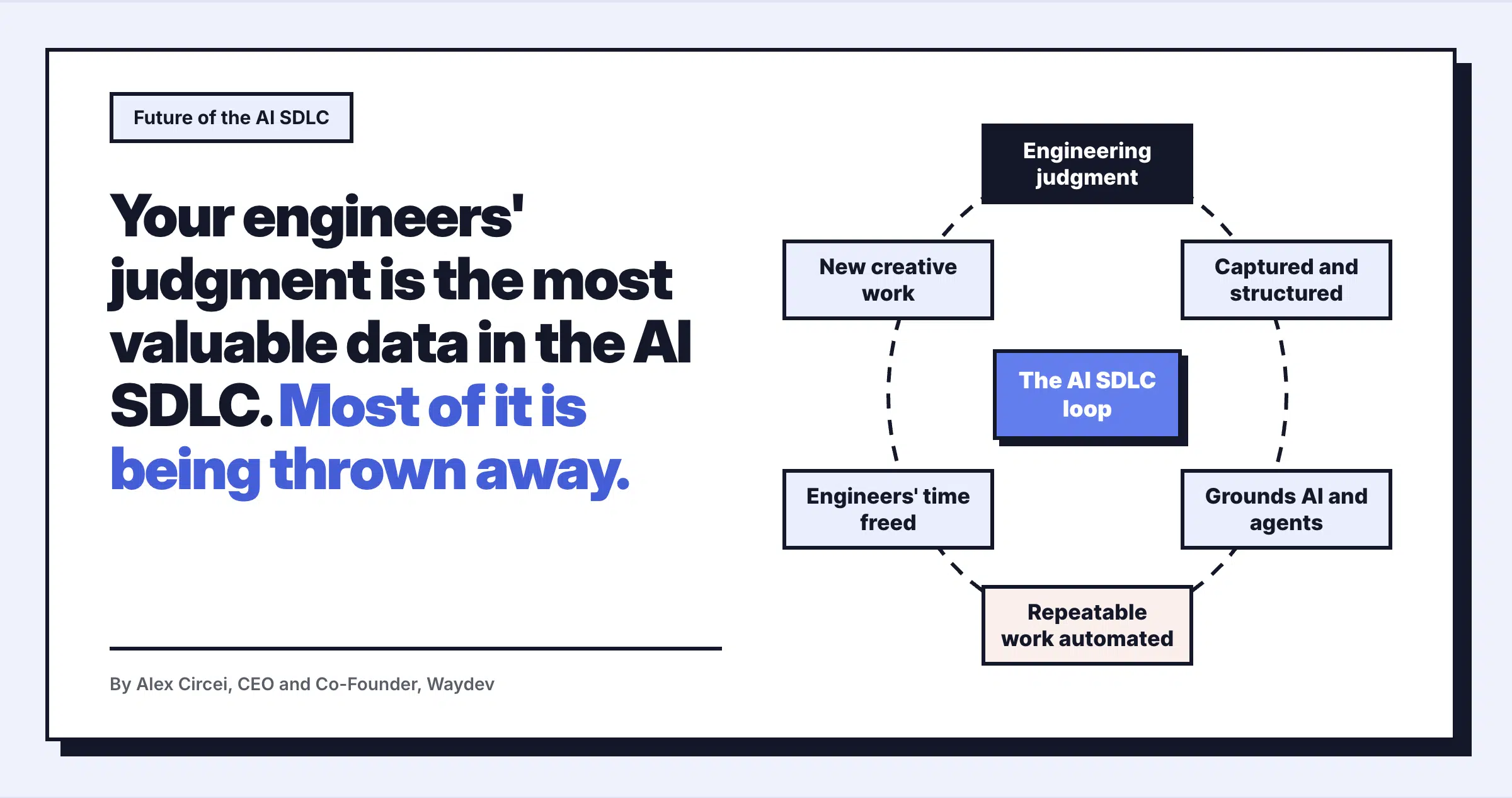
Engineering goes firstAnsari describes a permanent cycle. Automation frees time. People use that time for new, creative work. That work becomes repeatable, then gets automated, and the cycle repeats. It also has a requirement that is easy to miss: functions have to keep running while they are being automated.
That is a precise description of software engineering in 2026. Teams are shipping production software every day while agents take over more of the implementation. Engineers are moving from writing every line to specifying, reviewing and deciding. And every one of those decisions is exactly the kind of structured human judgment Ansari is talking about. As we argued in When code gets cheap, engineering judgment gets expensive, the constraint has moved from producing code to deciding what should exist.
The signalAnsari says every decision, exception, failure and tradeoff creates data. In an engineering organization, that data is generated every day. It is just rarely captured in a form anyone can learn from.
Ansari is clear that activity alone has little value. It has to be recorded, structured, evaluated and packaged. In most engineering organizations, judgment is scattered across Git, Jira, Slack threads and people’s memories, with no link between a review comment, the change it shaped and whether that change held up in production.
Ansari argues we should never call human data work “annotation” again, because the label hides where the value comes from. Engineering has its own version of this mistake. Code review, design discussion and incident analysis are routinely treated as overhead that slows delivery, and the goal becomes minimizing them.
In the AI SDLC, that is backwards. Review is where human judgment meets machine output, and every review decision is a learning signal. The goal is not less review. It is review that is captured, structured and fed back, so each decision makes the next agent change better and the review after that faster.
Your engineers are not just shipping software. Every review and every decision is training the next version of your engineering org.
Alex Circei, CEO, Waydev
That last shift has a twist. Ansari’s thesis is that human data has external market value, and labs will pay for it. For most companies, the structured judgment of their engineering organization is worth far more kept inside: it encodes how they build, what they will not compromise on, and what they learned the hard way. It is a competitive advantage, not a product to sell. Our 2026 Intelligence Report, Leading Engineering in the Age of AI, covers how to measure and govern that advantage as agents take on more of the work.
Where Waydev fitsWaydev already does the first half of Ansari’s pipeline for engineering. It records and structures activity across Git, ticketing and CI/CD, links it to teams and work, separates human and AI contribution, and measures what held up, through AI adoption, quality and AI ROI metrics. Through Waydev MCP, that structured context can be served to the coding agents your teams already use.
Your engineering judgment, packaged into your own model, inside your own walls.
Waydev Brain is a private, air-gapped deployment of Waydev with its own SDLC model, Waydev 15B, and its own agents, tailored to each customer. It closes the loop: the judgment your engineers produce every day becomes context for the model that helps them, and none of it leaves your environment.
Ansari ends on an optimistic note: automation does not shrink human work, it pushes people toward higher-value, more creative work, and human judgment becomes a first-class input to the economy. Software engineering is where that future arrives first. The teams that win will not be the ones with the most agents. They will be the ones that capture their engineers’ judgment best, keep it as their own, and let it compound.
Make your engineering judgment compound
See how Waydev and Waydev Brain turn your engineering data into context your agents can learn from, inside your own environment.
Book a demoMore from Waydev
ARTICLEWhen code gets cheap, engineering judgment gets expensive → REPORT2026 Intelligence Report: Leading Engineering in the Age of AI → GUIDEHow to measure AI ROI on your engineering team → GUIDEHow to measure AI adoption in engineering → DOCSWaydev MCP: give your agents engineering context → COMPARISONBest engineering intelligence platforms for AI coding ROI → USE CASEWaydev for code review workflow →Ali Ansari, CEO of micro1, “human data will be a $1 trillion/year market,” January 8, 2026. Market sizing and micro1 figures are as stated in the essay. The engineering interpretation and Waydev sections are Waydev’s own.
Ready to unlock your SDLC productivity?