Satya Nadella published a post this week that every engineering leader should read twice.
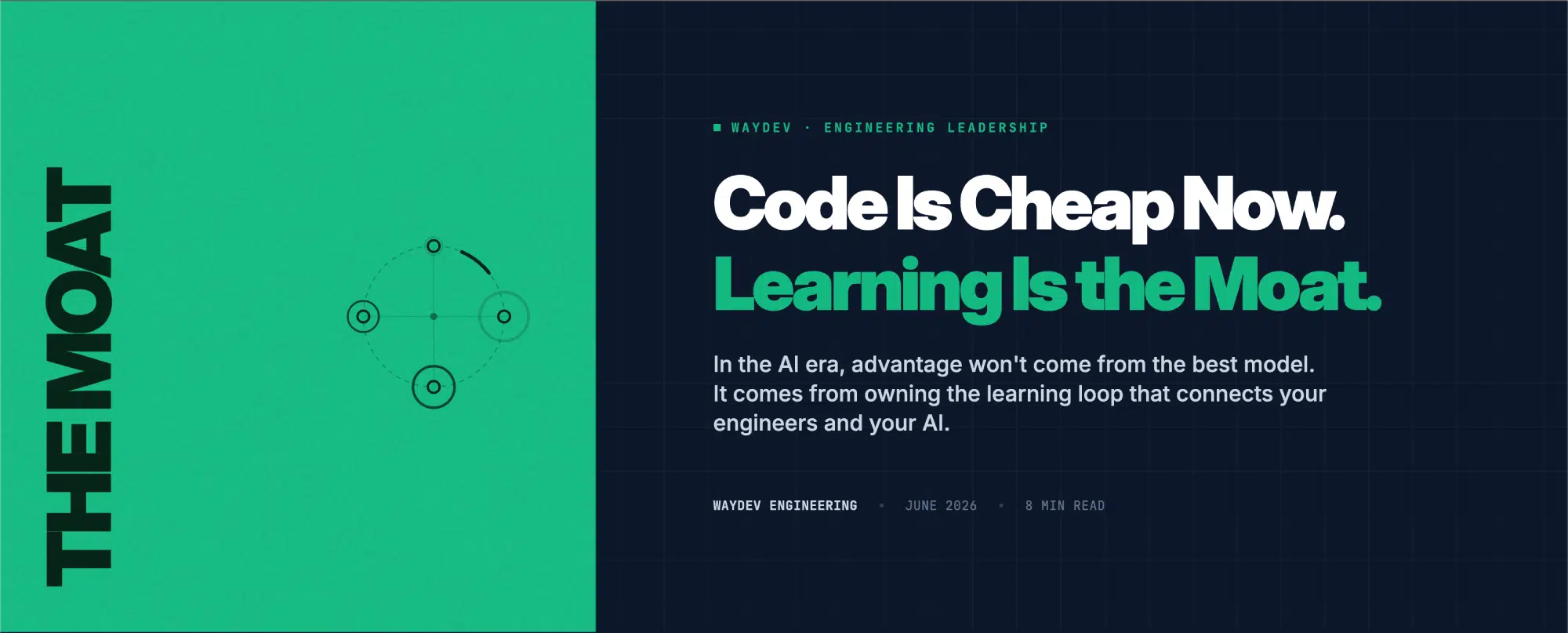
His argument is simple. The advantage of a company in the AI era will not come from access to the best model. It will come from owning the learning loop that connects people and AI.
For engineering organizations, this is the whole game. It is the thesis Waydev was rebuilt around.
For most of software history, engineering orgs competed on human capital. The knowledge, judgment, architectural taste, and pattern recognition of your engineers. The senior who knows why that service is fragile. The staff engineer who can read an incident in thirty seconds. That was the asset.
AI introduces a second asset. Nadella calls it token capital. It is the AI capability your org builds and owns. The agents in your pipeline, the workflows, the evals, the knowledge bases, the reinforcement loops that get better every sprint.
The fear is that token capital replaces your engineers. It does not. It is the opposite. Your engineers are the fuel that produces token capital. Without their expertise, your AI systems have nothing worth learning from. Without their judgment, your agents have no direction. Without human direction, you have compute running in circles.
The engineering orgs that win will compound the two together. People and agents climbing the same hill.
Most engineering leaders are measuring the wrong thing.
You know how many developers have Copilot or Claude Code. You know how many prompts were sent. You know how many tokens were burned across the org. Tokenmeter exists because tracking that spend should be free and easy.
But adoption is not advantage. Two engineering orgs can have identical AI adoption and end up in completely different places. One ships thousands of AI-assisted pull requests and creates almost no value. Rework goes up. Review queues clog. Defects leak to production. The other ships fewer changes and accelerates delivery, raises quality, and captures knowledge that compounds across teams.
Adoption is the starting line. Learning is the destination.
The question is not how much AI your engineers consume. The question is whether your engineering organization is getting smarter with every release.
For decades, engineering value lived in code, architecture, patents, and the people who held the context in their heads.
A new asset is forming on top of those.
An engineer makes a decision. AI systems observe that decision in the PR, the review, the deploy, the rollback. The org measures what happened in production. That feedback improves the next decision. The cycle repeats.
Every commit, pull request, incident review, architecture call, and retrospective becomes training signal for the org itself. Unlike most assets, this one compounds. Every improved workflow generates a better signal, which speeds the accumulation of tacit engineering knowledge that is unique to your codebase and your teams.
Build this loop early and you create an advantage competitors cannot copy, no matter which foundation model is on top next quarter.
Here is the practical test Nadella offers, and for engineering orgs it is exactly the right one.
You should be able to swap out a generalist model without losing your company veteran expertise.
If changing the model behind your coding agents means losing your workflows, your evals, your repo context, and your institutional memory, then the model provider owns your value. If the switch is painless because your learning system stays intact, then you own it.
The model should be replaceable. Your engineering learning system should not be. That is the difference between renting intelligence and owning it.
This is what sovereignty looks like in an engineering org. Private evals that measure whether a model improves against outcomes that matter to your delivery, not generic coding benchmarks. Private reinforcement environments that let agents grow stronger on real traces from inside your codebase. A knowledge base that makes institutional memory queryable so engineers stop re-solving solved problems. That loop is your IP.
The first generation of AI measurement counted activity. Prompts. Tokens. Seats. Suggestions accepted. That explains consumption. It does not explain value.
The next generation has to answer harder questions.
Which teams produce the strongest learning signals. Which workflows improve with repeated AI use. Which repositories generate reusable knowledge instead of one-off output. Which AI-generated changes survive longest in production and which get reverted. Which agents actually improve cycle time, quality, and reliability over time. Which AI investments build lasting engineering intelligence and which ones just generate motion in the dashboard.
These are not adoption metrics. They are learning metrics. They are the difference between knowing what your agents produced and knowing what your engineering organization learned.
Nadella made a larger point worth sitting with.
The danger is a winner-take-all outcome, where a few models absorb the expertise of every engineering team and commoditize it. He drew the parallel to the first phase of globalization, where entire industrial economies were hollowed out by outsourcing. The headline numbers looked fine. The displacement was real and we are still living with it.
The fix is not to slow AI down. The fix is to build a frontier ecosystem, not just a frontier model, so value flows across every company. Every engineering org owning the loop that encodes its own hard-won knowledge. That is the stable equilibrium, and it is the one worth building.
This is the chapter we are building for.
Waydev started by measuring AI Adoption across engineering. Then AI Impact and AI ROI. The next frontier is organizational learning.
Not just how much AI your engineers use. Not just what your agents produced. But how your people and your AI systems work together to create a compounding advantage that becomes the intellectual property of your engineering organization.
In the age of AI, code is becoming abundant. Engineering judgment, captured and compounded, is becoming scarce.
Scarce assets are the ones that endure. Build the loop.
Ready to unlock your SDLC productivity?