Software development team management works when engineering managers combine clear goal-setting, the right tooling, and consistent performance tracking into a single operating rhythm. Without all three, teams tend to drift: deadlines slip, skill gaps go unaddressed, and engineers lose sight of how their work connects to business outcomes.
With an engineering management platform like Waydev, engineering managers gain full visibility into team workflows and the data they need to act on problems before they become missed sprints.
Quick summary: This guide covers 12 tactics for managing software development teams, including goal-setting, task assignment, deadline tracking, and performance metrics, plus specific guidance for non-technical managers and remote teams. Each section references Waydev features that surface the relevant data automatically.
Below, we cover 12 essential tactics for managing software developer teams, plus bonus guidance for leading engineering teams as a non-technical professional. With these insights at your disposal and the right engineering management platform, you’ll be able to maximize your team’s potential and improve your software development process.
Software development and project management complement each other, as engineering teams usually work through the Software Development Life Cycles, also known as SDLC.
SDLC refers to the process of organized management for a project, meant to help engineering teams produce the highest quality software with the minimum cost of financial and human resources. In simpler terms, tech leaders implement SDLC to have a clearer picture of their team’s workflows and make better-informed decisions.
Software development planning encompasses the timeline of a development project. The plan describes all the phases of the process, analysis and planning, ideation, design and development, deployment, production and launch, and maintenance.
To deliver products faster to the market and accomplish software-related objectives, but also to improve the efficiency and effectiveness of your software development team management best practice, SDLC methodologies aren’t sufficient.
As an engineering manager, you also need a project management system.
Using the proper SDLC methodologies and engineering project management software, tech managers can lead their teams to success and expedite development process with minimal costs.
With an engineering management platform like Waydev, tech leaders and executives have full transparency over the entire SDLC process. We’ll cover essential tactics for managing software development teams with project management technologies in the following lines.
The first step in managing a software development teams is identifying and mapping our requirements.
As a technical manager, it’s your job to clearly define the development work’s scope and the expected deliverables within a specific timeframe.
You can unlock your team’s full potential only if they know exactly what objectives they need to meet. Communicate these goals clearly and provide a list of straightforward tasks with meaningful priorities.
Putting all of this information in a centralized location within your project management software platform will help you to make sure all team members are on the same page and meet the company’s goals and expectations.
The to-do lists of the engineers from your team can be very long. Especially in the development world, where issues appear overnight and need to be fixed immediately, it can become challenging to know how to prioritize their tasks.
This is why it’s critical as an engineering manager to communicate requirements effectively and prioritize your team members’ workload.
The main advantage of using project management software is that it helps your team stay on track. Of course, assigning tasks can also be done manually by management, but using a project management tools is more efficient and transparent.
Pivot and reassign work as necessary when urgent demands arise by enabling you and your team members to identify what tasks are being worked on or coming up next.
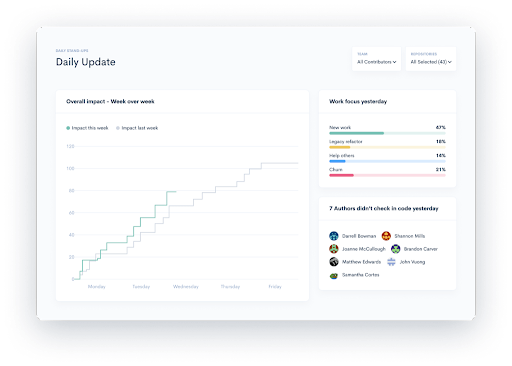
For instance, with Waydev’s Daily Update feature, engineering managers can track the evolution of their team’s velocity sprint over sprint. Find out where yesterday’s work focus went and direct your efforts to accomplish business goals.
Meeting deadlines is essential from a business perspective and your team’s morale and productivity. Ensuring your team meets deadlines consistently is the perfect way to assess discipline and adherence to high standards.
Use a project management software platform to stay on top of deadlines. This will also help you keep track of multiple deadlines at once, understand how due dates rank against each other, and be prepared if you need to change deadlines.
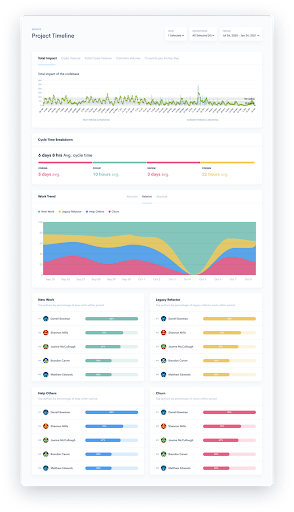
With Waydev’s Project Timeline feature, technical leaders can easily spot unhealthy work patterns and address them backed by data to avoid missing deadlines. You’ll understand how your team’s volume modifies over time and have a clear overview of your team’s work focus.
Technical skills are valuable resources for any company. As such, save your team’s time by handling all non-technical work yourself whenever possible.
As an engineering manager, taking the administrative work off your team members’ plate gives them the space to focus on their primary tasks – coding.
This doesn’t mean that your team’s only task should be coding; they still need to communicate effectively with other team members or departments, which is vital, especially in remote or hybrid teams.
With our calendar integrations, you’ll have complete visibility into your team’s focus work time so that you know when not to disturb them for meetings or other non-coding tasks.
Another critical aspect in managing a software development team is to allow your engineers the time to code, recognize their skills, and show them you trust them to do their job.
Simply put, give your engineers the time and space they need to code – this is what they love and were hired to do.
However, keep in mind that coding is also a creative job, where thinking outside the box and finding alternative solutions to different problems is essential.
Show your team members that you trust them to think outside coding and provide a safe space to develop solutions and foster their creativity.
A team’s success isn’t about how many lines of code were written but finding solutions, the ratio between quantity and quality, and how effectively they collaborate.
We’ve already talked about setting individual and team goals, but you must also assess the right metrics to track processes’ performance as an engineering manager.
Performance reviews can be beneficial to measure both individual and collective performance and spot areas of improvement.
As a technical manager, it’s your responsibility to assess the right metrics to keep track of your team’s performance. And because there are plenty of metrics to consider in software development, it can be challenging to know which to focus on.
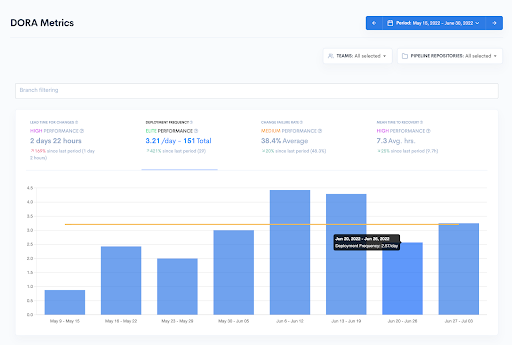
This is where DORA DevOps performance metrics come into play. They are designed to measure engineering team performance accurately and determine whether certain areas need improvement.
To measure and assess DORA metrics, you can use Waydev’s DORA metrics dashboard, which automatically tracks and displays these metrics in a single dashboard without requiring technical managers to aggregate individual data.
Professionals working in software development specialize in a plethora of areas and have vast ranges of skills.
Make sure you know the specific skills each member of your team has. An overview of your team’s skill sets will help you match the right project progress with the right engineer and set personal and professional development process plans.
The skills that make up your team don’t require you to be an engineering expert, but you should have enough of a high-level overview to know who to contact when specialized knowledge is needed.
In software development, especially in those teams that involve independent talent or remote work, communication and information are often dispersed across multiple platforms.
Some talks take place in chat, emails, and even online gatherings. Disconnection between team members, uncertainty, and wasted effort can result from fragmented interactions.
Give your team the resources they need to maintain alignment and achieve success. A project management software tool can help you distribute information more smoothly and keep and share files in one place.
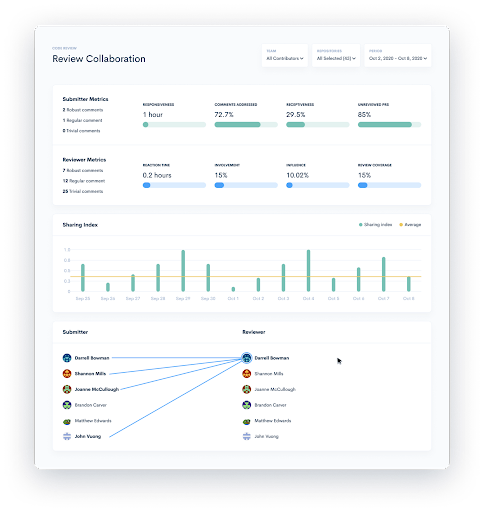
For example, our Review Collaboration feature helps engineering managers understand how their teams work collaboratively and effectively visualize the dynamics of their code review process.
Beyond keeping track of deadlines, it’s equally important to keep track of real-time updates. This can help you identify gaps in resource allocation, manage conflicting tasks and deadlines, and have an overview of your team’s progress.
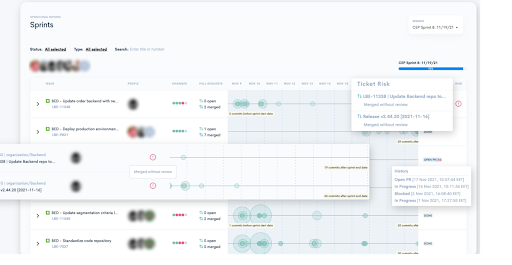
Use our Sprints feature to keep a pulse on your sprint progress. Visualize and mitigate sprint risk using our forecast model, and identify capacity issues and scope creep.
An open communication policy should be emphasized when managing a software development team.
Keep everyone on the same page by communicating expectations, considering potential issues that may occur, and listening to your team’s concerns.
Another way of encouraging open communication is to distill the information you receive from upper management and other non-technical details. This will show transparency and respect for your team’s time and skills.
And lastly, set an example. If you want your team to be open, you must do it yourself.
When assigning assignments or issuing directives, strive to provide as much context as possible. If your team has a broader context of why they do what they do, they will work more efficiently.
Explaining why they should do something rather than merely telling them what they must do should motivate your team. They value their time just as much as you do, and if they can find a more efficient way to complete a task, they won’t waste it.
Try to provide as much information as possible by presenting your team with the business goals and customer needs.
Working in software development isn’t easy. And compared to other teams, such as sales, it’s more difficult to quantity efforts and gain recognition.
This is why it’s essential to take the time and acknowledge your team’s good work and efforts and give them credit for their accomplishments.
Call out and publicly commend someone’s work when they have done a great job or shown behavior you wish to see in the team.
You can also share positive feedback from upper management or customers.
In case you are in an executive role but don’t have much technical background, here are four steps to help you manage a development team.
Nowadays, plenty of resources are available to make you more confident in the field of software development.
Try to educate yourself on standard concepts, technologies, and terminologies by reading books, online courses, watching tutorials, or attending workshops.
This will make you relate to your team and their projects and offer you new perspectives on managing your software development team more effectively.
We’ve already discussed the importance of determining the individual strengths of each team member.
As a non-technical person, consider talking to team members who are educated about the industry if you are managing a software development team and are unfamiliar with it. You can start figuring out each employee’s talents or skills as you get to know them better.
After that, talk to your team members individually and understand what motivates them personally and professionally.
This information will help you create projects and pair tasks with the appropriate skills and personal interests.
Another great tactic to adopt in your day-to-day management of software development teams is not being reluctant to ask questions.
Whenever you encounter a situation when you’re unsure or unfamiliar with certain concepts or processes, ask your team for clarifications.
This will help you learn about software development and strengthen your team’s relationships.
Even if you don’t have plenty of technical background, you still bring valuable knowledge of your client’s needs and desires.
As an engineering manager, you are the liaison between your team and your clients. Make sure your clients understand your team’s work and divide large projects into smaller tasks so that your team understands business goals.
If you’re managing a team of software engineers working remotely, then your managing style needs a slightly different approach. Here are four tips for adopting if you operate a remote software team.
Regular check-ins with your team are essential in any management style, especially in a remote work environment.
Make sure to schedule regular individual and team meetings to ensure your team have everything they need and understand what their tasks are. This is an excellent opportunity to make sure everyone is on track and for them to ask clarifying questions.
However, ensure you don’t micromanage and find a healthy balance between meetings and the time needed to complete their tasks.
Even if your team works remotely, it’s still important to encourage collaboration
Ready to unlock your SDLC productivity?