





Waydev for Enterprise / 500 to 20,000 engineers
Prove what AI actually did to your engineering org. Not a dashboard. A statement you can sign.
Waydev measures AI adoption across every team, tracks its impact from first commit to production, and reconciles it against every token and licence you paid for. The output is evidence: figures your CFO accepts, your auditors can trace, and your board can act on.
AI Engineering Statement
Global Technology · 4,200 contributors · Q2 FY26 · generated 01 Jul 2026
Illustrative figures. In your tenant every line is computed from your own systems, and every line opens the exact SQL that produced it. Click a row above.
Deployed inside Fortune 500 engineering organisations
The gap
Your AI budget got approved on a promise. Renewal will not be.
Licences went out across thousands of engineers. Usage dashboards from each vendor tell you seats were consumed. None of them tell you whether anything shipped faster, whether quality held, or what the return was. That question lands on the VP of Engineering, and it lands with Finance in the room.
Who is actually using it, and how
Seat reports flatter you. Waydev separates licensed from active from effective, per team, per tool, per repository.
- Active use versus provisioned seats
- Copilot, Cursor, Claude Code, Codex, Windsurf, Gemini
- Adoption curve by team, tenure and language
- Where enablement is failing, named
What it did to delivery and quality
AI-assisted changes are tracked from first commit through review, merge, deploy and incident, then compared against your own baseline.
- Cycle time on assisted versus unassisted work
- Change failure rate and rework, 30 and 90 day windows
- Code retained after merge, not just generated
- Review load shifted onto senior engineers
What it returned, in currency
Token and licence cost attributed down to team and initiative, set against measured hours returned and delivery gains. One number, fully traceable.
- Cost per merged change, per team
- Hours returned, converted at your own rates
- Capitalisation-ready allocation of AI-assisted work
- Board and audit committee export
Standards
Measured on DORA, SPACE and DX, not on a metric we invented to sell you something.
Your engineering org almost certainly already reports on DORA. Your people team almost certainly already cares about the things SPACE describes, and DX is how the industry now talks about the developer side of it. Waydev computes both from your systems, then layers AI adoption on top so the comparison is like for like. No new vocabulary for your leadership to learn, and nothing an external auditor has to take on faith.
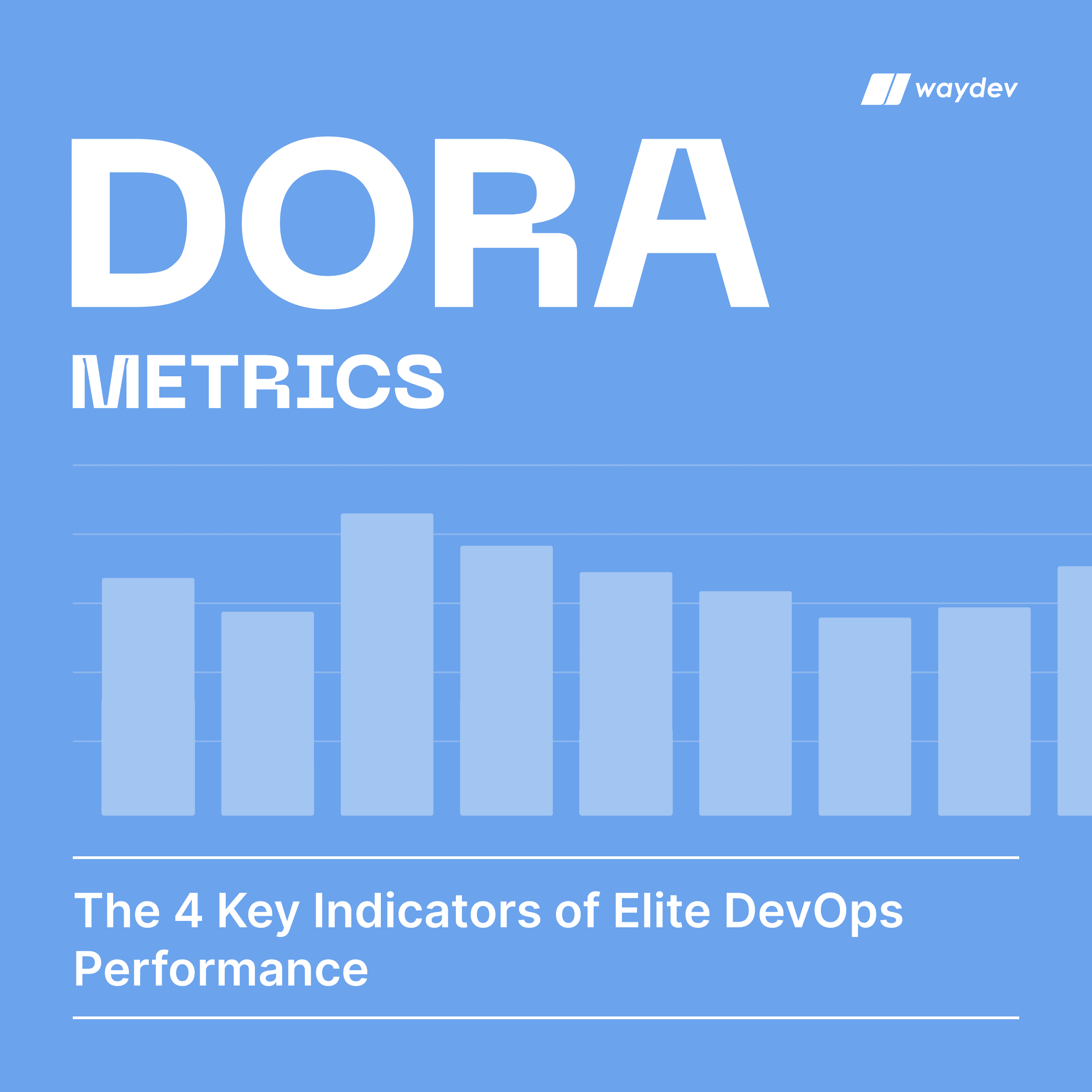
DORA metrics
Delivery performanceThe four keys, computed from your deployments rather than from a survey, and split by AI-assisted and unassisted work so you can see which one moved.
-
01
Deployment frequencyHow often you actually ship to production, per service and per team, not per release train.
-
02
Lead time for changesFirst commit to running in production, broken into coding, review, and waiting so you can see where the time really goes.
-
03
Change failure rateThe share of deployments that caused a rollback, hotfix or incident. This is where AI-assisted work tends to show its cost.
-
04
Time to restore serviceIncident open to resolved, joined back to the change that caused it.
Benchmarked against your own trailing baseline and against industry bands
SPACE framework
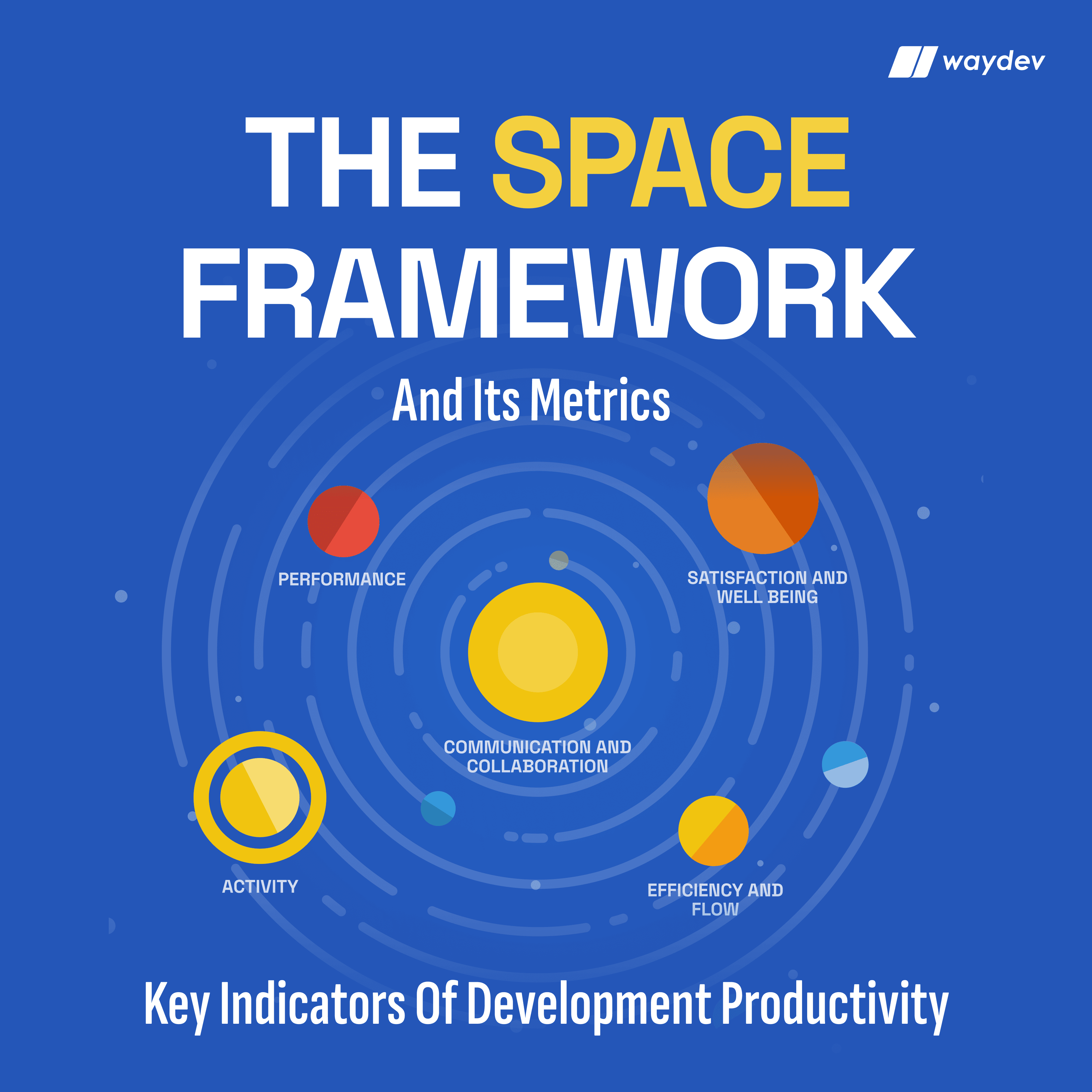
Productivity, in five dimensionsDelivery speed alone gets teams burned out and gets leaders bad data. SPACE keeps five dimensions in view at once, and Waydev populates each one from system signals plus your own DX surveys.
-
S
Satisfaction and wellbeingDeveloper experience surveys delivered through Slack or Teams, correlated with delivery data rather than read in isolation.
-
P
PerformanceOutcomes, not output. Change failure rate, rework and code that survived thirty days past merge.
-
A
ActivityCommits, reviews, deploys and AI tool usage, aggregated to team level by default.
-
C
Communication and collaborationReview load, response times and where knowledge is concentrated in too few people.
-
E
Efficiency and flowCycle time, waiting time, unplanned work and context switching across active initiatives.
Populated from system signals plus your own survey responses
DX framework
Developer experienceDORA tells you how the system is performing. SPACE widens the lens. DX asks the engineers themselves, then joins their answers back to the delivery data so a complaint about slow builds becomes a measured cost rather than an anecdote in a skip-level.
Surveys delivered through Slack or Teams, aggregated to team level by default
A framework your board already accepts is what makes the AI number defensible.
Every AI claim in the statement is a delta against a DORA, SPACE or DX measurement you were already taking. That is the difference between telling your board that AI helped and showing them that lead time on assisted changes fell against a baseline they signed off on last year.
Productive throughput has almost doubled, and commits per day and active days are up 20 to 30 percent.
We were looking at burndown charts. After Waydev we could get a lot deeper than that.
It gives me a bird’s eye view of my engineering team’s efficiency and productivity.
Deployment
Run it in our cloud, or entirely inside your own perimeter.
Same product, same release cadence. The decision belongs to your security team, not to us.
| Waydev Cloud | Self-hosted | |
|---|---|---|
| Data residency | Managed regions | Your VPC, your regionGDPRAWS, Azure or GCP, wherever your data has to stay |
| Source code | Never stored. Waydev reads metadata and diff statistics through your Git provider, then discards content. | |
| Identity | SAML SSO, SCIM | SAML SSO, SCIM, your IdP |
| Network | IP allowlisting | Fully air-gapped optionNo egress required |
| Time to first insight | Same day | Typically 5 to 10 business days |
| Support | Named CSM, 8×5 | Named CSM plus solution architect, 24×5 |
Architecture
The data flow, before your security team asks for it.
Read-only in. Metadata and statistics only. Source code is processed in memory and never written to disk. This is the same diagram that ships in the security package, and in a self-hosted deployment the entire right side moves inside your perimeter.
Scroll sideways to follow the flow →
Governance
Designed for organisations with works councils, regulators and an audit committee.
Engineering measurement fails in large enterprises for one reason: it feels like surveillance. Waydev ships with individual-level metrics disabled, aggregation thresholds enforced, and a permission model your employee representatives can review before a single repository is connected.
- Team-level aggregation on by default
- Minimum cohort size before any metric renders
- Contributor pseudonymisation
- Repository and author exclusion lists
- Role-based access down to team scope
- Full admin audit log, exportable
- Configurable retention and deletion
- Subprocessor register, notified in advance
Procurement package
What your security reviewer receives on day one
One package, one named reviewer on our side, responses within two business days.
Rollout
From connected to board-ready in one quarter.
The sequence below is how enterprise deployments actually run. Each stage has a named owner on our side and an exit criterion on yours.
Connect and scope
Read-only integration with your Git provider, tracker, CI and AI tooling. Team hierarchy imported from your IdP. Nothing is visible to managers yet.
Baseline
Twelve months of history backfilled. Delivery, quality and AI adoption baselines agreed with your leadership before anyone is measured against them.
Rollout
Access opened by role. Enablement sessions for engineering managers on how to read the data, and how not to. Works council briefing pack if required.
First statement
Your AI Engineering Statement for the quarter, reconciled against invoiced tooling spend, ready for the board and for Finance.
Procurement needs proof before it needs a signature.
A paid pilot on a defined scope, two to four teams, six weeks, with success criteria agreed in writing before we start. Pilot fees credit in full against year one. If the statement does not hold up in front of your Finance team, you walk and we have both learned something cheaply.
Coverage
Built to survive a real enterprise estate.
Multiple Git providers, inconsistent Jira hygiene, acquired business units on their own tooling, and a decade of history that nobody has cleaned up.
Every provider, together
GitHub, GitHub Enterprise Server, GitLab self-managed, Bitbucket Data Center and Azure DevOps in a single tenant.
Messy trackers, handled
Jira Data Center, Azure Boards, Linear and ServiceNow, with hygiene reporting on unlinked work rather than silent gaps.
Vendor agnostic
Copilot, Cursor, Claude Code, Codex, Gemini and Windsurf side by side. Switch vendors without losing your history.
Your questions, your SQL
Read and edit the SQL behind any metric, build custom metrics and dashboards, or pull everything through the API and MCP server.
Questions we get from enterprise buyers
The five that decide the deal.
Does Waydev store our source code?+
No. Waydev reads commit metadata, diff statistics and review activity through your Git provider’s API. File contents are processed in memory to compute statistics and are not persisted. In a self-hosted deployment nothing leaves your network at all.
Will this be used to rank or performance-manage individual engineers?+
Not by default, and we will say so in front of your works council. Individual-level views are disabled on install, aggregation thresholds are enforced, and contributor identities can be pseudonymised permanently. Enabling anything beyond team level is an explicit administrative action that is written to the audit log.
How is ROI calculated, and can we challenge it?+
Every figure in the statement resolves to a query you can open, read and edit. Cost comes from your tooling invoices and token usage. Value comes from measured delta against your own historical baseline, converted at rates you supply. If your Finance team disagrees with an assumption, they change the assumption rather than argue with a black box.
We have twelve business units on different tooling. Is that a problem?+
It is the normal case. Multiple Git providers, trackers and AI vendors coexist in one tenant with a shared team hierarchy imported from your identity provider. Acquired units can be onboarded incrementally and reported both separately and consolidated.
What does an enterprise agreement look like?+
Annual, priced on contributor bands, with volume tiers above 500. Your paper or ours, MSA plus DPA. A paid pilot on a defined scope is available where procurement needs evidence before a full commitment, and pilot fees credit against the first year.
Next step
Bring the question you cannot currently answer.
Forty-five minutes with a solution architect and, if it helps, with our CEO. We will map your estate, show the statement built on data shaped like yours, and tell you honestly if the answer you need is not one we can produce.
- Your AI tooling invoices for the last two quarters
- Rough contributor count and business unit split
- The Git providers and trackers actually in use
- The one number your board asked for and did not get
Under NDA before the call if that is easier. Send it to [email protected] and we will counter-sign the same day.
Waydev for Enterprise. Book a briefing, or send the security questionnaire straight to sales.
[email protected] Book a demo →