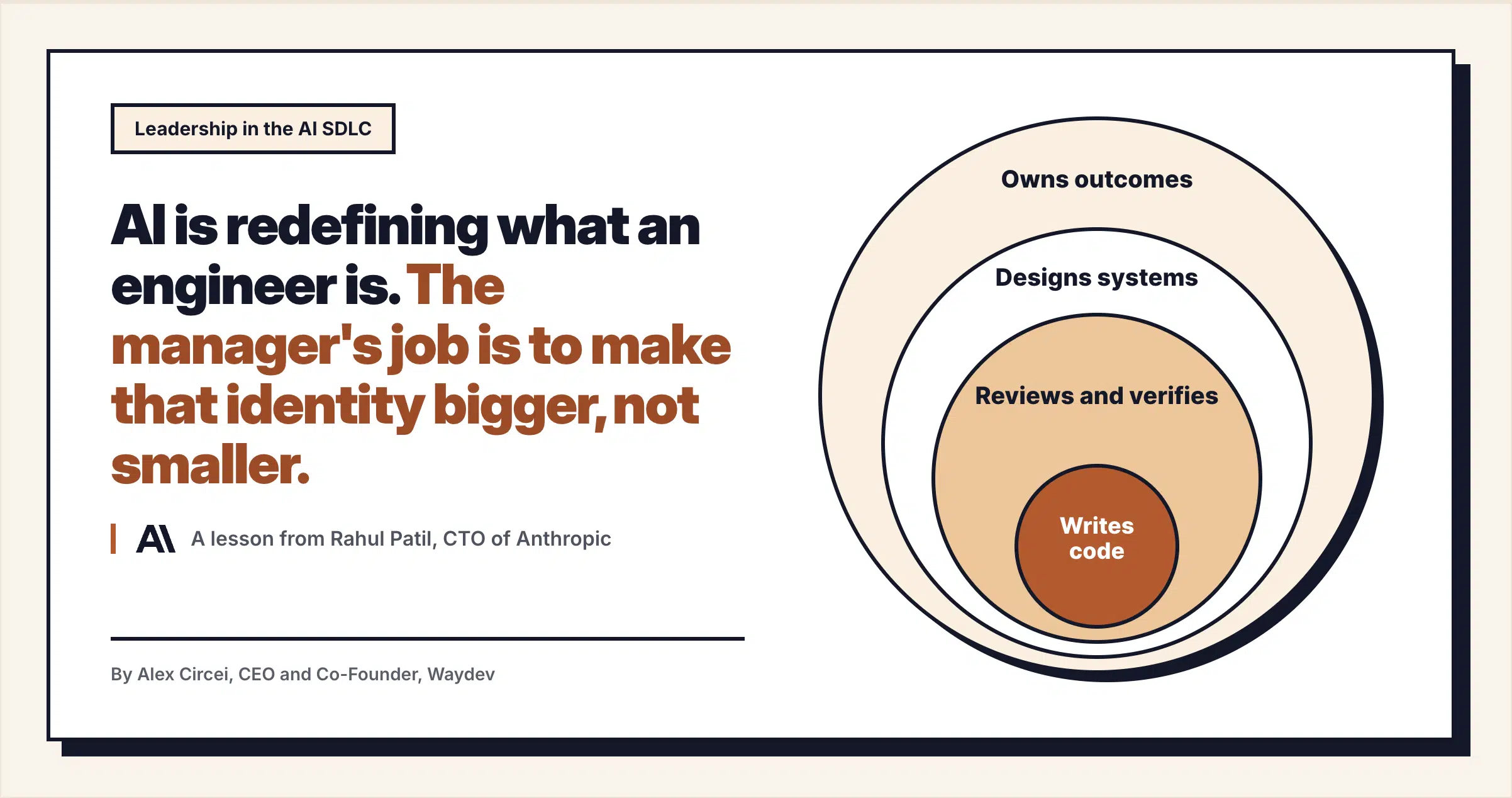
AI is redefining what an engineer is. The manager’s job is to make that identity bigger, not smaller.
Anthropic CTO Rahul Patil recently shared an internal post about the most important thing he believes a manager can do: expand a person’s core identity. It is a leadership lesson for any era. In the AI SDLC, where engineers are watching agents take over work that used to define them, it might be the most important management skill there is.
Patil describes a moment from early in his career. He was a young manager on an exceptional team, building software that still runs in production at enormous scale. Then customers delivered swift, harsh feedback about one commercial decision they hated. Nobody handled it well: not his manager, not him, not the team. He spent three hours alone in a conference room replaying everything, feeling small and alone, and decided he never wanted to feel that way again or see anyone else feel it.
“Expanding a person’s identity is the most important thing a manager can do.”
Rahul Patil, CTO at Anthropic, adding: especially in tough moments
His reasoning is worth sitting with. How we see ourselves, and what we believe we can do, is tightly linked to how we use our intelligence. When people feel their identity is under threat, much of their intelligence goes into protecting it. Help someone expand their identity, and you free that intelligence and passion for the actual mission.
Why nowFor decades, a software engineer’s identity was closely tied to writing code. Today, agents generate a growing share of it. Many engineers are quietly asking themselves a hard question: if an agent writes most of the code, what am I?
That is exactly the kind of identity threat Patil describes, and it shows up the same way. Engineers who feel smaller protect themselves. They resist new tools, avoid experiments that might fail in public, or adopt AI quietly without sharing what works. None of that is a technology problem. It is a management problem.
The opportunity is that the AI era genuinely makes the role bigger. As we wrote in When code gets cheap, engineering judgment gets expensive, the scarce skill is no longer typing code. It is deciding what should exist, verifying what agents produce, designing systems that hold up, and owning the outcome. A manager’s job is to help each engineer see themselves in that larger role.
The frameworkPatil names three qualities of a great manager, each an opportunity to expand individual and collective identity. Here is how each one translates for engineering leaders managing teams through the shift to AI.
This line from Patil’s post describes the AI SDLC almost perfectly. AI removed much of the friction of writing code. The constraint did not disappear. It moved downstream, into review queues, testing, release, and the product decisions about what to build next.
Illustrative. Where the bottleneck sits differs by team, and it keeps moving.
Patil’s advice is to not take it personally when you miss a bottleneck, and to swarm to the next one. That is only possible if you can see it. Teams that track code review flow, verification time and rework alongside AI adoption spot the new constraint in weeks. Teams without that visibility find out a quarter later, usually from a missed deadline.
Data and identityThis is where engineering intelligence and Patil’s principle meet. Data is powerful, and how it is used decides whether it expands or shrinks the people it describes. The same dashboard can be a tool for coaching or a tool for blame.
Engineering data should help people see who they can become, not just what they did last sprint.
Alex Circei, CEO, Waydev
Patil ends with a simple reflection for new and experienced managers alike: after each meeting, ask whether people left with their identity bigger or smaller. An honest answer, he says, teaches you a lot about being the best people coach you can be, for others and for yourself.
We would add one more place to ask it. After every engineering metrics review, every AI rollout update and every performance conversation that uses data, ask the same question.
Patil’s lesson is timeless, but its timing is perfect. AI will change what every engineer does in the next few years. Whether that change makes your people feel smaller or bigger is not up to the models. It is up to their managers, and to how those managers use every conversation, every review and every number in front of them.
Find your next bottleneck, together
See where work gets stuck across your teams and tools, and turn engineering data into better conversations.
Book a demoMore from Waydev
ARTICLEWhen code gets cheap, engineering judgment gets expensive → REPORT2026 Intelligence Report: Leading Engineering in the Age of AI → GUIDEHow to measure AI adoption in engineering → GUIDEHow to measure AI ROI on your engineering team → USE CASEWaydev for code review workflow →Rahul Patil, CTO at Anthropic, “Expanding a person’s core identity: the best thing I learned a manager can do,” shared on LinkedIn from an internal post, October 2026. His story and framework are paraphrased; the AI SDLC interpretation is Waydev’s own.
Ready to unlock your SDLC productivity?