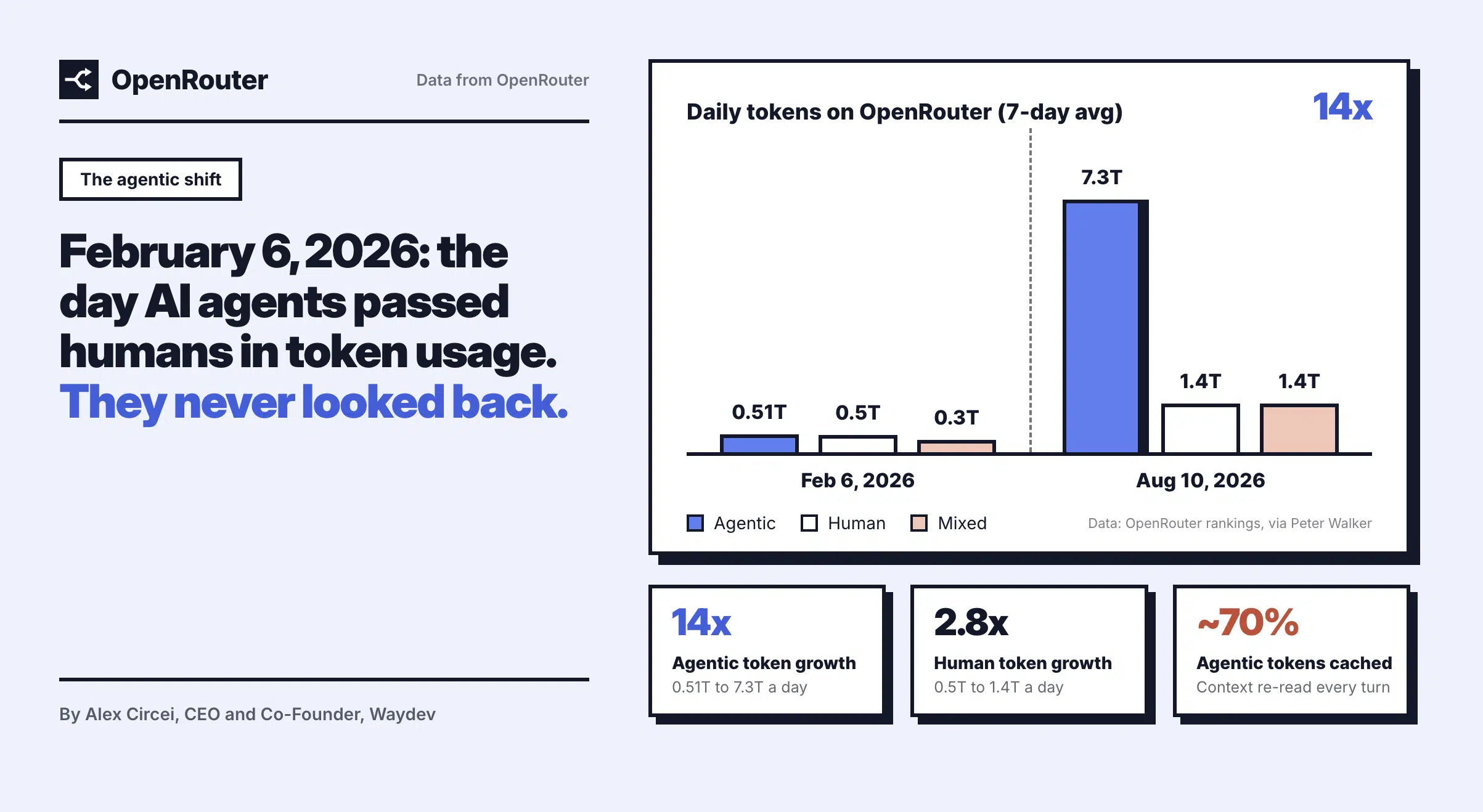
February 6, 2026: the day AI agents passed humans in token usage. They never looked back.
Data: OpenRouter rankings, as shared by Peter Walker, Head of Insights at OpenRouter.
New data from OpenRouter shows that AI agents, not people, are now the main consumers of AI. Agentic token usage grew 14x in about six months, while human usage grew 2.8x. For engineering leaders, this is not a market trivia point. It is a preview of where your AI budget, your workflows and your measurement problems are heading.
Peter Walker, Head of Insights at OpenRouter, pointed to February 6, 2026 as potentially the last day in history where humans used more tokens
than AI agents. On that day, agentic and human usage were roughly level at about 0.5 trillion tokens a day each, on a 7-day average. By August 10, agents were at 7.3 trillion tokens a day, while human usage had grown to 1.4 trillion and mixed usage to 1.4 trillion.
Humans did not stop using AI. Their usage nearly tripled. Agents simply grew five times faster. OpenRouter classifies traffic as agentic, human or mixed using a weighted score of seven signals per API key, including how often tools are called, the seconds between responses and the number of turns.
Walker’s explanation is simple. The new way of working, letting agents run autonomously over long periods, is the behavior change that unlocked the growth. A person asks a question and reads an answer. An agent plans, calls tools, reads results, retries and keeps going for minutes or hours, consuming tokens at every step.
Software engineering is where this shift is most visible. Coding agents open branches, run tests, read logs and iterate on pull requests with little human input between steps. Many engineering organizations already crossed their own February 6 without noticing: more of their AI spend now comes from agents working on their own than from engineers typing prompts.
For the AI SDLCThe caching detail is easy to skip, but it changes how engineering leaders should think about agent efficiency. If most of an agent’s tokens are context it re-reads every turn, then the size and quality of that context decides much of the bill. Bloated, noisy context costs more on every step and produces worse results. Tight, accurate engineering context costs less and helps the agent finish in fewer turns.
Your engineering org’s biggest AI users are no longer your engineers. They are the agents your engineers launch. Measure them like it.
Alex Circei, CEO, Waydev
Walker’s notes describe exactly the trade-off we built for. Agent workloads are huge and repetitive, cost pressure is pushing teams toward efficient models, and a model is only useful for agentic work if it is good at the specific job. That is why we launched Waydev 15B, our own model built for the software development lifecycle. The Waydev Agent now uses it by default, and teams can still choose other models at ai.waydev.co/models.
Agent-scale intelligence, inside your own walls.
Waydev Brain brings Waydev 15B, Waydev’s agents and your engineering data together in a private, air-gapped deployment. Your context stays in your environment, and the cost of running agents at volume is set by your infrastructure, not a per-token price list.
Explore Waydev Brain →Walker jokes that February 6 needs a better holiday name: liftoff day, takeoff day. Whatever we call it, it marks the point where AI stopped being mainly a tool people talk to and became a workforce that runs on its own. Engineering got there first. The leaders who measure that workforce by what it delivers, not by how many tokens it burns, will be the ones who get the most out of it.
See what your agents actually ship
Tie agent usage and spend to delivered, accepted work across every tool and model.
Book a demoMore from Waydev
PRODUCTWaydev Brain and Waydev 15B → ARTICLEWhen code gets cheap, engineering judgment gets expensive → REPORT2026 Intelligence Report: Leading Engineering in the Age of AI → GUIDEHow to measure AI ROI on your engineering team → COMPARISONBest engineering intelligence platforms for AI coding ROI →Peter Walker, Head of Insights at OpenRouter, LinkedIn post, August 11, 2026, and chart “7-day average token usage on OpenRouter split by type,” openrouter.ai/rankings. Figures reflect OpenRouter traffic only and its own agentic, human and mixed classification. The engineering interpretation is Waydev’s.
Ready to unlock your SDLC productivity?