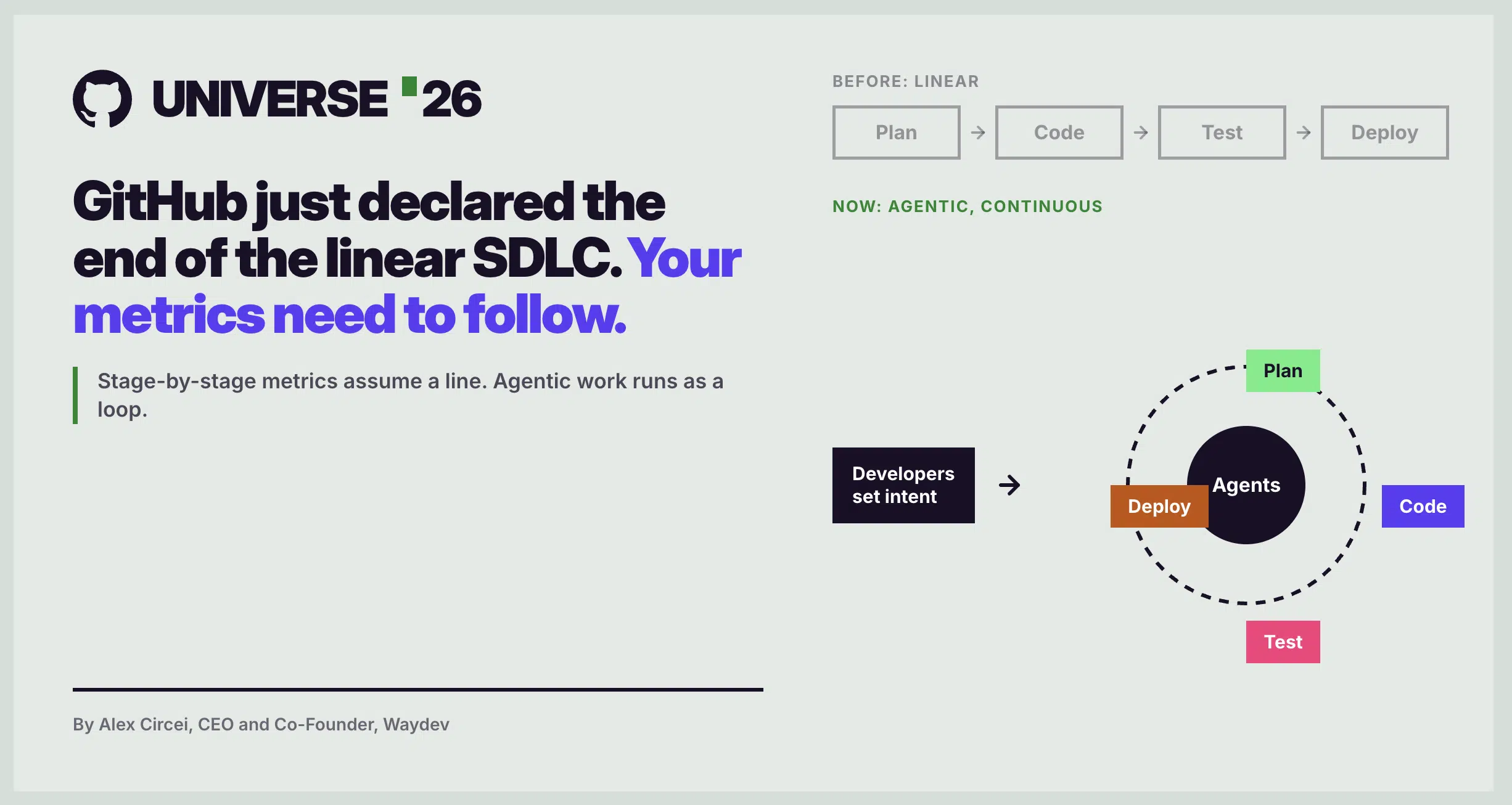
GitHub just declared the end of the linear SDLC. Your metrics need to follow.
Based on the agentic software delivery model GitHub described at Universe 2026.
At GitHub Universe 2026, GitHub laid out its plan to become an end-to-end software delivery system for developers and their agents. The products are impressive. The bigger story is the definition of success underneath them. GitHub is now saying, plainly, that code is not the output. Completed work is. That changes what every engineering organization should measure.
In his Universe keynote post, Jay Parikh, EVP of CoreAI at Microsoft, describes how fast the job has changed: in a couple of years, developers went from writing every line of code, to working with AI assistants, to orchestrating fleets of agents. The goal stayed the same: ship a feature, a bug fix, a security fix.
“Completed work, not more code, is the output that matters.”
Jay Parikh, EVP of CoreAI at Microsoft, GitHub Universe 2026
GitHub also argues the SDLC is no longer a straight line from planning to coding to testing to deployment. A code change, a colleague’s request or a production metric can trigger work anywhere in the system. Developers set direction, make decisions and stay accountable for what ships. Agents implement and verify. And everything feeds a continuous learning engine that makes the next cycle better. GitHub frames the goal in three words: velocity, intelligence and quality.
What launchedUnderneath, GitHub says it has added 4 million CPU cores, 160 PB of high-speed storage and 50 Tb/s of network capacity this year, is moving to a multi-region Azure deployment, and is rebuilding its Git architecture for agent-scale traffic. Parikh’s boldest line: all the software written so far may amount to less than 1% of what will be written in the next five years.
What it meansAs reported by GitHub, Artificial Analysis Coding Agent Index. Relative values, not raw scores.
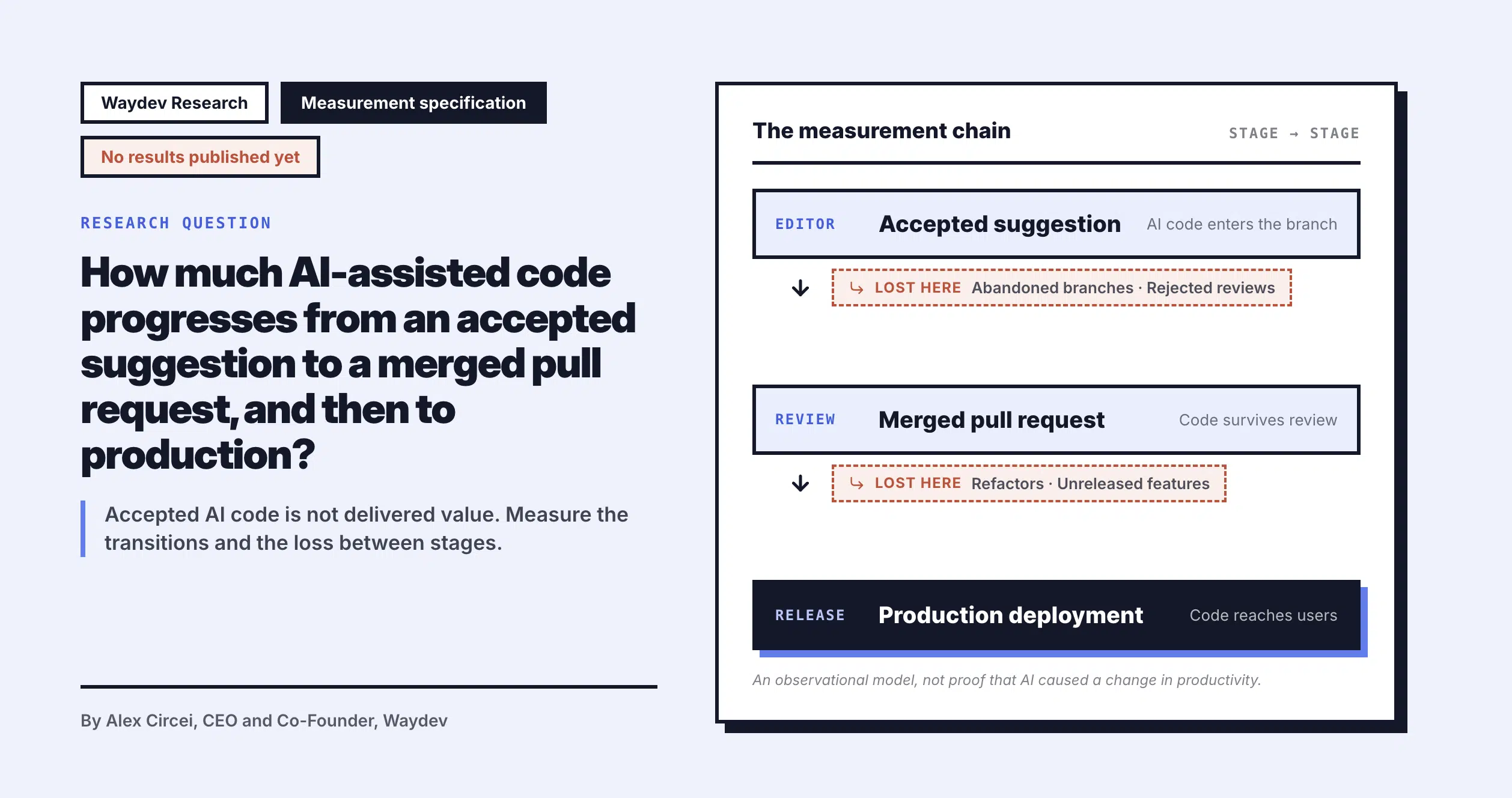
When the platform says completed work is the output, every engineering leader needs a way to count completed work, and what it cost.
Alex Circei, CEO, Waydev
The most important idea in GitHub’s vision is the continuous learning engine: completed work feeds back so the next cycle is better. We agree, and it raises a practical question for every enterprise. Most engineering organizations do not run on one vendor. Code lives across GitHub, GitLab, Bitbucket and Azure DevOps. Planning lives in Jira or Linear. Agents come from several providers. GitHub itself stresses that it stays open and extensible, with integrations to tools teams already rely on.
That means the learning that matters most, how your organization delivers software across every tool, model and team, has to be captured somewhere neutral. And for many enterprises, the richest version of that context is too sensitive to leave their environment.
Your own learning engine, built for the SDLC, inside your walls.
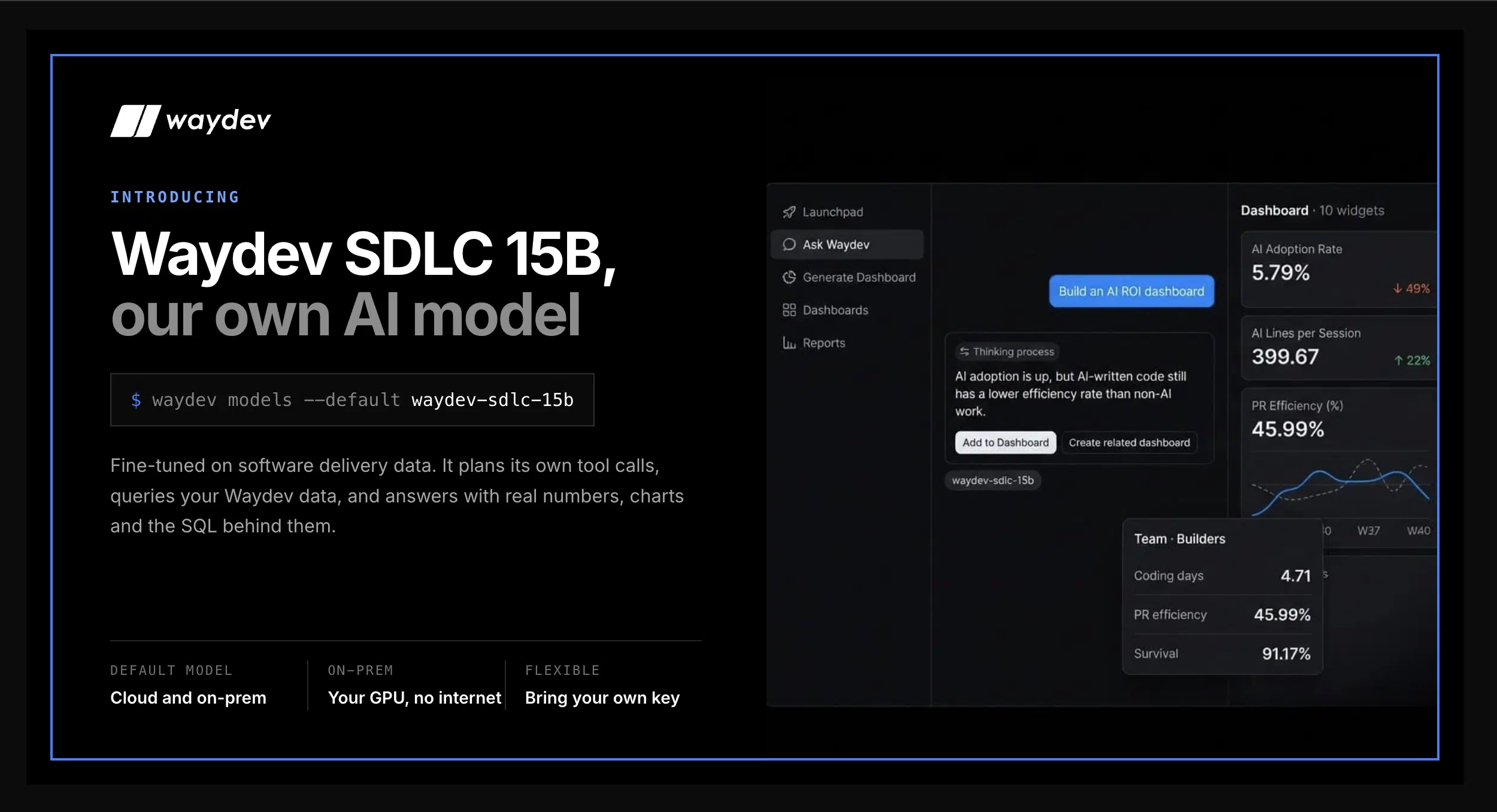
Waydev 15B is our model built for the software development lifecycle, and the default model behind the Waydev Agent. Waydev Brain brings it together with Waydev’s agents and your engineering data in a private, air-gapped deployment, so the learning from your completed work stays your own.
Explore Waydev Brain →If Parikh is right that today’s software is less than 1% of what will be written in the next five years, the volume of agent work is about to grow by orders of magnitude. GitHub is rebuilding its infrastructure for that world. Engineering leaders need to rebuild their measurement for it too: around completed work, end-to-end flow, cost per outcome and quality by model, across every tool their teams use.
Measure completed work, not code
See what your developers and agents actually ship, across GitHub and every other tool, and what it costs.
Book a demoMore from Waydev
PRODUCTWaydev Brain and Waydev 15B → ARTICLEWhen code gets cheap, engineering judgment gets expensive → REPORT2026 Intelligence Report: Leading Engineering in the Age of AI → GUIDEHow to measure AI ROI on your engineering team → COMPARISONBest engineering intelligence platforms for AI coding ROI →Jay Parikh, “GitHub Universe 2026: Evolving every layer of the stack,” The GitHub Blog, October 28, 2026. Product details, benchmark claims and infrastructure figures are as reported by GitHub. The interpretation is Waydev’s.
Ready to unlock your SDLC productivity?