AI Adoption · AI Impact · AI ROI
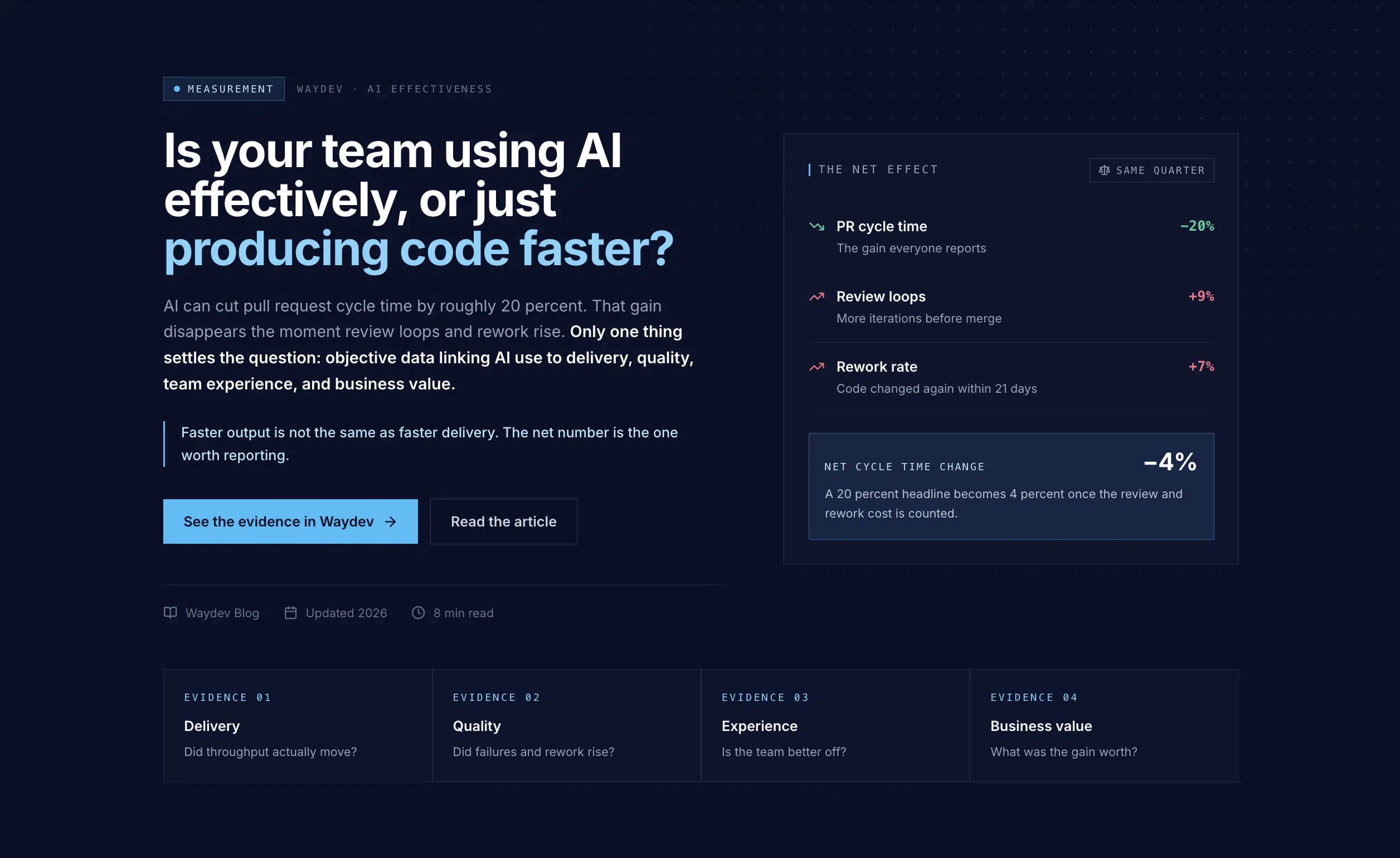
AI can cut pull request cycle time by roughly 20 percent. That gain disappears the moment review loops and rework rise. Only one thing settles the question: objective data linking AI use to delivery, quality, team experience, and business value.
Most engineering organizations can tell you how many AI licenses they bought. Far fewer can tell you what those licenses changed. The gap between those two facts is where AI budgets get cut.
What this covers
At a large engineering organization, effective AI use means more than counting licenses or asking how many lines a model generated. It means AI helps teams deliver useful software with less wasted effort while quality stays steady.
That distinction matters because speed can fool you. AI-assisted pull requests may move through coding faster, but the same work can trigger more review rounds, follow-up edits, or post-merge fixes. A short coding phase does not prove that the full delivery path improved.
Start with four measurement layers. Each one answers a question the layer above it cannot.
Active use, AI-touched work, acceptance patterns, and usage cost.
answers: is anyone actually using it?Cycle time, review wait time, deployment frequency, and lead time.
answers: did the work move faster end to end?Rework, churn, escaped defects, incidents, and change failure rate.
answers: did we pay for the speed later?Licenses, tokens, training, integration work, and capacity value.
answers: was the spend worth it?Keep the unit of analysis at the team, service, or organization level. Individual rankings damage trust and tell you little about whether an investment is working. A team may have slower cycle time because it handles a hard migration, not because its engineers use AI poorly.
DORA metrics help you read delivery performance through measures such as deployment frequency and change failure rate. Team experience, collaboration, satisfaction, and flow add context. Leaders who want the full picture use experience and collaboration measures alongside delivery data.
Illustrative. A shorter coding phase is easy to see and easy to celebrate. Whether the total path got shorter depends on what happened in review and rework, which is the part most AI reporting never touches.
Waydev connects engineering data with AI adoption signals so leaders can compare performance before and after rollout. It shows which teams use AI in repeatable workflows, where AI-assisted work stalls, and whether the output reaches production.
That last point is the test. A suggestion accepted in an editor has little value if it never merges, ships, or helps a customer.
Key takeawayAI is working when better delivery or capacity value appears without a hidden rise in rework, defects, or review burden.
When leaders ask whether their team is using AI effectively, they should look at workflow design, not tool count. AI works best as a teammate with a clear role, a human owner, and a defined handoff.
Think of AI as a fast junior partner. It can draft a test, suggest a code change, summarize a long incident, or point out edge cases. It cannot own the product decision or explain why a design fits the customer need.
Before a team adds AI to a workflow, define three things:
For example, an engineering team might use AI to draft tests for routine code. The team still sets the test goal. A reviewer checks the cases. The leader watches review time and escaped defects. If test volume rises but defect rates also climb, the workflow needs work.
Good teams design before they prompt. Ask AI to suggest several approaches or challenge a proposed design, then let an engineer make the call.
That keeps judgment with the people who understand the system, its users, and its risks. Prompt quality itself improves when teams use a repeatable loop:
State the task and the desired result. Ambiguity at this step propagates through everything after it.
Give the model only the context it needs. More context is not better context.
Set limits, such as coding standards or output format. Constraints are cheaper to state than to correct.
Ask for assumptions and likely failure points. This surfaces the reasoning a reviewer needs to check.
Review the result, then revise the prompt. The prompt is an artifact worth improving, not a one-time input.
Prompt chaining helps with larger work. First, ask AI to summarize a ticket. Then ask it to list acceptance criteria. Once a human approves those criteria, ask for test ideas. Each step gives the next one a cleaner input.
AI can also reduce management drag. Meeting notes can become searchable decisions. An internal assistant can answer routine onboarding questions. A low-code agent can route a support issue to the right team. But access rules still apply. Meeting recordings may contain personal or sensitive information, so the workflow needs consent, retention rules, and clear access limits.
Use AI to protect focus, not to fill every quiet hour with more meetings. The time saved by automation should go toward design work, customer problems, mentoring, or system improvements.
AI adoption also changes the software delivery life cycle. Teams need checkpoints at coding, review, continuous integration, deployment, and post-release review. Waydev’s AI Checkpoints help leaders see where AI-assisted work slows down or creates extra loops, instead of waiting for a quarterly report to reveal it.
Pro tipGive every AI use case one owner and one success measure before you expand it to more teams.
Effective AI use depends on skills and trust as much as software. If your team is unsure how to prompt, review, or question an output, adoption will stay shallow or become risky.
Training should cover the full task, not just the tool interface. Engineers need to know how to give useful context, check an answer, spot made-up details, and test generated code. Managers need to know how to read outcome data without turning it into surveillance.
Set clear boundaries. Your policy should explain:
A documented risk-management approach treats risk work as a continuous process, and that fits engineering adoption well. Review risk before launch, during use, and after incidents. A policy locked in a document will not guide a team through a live production issue.
Trust falls quickly when leaders use AI to watch individuals. Mouse activity, message counts, and raw output volume are easy to collect. They are weak proof of value. A team that solves a deep reliability issue may produce fewer visible events while doing more important work.
Use privacy-safe data at the team and service level. Share trends with engineers. Let teams explain changes in their workflow. Ask what AI removes from their day and what new work it adds.
Training should also include non-coding roles. Product managers can use AI to test a requirement for gaps. Technical writers can turn approved decisions into draft documentation. Engineering managers can prepare clearer one-on-one agendas or summarize recurring blockers. Every use case still needs a human check.
Waydev supports this trust layer with granular visibility into team patterns rather than individual surveillance. Signals can flag a rise in review time or rework, giving leaders a prompt for a team conversation. The purpose is to fix the workflow, not label a person.
Illustrative. A useful readiness review covers data quality, skills, workflow fit, governance, and measurement. If one area scores low, fix that constraint before buying more seats. More access will not solve poor source data or unclear ownership.
To prove AI ROI, engineering leaders must connect spend to a measured change in delivery, quality, or capacity. A license count is an input. It is not a business result. A disciplined approach to measuring AI ROI on an engineering team starts with evidence that finance and the board can audit.
Start with a baseline before a major rollout. Use a fixed period that captures normal release work. Then compare similar teams or services when possible. A product team working on a new platform should not be compared with a team handling routine maintenance.
Track AI use beside business outcomes. A board-ready scorecard can include:
Do not count the same gain twice. If saved hours helped a team ship more features, treat that as one capacity benefit. Do not report the hours and the full value of the added output as separate gains unless finance agrees on the method.
A simple capacity model
annual capacity value =
verified hours saved per week
× loaded hourly cost
× working weeks
× realization rate
Subtract the full program cost. Include seats, usage fees, integration work, security review, training, administration, and evaluation. Use conservative assumptions. The CFO will trust a smaller claim with clear evidence more than a large claim built on guesses.
Quality needs equal weight. A 20 percent cycle-time improvement means little if rework rises by the same amount. Compare AI-touched work with other work across the same service. Review results after enough time has passed for post-merge problems to appear.
Present the story in three views:
Adoption, flow, review friction, and quality. Reviewed monthly by engineering leadership.
Spend, usage depth, capacity value, and payback. Taken to finance each quarter.
Incidents, sensitive data events, and policy gaps. Escalated whenever the picture changes.
Waydev brings these three views together with engineering intelligence data spanning more than 150 engineering metrics. Predict & Improve helps leaders move from a trend to a likely next action, while Ask Waydev gives executives a faster way to question the data in plain language.
If a team shows high use but no delivery gain, investigate the workflow before renewing the tool. If quality improves while speed holds steady, that may be the stronger business case.
For a board discussion, show the baseline beside the current result. Name the owner. State the next decision. The board does not need another AI demo. It needs a clear answer about where capital should go next.
Teams that use AI effectively treat measurement as part of adoption, not a report added later. Build a small scorecard, review it at team and executive levels, and use the results to guide tool spend.
Your team is using AI effectively when AI-assisted work improves delivery or capacity without causing a hidden rise in defects, rework, or review time. Check adoption beside cycle time, deployment frequency, change failure rate, team feedback, and cost. High usage alone proves access. It does not prove useful impact.
Measure AI productivity with a mix of adoption, delivery, quality, and finance signals. Compare AI-touched work with a pre-AI baseline. Track cycle time, review time, deployment frequency, rework, incidents, tool cost, and verified hours saved. Keep the analysis at team or service level so the data supports improvement rather than individual surveillance.
The best AI adoption metrics show depth as well as reach. Track active users, engaged teams, AI-touched pull requests, acceptance patterns, tool mix, and usage cost. Then connect those signals to delivery and quality. A team that uses AI often but produces more rework needs a workflow fix, not a higher adoption target.
Engineering leaders can prove AI ROI by showing spend beside measured outcomes and a clear baseline. Include tool and enablement costs, delivery changes, quality results, and verified capacity value. Compare similar teams where possible. Use conservative assumptions and explain the next funding decision. The board should see what changed and why.
Teams should use AI to improve shared workflows, not rank individual engineers. Set rules for sensitive data, human review, access, and incident reporting. Share team-level trends with the people doing the work. Ask engineers which tasks AI removes and which review burdens it adds. Trust grows when measurement leads to support, not suspicion.
Waydev connects AI usage with delivery performance, quality signals, and financial value across the engineering organization. Bring your baseline. We will show you the rest.
Book a demoWaydev is an AI-native engineering intelligence platform measuring AI adoption, impact, and ROI across engineering organizations, trusted by Fortune 500 companies including American Express, Dropbox, Caterpillar, and PwC.
Ready to unlock your SDLC productivity?