Your teams and agents can generate change faster than anyone can steer it.
Linear CEO Karri Saarinen just named a problem most engineering leaders feel but rarely say out loud. Agents and teams can now produce change faster than any leader can understand it, and leadership is quietly losing the ability to steer. Here is what he describes, and what it takes to steer an engineering organization in the AI SDLC.
In his essay, Saarinen describes how hard it has become to live up to a principle he has written about before: you can outsource work, but not your understanding.
“It feels like our organizations are being DDoSed from the inside.”
Karri Saarinen, CEO of Linear
Nobody is attacking the company. Everyone is doing work they believe is useful. But all of it draws on the same limited capacity to understand, review and decide, and that capacity has not grown at the speed of generation. Saarinen compares it to a car speeding up until it becomes impossible to steer. Leaders never saw every piece of work, but the work can now change the direction of the company faster than leadership can respond.
He is careful to say this is not about people making poor decisions. Linear invests heavily in hiring and in an environment built for good judgment. Even so, he describes unclear or shifting direction and overlapping or conflicting features. Something can go from idea to working implementation before anyone outside the immediate team knows it exists.
The trapWhen something takes twenty minutes to build, asking to discuss it at tomorrow’s meeting starts to feel unreasonable. Saying “looks good, let’s go” is easier. Saarinen’s answer is the core of the essay: the fact that work exists does not tell you whether it is the right thing to do. We have to stop treating output as proof of value. A working implementation proves something can be built, not that it belongs in the product, and some changes have negative value.
But the opposite extreme fails too. You cannot hold an alignment meeting for every one of the 1,000 pull requests a team might open in a day. Leaders are stuck between rubber-stamping everything and becoming the bottleneck.
What Linear is tryingThat gap is the heart of the problem. Intent and gates are inputs. Steering also needs feedback: a continuous, honest picture of where the work is actually going. And it is not just a CEO problem. Saarinen points out that every leader whose judgment you rely on is also trying to keep up with everyone else.
The steering loopEvery steering system has the same shape: a direction, an engine, and instruments that show where you are actually heading. Most engineering organizations upgraded the engine with agents and kept the old instruments.
The aggregate view is what turns a pile of individually reasonable changes into something a leader can steer. In practice, it answers questions like these every week, without reading 1,000 pull requests:
Saarinen makes a point worth repeating: he trusts his people, and the problem is not bad decisions. That matters for how leaders respond. The surge of change is driven by agent throughput, not by people suddenly working differently. Watching engineers more closely will not restore steering. Understanding what the agents are producing, where it goes and whether it holds up, will.
That is the direction we have taken at Waydev: measure AI agents, not people. Which agents generate the most change, how much of it lands, how much creates review load or rework, and whether it moves the bets the company actually made. People stay accountable for direction and judgment. The instruments watch the engine.
Agents upgraded the engine of every engineering org. Most leaders are still steering with the old dashboard.
Alex Circei, CEO, Waydev
Saarinen’s first move, writing intent down so people and agents can check their own work against it, only works if agents can actually read that intent alongside how your organization builds software: ownership, standards, what is in flight, and what broke last time. For most enterprises, that context is too sensitive to send to a public model. So it either never reaches the agents, or it leaks.
Private agent intelligence, inside your own walls.
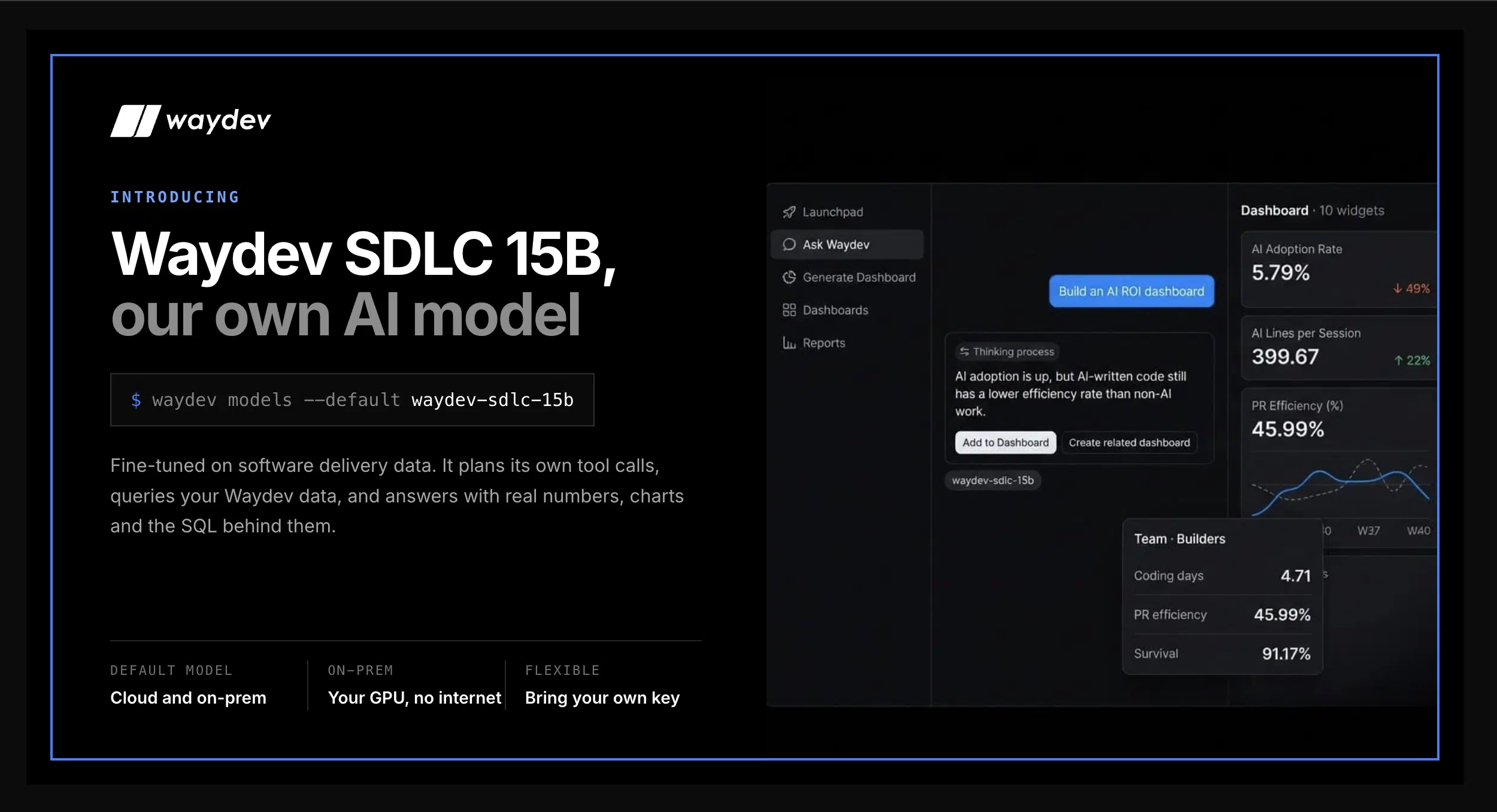
Waydev Brain brings Waydev 15B, our model built for the software development lifecycle, together with Waydev’s agents and your engineering data in a private, air-gapped deployment. It measures what your agents produce, understands your engineering context, and keeps that context, and the intent you set, inside your environment.
Explore Waydev Brain →Saarinen ends on a point every engineering leader should hold onto: stepping back does not remove responsibility for where it all leads. Each team can make reasonable decisions, and leaders still own what those decisions add up to. In the AI SDLC, the way to keep that responsibility without becoming the bottleneck is not more meetings. It is better instruments, clearer intent, and agents that work inside both.
Get your steering back
See what your agents and teams are really changing, and whether it adds up to the direction you set.
Book a demoMore from Waydev
PRODUCTWaydev Brain and Waydev 15B → ARTICLEWhen code gets cheap, engineering judgment gets expensive → REPORT2026 Intelligence Report: Leading Engineering in the Age of AI → GUIDEHow to measure AI ROI on your engineering team → COMPARISONBest engineering intelligence platforms for AI coding ROI →Karri Saarinen, CEO of Linear, “Our organizations are being DDoSed from the inside,” November 2, 2026. His essay is paraphrased; the engineering measurement interpretation is Waydev’s.
Ready to unlock your SDLC productivity?