| Executive briefing | Waydev · Migration series · No. 04 |
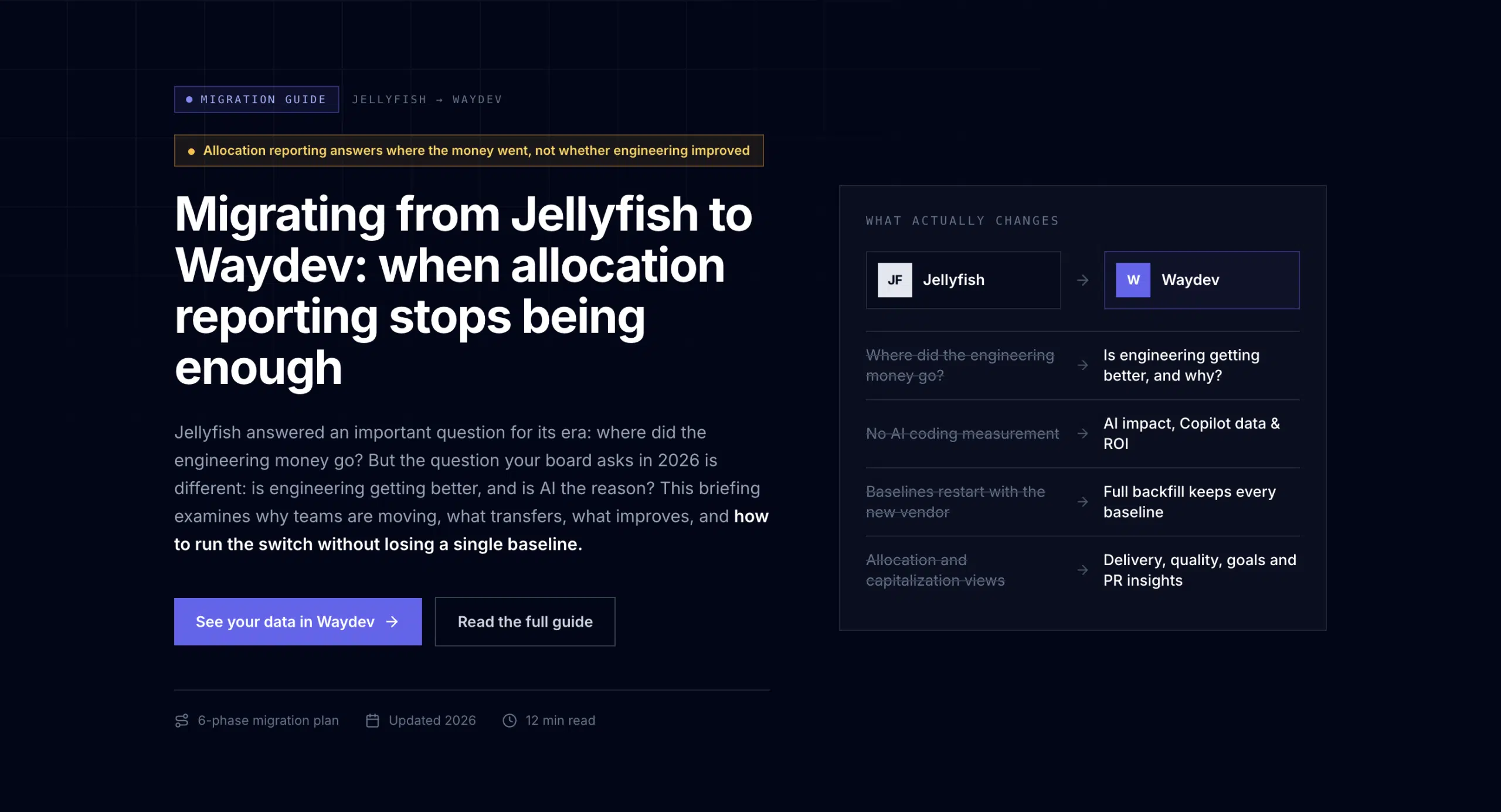
Jellyfish answered an important question for its era: where did the engineering money go? But the question your board asks in 2026 is different: is engineering getting better, and is AI the reason? This briefing examines why teams are moving, what transfers, what improves, and how to run the switch without losing a single baseline.
Key findings
| I.
Jellyfish and Waydev answer different questions. Jellyfish reports on allocation for finance. Waydev measures performance for engineering, and reports allocation as a byproduct. |
II.
Jellyfish’s model is ticket-first: its accuracy depends on Jira hygiene and continuous categorization upkeep. Waydev is Git-first: the source of truth is the work itself. |
| III.
The switch carries no historical cost. Waydev rebuilds your full metric history directly from your Git provider. Baselines, trends, and year-over-year comparisons survive intact. |
IV.
A 30-day parallel run before renewal produces a side-by-side comparison on your own data, and leverage in the renewal conversation whichever way you decide. |
Section 01
Every platform in this category embodies a theory about where the truth of engineering work lives. Jellyfish and Waydev sit at opposite ends of that spectrum, and most of the friction Jellyfish customers describe traces back to this single architectural choice.
|
Jellyfish The ticket is the truthWork is understood through project management data. Effort is inferred from tickets and mapped to initiatives, producing allocation and investment reports finance can consume. The cost: the model is only as good as your Jira hygiene. Categorization needs constant tuning. As the org evolves, categories go stale, and someone owns that maintenance forever. Engineering managers get reporting, not daily operational value. |
Waydev The work is the truthWork is understood at the source: commits, pull requests, reviews, and deployments, enriched with ticket context. Waydev’s Git analytics are USPTO-patented, and business alignment is inferred by AI from the work itself. The gain: accuracy does not depend on ticket discipline. No categorization taxonomy to maintain. Managers get commit-level operational visibility daily, and executives still get the allocation view. |
A measurement platform that requires its own data hygiene program is not measuring your organization. Your organization is working for it.
Section 02
| 01 |
The categorization tax came dueThe implementation was heavy, and it never really ended. Allocation accuracy depends on ticket discipline across every team, so a program manager or ops lead becomes the permanent custodian of the taxonomy. When that person leaves or priorities shift, report quality quietly degrades, and with it, trust in the numbers. |
| 02 |
The EM value gapJellyfish is loved in the boardroom and tolerated on the floor. Ask your engineering managers what they open each morning to unblock their teams. If the answer is not Jellyfish, you are paying enterprise prices for a quarterly reporting tool. Waydev gives managers commit-level work patterns, review bottlenecks, and Slack-delivered Signals they act on the same day. |
| 03 |
The board changed the questionAllocation reporting answers “where did the engineering budget go.” The question every board asks now is “what is our AI investment returning, and is engineering actually improving.” That is a leverage question, not an allocation question, and it requires measuring adoption, impact, and ROI at the level of the work itself. Waydev was rebuilt around exactly this. |
| 04 |
Total cost of ownership, honestly countedThe invoice is only part of the cost. Add the implementation months, the categorization custodian, the Jira hygiene mandates pushed onto every team, and the analyst time spent interpreting dashboards. Waydev’s conversational layer and automatic alignment remove most of that operational overhead. Count both columns before renewal. |
Section 03
Every executive-facing view your organization relies on in Jellyfish exists in Waydev. The difference is what sits underneath it, and what it costs to keep accurate.
| Jellyfish capability | Waydev equivalent | The difference |
|---|---|---|
| Resource allocation reporting | ✓ Business alignment | AI infers alignment from commits, PRs, and ticket context. No taxonomy to maintain |
| Executive and board reporting | ✓ Executive reports | Plus Waydev AI: leadership asks questions in plain language, answers in seconds |
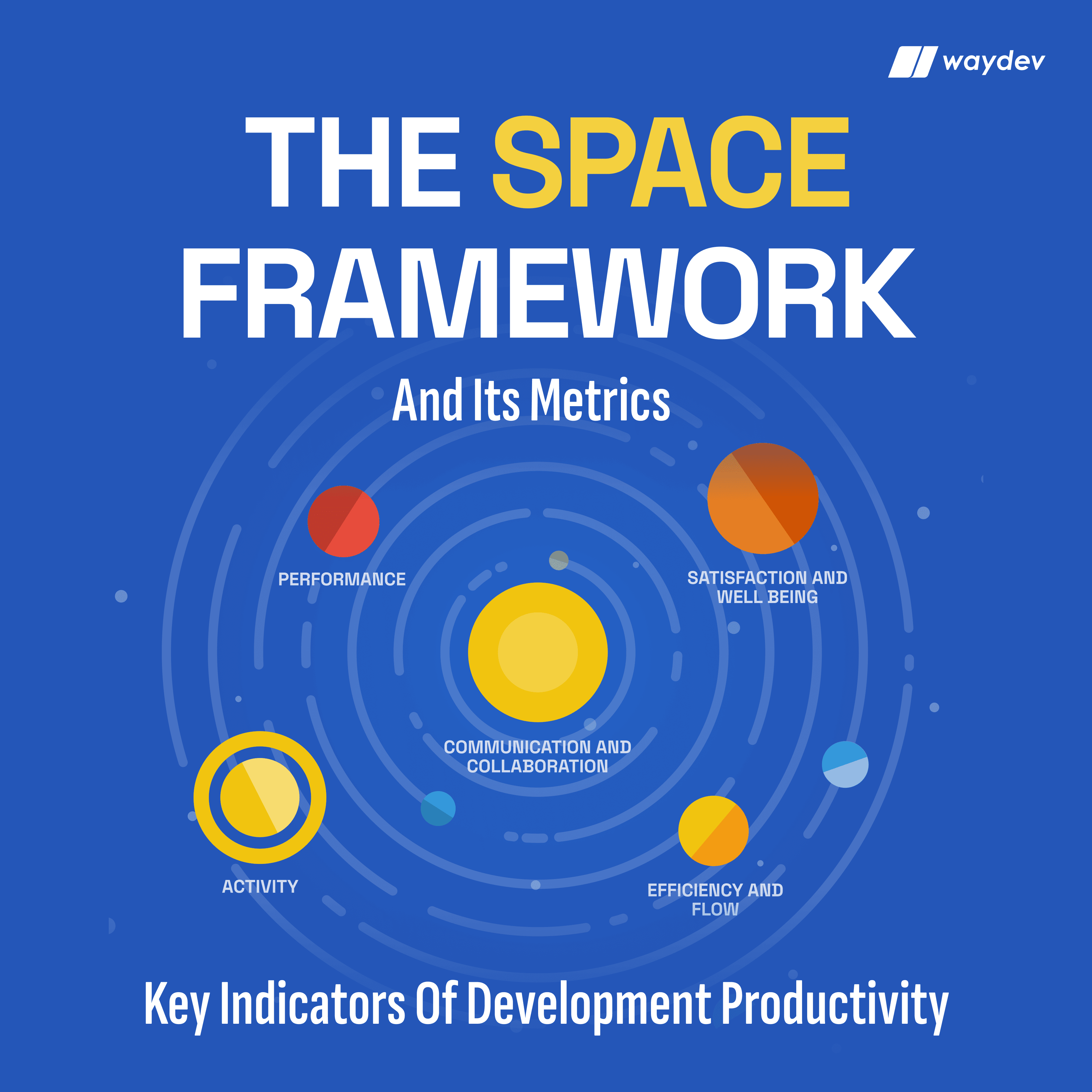
| DORA and delivery metrics | ✓ DORA metrics | Plus SPACE framework and industry benchmarks |
| Sprint and delivery tracking | ✓ Delivery analytics | Grounded in commit-level Git data, not ticket estimates |
| Team metrics and dashboards | ✓ Team dashboards | Plus daily operational value for EMs: work log, deep dives, review workflow |
| AI usage measurement | ✓ AI adoption / impact / ROI | Adoption, impact on delivery, and ROI down to the spend, in one view |
| Enterprise controls (SSO, RBAC) | ✓ Enterprise-ready | Plus roles and anonymization, approved by works councils at enterprise scale |
| Historical baselines | ✓ History rebuild | Rebuilt directly from your Git provider. Switching costs nothing historical |
If your finance team files cost capitalization reports built on Jellyfish’s specific templates, map that workflow before you switch and validate the replacement path with us on the first call. It is the one area where the migration needs finance in the room from day one, not after.
The core of it
Jellyfish tells your CFO where engineering spent its time. Waydev tells your CFO the same thing, and tells your engineering organization how to get better, and tells your board what AI is returning. One platform, three audiences, no taxonomy custodian.
Section 04
A Jellyfish replacement decision crosses three desks. Here is the case, tailored to each.
For the CFO
Allocation and investment reporting continues without interruption, with lower total cost: no implementation program, no categorization staffing, and an AI ROI answer that today requires manual correlation across tools. The budget line already exists. It was paying for Jellyfish.
For the VP of Engineering
Your managers finally get a tool they open daily: commit-level visibility, review bottlenecks surfaced by Signals in Slack, Goals that track themselves. And the metrics conversation with leadership moves from “here is the dashboard” to asking Waydev AI the question in the meeting.
For the CISO
SOC 2 certified, source code never stored, SSO and RBAC standard, with role-based anonymization on top. Individual-level data can be restricted while leadership keeps org-level visibility. Full documentation available for review before any data flows.
Section 05
Jellyfish is not going anywhere, which means your deadline is contractual, not existential. That is an advantage. Work backward from renewal.
| When | Move | Outcome |
|---|---|---|
| T minus 90 days | Audit real usage. Which Jellyfish reports were actually consumed last quarter, and by whom. Who maintains the categorization, and at what fraction of their time. | Your true requirements list, and your true cost of ownership |
| T minus 60 days | Connect Waydev to production repos. Read-only against Git, so both platforms coexist without conflict. History processes automatically. | Side-by-side baselines within days, on your own data |
| T minus 30 days | Run both with real users. Three EMs use both tools for weekly reviews. Finance validates one allocation report in each. One question at the end: which would you fight to keep? | A decision made by usage, not by demo |
| Renewal | Decide with leverage. Sign off with the memo below, or renegotiate Jellyfish from strength. Either way, the parallel run pays for itself. | The right platform at the right price |
Internal memo template for sign-off
Ahead of our Jellyfish renewal, we ran Waydev in parallel on our production repositories for 30 days, with engineering managers and finance validating both platforms. I recommend we switch to Waydev at renewal.
Waydev preserves everything we rely on in Jellyfish, including allocation reporting, DORA metrics, and executive dashboards, and removes the categorization maintenance our allocation accuracy currently depends on. It adds commit-level engineering visibility, AI adoption and ROI measurement, and a conversational interface that reduces our reporting overhead. Our historical baselines rebuilt directly from Git, so we lose no trend data.
Waydev is used by Fortune 500 engineering organizations including American Express and PwC, holds a USPTO patent in Git analytics, and is recognized by Gartner in the Developer Productivity Insight Platforms category. The budget is already approved: it was paying for Jellyfish, plus the internal time we will no longer spend maintaining it.
Yes, and it gets cheaper to keep accurate. Waydev infers business alignment from commits, PRs, and ticket context using AI, rather than depending on a manually maintained categorization taxonomy. Finance validates one report in each platform during the parallel run before anything changes.
No. The source data lives in your Git provider, not in Jellyfish. Waydev processes your full commit and PR history on connection, so trends and year-over-year comparisons rebuild from source.
Directionally yes, exactly no, and the deltas are informative. Ticket-inferred effort and Git-measured work diverge wherever ticket hygiene is weak. During onboarding we reconcile definitions against your Jellyfish baselines so leadership understands every delta before the switch, not after.
Technical setup takes one to two weeks, with full rollout in 30 to 60 days depending on org size. Because Waydev connects read-only to Git and rebuilds history automatically, there is no export-import project, and both platforms run in parallel until you cut over.
Waydev is SOC 2 certified and never stores source code. SSO and RBAC are standard. Role-based access and anonymization controls allow individual-level data to be restricted or anonymized while leadership keeps org-level visibility, a model works councils and legal teams have approved at enterprise scale.
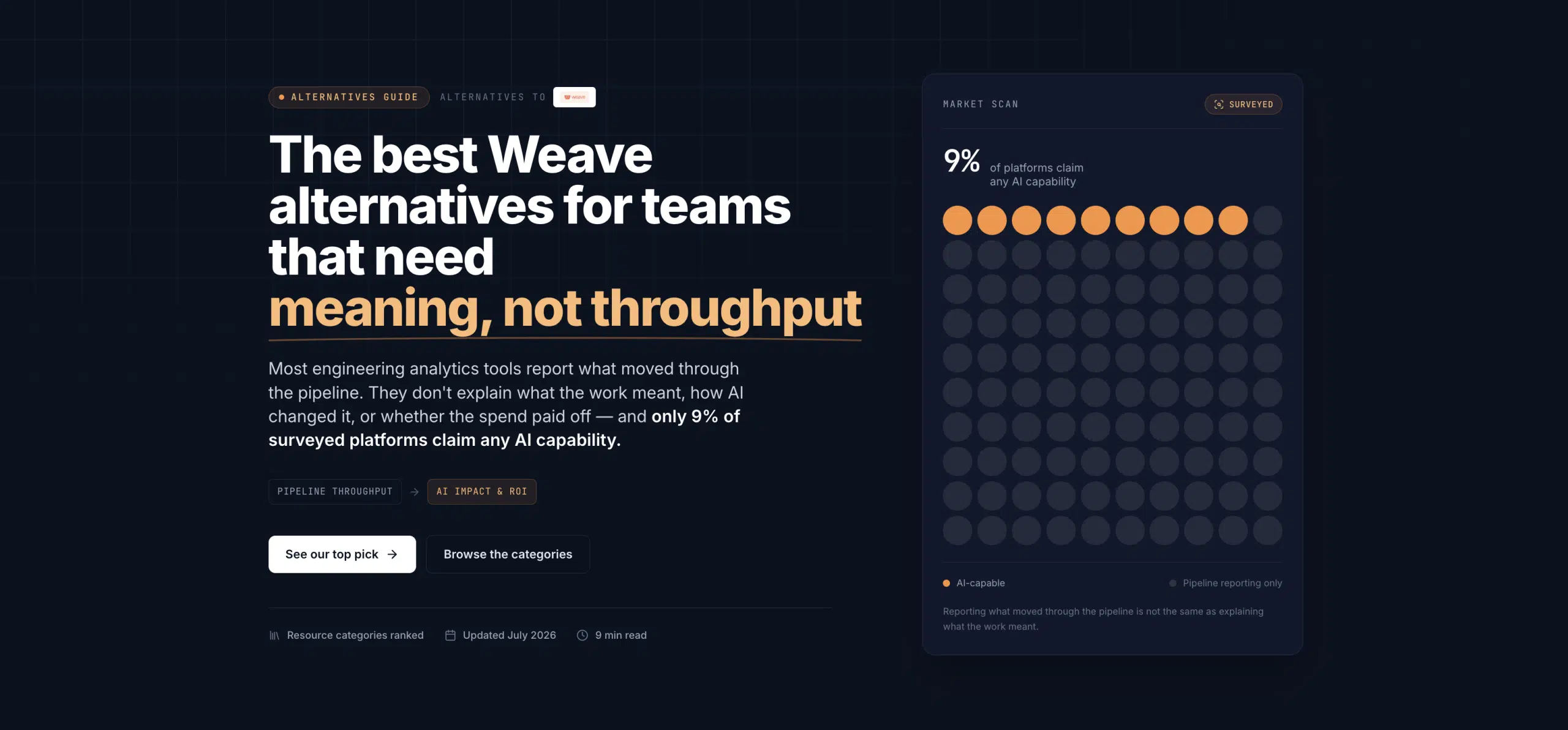
Waydev tracks AI adoption, impact, and ROI across engineering: who is using Copilot, Cursor, and agentic tools, how AI-assisted work moves through review and into production, and what the spend returns, connected to delivery outcomes at the PR level.
Thirty days, your production repositories, both platforms side by side. Your managers vote with usage, your finance team validates the allocation view, and you walk into renewal with leverage. If Jellyfish wins the comparison, keep it. We are confident it will not.
Ready to unlock your SDLC productivity?