| Total cost briefing | Waydev · Migration series · No. 07 |
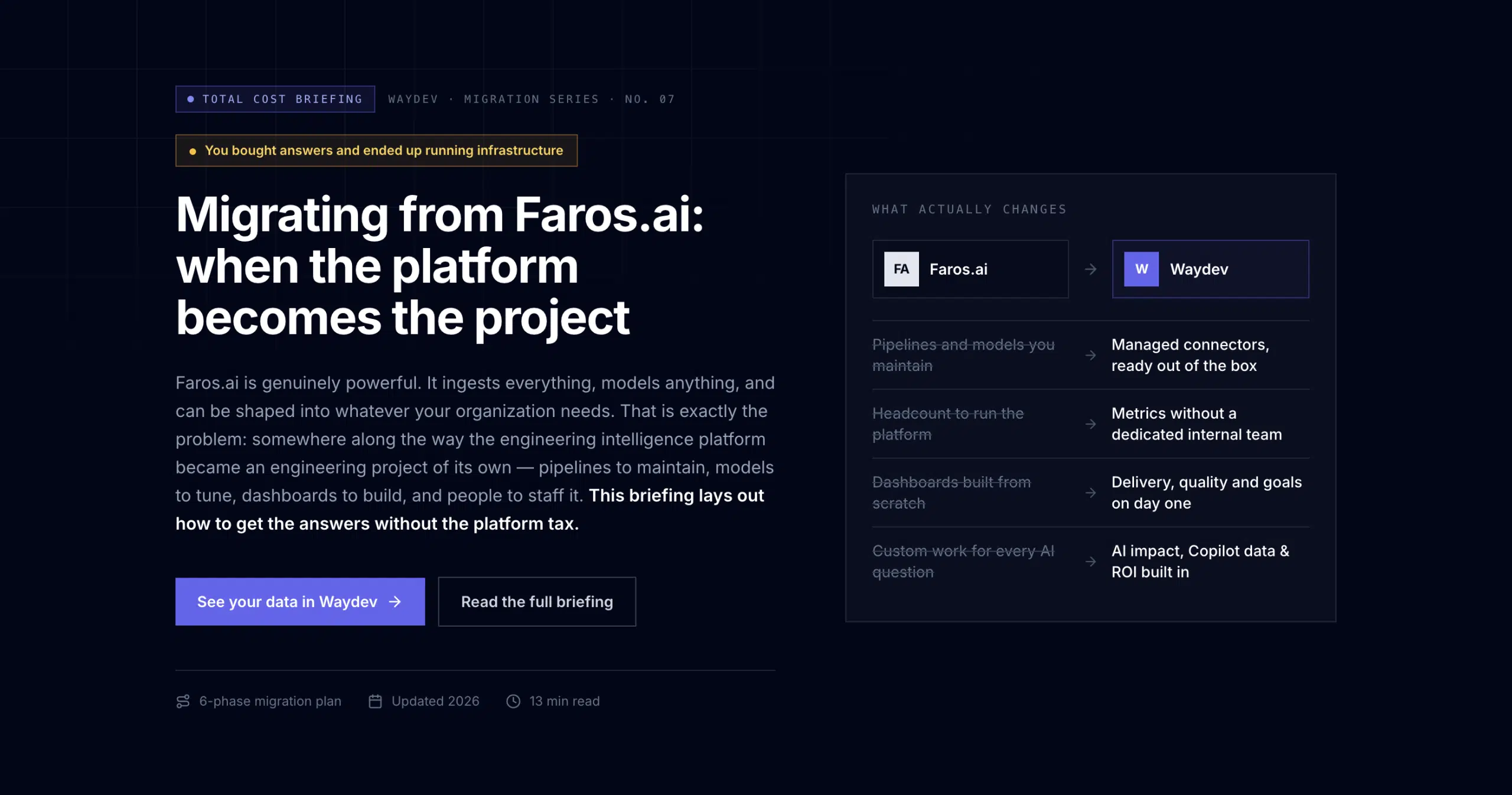
Faros.ai is genuinely powerful. It ingests everything, models anything, and can be shaped into whatever your organization needs. That is exactly the problem. Somewhere along the way, the engineering intelligence platform became an engineering project of its own: pipelines to maintain, models to tune, dashboards to build, and people to staff it. This briefing is for teams who bought answers and found themselves running infrastructure, and it lays out how to get the answers without the platform tax.
Time to first answer
One benchmark cuts through every feature comparison in this category. Pick a real question your board asked, for example “what is our AI coding spend returning, per tool, per team,” and time how long each platform takes to answer it, counted from contract signature and including the internal staffing required.
|
The data-platform path (Faros) A quarter, if staffed Connect sources, validate the ingestion, model the entities, define the metrics, build the dashboards, then interpret them. Each step is doable and each step is work, owned by someone on your platform team who was hired to build your product, not your measurement stack. |
The product path (Waydev) Days, then ask Connect your Git provider and project management tools. History processes automatically, AI measurement is built in, and Waydev AI answers the board’s question in plain language. The configuration project is the part that does not exist. |
Section 01
Faros’s flexibility is real, and flexibility always has a payroll. Before your renewal, put honest numbers next to each line. The invoice is the smallest one.
| Ledger line | What it looks like in practice | Your number |
|---|---|---|
| The subscription | The line procurement sees. Usually the only line anyone compares. | $______ |
| The custodians | The fraction of platform or data engineering time spent on connectors, entity resolution, metric definitions, and dashboard requests. Ask them directly. The answer is rarely under half an FTE, and often more. | ___ FTE |
| The queue | Every leadership question that becomes a dashboard ticket. Days between “the CFO asked” and “the chart exists” is decision latency, and it compounds quarterly. | ___ days |
| The bus factor | The number of people who actually understand your Faros setup. When they change teams or companies, the measurement stack becomes archaeology. | ___ people |
A platform that can answer anything answers nothing out of the box. You did not buy engineering intelligence. You bought the toolkit for building it, and the building never actually ends.
Section 02
The classic build-vs-buy framework assumes you know which one you chose. The data-platform model blurs it: the contract says buy, the operating reality says build. You are paying a vendor and staffing the solution.
There is a segment for whom that is the right call: organizations with dedicated engineering-metrics teams, bespoke methodology requirements, and a genuine appetite to own the semantic layer. If that is you, and the staffing is intentional and budgeted, Faros is a reasonable choice and this guide will not talk you out of it.
Most teams we talk to are not that segment. They wanted the DORA numbers, the delivery picture, the AI ROI answer, and an executive layer that does not require a ticket queue. For that majority, the composability they are paying for is a feature they use once, during setup, and pay for forever, in people.
In the last quarter, how many hours did your organization spend making the measurement platform work, versus acting on what it showed? If the first number is not close to zero, the platform is consuming the value it was bought to create.
Section 03
This category is consolidating. Pluralsight sold Flow to Appfire, which is sunsetting it in 2027. Code Climate pivoted to consulting and left Velocity behind. Atlassian bought DX for one billion dollars and is folding it into its suite. Each event stranded customers who believed their platform was permanent.
Faros is venture-backed. That is not a criticism, it is a structure, and structures have consequences: investors require an exit, and in a consolidating category the likeliest exits are acquisition by a suite vendor or a strategic buyer whose incentives become your incentives overnight. DX customers did not get a vote.
So ask the question before renewal, in writing: what contractual protections exist for customers in a change of control? Data portability, pricing protection, roadmap commitments. And ask the same of every vendor, including us. Waydev’s answer is structural: bootstrapped, profitable, nine years of independent operation, no investors requiring an exit and no timeline forcing one.
The core of it
Faros gives you the parts and the workbench. Waydev gives you the answer: AI adoption, impact, and ROI, DORA, and the executive picture, live in days, queryable in plain language, with nobody on your payroll keeping it alive.
Section 04
| Faros capability | Waydev equivalent | What stops being your job |
|---|---|---|
| DORA / delivery metrics | ✓ DORA, SPACE, DX | Defining and maintaining the metric layer. Definitions ship built in, with benchmarks |
| AI transformation dashboards | ✓ AI adoption / impact / ROI | Building the AI measurement model. Adoption, impact, and ROI per tool and per team, down to the spend, out of the box |
| Custom dashboards / BI layer | ✓ Waydev AI + reports | The dashboard queue. Leadership asks in plain language and gets the answer in seconds |
| Source connectors / pipelines | ✓ Native integrations | Pipeline upkeep. Git and PM connections are managed product surface, not your infrastructure |
| Team and org reporting | ✓ Team + executive layers | Assembling the exec view. Org rollups, Goals, and Signals to Slack are native |
| Enterprise controls | ✓ SSO, RBAC, anonymization | Access modeling. Roles and anonymization approved by works councils at enterprise scale |
| Historical data | ✓ History rebuild | Migration itself. Full history rebuilt directly from your Git provider, no export project |
If your team built genuinely bespoke analytics in Faros, custom entities, exotic data sources, in-house metric definitions, that work is specific to its data model and will not port. Inventory it honestly before deciding: in our experience most of it exists to reproduce what a product should have provided natively, and the remainder is usually better served by exporting Waydev data to your own warehouse than by keeping an entire platform alive for a handful of custom charts. Bring the list to the first call and we will tell you plainly which bucket each item falls into.
Section 05
Faros is a healthy vendor, so your deadline is contractual. Work backward from renewal, and make the platform tax visible before the decision.
| When | Move | Outcome |
|---|---|---|
| T minus 90 days | Fill in the ledger. Subscription, custodian FTEs, dashboard queue latency, bus factor. Inventory custom models and mark which reproduce standard capabilities versus genuinely bespoke work. | Your true total cost, and your true requirements |
| T minus 60 days | Connect Waydev to production repos. Read-only against Git, coexists with Faros, history processes automatically. Zero platform engineering hours required, which is itself a data point. | Side-by-side baselines within days |
| T minus 30 days | Run the time-to-answer test. Leadership asks both platforms the same three questions from your board’s last quarter. Time each answer, including internal work. EMs run weekly reviews in both. | The benchmark that settles the category |
| Renewal | Decide with leverage. Switch with the memo below and redeploy the custodian hours to your product, or stay with the tax explicitly budgeted and change-of-control protections in writing. | Answers without the platform tax, or a protected contract |
Internal memo template for sign-off
Ahead of our Faros.ai renewal, we audited the full cost of our engineering measurement stack and ran Waydev in parallel on our production repositories for 30 days. I recommend we switch to Waydev at renewal.
Our audit found that beyond the subscription, we spend significant platform engineering time maintaining connectors, metric definitions, and dashboards, and that leadership questions queue behind that work. Waydev provides the capabilities we actually consume, including DORA metrics, AI adoption and ROI measurement, and executive reporting, live within days and queryable in plain language, with no internal staffing requirement. Our historical baselines rebuilt directly from Git, so we lose no trend data, and the reclaimed engineering time returns to our product.
Waydev is used by Fortune 500 engineering organizations including American Express and PwC, holds a USPTO patent in Git analytics, and is recognized by Gartner in the Developer Productivity Insight Platforms category. As a bootstrapped and profitable vendor, Waydev also carries no acquisition-driven roadmap risk. The budget is already approved: it was paying for Faros, plus the engineering time we are reclaiming.
You lose the obligation to use it. The honest question is how much of that flexibility your org exercised after the initial setup, and how much of what was built reproduces capabilities a product should provide natively. For genuinely bespoke analysis, Waydev’s data can feed your own warehouse, which gives your data team flexibility where it belongs without keeping a measurement platform on their backlog.
Waydev connects your Git provider, project management, and AI tooling, which covers the delivery, planning, and AI layers where engineering intelligence actually lives, enriched at the commit level with USPTO-patented Git analytics. What it deliberately does not do is become a general-purpose data lake for every tool with an API, because that is the road that ends with your team maintaining pipelines.
No. The source data lives in your Git provider, not in Faros. Waydev processes your full commit and PR history on connection, so trends and year-over-year comparisons rebuild from source. Genuinely custom Faros models are the exception: inventory them before deciding, per the caveat above.
Yes, and you should. Waydev connects read-only to GitHub, GitLab, Bitbucket, or Azure DevOps, so the platforms coexist without conflict. The 30-day parallel run, with the time-to-answer test, is the strongest evaluation you can do.
Waydev is SOC 2 certified and never stores source code. SSO and RBAC are standard, with role-based access and anonymization controls approved by works councils at enterprise scale. Full documentation is available for CISO review before any data flows.
Ask this of every vendor, in writing. Waydev is bootstrapped and profitable: no investors requiring an exit, no timeline forcing one, nine years of independent operation, and Fortune 500 customers including American Express, Dropbox, Caterpillar, and PwC. In a consolidating category, that structure is the strongest protection that exists.
Thirty days, your production repositories, both platforms side by side. Ask each one what your AI spend is returning, per tool and per team, and time the answers, including your own team’s hours. We will take that benchmark any day of the week.
Ready to unlock your SDLC productivity?