| Vendor strategy briefing | Waydev · Migration series · No. 08 |
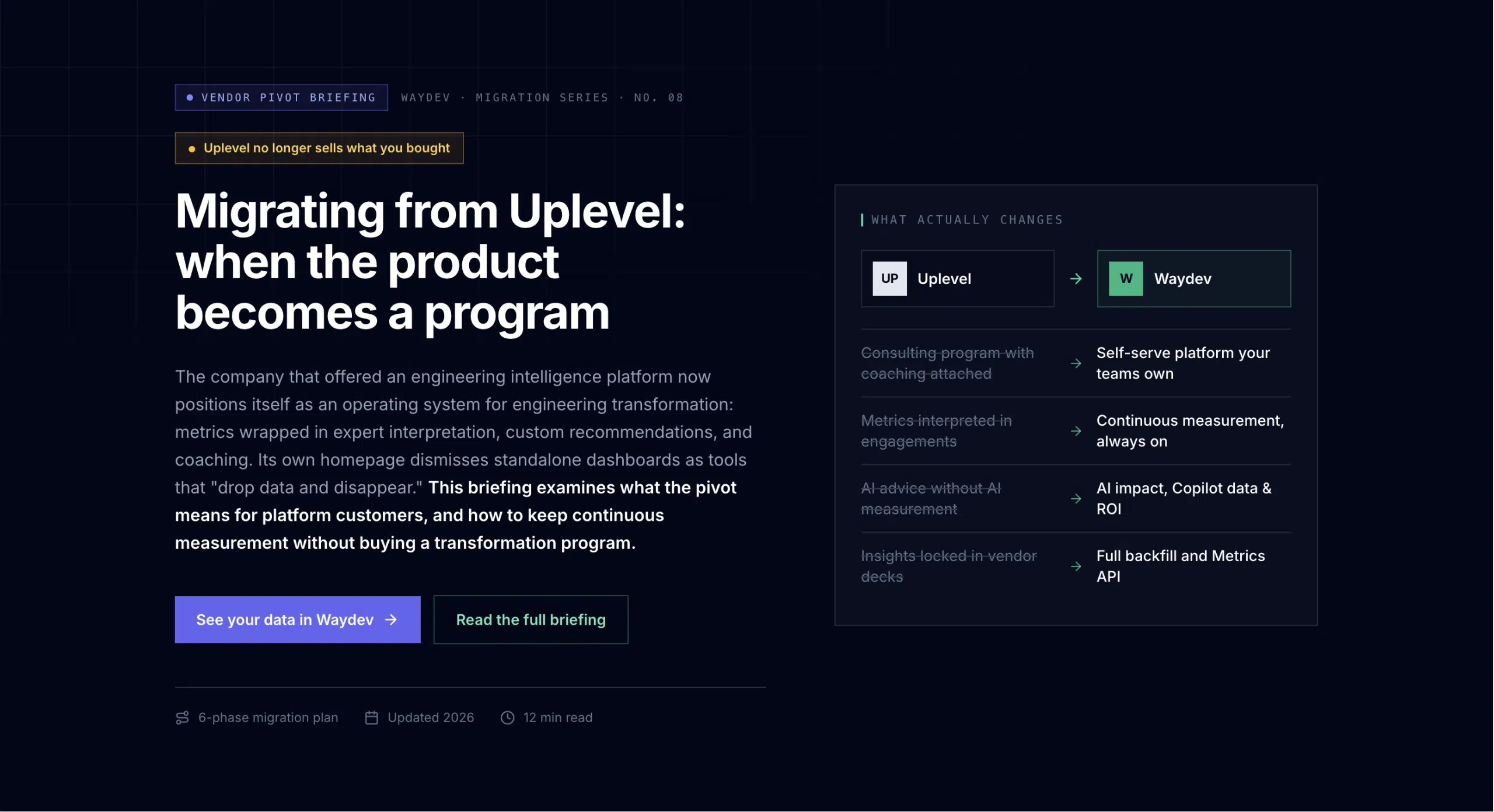
Uplevel no longer sells what you bought. The company that offered an engineering intelligence platform now positions itself as an operating system for engineering transformation: metrics wrapped in expert interpretation, custom recommendations, and coaching. Its own homepage dismisses standalone dashboards as tools that “drop data and disappear.” If you bought the platform, your vendor just told you what it thinks of your purchase. This briefing examines what the pivot means for platform customers, and how to keep continuous measurement without buying a transformation program.
Key findings
| I.
Uplevel has repositioned from platform to program: measurement plus interpretation, coaching, and capability building. Value that lives in people is engagement-shaped, not product-shaped, and it does not renew like software. |
II.
Part of Uplevel’s measurement model reads the workday: focus, meeting load, and collaboration signals. At enterprise scale that raises privacy questions works councils increasingly refuse to wave through. Waydev measures the work, not the workday. |
| III.
Transformation is a project. Measurement is infrastructure. Conflating the two means your system of record is priced, staffed, and roadmapped like an engagement. |
IV.
Leaving carries no historical cost. Waydev rebuilds your full metric history directly from your Git provider, and a 30-day parallel run settles the comparison on your own data. |
Section 01
Uplevel’s current framing is candid, and taken on its own terms it is coherent: dashboards alone do not change organizations, consultants leave, and internal tooling drains capacity. Their answer is a hybrid: platform plus expert interpretation plus coaching, with pricing designed to decline as your capability grows.
Now read those same statements from the seat of an existing platform customer, and three implications fall out.
When a vendor’s homepage argues that visibility tools “drop data and disappear,” it is describing the category it used to sell, and by extension the deployment you are running. Roadmap investment follows positioning. Expect the platform surface to evolve in service of the transformation program, not in service of standalone measurement customers.
Expert interpretation, prioritized recommendations, coaching, champion development: these are delivered by humans, which means quality depends on which humans you get, capacity is finite, and continuity depends on staffing you do not control. Uplevel’s own success criterion is that you eventually will not need them. Admirable as a philosophy. As an architecture for your permanent measurement layer, it is a sunset with better branding.
Either the coaching ends as promised, and you are left holding a platform whose differentiation was the coaches, or it does not end, and you have acquired exactly the consultant dependency the pitch warned you about, on a subscription. Neither branch leaves the platform customer better off. Measurement infrastructure should not have this fork in it at all.
Transformation is a project with an end date. Measurement is infrastructure with an uptime requirement. Buy them from the same vendor and the infrastructure inherits the project’s lifecycle.
Section 02
Part of Uplevel’s measurement heritage, and its current product surface, is the workday itself: focus time, meeting load, and collaboration patterns drawn from calendars and communication tools. The intent is benign, the insight can be real, and at enterprise scale it walks straight into two problems.
|
Workday signals (calendars, meetings, collaboration) The consent problemAnalyzing when people meet, focus, and message reads to employees and works councils as behavioral monitoring, whatever the dashboard calls it. In Europe especially, this is the category of measurement that legal reviews stall on, that unions escalate, and that quietly caps deployment to the teams that did not object. A measurement layer that cannot be rolled out everywhere is not a system of record. |
Work signals (commits, PRs, reviews, deployments) The Waydev positionWaydev measures the engineering work itself, at the commit and PR level, USPTO-patented, with role-based access and anonymization that works councils have approved at Fortune 500 scale. Individual-level data can be restricted or anonymized while leadership keeps the org-level picture. No calendars read, no messages analyzed, no monitoring debate to lose. |
There is also a measurement argument, not just a privacy one. Meeting load and focus time are proxies: they correlate with output, sometimes. Commits, reviews, and deployments are the output. In the AI era, when the board asks what Copilot and Cursor are returning, the answer lives in how AI-assisted work moves through review and into production, not in anyone’s calendar.
The core of it
Keep transformation programs and measurement infrastructure separate. Run whatever change initiative your org needs, with whoever you trust to run it. Underneath it, keep a measurement layer that is continuous, privacy-safe, people-independent, and still standing when the program ends. That layer is Waydev.
Section 03
| Uplevel capability | Waydev equivalent | The difference |
|---|---|---|
| AI impact and ROI | ✓ AI adoption / impact / ROI | Measured in the delivery path, per tool and per team, down to the spend, continuously |
| Allocation analysis | ✓ Business alignment | AI-inferred from the work itself, board-ready, no manual upkeep |
| Delivery and DORA metrics | ✓ DORA, SPACE, DX | Grounded in commit-level Git telemetry, with industry benchmarks |
| Targets and benchmarks | ✓ Goals & AutoGoals | Targets suggested from your own baselines and tracked automatically across every team |
| Expert interpretation and recommendations | ✓ Waydev AI + Signals | Interpretation on demand, in plain language, in seconds. Findings pushed to Slack daily. No dependence on whose calendar the expert has open |
| Executive reviews and reporting | ✓ Executive reports | Leadership asks the question in the meeting and gets the answer in the meeting |
| Enterprise controls | ✓ SSO, RBAC, anonymization | Roles and anonymization approved by works councils at enterprise scale |
| Historical baselines | ✓ History rebuild | Rebuilt directly from your Git provider. Leaving costs nothing historical |
If your organization genuinely values Uplevel’s human layer, the workshops, the champion development, the guided change program, be honest about that in the evaluation, because Waydev does not sell coaching and will not pretend to. Our position is that this layer, where needed, is better bought as a bounded engagement from a firm you choose, on top of measurement infrastructure you own the relationship with. What you should not do is keep your permanent measurement layer captive to preserve access to a change program.
Section 04
Your deadline is contractual. Use the runway to unbundle the decision: evaluate the measurement layer and the transformation layer separately, because they have different lifecycles and should have different vendors.
| When | Move | Outcome |
|---|---|---|
| T minus 90 days | Unbundle the invoice. Split what you pay Uplevel into measurement and program. Ask which reports leadership consumed last quarter, and which recommendations were acted on. Ask legal where the workday-signal measurement stands with your privacy obligations. | The real value of each layer, priced separately |
| T minus 60 days | Connect Waydev to production repos. Read-only against Git, coexists with Uplevel, history processes automatically. No calendar or messaging access requested, which shortens the legal review by itself. | Side-by-side baselines within days |
| T minus 30 days | Run the interpretation test. Take three findings from your last Uplevel executive review and ask Waydev AI the same questions. Compare depth, speed, and what each answer costs to produce. EMs run weekly reviews in both. | Evidence on whether interpretation needs a human layer |
| Renewal | Decide each layer on its merits. Move measurement to Waydev with the memo below. If the change program earns its keep, keep it, as a bounded engagement with an end date, the way projects are supposed to work. | Infrastructure that persists, programs that conclude |
Internal memo template for sign-off
Ahead of our Uplevel renewal, we evaluated our engineering measurement and transformation needs separately, and ran Waydev in parallel on our production repositories for 30 days. I recommend we move our measurement layer to Waydev at renewal, and treat any change-management support as a separately procured, bounded engagement.
Uplevel has repositioned around transformation coaching, and its measurement value increasingly depends on its human layer. Waydev provides the capabilities we consume continuously, including AI adoption and ROI measurement, DORA metrics, allocation views, and executive reporting, as a product: continuous, queryable in plain language, and independent of any engagement staffing. It measures the work itself rather than calendars and collaboration signals, which simplifies our privacy posture, and it rebuilt our historical baselines directly from Git, so we lose no trend data.
Waydev is used by Fortune 500 engineering organizations including American Express and PwC, holds a USPTO patent in Git analytics, and is recognized by Gartner in the Developer Productivity Insight Platforms category. As a bootstrapped and profitable vendor, it carries no pivot or acquisition-driven roadmap risk. The budget is already approved: it was paying for Uplevel.
For a transformation project, possibly. The question is whether it belongs fused to your permanent measurement layer. Projects end; measurement should not. Buying them together means your system of record inherits engagement pricing, engagement staffing, and an engagement lifecycle. Buy the program where you want, keep the infrastructure independent.
Waydev deliberately does not read calendars or messaging tools. Where meeting load genuinely constrains delivery, the effect shows up in the work: review pickup times, stalled PRs, cycle time patterns, and Signals surfaces exactly those. You get the operational conclusion without the behavioral monitoring, and without the works council escalation that comes with it.
Delivery history, no: the source data lives in your Git provider, and Waydev rebuilds trends and year-over-year comparisons from source on connection. Survey and sentiment history, partially: export summaries before transition, as that archive is not reconstructable from Git.
Yes, and you should. Waydev connects read-only to GitHub, GitLab, Bitbucket, or Azure DevOps, so the platforms coexist without conflict. The 30-day parallel run, including the interpretation test against your last executive review, is the strongest evaluation you can do.
Waydev is SOC 2 certified and never stores source code. SSO and RBAC are standard, with role-based access and anonymization controls approved by works councils at enterprise scale. And because Waydev does not request calendar or messaging access, the privacy review is materially shorter than for workday-signal platforms.
Ask this of every vendor, in writing. Waydev is bootstrapped and profitable: no investors requiring an exit, no timeline forcing one, no adjacent services business pulling the roadmap sideways. Nine years of independent operation, one product, Fortune 500 customers including American Express, Dropbox, Caterpillar, and PwC.
Thirty days, your production repositories, both platforms side by side. Take the findings from your last Uplevel executive review, ask Waydev AI the same questions, and time the answers. Measurement should not need a coach in the room.
Ready to unlock your SDLC productivity?