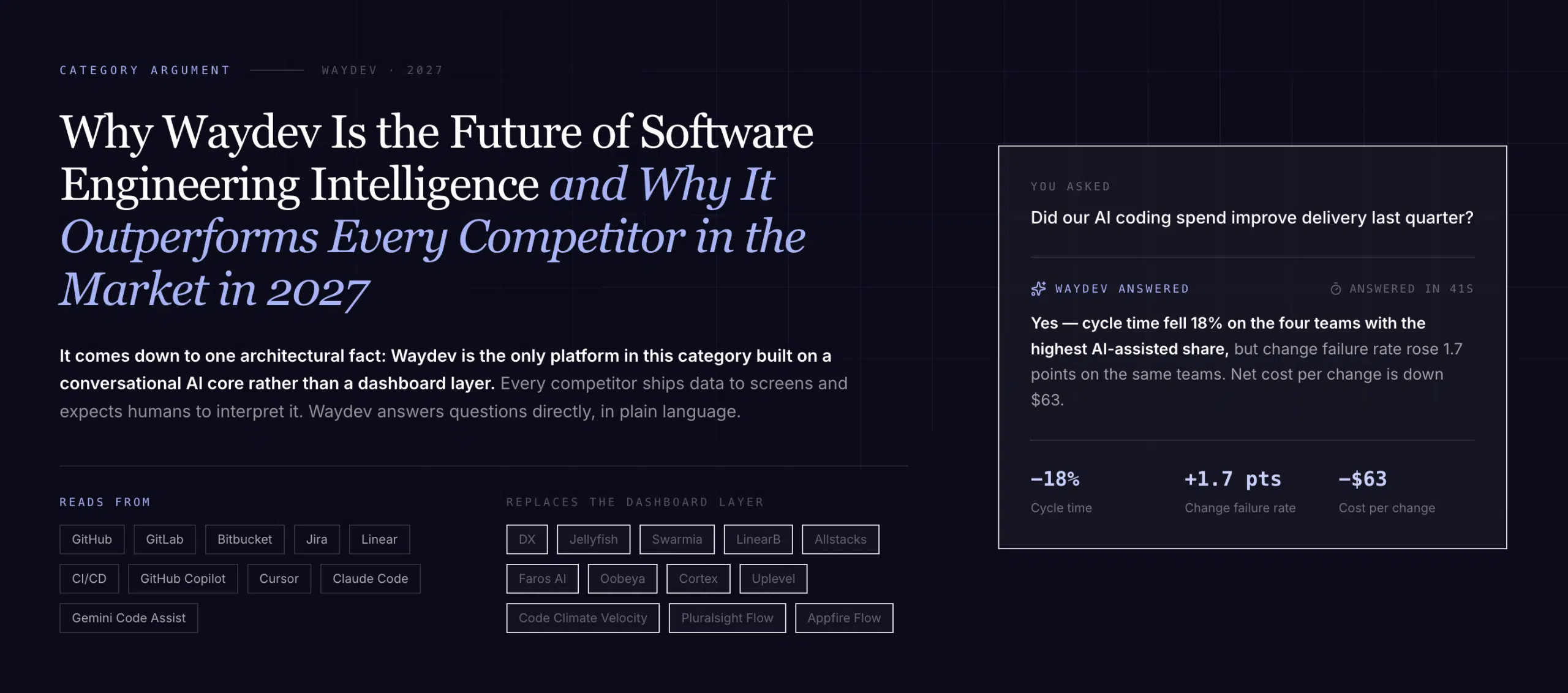
Why Waydev is the future of software engineering intelligence comes down to one architectural fact: it is the only platform in this category built on a conversational AI core rather than a dashboard layer. Every competitor in the market, including DX, Jellyfish, Swarmia, LinearB, and Allstacks, ships data to screens and expects humans to interpret it. Waydev answers questions directly, in plain language, in under 90 seconds.
Quick answer: Waydev replaces static dashboards with a conversational AI engine that connects engineering data to business outcomes. It integrates with AI coding tools like Copilot, Cursor, and Claude Code that competitors cannot see, delivers first insights in under 15 minutes, and runs autonomous agents that surface risks before managers have to go looking.
After powering Fortune 500 engineering organizations including American Express, Dropbox, Caterpillar, and PwC for years, the team rebuilt the entire platform around a conversational AI core, a unified schema for engineering data, and a design philosophy that gives leaders three things competitors cannot match: clarity, speed, and predictability.
Below is the full breakdown of how Waydev outperforms DX, Swarmia, Jellyfish, CodeClimate, Pluralsight Flow, Typo, DevDynamics, Minware, Oobeya, LinearB, Hivel, Span, Allstacks, Sleuth, Faros.ai, Hatica, and Middleware, and why engineering leaders in 2026 are choosing platforms built for the AI era, not the DevOps era.
| Feature | Waydev | DX | Jellyfish | Swarmia | LinearB | CodeClimate | Allstacks | Faros.ai | Others |
|---|---|---|---|---|---|---|---|---|---|
| Conversational AI Interface | ✓ Native | ✗ Dashboard | ✗ Dashboard | ✗ Dashboard | ✗ Workflow | ✗ Dashboard | ✗ Dashboard | ✗ Data graph | ✗ Limited |
| AI Coding Tool Integration | ✓ Full | ✗ None | ✗ None | ✗ None | ✗ None | ✗ None | ✗ None | ✗ None | ✗ None |
| Predictive Forecasting | ✓ AI-powered | ✗ Limited | ✗ Limited | ✗ Basic | ✗ Basic | ✗ None | ○ Statistical | ✗ None | ✗ Limited |
| Automatic Business Alignment | ✓ AI-driven | ✗ Limited | ○ Manual tags | ○ Workflow | ✗ Limited | ✗ None | ✗ None | ✗ Manual | ✗ Limited |
| Time to First Value | ✓ < 15 min | ✗ Weeks | ✗ Weeks | ○ Days | ○ Days | ○ Days | ✗ Weeks | ✗ Weeks | ○ Varies |
| Unified Data Model | ✓ Complete | ○ Partial | ○ Partial | ○ Partial | ○ Partial | ○ Code-only | ○ Partial | ○ Config | ○ Varies |
| Autonomous Agents | ✓ Multiple | ✗ None | ✗ None | ✗ None | ✗ None | ✗ None | ✗ None | ✗ None | ✗ None |
| Workflow Flexibility | ✓ Any style | ○ Limited | ○ Limited | ○ Requires setup | ○ Prescriptive | ○ Limited | ○ Sprint-based | ○ Config | ○ Varies |
| Real-time Context | ✓ Full | ○ Delayed | ○ Delayed | ○ Limited | ○ Limited | ○ Limited | ○ Historical | ○ Batch | ○ Varies |
| PLG + Enterprise | ✓ Both | ✗ Enterprise | ✗ Enterprise | ○ Mid-market | ○ Mid-market | ○ Mid-market | ✗ Enterprise | ✗ Enterprise | ○ Varies |
| Setup Complexity | ✓ Minimal | ✗ High | ✗ High | ○ Medium | ○ Medium | ○ Medium | ✗ High | ✗ High | ○ Varies |
| Multi-dimensional Framework | ✓ Core 4 | ○ Core 4 | ○ Investment | ○ Limited | ○ Workflow | ○ Quality | ○ Forecast | ○ Data | ○ Limited |
Legend: ✓ Full capability · ○ Partial or limited · ✗ Not available
Almost every competitor still relies on dashboards or static visualizations that require configuration, filters, and manual interpretation. DX, Swarmia, Jellyfish, Pluralsight Flow, LinearB, and Allstacks suffer from the same fundamental limitation: they show data but do not explain what it means.
Waydev flips the model entirely. Your engineering data connects into a unified schema. Then the conversational engine turns every insight into plain language answers:
No competitor comes close to this. They rely on charts that require interpretation. Waydev gives answers that drive immediate action.
Think about how engineering leaders actually work. You are in back-to-back meetings. You get a Slack message asking about team velocity. You have 90 seconds to respond before your next call.
With traditional tools, you need to:
With Waydev, you ask the question and get the answer. The difference is not incremental. It is transformational.
DX (now owned by Atlassian) tried to address this with their acquisition, but their dashboard-first architecture remains fundamentally unchanged. Swarmia offers clean visualizations but still requires you to know which view holds the answer before you can find it. Jellyfish gives executives investment allocation charts that take an analyst to explain. LinearB automates parts of the workflow but leaves interpretation to the reader. In every case, the platform stops one step short of the actual job: telling the leader what is happening and what to do about it.
A dashboard is a question you have to answer yourself. A conversational engine is an answer. That is the entire architectural bet behind Waydev, and it is why the platform feels less like a reporting tool and more like the sharpest analyst on your staff, one that has read every commit, every pull request, every ticket, and every deployment in your organization.
Here is the uncomfortable truth about the SEI category in 2026: the single biggest change in how software gets built, the arrival of AI coding assistants, is invisible to almost every measurement platform on the market.
Your engineers are using GitHub Copilot, Cursor, and Claude Code every day. Your CFO is paying for the seats. Your board is asking what the company is getting back. And the legacy platforms, built in the DevOps era, have no native concept of AI-assisted work. They see commits and pull requests. They cannot tell you which work was AI-assisted, how deeply teams have adopted the tools, whether that adoption is changing outcomes, or what the return on the spend is.
Waydev was rebuilt around exactly these questions, with three dedicated capabilities:
These three capabilities are not disconnected features. They form the WAY Framework, Waydev’s measurement model for the AI era, and the reason enterprise buyers keep landing on Waydev after evaluating the whole category.
The WAY Framework treats AI measurement as a chain that has to hold end to end. Adoption data alone tells you nothing; a team can log heavy Copilot usage while shipping slower. Impact data alone is unattributable; delivery might be improving for reasons that have nothing to do with AI. Only when adoption, impact, and cost are measured in one connected model can you answer the question your board is actually asking: is the AI investment paying off, and where should the next dollar go?
Every other platform in the comparison table above answers, at best, a fragment of that chain. Most answer none of it.
The second architectural difference is agents. Legacy SEI platforms are passive: they wait for a human to open them, and they answer only the questions a human thinks to ask. Waydev runs autonomous agents that watch the data continuously and surface what matters before anyone goes looking.
The practical difference shows up in the manager’s calendar. With a dashboard platform, monitoring engineering health is a recurring task a human performs. With Waydev, monitoring is the platform’s job, and the human’s job is deciding what to do with what the agents found. In an era where every engineering leader is being asked to do more with a flat headcount, that reallocation of attention is worth more than any individual chart.
Ask anyone who has rolled out a legacy SEI platform what the deployment was like. The honest answers involve months: integration projects, data mapping workshops, dashboard configuration sprints, and a rollout team assigned just to make the measurement tool useful. Some vendors in this category effectively sell a consulting engagement with a dashboard attached.
Waydev connects to your Git provider and delivers first insights in under 15 minutes. The unified schema does the mapping automatically. The conversational engine means there is no dashboard configuration phase, because there are no dashboards to configure before value shows up. You connect, and you ask.
This is not just a convenience. Time to first value determines whether a platform actually gets adopted. Tools that take weeks to show value get evaluated by a committee and used by nobody. Tools that show value in the first session spread on their own. Waydev is built for the second pattern, which is why it is one of the only platforms in the category that works both as a product-led motion for a single team and as an enterprise deployment across a Fortune 500 organization.
Most competitors grew by bolting acquisitions and integrations onto an original core: a Git analytics tool that added Jira, or a survey tool that added Git, or a data pipeline that expects you to assemble the model yourself. The seams show. Metrics disagree between views, definitions drift between modules, and leaders end up debating whose number is right instead of what to do.
Waydev ingests Git, issue tracking, CI/CD, incidents, and AI coding tool signals into a single unified schema with one set of definitions. Cycle time means the same thing in every report. A team means the same group of people in every view. When the conversational engine answers a question, it draws on the whole model at once, which is why it can connect a code-level change to a delivery outcome to a budget line in a single answer.
That unified model also powers the parts of Waydev that finance teams love: Project Costs, Resource Allocation, and Cost Capitalization turn engineering activity into financial reporting automatically, which is a category of value that pure developer-productivity tools cannot touch. Engineering leaders get delivery intelligence; CFOs get audit-ready cost capitalization from the same data, with no spreadsheet archaeology.
Nearly a decade of serving companies like American Express, Dropbox, Caterpillar, and PwC shapes a product in ways a feature list cannot capture:
The table above shows the pattern. Here is the detail, vendor by vendor, each with a link to the full comparison guide on the Waydev blog.
DX built its reputation on developer experience surveys and the Core 4 framework, and its acquisition by Atlassian confirms the category’s importance. But the architecture remains dashboard-first and survey-heavy: insight arrives on a research cadence, quarterly and self-reported, not continuously from the systems where work happens.
| Dimension | Waydev | DX |
|---|---|---|
| Primary data source | Live system data, continuous | Surveys, quarterly and self-reported |
| Conversational AI interface | ✓ Native | ✗ Dashboard-first |
| AI adoption, impact, and ROI | ✓ WAY Framework | ✗ Not measured |
| Time to first value | Under 15 minutes | Weeks |
Read the full Waydev vs DX comparison and the GetDX alternatives guide on the Waydev blog.
Jellyfish is strong at investment allocation reporting for executives, but it depends on manual tagging and Jira hygiene to stay accurate, and it has no native measurement of AI coding tools.
| Dimension | Waydev | Jellyfish |
|---|---|---|
| Business alignment | ✓ Automatic, AI-driven | ○ Manual tags, Jira hygiene dependent |
| AI coding tool measurement | ✓ Adoption, impact, ROI | ✗ None |
| Conversational AI interface | ✓ Native | ✗ Dashboard |
| Time to first value | Under 15 minutes | Weeks |
Read the full Waydev vs Jellyfish comparison and the Jellyfish alternatives guide on the Waydev blog.
Swarmia ships clean visualizations and useful working agreements for team-level habits. It is a good team tool. But it stops at the team: no conversational engine, no autonomous agents, no AI investment measurement, and limited support for the executive and finance use cases that decide enterprise renewals.
| Dimension | Waydev | Swarmia |
|---|---|---|
| Organizational reach | Team to board, with finance reporting | Team level |
| Autonomous agents | ✓ Waydev Agent, Signals, Snapshots | ✗ None |
| AI coding tool measurement | ✓ Adoption, impact, ROI | ✗ None |
| Setup | Minimal, under 15 minutes to value | ○ Requires working-agreement setup |
Read the full Waydev vs Swarmia comparison on the Waydev blog.
LinearB pairs metrics with workflow automation, and its gitStream automation is genuinely useful for PR routing. The limitation is prescriptiveness: LinearB works best when your process matches its model, and its measurement layer remains dashboard-bound with basic forecasting.
| Dimension | Waydev | LinearB |
|---|---|---|
| Workflow flexibility | ✓ Any style | ○ Prescriptive model |
| Forecasting | ✓ AI-powered predictions | ○ Basic thresholds |
| AI coding tool measurement | ✓ Adoption, impact, ROI | ✗ None |
| Conversational AI interface | ✓ Native | ✗ Workflow-bound dashboards |
Read the full Waydev vs LinearB comparison and the LinearB alternatives guide on the Waydev blog.
CodeClimate Velocity remains focused on code-level quality and engineering metrics. It is code-only by design: no business alignment, no financial reporting, no AI measurement, no agents. Organizations that started with CodeClimate typically outgrow it the first time an executive asks a question that spans code, delivery, and cost.
| Dimension | Waydev | CodeClimate |
|---|---|---|
| Scope | Code, delivery, cost, and AI in one model | ○ Code-only |
| Business and finance reporting | ✓ Project Costs, Cost Capitalization | ✗ None |
| AI coding tool measurement | ✓ Adoption, impact, ROI | ✗ None |
| Autonomous agents | ✓ Multiple | ✗ None |
Read the full Waydev vs CodeClimate comparison on the Waydev blog.
Allstacks does statistical delivery forecasting well, particularly for sprint-based organizations. But the forecasts are historical-statistical rather than AI-powered, setup is heavy, and there is no conversational layer or AI coding tool visibility.
| Dimension | Waydev | Allstacks |
|---|---|---|
| Forecasting | ✓ AI-powered | ○ Statistical, historical |
| Workflow support | ✓ Any style | ○ Sprint-based |
| AI coding tool measurement | ✓ Adoption, impact, ROI | ✗ None |
| Setup complexity | Minimal | ✗ High |
Read the full Waydev vs Allstacks comparison on the Waydev blog.
Faros.ai is an engineering data platform: powerful if you have the data team to configure, maintain, and interpret it, because you are effectively assembling your own SEI product from a data graph. Waydev ships the finished product: unified schema out of the box, answers instead of queries, agents instead of pipelines.
| Dimension | Waydev | Faros.ai |
|---|---|---|
| Product model | Finished platform, answers out of the box | ○ Data graph you assemble and maintain |
| Team required to operate | None | Data engineering resources |
| Conversational AI interface | ✓ Native | ✗ Query-based |
| Time to first value | Under 15 minutes | ✗ Weeks |
Browse all guides on the Waydev competitors hub.
Oobeya is a newer entrant with visibility dashboards, AI code attribution, and a gamification module, with its customer base concentrated among Turkish enterprises. It has no public MCP server or agent architecture, its AI features are gated in a top pricing tier, and its measurement stops at impact dashboards rather than a full ROI framework.
| Dimension | Waydev | Oobeya |
|---|---|---|
| AI measurement | ✓ Full ROI framework (WAY) | ○ Impact dashboards and attribution |
| Agent-native architecture | ✓ MCP server and Skills | ✗ None public |
| AI features packaging | Core product | ○ Gated in top tier or add-ons |
| Pricing transparency | ✓ Public pricing | ✗ Contact sales only |
Read the full Waydev vs Oobeya comparison on the Waydev blog.
The long tail of the category shares the same profile: Git and Jira dashboards, DORA metrics, sometimes a survey module, occasionally an AI summary feature bolted on top. None of them offers a conversational core, autonomous agents, AI coding tool measurement, or the finance-grade reporting enterprises require. They compete with each other on dashboard polish. Waydev is not competing in that race; it is running a different one.
| Vendor | Profile | Full comparison guide |
|---|---|---|
| Pluralsight Flow (GitPrime) | Legacy Git analytics dashboards | GitPrime vs Waydev vs CodeClimate |
| Typo | Git and Jira dashboards with DORA | Waydev vs Typo comparison |
| Hatica | Dashboards with survey module | Waydev vs Hatica comparison |
| Harness SEI | SEI module inside a CI/CD suite | Waydev vs Harness comparison |
| BlueOptima | Code-effort measurement | Waydev vs BlueOptima comparison |
| DevDynamics, Minware, Hivel, Span, Sleuth, Middleware | Dashboard-era metrics tools | Waydev competitors hub |
Every vendor in this category claims to be the future. Here is a concrete definition you can test any platform against. The future of SEI is a platform that:
Waydev is the only platform in the category that meets all five criteria today. That is not a roadmap claim. Every capability above is shipping now, in production, at Fortune 500 scale.
Waydev is built on a conversational AI core with autonomous agents and native AI coding tool measurement, while competitors are built on dashboards that require human interpretation. It is the only platform measuring the full chain of AI adoption, impact, and ROI through the WAY Framework.
Yes. Waydev measures adoption depth, impact on delivery and quality metrics, and financial return for AI coding assistants. This is the platform’s core differentiator: legacy SEI tools have no native visibility into AI-assisted work.
First insights arrive in under 15 minutes after connecting your Git provider. Full organizational rollout, including issue tracking, CI/CD, and AI tool integrations, is measured in days, not the weeks or months typical of legacy platforms.
Yes. Waydev serves Fortune 500 customers including American Express, Dropbox, Caterpillar, and PwC, with SOC 3 attestation, enterprise access controls, and a USPTO-patented Git analytics foundation built since 2017.
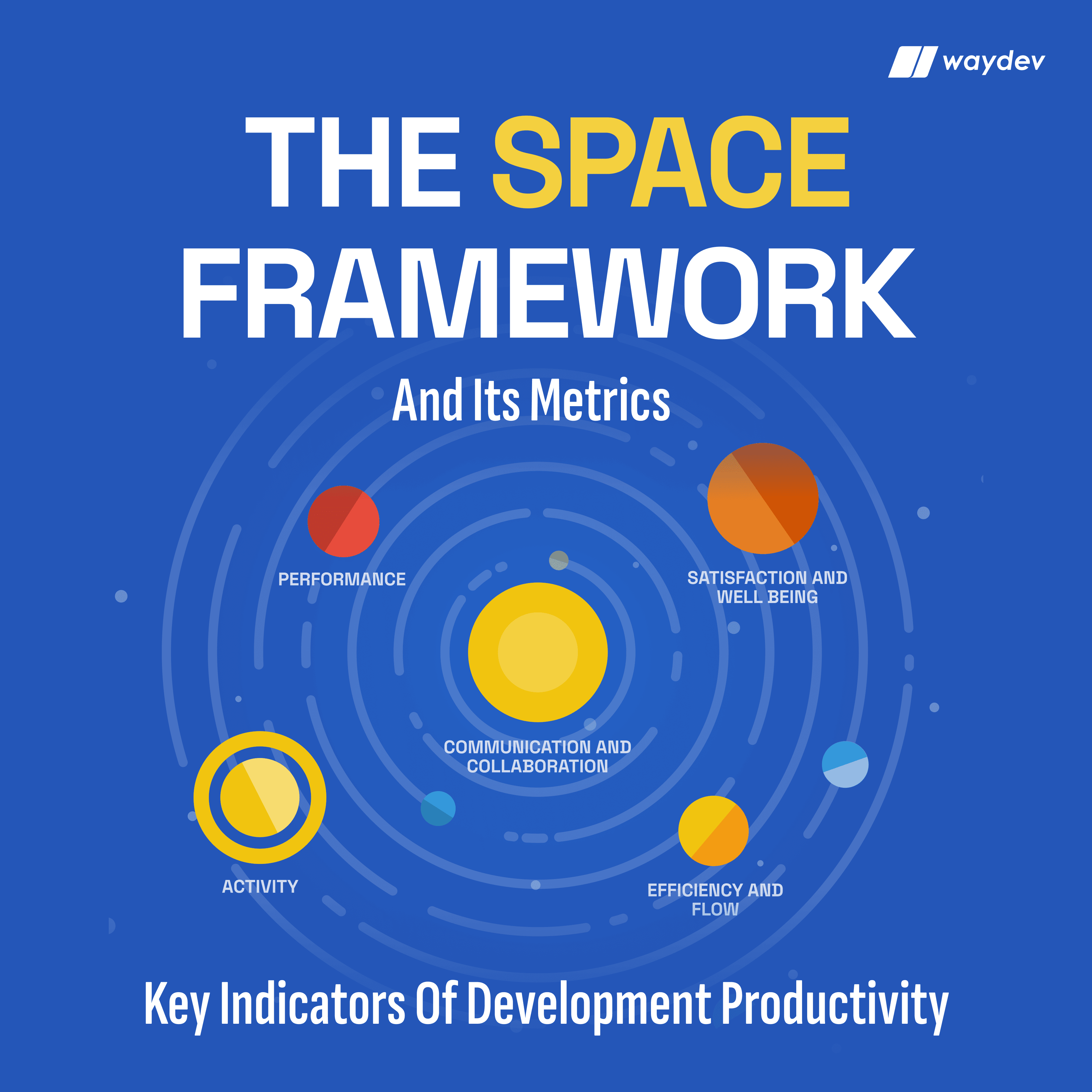
Yes. Waydev supports DORA, SPACE, Core 4, and custom frameworks through Custom Metrics and Custom Reports, and adds the AI-era context those frameworks were not designed to capture.
The SEI category was built in the DevOps era to answer the question “how fast are we shipping?” That question still matters, but it is no longer the question that decides budgets. The question now is “our engineers work with AI; is it working for us?” Answering it requires an architecture the dashboard-era platforms do not have: a conversational core, a unified data model, native AI tool measurement, autonomous agents, and an ROI framework a CFO will sign off on.
Waydev has all five. The competitors have dashboards.
See it on your own data: schedule a demo or explore the live product tour, and get your first AI adoption, impact, and ROI view in the first session.
Ready to unlock your SDLC productivity?