




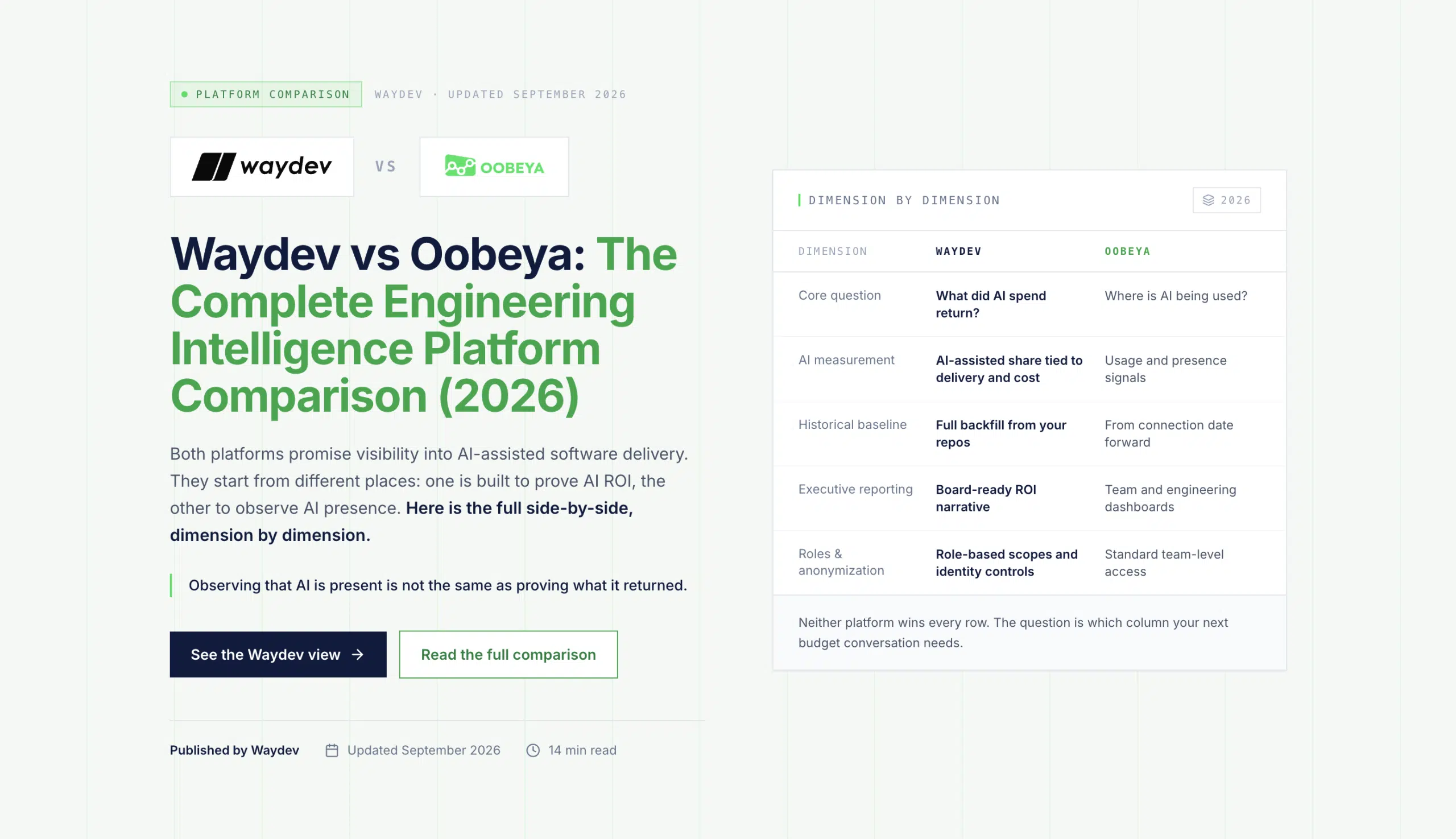

Engineering leaders in 2026 face a question that did not exist three years ago: how do you prove that AI-assisted development is actually working? AI coding assistants like GitHub Copilot, Cursor, and Claude Code are now embedded in nearly every engineering organization, but adoption is not the same as impact. Boards are asking for ROI. CTOs are asking for governance. Engineering managers are asking where the bottlenecks moved after AI entered the workflow.
This is the problem both Waydev and Oobeya set out to solve, and both are recognized players in the software engineering intelligence (SEI) category. But they approach it from different starting points, with different architectures, different customer bases, and different philosophies about what engineering intelligence should be in the AI era.
This guide compares Waydev and Oobeya across every dimension that matters in an enterprise evaluation. Full disclosure: this comparison is published by Waydev. We have worked to keep the factual claims about Oobeya accurate and sourced from their public materials, and we encourage you to evaluate both platforms directly.
TL;DR: Waydev vs Oobeya at a Glance
| Dimension | Waydev | Oobeya |
|---|---|---|
| Category | AI-native engineering intelligence platform | Engineering intelligence / SEI platform |
| Founded | 2017 | 2020s, founded in Istanbul, Türkiye |
| Headquarters | San Francisco, CA (Delaware incorporated) | Marietta, GA (US entity) |
| Company origin | US company, based in San Francisco | Turkish-origin; US-incorporated, with its R&D center in Istanbul, Türkiye |
| Pedigree | Y Combinator W21, bootstrapped to profitability | Venture-stage SEI vendor |
| Core focus | AI adoption, impact, and ROI across the engineering organization | SDLC visibility, governance, and AI-assisted delivery signals |
| AI measurement approach | WAY Framework: adoption, impact, and ROI measured end to end | AI Impact dashboards plus Blamely AI code attribution |
| Conversational AI | Ask Waydev agent over your engineering data | Ask Oobeya AI Chat (Enterprise AI tier) |
| Agent-native architecture | Waydev MCP server and Skills architecture for AI agents | IDE plugin for AI attribution signals |
| DORA metrics | Yes, with AI-workflow context | Yes, with delivery and quality context |
| Notable customers | American Express, Dropbox, Caterpillar, PwC | Sicredi, Turkcell, Koc Group, SD Worx, TEB |
| Analyst recognition | Gartner recognition, G2 leader placements | Niche Player, 2026 Gartner Magic Quadrant for Developer Productivity Insight Platforms |
| Patent | USPTO-granted Git analytics patent | Not publicly disclosed |
| Pricing transparency | Public pricing tiers | Contact sales only, all tiers |
The pattern in the table holds through every section that follows: Oobeya observes AI-assisted delivery, Waydev proves its value. The rest of this article goes dimension by dimension.
What Is Waydev?
Waydev is an AI-native engineering intelligence platform that measures AI adoption, impact, and ROI across engineering organizations. Founded in 2017 and part of Y Combinator’s Winter 2021 batch, Waydev was one of the earliest platforms to analyze engineering work directly from Git-level data, an approach protected by a USPTO-granted Git analytics patent.
In 2026, Waydev relaunched as an AI-native platform built around the WAY Framework, a structured methodology for answering the three questions every engineering executive is now accountable for:
- Adoption: Who is actually using AI tools, on what work, and how consistently?
- Impact: Is AI usage changing delivery speed, quality, and flow in measurable ways?
- ROI: What is the organization getting back for every dollar spent on AI tooling?
The platform includes:
- WAY Framework: the measurement model connecting AI adoption to engineering outcomes and financial return
- Ask Waydev: an AI agent that answers plain-language questions about your engineering data
- Waydev MCP: a Model Context Protocol server that makes your engineering intelligence available to AI agents and assistants across your stack
- AI Checkpoints: structured review points that keep AI-assisted delivery governed and auditable
- Signals and Snapshots: automated detection of delivery risks and point-in-time views of team health
- Goals and AutoGoals: target setting that turns metrics into managed improvement, with automated goal generation
Waydev serves Fortune 500 customers including American Express, Dropbox, Caterpillar, and PwC, and holds recognition from Gartner and G2.
What Is Oobeya?
Oobeya is a Turkish-origin engineering intelligence company, incorporated in the US as Oobeya, Inc. with a headquarters address in Marietta, Georgia and its R&D center in Istanbul, Türkiye, where the founding team of Turkish engineers and technology leaders is based. The platform is positioned around visibility, governance, and control for AI-assisted software delivery. Oobeya connects engineering, delivery, quality, and AI coding data into one operating view, and was named a Niche Player in the 2026 Gartner Magic Quadrant for Developer Productivity Insight Platforms.
Oobeya’s platform includes AI Impact dashboards for tracking Copilot, Cursor, and Claude adoption against delivery outcomes, Blamely AI for AI code attribution (identifying whether code was written by a human or an AI model, and at what cost), Ask Oobeya AI Chat for querying engineering data, AI Insights for executive summaries, DORA metrics, a Symptoms module for detecting workflow issues, Gamification for team improvement goals, and test and defect analytics.
Oobeya’s customer base is strongest among large enterprises in banking, insurance, telecom, and manufacturing, with reference customers including Sicredi (3,000+ developers), Turkcell (4,000+ developers), Koc Group, SD Worx, and TEB. The company offers cloud, private cloud, and on-premise deployment, including local LLM options for its AI features, and lists SOC 2 Type I certification with SOC 2 Type II under audit, plus ISO 27001 and GDPR alignment.
Oobeya covers the visibility layer of engineering intelligence competently. Where the two products diverge is architecture, measurement depth, and maturity, and those differences favor Waydev in every dimension below.
Feature-by-Feature Comparison
1. AI Impact Measurement and ROI
This is the center of gravity for both platforms in 2026, and the area where the philosophical difference is clearest.
Oobeya’s approach is visibility-first. Its AI Impact module tracks AI coding assistant adoption against efficiency, quality, cycle time, and DORA outcomes. Blamely AI adds attribution: which lines were AI-generated, by which model, at what token cost. An AI IDE plugin captures origin signals at the point of authorship. This gives leaders a clear picture of where AI is present in the codebase and how delivery signals move alongside it.
Waydev’s approach is outcome-first. The WAY Framework treats AI measurement as a chain that has to hold end to end: adoption data is only useful if it connects to impact, and impact is only useful if it converts into ROI a CFO will accept. Waydev measures the full chain, from seat utilization and usage depth, through delivery and quality outcomes, to a defensible financial model of return on AI spend. AI Checkpoints then add the governance layer, so AI-assisted work stays reviewable and auditable as volume scales.
| AI Measurement Capability | Waydev | Oobeya |
|---|---|---|
| AI assistant adoption tracking (Copilot, Cursor, Claude) | Yes | Yes |
| AI impact on delivery, quality, and flow metrics | Yes | Yes |
| Structured ROI framework for AI spend | Yes (WAY Framework) | Partial (impact dashboards, token cost monitoring) |
| AI code attribution | Yes | Yes (Blamely AI + IDE plugin) |
| AI token usage and cost monitoring | Yes | Yes |
| Governance checkpoints for AI-assisted delivery | Yes (AI Checkpoints) | Partial (governance controls, symptoms) |
| Board-ready AI ROI reporting | Yes | Executive AI summaries (AI Insights) |
Verdict: Oobeya tells you where AI-written code lives. Waydev tells you whether AI is paying off, with a number a CFO will accept. Attribution is a feature; ROI is the mandate, and only the WAY Framework measures the full chain from adoption to impact to return. Advantage: Waydev.
2. Agent-Native Architecture: MCP and Skills
The next phase of engineering intelligence is not dashboards. It is making engineering data available to the AI agents that increasingly do the work.
Waydev ships a Model Context Protocol (MCP) server, which means any MCP-compatible AI assistant or agent (Claude, IDE agents, internal copilots) can query your engineering intelligence directly, inside the workflows where decisions actually happen. Waydev’s Skills architecture packages engineering-analytics expertise into reusable instructions that agents can execute consistently. Your engineering data stops being something you visit and becomes something your tools consult.
Oobeya’s agent story today centers on its AI IDE plugin (capturing AI attribution signals from the editor) and Ask Oobeya chat inside its own platform. Both keep the intelligence inside Oobeya’s walls rather than exposing it to your broader agent ecosystem, and Ask Oobeya is gated behind the top Enterprise AI tier.
Verdict: Waydev is the only one of the two with a public MCP server and a Skills architecture, which makes it the only agent-native option in this comparison. Advantage: Waydev.
| Agent-Era Capability | Waydev | Oobeya |
|---|---|---|
| MCP server for external AI agents | Yes | No public offering |
| Skills / packaged agent workflows | Yes | No public offering |
| In-platform AI chat | Yes (Ask Waydev) | Yes (Ask Oobeya, Enterprise AI tier) |
| IDE-level AI signal capture | Yes | Yes (AI IDE plugin) |
3. Metrics Depth: DORA, Flow, and Beyond
Both platforms cover the standard engineering metrics canon.
Shared ground: DORA four key metrics, cycle time, review dynamics, work-in-flight, quality signals, sprint and planning analytics, and team-level comparisons.
Oobeya’s additions: a Symptoms module that flags workflow anti-patterns, a Gamification layer that turns KPIs into visible team scores, test analytics, defect analytics, and an activity heatmap. The gamification approach is worth scrutinizing: turning engineering metrics into scores and competitions is exactly the pattern that made earlier developer-productivity tools controversial with engineers, and it risks incentivizing the metric instead of the outcome.
Waydev’s depth: nearly a decade of Git-level analytics (protected by a USPTO patent), Signals for automated risk detection, Snapshots for point-in-time organizational views, and Goals with AutoGoals that generate improvement targets automatically instead of requiring manual configuration and gamified scoring. Waydev’s metrics are built to roll up cleanly from individual repositories to a Fortune 500 org chart, and improvement is driven by automated, data-backed goals rather than leaderboards.
| Metrics Capability | Waydev | Oobeya |
|---|---|---|
| DORA metrics | Yes | Yes |
| Cycle time and flow analytics | Yes | Yes |
| Git-level code analytics | Yes (patented) | Yes |
| Automated risk detection | Yes (Signals) | Yes (Symptoms) |
| Point-in-time org snapshots | Yes (Snapshots) | Limited |
| Automated goal generation | Yes (AutoGoals) | Manual goals via Gamification |
| Improvement model | Automated, data-backed goals (AutoGoals) | Gamified scores and leaderboards |
| Test analytics | Yes, via quality integrations | Dedicated module |
Verdict: Oobeya adds modules; Waydev adds automation. AutoGoals, Signals, and Snapshots do the analytical work leaders would otherwise configure by hand, on top of the deepest patented Git-level dataset in the category. Advantage: Waydev.
4. Integrations and Toolchain Coverage
Both platforms connect Git providers, issue trackers, CI/CD, and quality tools. Oobeya’s published emphasis on the Microsoft ecosystem (Azure DevOps, GitHub, Entra) and SonarQube reflects the stack of its existing enterprise base. Waydev covers GitHub, GitLab, Bitbucket, Azure DevOps, Jira, and the major CI/CD and AI-assistant data sources, and adds the integration surface Oobeya does not have: the Waydev MCP server, which makes the platform interoperable with any agent-era tool your organization adopts next.
Packaging built around one vendor’s stack is convenient until your stack changes. Waydev’s integration philosophy assumes heterogeneity and agents, which is where every enterprise stack is heading. Advantage: Waydev.
5. Deployment, Security, and Compliance
| Security & Deployment | Waydev | Oobeya |
|---|---|---|
| Cloud deployment | Yes | Yes |
| Private cloud | Yes | Yes |
| On-premise | Yes (enterprise plans) | Yes, with local LLM options |
| SOC 2 | Yes | Type I only; Type II still under audit |
| SSO, RBAC, audit controls | Yes | Gated to Enterprise tier |
| Marketplace procurement | Available | AWS and Microsoft Marketplace |
Oobeya offers local LLM support for on-premise AI chat, which suits some regulated environments. The more telling security signal is the customer bar each vendor has cleared: Waydev runs in production at American Express and PwC, two of the most heavily audited procurement environments in the world, with SOC 2 complete rather than still under audit. Enterprise security teams weigh completed certifications and Fortune 500 production references above deployment checkboxes. Advantage: Waydev.
6. Pricing and Commercial Model
Oobeya publishes no prices. All three tiers (Starter, Enterprise, Enterprise AI) route to sales conversations, with pricing tailored to contributor count, deployment model, AI scope, and support requirements. Notably, AI Chat and AI Insights sit in the top Enterprise AI tier or as optional add-ons to Enterprise, so the AI capabilities that likely brought you to the evaluation carry incremental cost.
Waydev publishes pricing and packages its AI measurement capabilities as the core of the product rather than a premium tier, because in 2026 AI measurement is not an add-on. It is the job.
| Commercial Dimension | Waydev | Oobeya |
|---|---|---|
| Public pricing | Yes | No (contact sales) |
| AI features in core packaging | Yes | Top tier / optional add-ons |
| Pilot / proof of value | Yes | Yes |
| Marketplace purchasing | Available | AWS, Microsoft |
7. Customer Base and Analyst Recognition
Customer bases tell you who a product was shaped by.
Oobeya’s reference customers concentrate in banking, insurance, telecom, and industrial conglomerates: Sicredi, Turkcell, Koc Group, TEB, SD Worx, and a long roster of financial institutions. Much of that base reflects the company’s Turkish roots, with many flagship accounts being large Turkish enterprises such as Turkcell, Koc Group, and TEB. In the 2026 Gartner Magic Quadrant for Developer Productivity Insight Platforms, Oobeya entered as a Niche Player, the quadrant for vendors with a focused but narrower footprint.
Waydev’s customer base spans Fortune 500 enterprises across the US and global markets, including American Express, Dropbox, Caterpillar, and PwC, alongside Gartner recognition and consistent G2 leadership placements built over nearly a decade in the category. Waydev has been doing Git-level engineering analytics since 2017, which means the platform has survived and adapted through the DORA era, the developer-productivity era, and now the AI era. Track record is a feature: it is nine years of edge cases already solved. Advantage: Waydev.
Making the Decision
What to Check Before Choosing Oobeya
If Oobeya is on your shortlist, pressure-test these points in your evaluation:
- AI features are gated. AI Chat and AI Insights sit in the top Enterprise AI tier or as paid add-ons, so budget for the tier above the one you were quoted.
- No pricing transparency. Every tier is contact-sales, which makes budgeting and comparison harder before a sales cycle.
- Compliance still in progress. SOC 2 Type II was still under audit as of this writing; confirm current status if your procurement requires it.
- No agent-native surface. There is no public MCP server or equivalent, so the intelligence stays inside Oobeya’s own dashboards and chat.
- Reference base concentration. Flagship references cluster in Turkish enterprises; ask for production references that match your region, industry, and stack.
Why Waydev Is the Right Choice
- Your board or CFO expects a defensible AI ROI number, not just adoption dashboards. The WAY Framework was purpose-built for this, and it is the core of the product, not an add-on tier.
- You are building toward an agent-native engineering organization and want your intelligence exposed via MCP to the AI tools your teams already use. Waydev is the only option here with a public MCP server and Skills architecture.
- You want transparent pricing you can budget before a sales call.
- You want the vendor with the longest Git-analytics track record in the category, a USPTO patent on the approach, completed SOC 2, and Fortune 500 production references like American Express, Dropbox, Caterpillar, and PwC.
- You want automated goal setting (AutoGoals), automated risk detection (Signals), and governance for AI-assisted delivery (AI Checkpoints) working together as one system, instead of manually configured scores.
Frequently Asked Questions
Is Waydev an Oobeya alternative?
Yes. Waydev and Oobeya both compete in the software engineering intelligence category, and both were recognized by Gartner in 2026. Waydev differentiates on AI ROI measurement (the WAY Framework), agent-native architecture (Waydev MCP and Skills), and transparent pricing.
Do both platforms measure AI coding assistant impact?
Yes. Both track adoption and impact of tools like GitHub Copilot, Cursor, and Claude. Waydev extends this into a full ROI framework; Oobeya extends it into code-level attribution with Blamely AI and its IDE plugin.
Which platform supports DORA metrics?
Both. Waydev contextualizes DORA with AI-workflow data and automated goals; Oobeya contextualizes DORA with quality and delivery-risk signals.
Which is better for on-premise deployment?
Waydev supports cloud, private cloud, and on-premise deployment on enterprise plans, with completed SOC 2 and Fortune 500 production references in heavily regulated environments like American Express and PwC. Oobeya also offers on-premise deployment, with local LLM options for its AI chat; note its SOC 2 Type II was still under audit as of this writing.
How is pricing different?
Waydev publishes pricing with AI measurement in the core product. Oobeya’s pricing is contact-sales only across all tiers, with AI Chat and AI Insights positioned in its top Enterprise AI tier or as optional add-ons.
Is Oobeya a Turkish company?
Oobeya is a Turkish-origin company. It is incorporated in the United States as Oobeya, Inc. with a headquarters address in Marietta, Georgia, while its R&D center and founding team are based in Istanbul, Türkiye. Its customer base reflects those roots, with many flagship accounts among large Turkish enterprises. Waydev is a US company headquartered in San Francisco and incorporated in Delaware.
How long has each company been in the market?
Waydev has been building Git-level engineering analytics since 2017 and went through Y Combinator in Winter 2021. Oobeya is a newer entrant that has grown quickly, particularly in banking, telecom, and industrial enterprises.
The Bottom Line
Oobeya covers the visibility basics and has grown a real enterprise footprint. But on every dimension that decides a 2026 evaluation, the comparison points the same way: Waydev has the ROI framework Oobeya lacks, the agent-native MCP architecture Oobeya lacks, the automated goal and risk system Oobeya replaces with manual gamification, the completed compliance posture, the transparent pricing, the patented decade of Git-analytics depth, and the Fortune 500 production references.
Waydev is built for the question that now defines the category: not “is AI present in our codebase?” but “is AI paying off, and can we prove it?” With the WAY Framework connecting adoption to impact to ROI, AI Checkpoints keeping AI-assisted delivery governed, and Ask Waydev and Waydev MCP making intelligence available wherever work happens, Waydev is the platform for engineering organizations that need to lead in the AI era, not just observe it.
See it on your own data
Get your first AI adoption, impact, and ROI view in days, not quarters.