Disclosure: Alex Roetter is an investor in Waydev. He speaks positively about the product in this conversation, and you should read those parts with that in mind. We have published his answers as given.
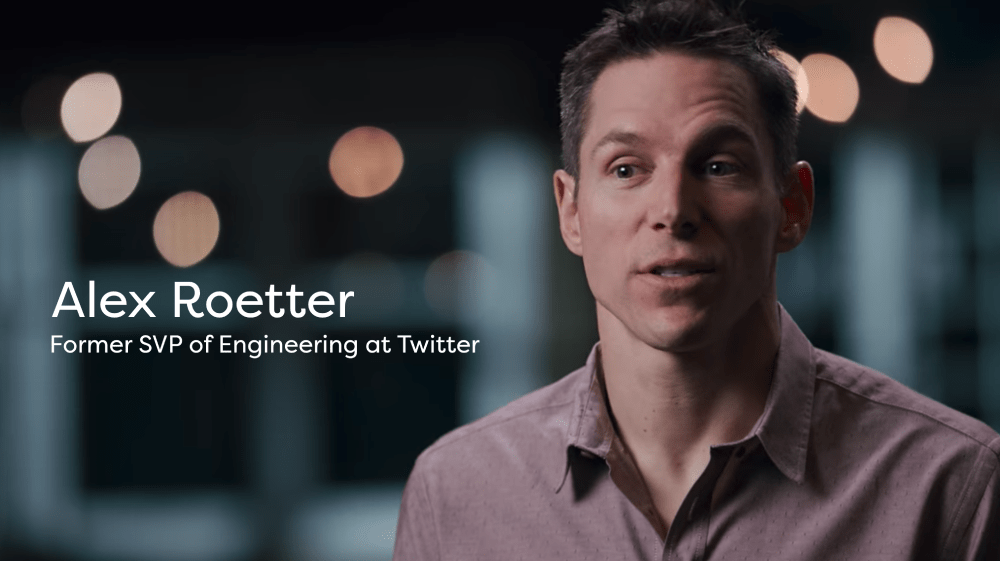
Alex Roetter ran engineering for more than 2,000 people at Twitter, built the ads organization from roughly ten people to four hundred, and helped take that business from near zero to $2.5B a year. He talked to our co-founder Alex Circei about what actually breaks when an engineering organization scales, why he treated org design as a software architecture problem, and the one thing he wished he could have measured and could not.
The interview subject
Alex Roetter
Former SVP of Engineering, Twitter. Led an organization of 2,000+ engineers.
Grew the ads business from near zero to $2.5B in annual revenue.
Managing Director and General Partner at Moxxie Ventures, investing at seed stage.
Featured in the Netflix documentary The Social Dilemma.
Context
This conversation took place in January 2022, and describes Twitter as Roetter led it during his tenure, several years before the company was acquired and renamed X. We have left it as a historical account rather than updating the references, because the lessons are about scale, not about that company.
Output grows linearly with headcount. Communication overhead grows quadratically. That gap is the whole scaling problem, stated in one sentence.
Design the org the way you design software. Clear interfaces, minimal public surface, unambiguous ownership. Responsibility without authority is a design bug.
Talk about the unglamorous work until the company believes you. Build speed, test reliability, review latency. Whatever senior leaders repeat becomes what the company values.
Engineering was the least instrumented function he had ever run. Sales is run by numbers. Aircraft are covered in sensors. Engineering was guesswork, and that bothered him more than anything else on this list.
Alex Circei
We would like to hear how you managed to scale the engineering part at Twitter, and what metrics you used there.
Alex Roetter
When I joined Twitter, the whole company was a couple of hundred people, and I started the ads team with around ten people. There was a small group working on ads, but we grew exponentially, and I became the leader of that team. Later, that turned into about 400 people, and we grew from zero to $2.5B in revenue over a few years.
Then I took over engineering for Twitter. Overnight my team went from 400, which was just the ads team, to the whole engineering organization, which was slightly over half the company. That meant around 2,000 people, so there were multiple scaling activities and challenges.
One of these activities was a lot of hiring. The other was something we noticed immediately. We weren’t getting enough done for the size that we were, so I spent a lot of time trying to figure out why this was happening.
“The number of pointwise edges in a graph with N nodes grows as N squared. So your communications overhead grows quadratically, but your theoretical best output grows only linearly.”
Speaking in graph theory terms, one high-level observation we made was that if you think about productivity, the fastest you can get work done is linear with the number of hires, so you’re never going to get more than twice as much stuff done if you double the size of your team. Think about your organization as a graph. The number of pointwise edges in a graph with N nodes grows as N squared. So your communications overhead grows quadratically, but your theoretical best output grows only linearly. That’s really a communications drag, and there are many other communications drags that grow super-linearly as well.
We just found ourselves saying “Wow, this company is huge. It’s 2,000 engineers, 4,000 people. Are we really getting as much done as we want to get done?” Given the massive investment and the amount of life energy that people were pouring in, the answer was no.
A lot of the work was organizational, because we really wanted to make sure that people could run independently with clear interfaces. When you design software, you sit down and build a bunch of objects, where each one has a very clear interface, and a minimal but sufficient set of public methods.
You don’t accidentally expose implementation details in the direct declarations of the public functions, and you keep private members private, and you really make none, or the minimum number of them, public. You need the same thing in an organization, where objects are teams, or individuals. This allows people to run independently, with very clear expectations with respect to other parts of the organization. Often this doesn’t happen, and one is left wondering: “Who’s responsible for what? Do I have authority to do that?”
For example, let’s say I’m on the Growth team and I’m responsible for DAUs, but a lot of the levers I need to pull are levers that I don’t control. So now I’m responsible for something over which I don’t have the authority to change. It’s extremely frustrating and I’m set up to fail. I don’t even think it’s my fault, because you asked me to do something but you didn’t give me the resources or the ability to do it. We found a lot of things like that.
Also, we really wanted to understand why we were shipping software more slowly, so we did something very low-tech. I just walked around and asked people, “Is this the best job you’ve ever had?” And I sort of knew the answer was going to be no, but I wanted to hear from people why they felt that way.
So I asked, “Why not?” And we learned things like the gulf between authority and accountability we talked about, and that it was not clear who owns decisions, which is very important too. If it’s not clear who owns a data structure, your software is going to be riddled with bugs. Who needs to get a lock to it before they write to a certain piece of memory? Can anyone just write to it? Should I expect that it’s in the state that I last left it in? Those being unknowns would be a disaster in software architecture, but that’s exactly what organizations do.
There were also some tactical things. The builds had gotten extremely slow and there was inadequate testing. Git’s master branch in many of our largest repositories was often broken. I couldn’t submit code when master was broken, and I couldn’t do a PR or refresh and get a clean master on which to build, so it was very hard for many of our excellent engineers to run tests and validate that everything was working. It was very hard to deploy things in a world like that.
We invested and created a new team, which was first called “Team Awesome”. Then we called it “Engineering Effectiveness”, and it was just all about creating the best environment for engineers to do the best, most productive, most satisfying work of their careers. That was our north star, and a bunch of the best engineers in the company transferred into this team.
Every time I gave a talk at an all-hands meeting, that’s what I talked about, because Twitter had this culture that the only thing that matters, and the only thing that the CEO cares about, are demos and features. So the company was littered with demos that never shipped, which of course really hurt morale.
For example, we had this thing called Hack Week, where you could just build whatever you wanted for a week and demonstrate it at the end of that week. It was full of great ideas because the company was full of really creative, innovative, interesting, passionate people, but a tiny fraction of these things ever shipped.
“We didn’t have a lack of ideas. We had a lack of execution, and a lack of ability to ship high-quality software quickly.”
It was extremely frustrating for everybody. It was frustrating for the people who built all the projects that looked awesome and that people loved on demo day, but then never saw come to fruition, and it was frustrating for the company, which wondered: “Why weren’t we investing in all these new ideas that never shipped?” We didn’t have a lack of ideas, we had a lack of execution, and a lack of ability to ship high-quality software quickly.
But there was a real culture where the only thing that mattered was shiny demos, not perceived “grunt work” like making the build faster. So I started talking, almost exclusively, to the company just about the build being fast, the tests not being broken, how to deploy more continuously, the code review latency, and stuff that’s viewed as not sexy but really crucial to building a frictionless machine where people can work. Companies have a way of deciding “Hey, whatever the senior leaders talk about all the time must be important.” At least, if you repeat yourself enough.
If you don’t have a very tight inner loop of understanding the customer, prototyping, testing, shipping, learning, and changing, over and over and over, then you can never make progress fast enough, especially when you’re really trying to optimize some metrics that are hard to move, like Twitter usage or product-market fit, or a new ad product. You really need to tighten the inner loop to have any hope of moving fast enough. The core tools that support that workflow, fast builds, tests, deploys and so on, really have to be excellent and efficient for everyone.
Let’s think of what the smallest unit of a core agile team does every week: select user stories, ship tickets that address them, test the new version, learn from the users, postmortem that whole process, then rinse and repeat. If that’s not really friction-free, you’re never going to make progress, and it’s extremely frustrating. Some really great people quit and went somewhere else where they could find more enjoyable, satisfying environments for themselves. We had to fix that environment as soon as possible.
Another thing that’s hard about scaling is that the bigger things get, the easier it is to breed distrust. If there are four of you working on a thing forever, and you’re always sitting around the same table together, it’s very hard to breed distrust and question intentions. The bigger you get, and the more management churn there is, and more new groups coming in through acquisition or hiring, the harder it becomes to trust everybody as a default. Twitter was a high churn place, so the whole company struggled with that. There is very little malice in the world compared to the amount of confusion or errors, but it’s easy to ascribe malice when there are large groups you’ve maybe never met, or haven’t built trust with.
Alex Circei
If you had had Waydev, what do you think would have been different?
Alex Roetter
I think the value of a tool like Waydev is to fight distrust. There are many ways to fight distrust, but one of these is certainly transparency. Once you know what the person is working on, you understand their perspective and combat the natural tendency to lose trust as you scale.
As we discussed, we spent a bunch of time just making the engineering machine internally be as good as it could be, and part of that was trying to measure what was happening. That was a really hard problem. Maybe if Waydev was around back then, it would have helped. We were able to measure some things, like how often the build was broken, deploy times, code coverage.
So we did all of that, and also we did one other thing: we graphed tickets closed by date as a time series. We had this quarterly OKR planning process, which was supposed to be high level and directional. But some teams had completely abandoned an inner loop of agile development and were just running on quarters.
“We saw that because their graphs of tickets closed just had four spikes a year.”
We saw that because their graphs of tickets closed just had four spikes a year. So on the last day of every quarter they closed a bunch of tickets, and the rest of the quarter they closed almost no tickets, which was completely crazy. This data really reinforced our intuition about what teams were higher-performing versus which ones had more opportunities to improve.
Of course, one really wants to be doing work all the time, especially when some of the higher-performing teams really were closing tickets all the time. After we discovered that, we tried to debug it, asking some questions: “Are the tickets too big?” “Are people just not feeling urgency except at the end of the quarter?”
For example, let’s say you want to go run a race and you say “Okay, I’m going to run a 1600 meter race around a track in seven minutes”, and your strategy would be “I’ll run each of the first three laps in 2 minutes and then I’ll do the last lap in 1 minute.” That’s a terrible strategy. And that’s what these teams were doing, not intentionally, but we discovered that from looking at this data.
Also, we did not have great metrics on code quality. We looked at little things like “How often do tickets go back and forth? What is the latency for a code review?” But it was very hard to tell why latency was high when it was high. “Did the code reviewer not have time, or was he or she simply not prioritizing the reviews? Were they making a bunch of pedantic comments, or really useful comments that made the system better?” “Were the code reviews too large?”
We looked at the distribution of sizes of code reviews too. Obviously it’s better to do smaller code reviews, instead of a single massive one that ends up being a lot of throw-away work based on the comments. The urge to not re-do work is so strong that it was easy to fight comments you received on a large review, even if they made things much better.
“How good was the code that we were building?” was a real blind spot for us. We had an experimental framework, so we looked a lot at what experiments were shipping, what experiments were not, what experiments were getting reverted, and what things performed at full scale in the way that we predicted by experiment. That was a great system that provided a lot of insight. But we didn’t have something as good and illustrative on the engineering work and code itself.
There’s a really good side to all of this: great engineers know what’s getting in their way. You just have to ask them. One of the main frustrations is that no one’s asking them. We made a lot of progress just by asking engineers what slowed them down, listening, then spinning up projects like making the build faster, more distributed, rewarding code health instead of more demos that we could never ship.
“If you’re a pilot, the aircraft systems are extremely well instrumented. We were really struggling with the org not being well-instrumented.”
But I always wished the system was more well-instrumented. Most systems that you’re trying to optimize are very well instrumented. If you think about a sales organization, it is extremely well-instrumented, you can really run sales by the numbers. If you’re a pilot, the aircraft systems are extremely well instrumented, and you can look at all the pressures, temperatures, fuel flow numbers, and all kinds of metrics. We were really struggling with the org not being well-instrumented. So we tried to measure what was easy, trying to fix the low-hanging fruit, but it wasn’t perfect. That’s probably the area I wish Waydev had existed, several years ago.
Editor’s note, 2026
Roetter’s complaint, that engineering was the least instrumented function he had ever run, has aged into the defining question of this decade rather than out of relevance. Boards now approve large AI tooling budgets and ask what came back. Answering that requires exactly the instrumentation he did not have: cycle time broken into stages, change failure rate, review load and review depth, and AI ROI against tool spend.
His other observation, that great engineers already know what is slowing them down and nobody asks, is why Developer Experience surveys sit next to system data in the WAY Framework rather than being treated as a soft extra. Git tells you what happened. Only your engineers can tell you why.
Alex Circei
What was the structure of the teams? What tools did the engineering managers have to improve and work better?
Alex Roetter
We also did some work on the shape of the organization. We looked at things like the average span of control, which showed how many reports a manager had. By the way, I think that’s a horrible phrase, because it implies that management is about control. Management is about the opposite of that. It’s about empowerment, enabling people to do work, and giving them the tools they need. It’s not about control. It’s the packaging and the glue that holds things together. It’s not the actual work, which is building products for users. As a result of that, it should be the minimum skeleton number of managers you need, but it’s not the main point of the organization.
There were around 8 Engineering VPs who reported to me. Then they each had organizations that were a couple hundred each, and from there it was recursive. But also, in some cases, we divorced the management structure from the teams doing work structure, and actually the team that did this best was a team that we acquired into Twitter.
They had a bunch of engineers reporting to managers who knew about their specific type of engineering, whether it was mobile, backend, or whatever. But teams were assembled more on the fly. The team was the agile group that was doing work that would meet up to burn through a bunch of user stories for a specific product that we were building.
“Probably the single biggest determinant of whether or not you like your job is: do you get along with your manager?”
Those could be disbanded and reassembled, but it didn’t require switching managers and coming up with a new career plan for yourself, being told that the path to the promotion you were on, you’re not on anymore because now you have a new manager, and all the kind of stress that comes with switching managers. Because at the end of the day, probably the single biggest determinant of whether or not you like your job is: do you get along with your manager?
If you don’t like your manager, I will bet serious money that you will quit your job in a short amount of time, or transfer. So we tried to decouple that, and let project groups spin up or shut down without people getting different managers.
Another thing we tried to invest in is helping those managers have all the tools to succeed. We built a management course specifically on engineering management that we taught, and we tried to teach how to run and effectively empower teams, what success looks like for them, and how to ask for help. It ended up being a great set of content and I’m really proud of the folks that built it.
We built that, but there wasn’t one specific way of doing work across the company. So it was more about best practices and providing a template, not mandating a single way to run a team. There wasn’t one set of tools that everyone had. Twitter, for better or for worse, was a very fragmented engineering culture. How one team worked was very different from how others worked, and in some cases it had some downsides. There were very different ways of thinking and working, as a function of people’s backgrounds, where they worked before, their specific beliefs, and many other things, and that caused a lot of tension. In many cases, people started resenting how other teams worked.
Twitter wasn’t really a place where you could mandate one way to do things. We did that in some cases, but that was a very expensive thing to do in terms of backlash and effectiveness. So we really tried to build toolboxes of things that people could use without actually mandating them. That said, I do think the more you can agree to a base set of things that are important and the ways to achieve those, the better.
As a result of that, we did come up with this thing called Engineering Principles. I think there were 10 to 12, and it was things that we valued. We had a point of view on build versus buy, appropriate reuse, and test-driven development, to name just a few examples. We tried to come up with philosophical tenets that we could all agree to, so that when we went out into the world of this very distributed, bottom-up, heterogeneous, decision-making environment, people at least had shared values that they could look at to make their own localized decisions. I think that worked pretty well. It wasn’t perfect, but that was the thing that we tried to do, just because we didn’t have a culture of top-down, homogenous control, and a single way to work all the time.
Certainly, I think if you just showed up from another company, and you were now the manager of a group and you have to build things, there wasn’t really a pre-made box I could give you: “Here are all the tools, processes, methodologies, and philosophies that we believe in, and this is how software development works.” We tried to standardize that a little bit, but there was very much this countercultural, kind of revolutionary culture, where people didn’t want to do these things. It was an interesting challenge to try to create that to some extent.
Alex Circei
What would you think if each manager used different tools? Would it be hard to have the same picture, or a data-driven approach?
Alex Roetter
It’s really hard. Go back to the OOP analogy again: you can do whatever you want, it’s all behind your header file, and you implement it however you want. However, there are certain things, like “I need you to respond to this message and take these arguments and return an answer in this format.”
Code had to live on a certain server, the deploy tools had to work in a certain way, monitoring and observability had to be done in a certain way, so that our observability daemons could scrape variables and aggregate them across all the data centers. That requires you to report how much RAM you’re using in a standard way, report your latency in a certain way, and so on.
We tried to build a little interface where we could get certain things, and it wasn’t just machine metrics. “Your projects have to be in a certain place, so we can see what people are working on. Your OKRs need to be in this format and need to live here. We can see the goals of the whole organization, your key metrics need to be here.” We built some of that scaffolding.
For instance, I don’t care what you do in your house, but we do need to agree that when we meet up in court, we’re going to use the same set of laws, and that when we drive around and share roads, we’re going to all drive on the right, at least in the US.
There is efficiency to a single way of doing everything. You’re never reinventing the wheel, you’re not doubling effort, but also there’s a huge cost. You’re now forcing everyone into a certain thing, which might not be the right fit for them. You are also squashing good ideas, because you are limiting innovation.
Alex Circei
Can you tell us a bit about what you are doing now?
Alex Roetter
I’m a full-time seed-stage investor now. A lot of the activities of an investor, identifying great talent, helping them succeed, coaching, and knowing when to get out of the way, are similar across operating and venture. Don’t get me wrong, a lot is different as well. Katie Stanton, who is a long-time colleague of mine from Twitter and even before, and I are working together at Moxxie Ventures, a firm she founded a few years ago.
We just raised a new venture fund, an $85M seed-stage fund, and we’re deploying it now. We’re investing across verticals, always early-stage companies. We try to write $1.5-2M checks, try to buy 10 percent of companies in the early stage, and partner with them.
We really leverage our operating experience. Both Katie and I have operated for so long in different verticals. She operated in marketing, branding, go-to-market, and communications, and me more on product and engineering. We try to find places where we can help leverage that operating experience to accelerate companies and help them avoid some of the pitfalls of operating, especially in hyper-growth environments.
We are not a vertical-specific fund. We look across verticals, but in particular we’re doing a lot in climate tech these days. As you know, I really like developer tools, engineering productivity, and applications of AI. We’re also looking a lot at FinTech and financial inclusion.
But the area I’m most excited about is climate. It’s the largest problem facing us, it is at the root of other problems, inequality, poverty, injustice, poor health outcomes, and transitioning the world’s economy to a sustainable future represents a massive economic opportunity for the investors and entrepreneurs who enable it. It’s really fun. I get to work with great entrepreneurs and try to help them. It’s really satisfying and enjoyable.
Fund details and investment focus are as described in January 2022 and will have moved on since. Roetter’s current work is at Moxxie Ventures.
Why we republished this
Every scaling problem Roetter describes has got harder, not easier. Agents now create services faster than any org chart can absorb, review capacity is the binding constraint, and the gap between what a company thinks it ships and what it actually ships is wider than it was in 2022. The instrument he wanted exists now. The question is whether leaders use it.
Instrument your own organization
Connect your repositories and we will backfill your history, so you can see review latency, code review size distribution and ticket flow across your teams. The things Roetter had to walk around and ask about.
More for engineering leaders: The VP of Engineering is the new kingmaker · Becoming a great engineering manager · Engineering manager responsibilities · Engineering Leaders Handbook
Related: The WAY Framework · Developer Experience · Cycle Time · Merge Quality · DORA metrics
Ready to unlock your SDLC productivity?