Migration guide
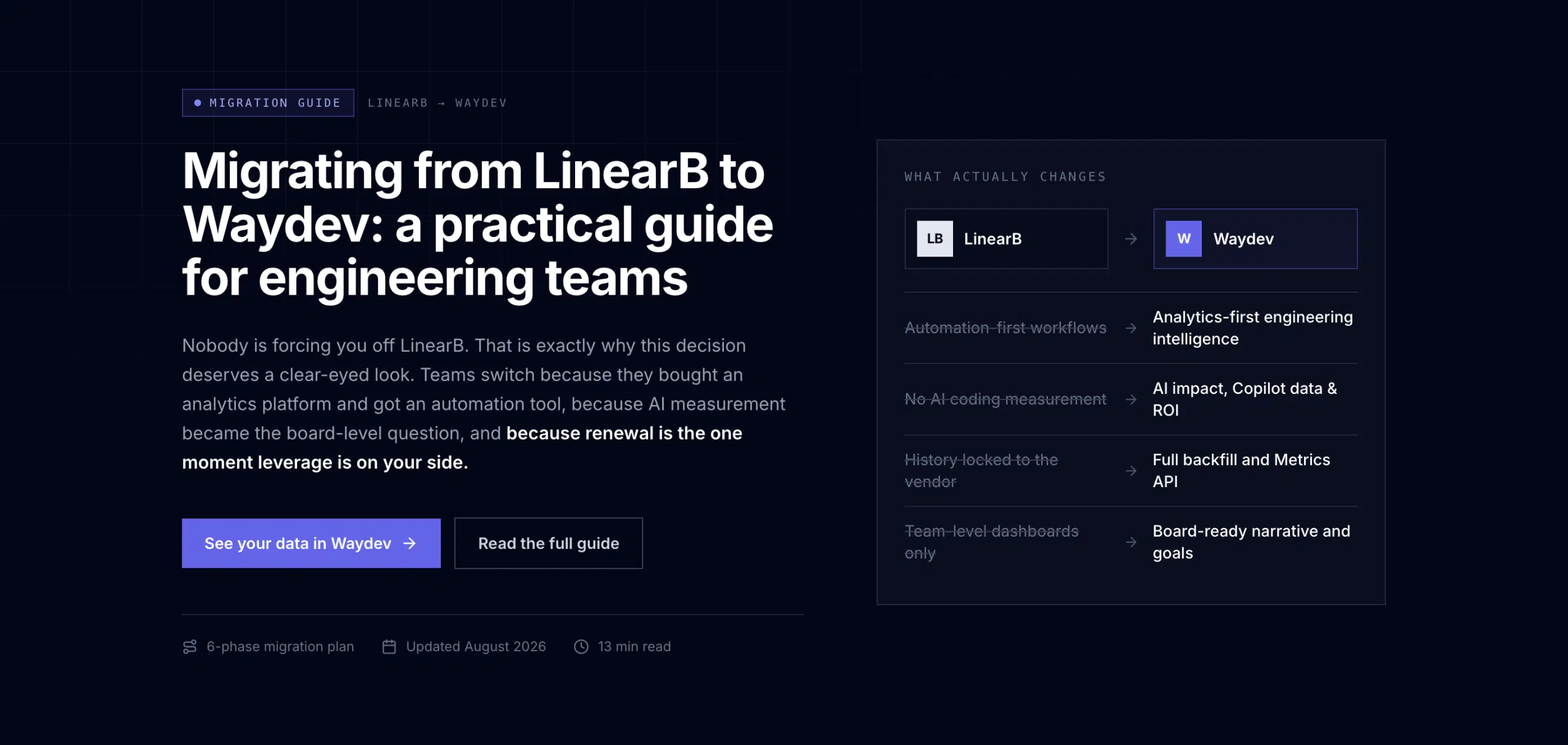
Nobody is forcing you off LinearB. That is exactly why this decision deserves a clear-eyed look. Teams are switching to Waydev because they bought an analytics platform and got an automation tool, because AI measurement became the board-level question, and because renewal is the one moment leverage is on your side. Here is how to evaluate the move properly.
Summary
LinearB is a capable product with strong marketing. The teams that leave are not leaving because it is bad. They are leaving because of a mismatch between what they bought and what they needed. These are the four patterns we hear most often from switchers.
LinearB’s center of gravity is gitStream, its PR automation engine. Automation is useful, but it is not visibility. Teams that need commit-level work patterns, individual and team deep dives, and granular Git analytics find the analytical layer thinner than expected. Waydev is Git-first by design, backed by a USPTO patent in Git analytics.
Your board is not asking about PR routing rules. It is asking what the AI spend is returning. Waydev was rebuilt around exactly this: AI adoption, impact, and ROI measured across your engineering org, connected to delivery outcomes, down to the spend. One platform, one answer, ready for the board deck.
Configuring dashboards, tuning automations, and interpreting charts is work someone on your team owns forever. Waydev AI is conversational. Ask “which teams improved cycle time this quarter and why” and get a data-backed answer in seconds. No dashboard archaeology, no dedicated platform owner.
If usage settled into a handful of reports while the invoice kept growing, you are paying platform prices for report value. Renewal is the one moment you have leverage. Use it to re-evaluate, even if you end up staying.
Every metric your team uses in LinearB is available in Waydev. The difference is depth on the Git side and the AI measurement layer on top.
| LinearB feature | Waydev equivalent | What you also get |
|---|---|---|
| DORA metrics | ✓ DORA metrics | Plus SPACE framework and industry benchmarks |
| Cycle time tracking | ✓ Cycle time | PR-level breakdown: coding, pickup, review, deploy |
| PR analytics | ✓ Review workflow | Plus commit-level Git analytics, USPTO-patented |
| Team dashboards | ✓ Team dashboards | Plus Waydev AI: ask questions, skip the configuration |
| Goals / working agreements | ✓ Goals & AutoGoals | AutoGoals suggests targets from your own baselines |
| WorkerB notifications | ✓ Signals | AI-evaluated checks delivered via Slack, no rules to write or maintain |
| AI impact tracking | ✓ AI adoption / impact / ROI | ROI quantified down to spend, tied to delivery outcomes |
| Historical data | ✓ History rebuild | Rebuilt directly from your Git provider, no export needed |
The fear that keeps teams on a platform past its usefulness is losing years of baselines. With Waydev that fear does not apply. Connect GitHub, GitLab, Bitbucket, or Azure DevOps and Waydev processes your full commit and PR history from source. Your trends, baselines, and year-over-year comparisons rebuild automatically. Switching costs you nothing historical.
If your team built PR routing and approval rules in gitStream, those are LinearB-specific and will not migrate. Most switchers find that Signals covers the alerting use cases without rule maintenance, and that routing rules belong in native GitHub or GitLab settings anyway. Audit which automations you actually use before you decide. It is usually fewer than you think.
A switch has to be an upgrade, not a lateral move. Here is what changes.
AI adoption / impact / ROI
Waydev measures who is adopting Copilot, Cursor, and agentic tools, whether output and quality are improving, and what the spend is returning. Adoption, impact, and ROI in one view, tied to delivery outcomes, not seat counts or adoption dashboards.
Git-first depth
Waydev’s patented Git analytics show work patterns at the commit level: work log, deep dives, repo views, individual and team trends. When a manager asks why a team slowed down, you see the actual work, not just the PR queue.
Waydev AI
Conversational engineering intelligence. Ask anything about your teams, delivery, and AI adoption and get immediate, data-backed answers. No configuration project, no platform owner, no chart interpretation meetings.
Signals
Signals runs AI-evaluated checks on your engineering work and sends findings to the right people via Slack. Risky PRs, stalled work, review bottlenecks. No YAML rules to write, tune, and maintain as your org changes.
Vendor stability
Waydev is bootstrapped to profitability with Fortune 500 customers including American Express, Dropbox, Caterpillar, and PwC. VC-backed vendors eventually need an exit. Appfire Flow customers just learned what that can mean. Ask every vendor about their path.
You are not under a sunset deadline, so use that to your advantage. Run Waydev alongside LinearB for 30 days in the window before your renewal. Same repos, same teams, side by side. The comparison makes the decision for you.
STEP 1 · 90 DAYS BEFORE RENEWAL
List the LinearB reports, dashboards, and automations your team touched in the last quarter. Not what is configured. What is used. This list is your real requirements document.
STEP 2 · 60 DAYS BEFORE RENEWAL
Not a sandbox. Your actual GitHub, GitLab, Bitbucket, or Azure DevOps. History processes automatically, so you compare real baselines against LinearB’s numbers within days.
STEP 3 · 30 DAYS BEFORE RENEWAL
Give two or three engineering managers both tools for their weekly reviews. Ask one question at the end: which one would you fight to keep? Managers vote with usage.
STEP 4 · RENEWAL
You now have a side-by-side comparison on your own data and a credible alternative. Whatever you decide, you decide it from strength. Use the memo below to fast-track sign-off.
Internal memo template for sign-off
Ahead of our LinearB renewal, we ran Waydev in parallel on our production repositories for 30 days. I recommend we switch to Waydev as our engineering intelligence platform at renewal.
Waydev covers every metric we use in LinearB, including DORA, cycle time, and PR analytics, and adds commit-level Git analytics, AI adoption and ROI measurement, and a conversational interface that removes our dashboard maintenance overhead. Our historical baselines rebuilt directly from Git, so we lose no trend data.
Waydev is used by Fortune 500 engineering organizations including American Express and PwC, holds a USPTO patent in Git analytics, and is recognized by Gartner in the Developer Productivity Insight Platforms category. The budget is already approved: it was paying for LinearB.
Because Waydev rebuilds history from Git, the migration is lighter than most teams expect. There is no export-import project.
| Milestone | Timeline | What happens |
|---|---|---|
| Kickoff | Day 1 | Dedicated onboarding owner assigned, team structure mapped from your LinearB setup |
| Technical setup | Days 1 to 14 | Git and PM tools connected, full history processed, roles and anonymization configured |
| First value review | Day 30 | Baselines validated against your LinearB numbers, first Goals and Signals live |
| Expanded rollout | Days 31 to 60 | All teams onboarded, AI measurement and executive reporting configured |
| Business review | Day 90 | Leadership review against pre-switch baselines, LinearB contract closed out |
No. Your source data lives in your Git provider, not in LinearB. Waydev processes your full commit and PR history on connection, so cycle time trends, DORA baselines, and year-over-year comparisons rebuild from source.
Directionally yes, exactly no. Every platform defines metric boundaries slightly differently, for example where cycle time starts and ends. During onboarding we validate definitions against your LinearB baselines so leadership understands any deltas before the switch, not after.
They do not transfer. Audit which ones your team actually relies on. Alerting use cases move to Signals with no rule maintenance. Routing and approval policies usually belong in native GitHub or GitLab settings, where they survive any vendor change.
Yes, and you should. Both are read-only against your Git provider, so they coexist with no conflicts. A 30-day parallel run on real repos is the strongest evaluation you can do.
Waydev is SOC 2 certified and never stores your source code. Full security documentation is available for CISO review on request.
Yes. Role-based access and anonymization controls are built in. Individual-level data can be restricted or anonymized while leadership keeps org-level visibility. Works councils and legal teams have approved this model at enterprise scale.
We will connect your real repositories on the first call and show you your own data, side by side with what LinearB shows you today. If the comparison does not make the case, keep what you have. The goal is the right decision at renewal, not a great demo.
Ready to unlock your SDLC productivity?