This is our own page about alternatives to our own product, so read it with appropriate suspicion. Here is the deal we will make with you: we will name every serious alternative, say honestly what each one is better at than us, and tell you how to take your data with you if you decide to leave. In exchange, we would like a fair hearing on the cases where we think we are the right answer.
The most common alternative to any engineering intelligence platform is not a competitor. It is a data engineer, a warehouse and three months. Plenty of organizations do this well, and if you have the team for it you should at least price it out.
| Approach | Works well for | Where it breaks |
|---|---|---|
| Git CLI and scripts | A handful of repositories, one team, a specific question you ask occasionally. | Identity merging, bot commits, monorepos, and the moment someone asks for a trend. |
| Warehouse plus BI | Organizations with a data team who want metrics in the same place as the rest of the business. | The maintenance cost, which lands on the data team forever and is rarely in the business case. |
| Open source plus dashboards | Teams that want DORA metrics from CI data and nothing more. | Review, planning and cost questions, which need ticketing and Git joined together. |
| Provider-native insights | Single-provider shops wanting basic visibility with zero procurement. | Multi-provider estates, which is most enterprises after a couple of acquisitions. |
The honest comparison is not licence cost against zero. It is licence cost against the loaded cost of the engineer maintaining it, plus the reporting that quietly stops when that person changes team. Build it if measurement is core to how you operate and you will resource it properly. Buy it if you want the answer rather than the pipeline.
| Alternative | Choose it over Waydev if | Trade-off to check |
|---|---|---|
| Jellyfish | Your primary buyer is finance-adjacent and investment allocation reporting is the main deliverable. | No on-premise option; less depth on code-level delivery diagnostics. |
| LinearB | You want workflow automation acting on pull requests, not just measurement of them. | APEX is proprietary, so the framework comes with the platform. |
| DX (Atlassian) | You are deeply Atlassian, and want survey-led developer experience measurement with research pedigree. | DXI is proprietary, and the measurer now owns the toolchain being measured. |
| Swarmia | Developer trust is your first constraint and you want working agreements rather than executive reporting. | Lighter on cost capitalization, resource planning and board-level reporting. |
| Allstacks | ML forecasting of whether initiatives will land on time is the problem you are actually solving. | Pricing is not published, so every evaluation is sales-led. |
| Cortex | You want an internal developer portal and service catalog, with metrics as a layer on top. | The metrics value depends on adopting the portal first. |
| Appfire Flow | You are already invested in it and the code-level metric heritage fits how your leaders think. | Third owner since GitPrime; ask about roadmap investment. |
| Typo, Hatica | Budget is the binding constraint and you need core delivery metrics at a lower price point. | Check enterprise scale, deployment options and support depth. |
| Harness SEI | You already run Harness for CI/CD and want the intelligence module in the same contract. | Consolidation benefits assume you stay on that platform. |
| BlueOptima | You need outsourced or contractor delivery assessed against contractual output. | A very different philosophy from ours on measuring individuals. |
Accurate as of September 2026, based on public information. Every vendor here changes quickly; verify before deciding. Full list at the comparison hub.
You have fewer than about fifty engineers. We are priced and built for scale. Below that, a lighter tool or a well-maintained dashboard usually gives you more value per pound.
You want a free tier to try before talking to anyone. We do not have one. We run proof of concept engagements on your own repositories instead, but if self-serve is a hard requirement, that is a real mismatch.
Your main need is workflow automation. We measure and report; we do not automate your pull request process. If you want the tool to act rather than inform, look at the automation-led platforms.
You want individual developer scorecards. We will not build them and we will push back if you ask. If ranking individuals is the requirement, we are the wrong vendor and we would rather say so now than a quarter into a contract.
Your board is asking what the AI investment returned
We keep adoption, impact and ROI as three separate measurements across Copilot, Cursor, Claude Code and Codex, so tool spend never gets reported as productivity.
You want a framework you can keep
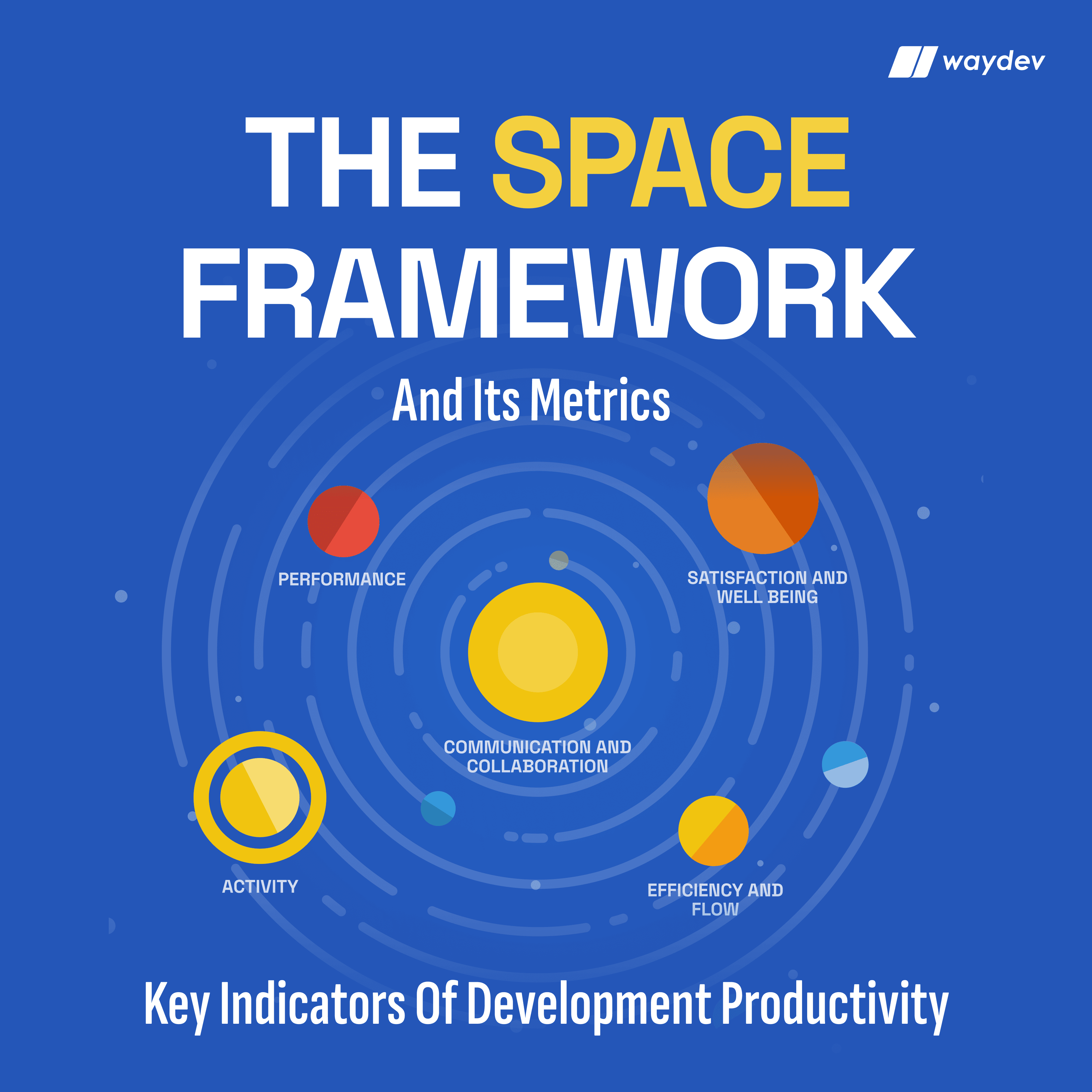
The WAY Framework combines DORA, SPACE and Core 4 instead of replacing them with a proprietary index. Nothing central to it requires our product to compute, which is the whole point of the page you are reading.
Your security review starts with where the data lives
Cloud, self-hosted or fully on-premise including on-premise Git and ticketing, with SAML SSO and team-level access control. Details on the security page.
Engineering and finance need the same numbers
Cost capitalization, project costs and resource allocation sit alongside DORA and cycle time, so the CFO conversation and the engineering conversation run off one dataset.
We would rather you leave cleanly than stay because switching is painful. Practically:
Step 1
Export through the Waydev API. It pushes as well as pulls, so your history can go to a warehouse or straight into the next tool.
Step 2
Keep your definitions. Because the WAY Framework builds on public standards, your targets and your board narrative still mean the same thing in the next platform. Any metric you cannot reproduce elsewhere was a lock-in you should not have accepted, including from us.
Step 3
Run both in parallel for one cycle before you cut over, and check the numbers agree. Different platforms define cycle time and change failure rate differently, and discovering that in a board meeting is unpleasant. We say the same thing to people migrating to us.
What is the closest alternative to Waydev?
On breadth, Jellyfish and Allstacks overlap most. On AI measurement specifically, the field is thinner than the marketing suggests, so ask every vendor to show adoption, impact and ROI as three separate numbers on your data.
Is there a free Waydev alternative?
Yes. Open source dashboards over your CI and Git data will give you DORA metrics for the cost of the engineering time to build and maintain them. That cost is real but it is not a licence line, which matters to some budgets.
How much does Waydev cost?
Pro from $348 and Premium from $648 per year per active contributor, with Enterprise custom. Unlimited users and teams on every plan. Published on the pricing page, unlike several alternatives on this list.
Already a customer with a complaint? Tell us before you shortlist replacements. Contact us and it reaches someone who can act on it.
The short version
If a vendor cannot tell you where they are the wrong choice, they are not telling you much about where they are the right one. Take this list, run a proof of concept on your own data with two or three of us, and pick on evidence.
Compare on your own data
We will connect your repositories, backfill your history and show you your real delivery and AI numbers. Do the same with two competitors and decide on evidence. You keep the analysis either way.
Detailed comparisons: Jellyfish · LinearB · DX · Swarmia · Allstacks · Cortex · Typo · Hatica · Harness · BlueOptima · Port · Comparison hub
Further reading: The WAY Framework · DORA metrics · How Waydev works · Customer stories · Pricing · Security
Ready to unlock your SDLC productivity?