Migration guide
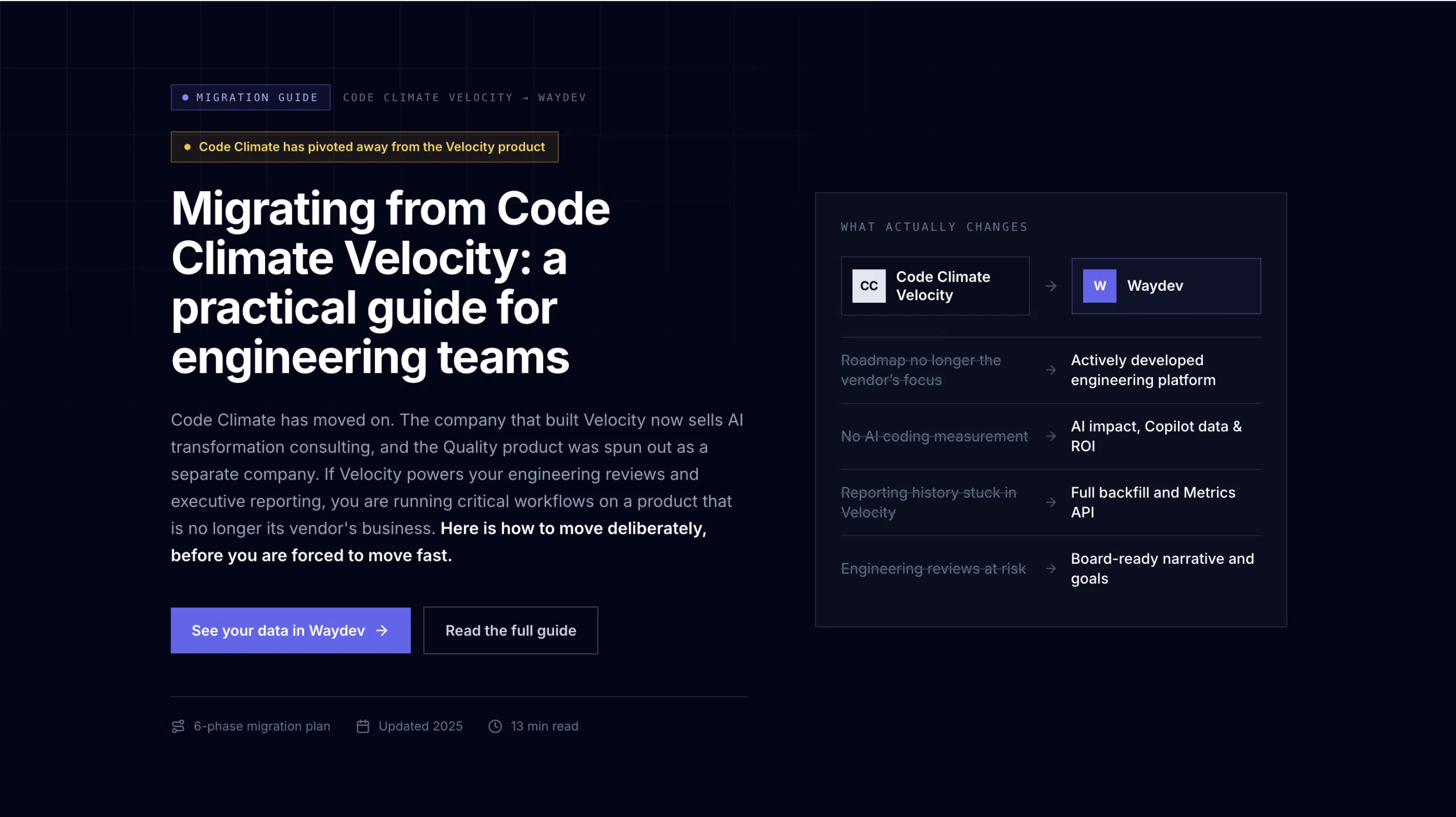
● Code Climate has pivoted away from the Velocity product
Code Climate has moved on. The company that built Velocity now sells AI transformation consulting, and the Quality product was spun out as a separate company. If Velocity powers your engineering reviews and executive reporting, you are running critical workflows on a product that is no longer its vendor’s business. Here is how to move deliberately, before you are forced to move fast.
Summary
Nobody sent you a sunset email, and that is exactly the problem. A quiet pivot is harder to plan around than an announced shutdown. Watch for these four signals, and act on them before renewal.
Code Climate’s site today leads with AI transformation advisory, playbooks, and a “thirty-minute conversation,” not with the Velocity platform. When the vendor’s front door stops selling the product you run, the roadmap has already told you where investment is going.
The Quality product was spun out as a separate company. Corporate restructuring around a product line is rarely followed by heavy investment in what stayed behind. Ask your account contact directly: what shipped in Velocity in the last two quarters, and what is committed for the next two?
Velocity was built for the pre-AI era of engineering analytics. It cannot tell you who is using Copilot, Cursor, or agentic tools, whether the code they produce ships faster or breaks more, or what the spend returns. A product in maintenance mode will not build this. Your board is asking about it now.
Weekly team reviews, executive dashboards, quarterly reporting: the workflows your org built on Velocity need a home that will exist in three years. Map them now. You are migrating processes, not a login. And if the product does eventually get a sunset date, you want to be the team that already left, not the one scrambling.
Velocity and Waydev grew up in the same category: Git-based engineering analytics. Both are Git-first, both work at the commit and PR level, both serve engineering leaders. Your team’s mental model transfers directly, and Waydev’s Git analytics are backed by a USPTO patent.
| Velocity feature | Waydev equivalent | What you also get |
|---|---|---|
| Commit and PR analytics | ✓ Git analytics | USPTO-patented. Work log, deep dive, repo-level views |
| Cycle time tracking | ✓ Cycle time | PR-level breakdown: coding, pickup, review, deploy |
| Review and collaboration metrics | ✓ Review workflow | Review load, collaboration patterns, merge health |
| DORA and deployment tracking | ✓ DORA metrics | Plus SPACE framework and industry benchmarks |
| Team dashboards and reports | ✓ Team dashboards | Plus Waydev AI: ask questions, skip the configuration |
| Working agreements / targets | ✓ Goals & AutoGoals | AutoGoals suggests targets from your own baselines |
| Enterprise deployment (SSO, RBAC) | ✓ Enterprise-ready | SSO, RBAC, plus roles and anonymization controls |
| Historical trend data | ✓ History rebuild | Rebuilt directly from your Git provider, no export needed |
Velocity’s core insight was that Git holds the truth about engineering work. That same insight is your exit path. Connect GitHub, GitLab, Bitbucket, or Azure DevOps and Waydev processes your full commit and PR history from source. Your cycle time trends, DORA baselines, and year-over-year comparisons rebuild automatically. Whatever happens to Velocity’s servers, your history is safe, because it was never really theirs.
Velocity stopped evolving. The category did not. Here is what has been built since.
AI adoption / impact / ROI
Waydev measures who is adopting Copilot, Cursor, and agentic tools, whether output and quality are improving, and what the spend is returning. Adoption, impact, and ROI in one view, tied to delivery outcomes at the PR level.
Waydev AI
Conversational engineering intelligence. Ask “which teams improved cycle time this quarter and why” and get a data-backed answer in seconds. No dashboard configuration, no dedicated platform owner, no chart interpretation meetings.
Signals
Signals runs AI-evaluated checks on your engineering work and sends findings straight to the people who can act, via Slack. Risky PRs, stalled work, review bottlenecks. Before the retro, not after.
Goals & AutoGoals
Set measurable targets on any metric. Cycle time under three days. Review pickup under four hours. Waydev tracks progress automatically, and AutoGoals suggests realistic targets from your own baselines.
Vendor stability
Waydev is bootstrapped, profitable, and focused on one thing: engineering intelligence. Fortune 500 customers include American Express, Dropbox, Caterpillar, and PwC. No pivot to consulting, no spinoffs, no exit pressure. You just watched what a vendor pivot does to a product. Make stability a selection criterion this time.
The advantage of acting on a pivot instead of a shutdown notice is time. Use it. Four steps, roughly six weeks, and the decision is made with evidence instead of urgency.
STEP 1
List the reports, dashboards, and review rituals your org actually used last quarter. Note who consumes each one: managers, executives, finance. This is your requirements document.
STEP 2
Export any custom reports or configurations from Velocity while access is guaranteed. Then confirm the important part: your underlying history rebuilds from Git, so the export is a safety net, not a dependency.
STEP 3
Connect your actual Git provider, not a sandbox. Both tools are read-only against Git, so they coexist without conflict. Give two or three managers both tools and ask which one they would fight to keep.
STEP 4
Validate baselines side by side, sign off with the memo below, and end the Velocity contract at the next renewal point. Clean exit, zero data loss, no fire drill.
Internal memo template for sign-off
Code Climate has pivoted away from the Velocity product toward advisory services, which puts our engineering reporting on a platform without an active roadmap. After a 30-day parallel evaluation on our production repositories, I recommend we migrate to Waydev.
Waydev covers everything we use in Velocity, including Git analytics, cycle time, DORA metrics, and team reporting, and adds AI adoption and ROI measurement, automated Signals, and goal tracking. Our historical baselines rebuilt directly from Git, so we lose no trend data.
Waydev is used by Fortune 500 engineering organizations including American Express and PwC, holds a USPTO patent in Git analytics, and is recognized by Gartner in the Developer Productivity Insight Platforms category. The budget is already approved: it was paying for Velocity.
Because Waydev rebuilds history from Git, there is no export-import project. The heavy lifting happens automatically in the first two weeks.
| Milestone | Timeline | What happens |
|---|---|---|
| Kickoff | Day 1 | Dedicated onboarding owner assigned, team structure mapped from your Velocity setup |
| Technical setup | Days 1 to 14 | Git and PM tools connected, full history processed, SSO, roles, and anonymization configured |
| First value review | Day 30 | Baselines validated against your Velocity numbers, first Goals and Signals live |
| Expanded rollout | Days 31 to 60 | All teams onboarded, AI measurement and executive reporting configured |
| Business review | Day 90 | Leadership review against pre-switch baselines, Velocity contract closed out |
There is no public sunset announcement as of this writing. What is public: Code Climate’s business is now AI transformation advisory, and the Quality product was spun out as a separate company. A product outside its vendor’s core business carries roadmap and support risk regardless of whether a shutdown date exists. Ask your account contact for a written roadmap commitment, and plan for the answer you get.
No. Your source data lives in your Git provider, not in Velocity. Waydev processes your full commit and PR history on connection, so cycle time trends, DORA baselines, and year-over-year comparisons rebuild from source.
Directionally yes, exactly no. Platforms define metric boundaries slightly differently, for example where cycle time starts and ends. During onboarding we validate definitions against your Velocity baselines so leadership understands any deltas before the switch, not after.
Technical setup takes one to two weeks. Full rollout is typically complete within 30 to 60 days depending on org size.
Waydev is SOC 2 certified and never stores your source code. SSO and RBAC are standard, with role-based access and anonymization controls on top. Full security documentation is available for CISO review on request.
Waydev tracks AI adoption, impact, and ROI across engineering, connecting AI tool usage to delivery outcomes at the PR level. You see who is adopting, whether output and quality are improving, and what the spend is returning.
We will connect your real repositories on the first call and show you your own data next to what Velocity shows you today. Your history rebuilds from Git, so there is nothing to lose by looking. The goal is a calm migration on your timeline, not a fire drill on someone else’s.
Ready to unlock your SDLC productivity?